Most strength programs are written for an uninterrupted hour. A house with kids offers a different schedule: a nap that ends at minute 22, a toddler who wants to hold the dumbbell, a night of bad sleep that leaves you with a quarter of the energy you planned for. A plan with one fixed session length turns every one of those into a skipped workout.
The fix is a single session template that comes in three sizes: 30, 15, and 8 minutes. You use the same four movements and the same weights every time, and the window you actually get decides how many rounds you do. This guide builds that template for a strength training program for busy parents who already know the basic lifts.
Why a fixed 45-minute plan fails in a house with kids
A 45-minute session has a hidden requirement: 45 uninterrupted minutes. When the workout is written as one block, an interruption at minute 20 leaves you with half a session that has no clean ending. Most people stop and call it a missed day.
A fixed plan also hides a second problem. It treats the long version as the real workout and anything shorter as a failure. That framing makes a 10-minute window feel too small to bother with, so the window goes to the phone or the dishes instead.
The template approach reverses this. All three sizes count as the session. The 8-minute version is the same workout with fewer rounds, so finishing it keeps the habit and the movement practice intact. If you want to see how to organize training phases around a 45-minute limit, that is covered in how to periodize your lifting when you only have 45 minutes. This article deals with something different: what a single session looks like when the day keeps changing.
Pick four movement patterns and drop everything else
A shrinkable session needs a short list. Four patterns cover most of what a full-body day needs:
- Squat or lunge: goblet squat, front squat, split squat.
- Hinge: Romanian deadlift, kettlebell deadlift, swing.
- Push: push-up, overhead press, floor press.
- Pull: one-arm row, band row, pull-up if you have a bar.
Pick one exercise for each pattern and keep it for several weeks. Choosing from a longer menu every session costs thinking time, and thinking time is the first thing a short window cannot spare. Exercises you already know well are also the ones you can do safely while tired or distracted.
Anything outside these four goes into a “when there’s room” list: arm work, calf raises, extra core. They are fine additions on a good day. The template never depends on them.
The 30-minute session: pairings that replace long rest periods
In a normal gym session, rest between sets takes up a large share of the clock. Pairing two exercises that do not compete for the same muscles lets you rest one while you work the other. A squat followed by a push-up gives your legs a break during the push-up and your chest a break during the next squat.
Build two pairs:
- Pair A: squat + push
- Pair B: hinge + pull
A 30-minute session looks like this:
- Warm-up, about 5 minutes. A few minutes of easy movement, then one lighter set of each of your four exercises.
- Pair A, four rounds. Do a set of the squat, then a set of the push, then rest about 60 seconds. Repeat. Sets of 6 to 10 reps at a weight that leaves a couple of reps in reserve work well.
- Pair B, four rounds. Same structure with the hinge and the pull.
- Optional finisher, any time left. A loaded carry around the house or garden, or a plank, is enough.
At roughly 40 seconds per set plus the rest, each pair takes about 9 to 10 minutes, so the whole session fits in 30 with a few minutes to spare. Treat those figures as a planning estimate. Your pace will differ, so time your first session and adjust the number of rounds, not the exercises.
The pairing also helps when you are interrupted. If you get pulled away between the squat and the push, you pick up at the push. Nothing needs resetting.
The 15 and 8 minute versions of the same workout
The smaller versions use the same four exercises. What changes is how they are arranged.
The 15-minute version
Drop the separate pairs and run all four movements as one circuit: squat, push, hinge, pull, with about 30 seconds of rest after the pull. Do three rounds. The first round at a lighter weight or lower effort doubles as your warm-up, so you do not need a separate one. Twelve working sets at a minute or so each, plus short rests, lands close to 15 minutes.
The 8-minute version
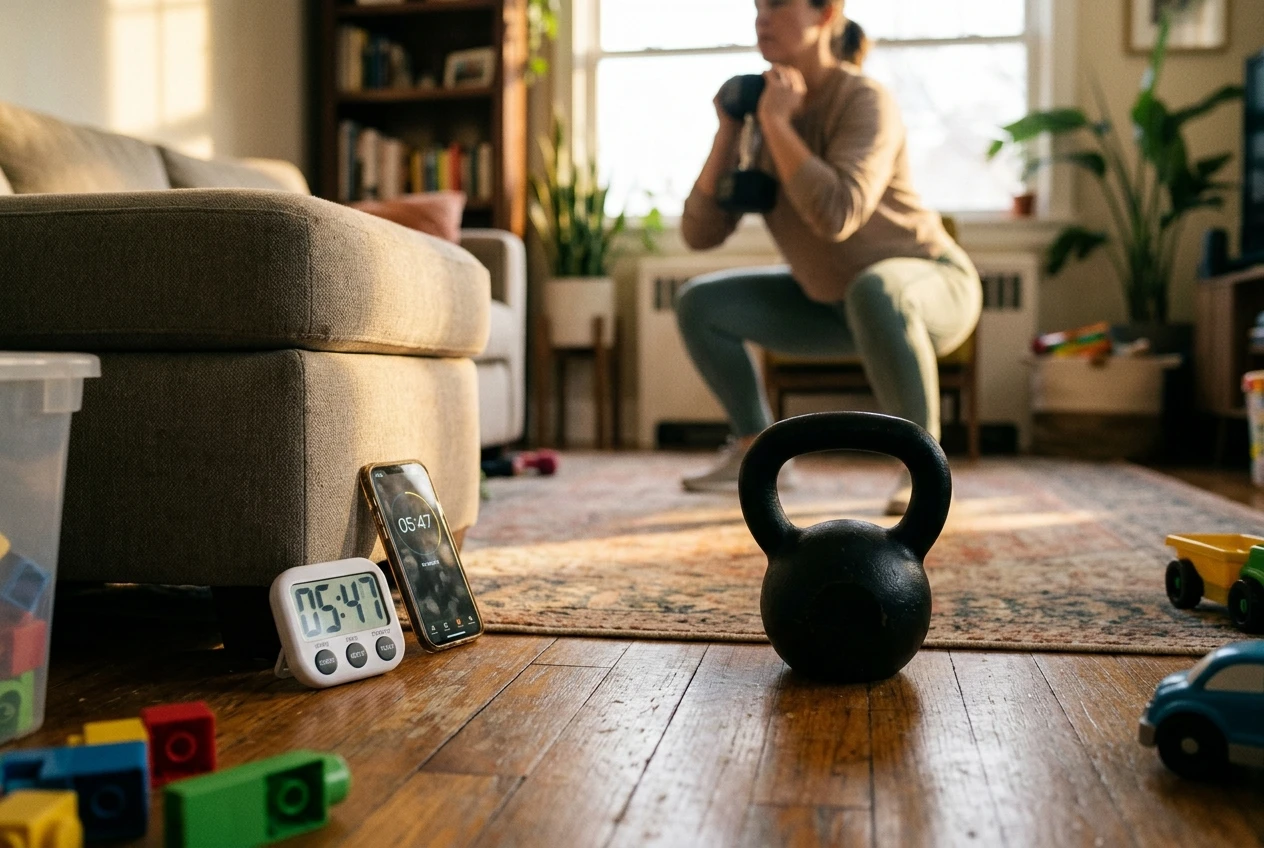
Set a timer to beep every minute. In minute one, do a squat set. Minute two, a push set. Minute three, a hinge set. Minute four, a pull set. Then repeat the sequence once. That is eight sets in eight minutes, each one finished with a few seconds to spare, and the leftover seconds are your rest.
This version is not a lighter exercise program. It is two sets per pattern, which is a real, if small, dose of the same work. Keep the weights the same as in the long session unless you are very tired.
Choosing a version
Decide before you start, based on the time you can see, not the time you hope for. If you are interrupted mid-session, step down a version instead of quitting: a 30-minute session cut at minute 12 can finish as the 8-minute sequence from where you are. The only rule is that all four patterns get touched at least once.
Cut setup time: one corner, two or three tools, nothing to assemble
A session that needs ten minutes of setup cannot fit in an 8-minute window. Setup is the part of the workout you can remove entirely.
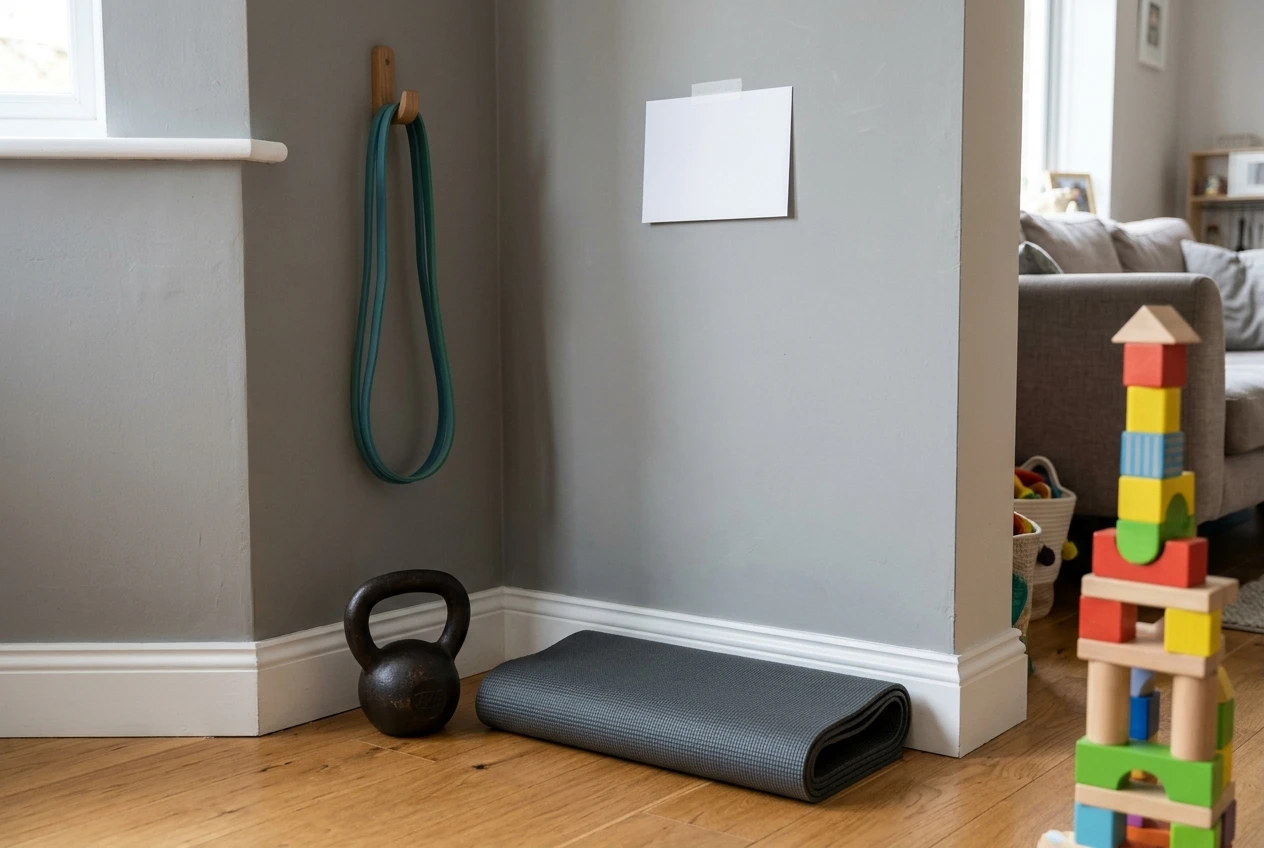
Choose one corner of a room and keep your equipment there permanently. A square of floor, a wall, and two or three tools is enough:
- One pair of weights. A single kettlebell or a pair of dumbbells covers goblet squats, hinges, presses, and one-arm rows. If you are not sure how many sizes you will end up needing, why one kettlebell won’t carry you through a program explains how that decision plays out.
- One band. It handles rows and warm-up work, and it fits in a drawer.
- Your body. Push-ups need nothing.
The rule for the corner is that nothing gets put away. When equipment stays where you lift, the time between deciding to train and your first set drops to a minute or two. For a quick gym visit, the equivalent is picking one rack, one bench, and one set of dumbbells before you arrive, so you are not wandering between stations.
Also decide in advance where the notes live. A phone note or a card taped to the wall with your four exercises and last session’s weights removes the need to remember anything while a child is asking for a snack.
Fitting three sessions into a week you don’t control
Three sessions a week is a workable target for this template. The days matter less than the count, and leaving a day between sessions is helpful when you can manage it.
Do not assign a version to each day in advance. Instead, aim for the 30-minute version and let the day decide. A realistic week might include one full session during a nap, one 15-minute circuit while dinner cooks, and one 8-minute minute-by-minute session on the day nothing went to plan. All three are sessions, and all three count toward your three.
A few habits keep the week from collapsing:
- Check the window at breakfast. Look at the day and name the likeliest gap for training. A named gap is more likely to be used than a vague intention.
- Keep the weights constant across versions. Changing weights with the session length makes progress hard to read.
- Rotate which pair goes first. On the 30-minute day, start with Pair A one week and Pair B the next, so that if you run out of time, neither gets shortchanged every time.
- Count a session when all four patterns happened. An 8-minute session qualifies. A partial one with only pushing does not, and it is worth saying so to keep the template honest.
What to do when you miss a week and how to restart without starting over
A sick child, travel, or a week of broken sleep will eventually take out a whole week. The template makes the restart simple because the plan never changed.
Return with the 8-minute version. It takes almost no commitment, so the barrier to starting is low, and it lets you check how your body handles the weights again. If the weights felt fine, do a 15-minute session next, then the 30-minute one. If they felt heavier than you remember, take a modest amount off for a session or two and build back up.
You do not need to repeat the weeks you already did or invent a make-up session to cover the missed ones. Sessions missed are simply sessions that did not happen. The next one is the next one, using the same exercises, in the same corner.
If a break runs longer than a week or two, or you are coming back after illness or injury, build back more slowly and use whatever guidance your doctor or physical therapist gave you. The template does not replace medical advice.
Which gear and program format actually save time, and which are clutter
For a short-window program, useful gear shares three traits: it is ready in seconds, it covers several patterns, and it does not need a long setup.
Worth having:
- A kettlebell or adjustable dumbbells that cover your squat, hinge, and press weights.
- A resistance band for rows and warm-ups. If you are shopping for one, which resistance bands are worth buying for a home gym shows what to check before you buy.
- A timer you can see, whether a phone on the floor or a kitchen timer.
Clutter for this use:
- Anything that needs assembling before each session, such as a bench you have to rebuild or a cable attachment you swap out.
- A long list of accessories you only use when you have spare time.
- Programs with six different days of different exercises. They are hard to shrink when a day goes wrong.
Program format matters too. A one-page template on the wall or in a note is cheap and flexible, but you plan it and you keep time yourself. A guided program removes the planning, which some parents prefer when attention is the scarcest resource in the house.
If you would rather have a coach on screen and no planning
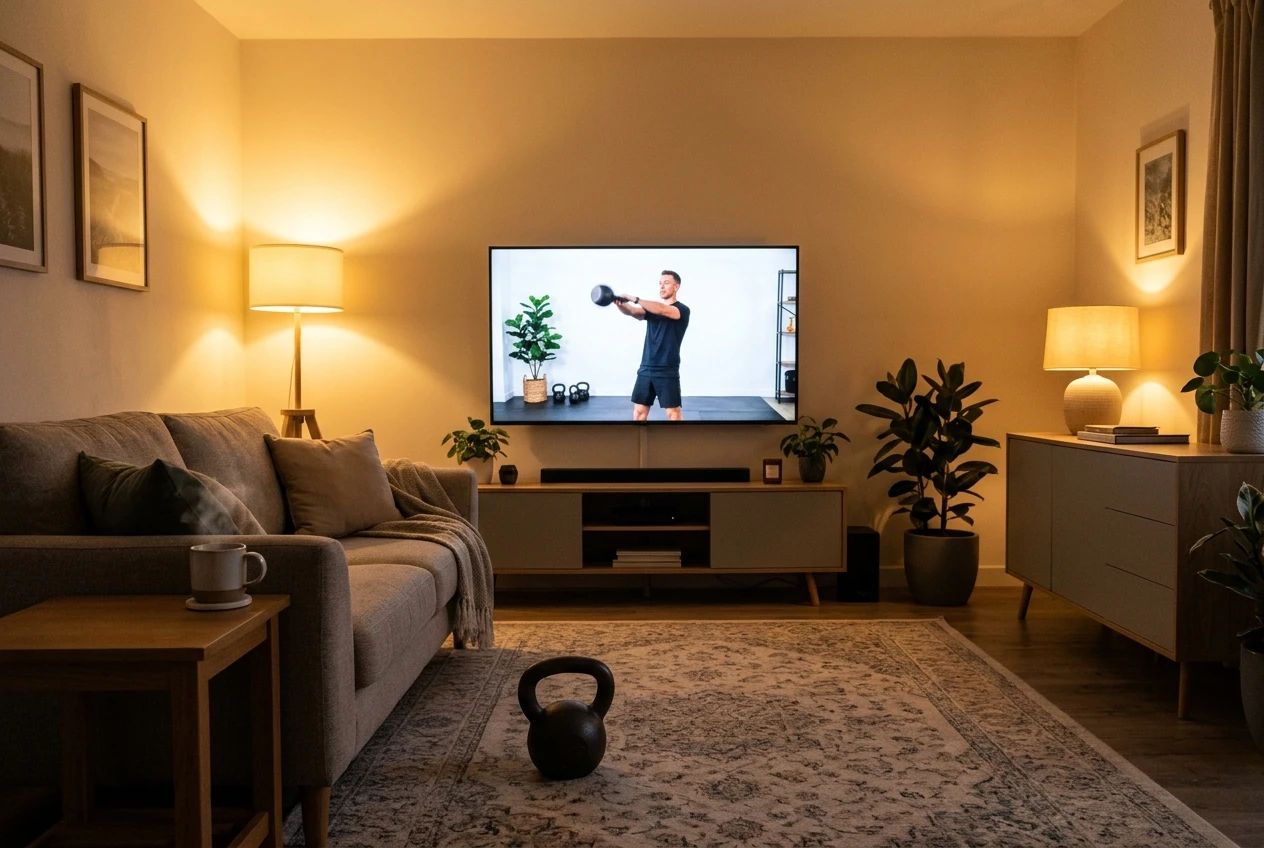
If building and timing your own sessions is one more task you do not have room for, the kettlebell.monster program puts a coach on the screen so you follow along without planning anything. It includes a Samsung Tizen TV workout app, which suits a living-room corner where the TV is already in view.
Affiliate disclosure: this is an affiliate link, so I may earn a commission if you buy through it, at no extra cost to you.
If you are still deciding between a printed plan, a spreadsheet, and an app, PDF, spreadsheet, or TV app: which program format actually gets you through the workout compares the formats side by side.