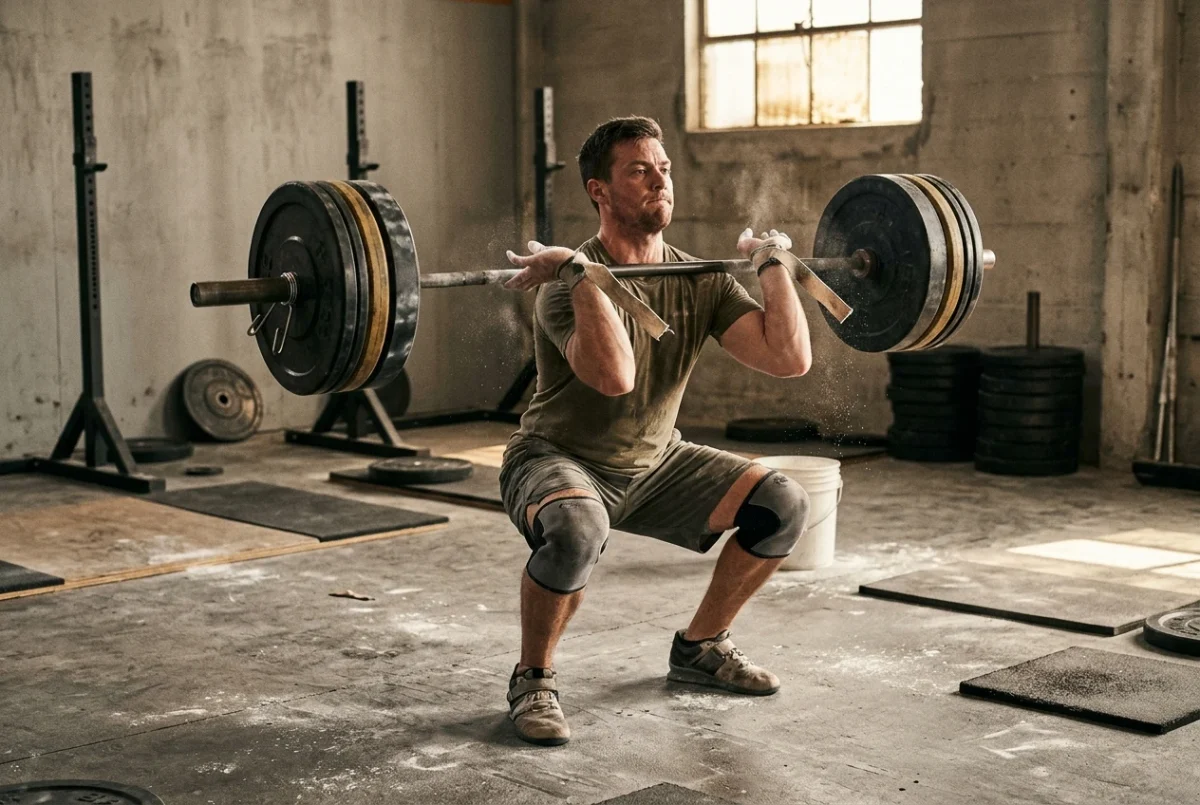
If your hands open before your legs, back or shoulders tire in a barbell complex, straps are an obvious fix. The catch is that most advice on lifting straps for barbell complexes is written for a deadlift, where the bar goes down between reps and you can reset your wrap at will. A complex gives you no such moment, so a strap that works in a deadlift can fail in a complex.
This article breaks a complex into its position changes, judges the common strap styles by which changes they survive, and ends with a test you can run on your own straps.
Why a complex is a different strap problem than a deadlift set
In a deadlift set, the strap has one job: keep the bar in your hand while you pull. You wrap, you pull, you set the bar down, and you can rewrap if anything slipped. The strap only has to be right in one position, and it gets a fresh start every rep or every set.
A complex strings several lifts together with the bar in your hands the whole time. Your hands go from a hanging pull grip to a rack catch, then to an overhead lockout, then to the bar resting on your back or shoulders. Each position loads the wrist differently and asks your fingers to do something different. The strap you wrapped for the first movement stays on for all the others.
So the question to ask is not “does this strap hold the bar?” but “what does this strap do to my hand in each position, and can I leave it alone for the whole round?” The rest of this article is built around that question.
Walk the complex position by position: where straps help and where they get in the way
Here is an example complex, which you should swap for your own: Romanian deadlift, bent-over row, hang clean, front squat, push press. Each movement puts the strap in a different situation.
- Romanian deadlift and row. The bar hangs from your hands and your fingers are the only thing holding it. Grip is the limiter here, so this is where a strap helps most. The wrist stays mostly neutral, so the strap rarely interferes with anything.
- Hang clean. You pull, then your hands rotate around the bar as it lands on your shoulders. This is the transition where a strap can bind, because the bar rotates in your hands while the strap is wound around it.
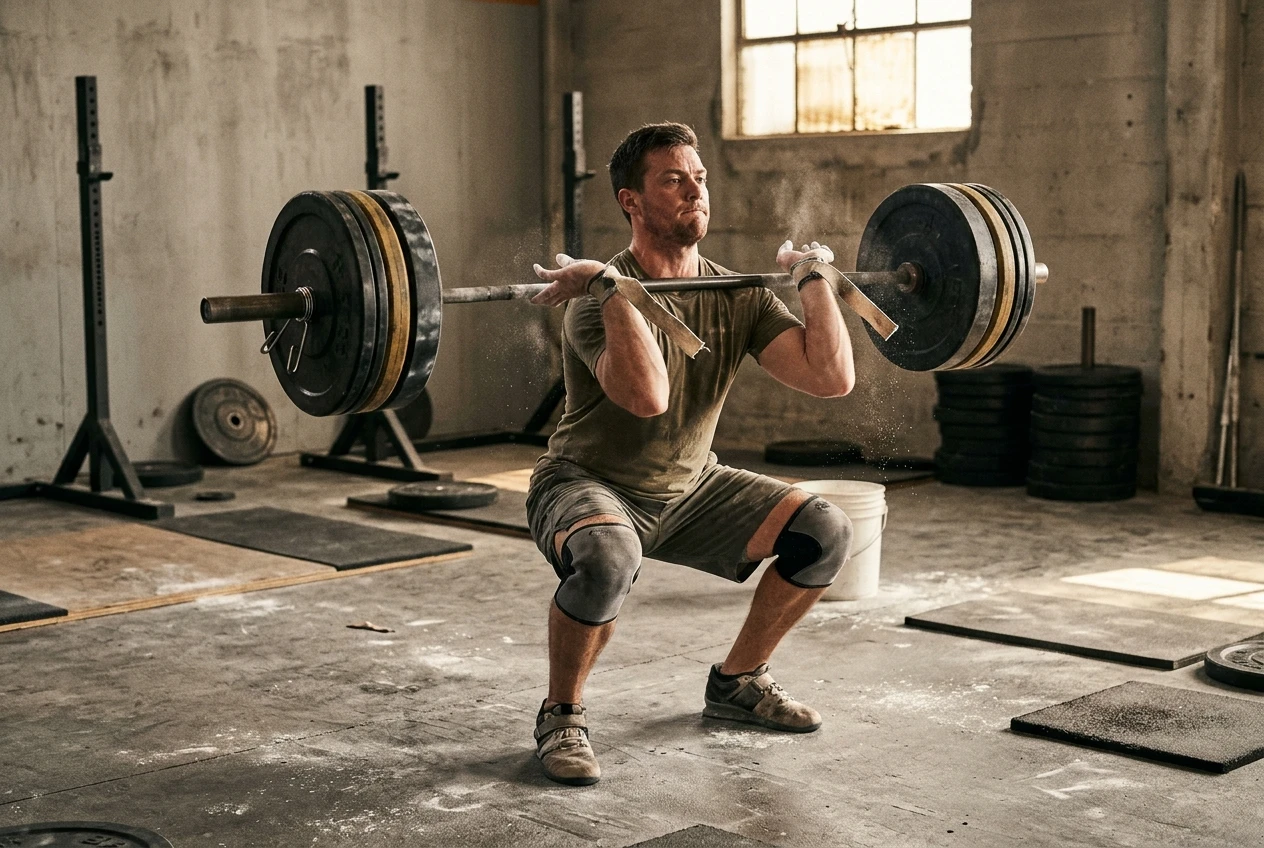
- Front squat. The bar sits on your shoulders and fingers, with the elbows forward. Grip is rarely the limiter in this position, so the strap is carrying no useful load and can only cause problems.
- Push press. The bar travels overhead from the rack position. Again your hands are guiding more than gripping, and anything bulky around the bar or wrist matters.
- Back squat or good morning, if your complex has one. The bar rests on your back and your hands only steady it. Straps add nothing.
The pattern: grip is the limiter in the hanging positions (the pull, the row, the high pull), and it is a minor factor in the racked and overhead positions. A strap earns its place in the first group and risks costing you in the second. What you want is a setup that helps with the first group while staying out of the way for the second.
The front rack and overhead problem: what a strap does to your catch
The rack catch is where most strap setups break down. To receive the bar on your shoulders, your wrists have to bend back and your elbows have to come up and forward quickly. Anything that adds thickness between your hand and the bar, or restricts how far your wrist can extend, changes that catch.
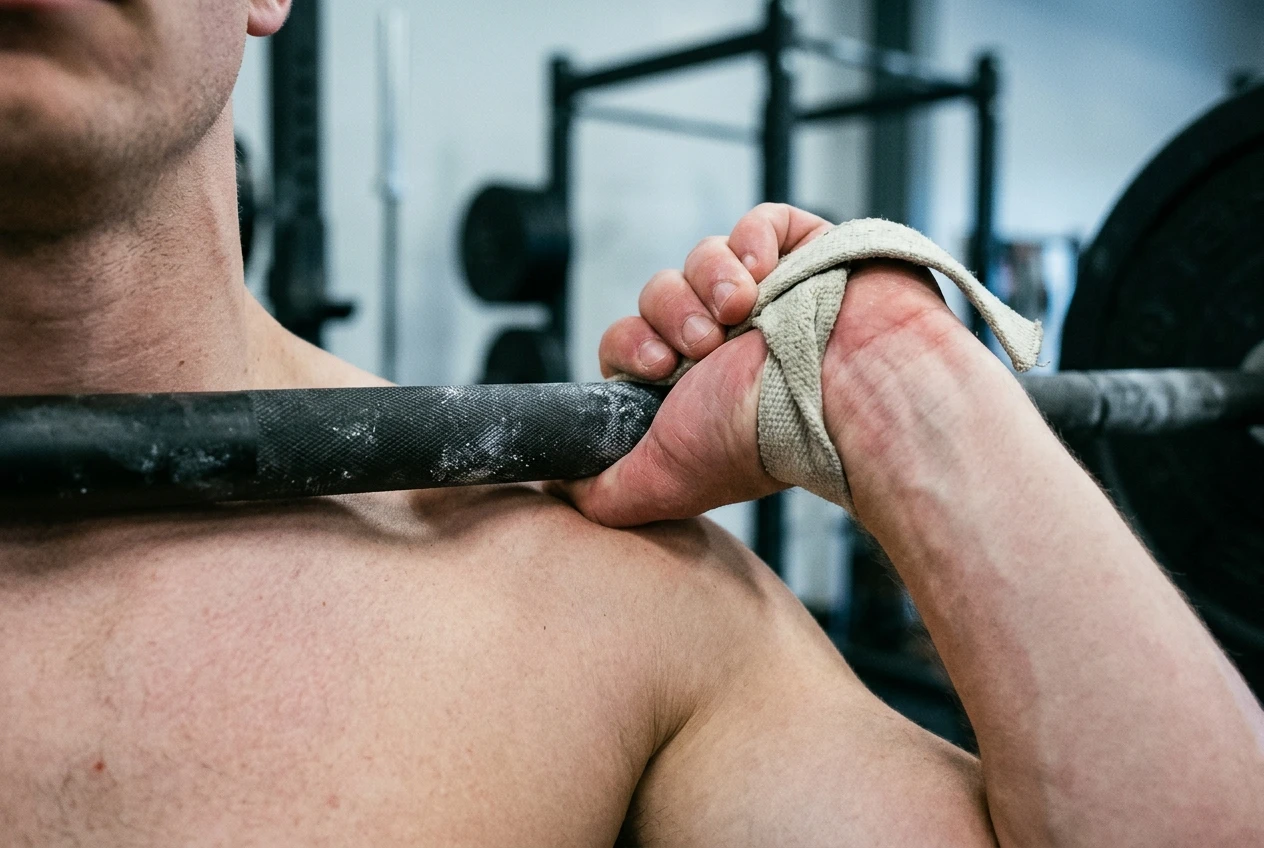
A wrapped strap puts extra material around the bar where your fingers want to sit. It can make the catch feel wider or lumpier, and if the tail of the strap ends up between the bar and your shoulder or palm, it will press into you under load. A strap that is tight on the wrist can also limit wrist extension, which is the position the front rack depends on.
Overhead raises a different issue: getting rid of the bar. If a push press goes wrong, you want to open your hands and let the bar go in a direction you chose. A strap that locks the bar to your hand makes that harder. Whether a particular strap does this depends on its style and how you wrapped it, which is why the style comparison below matters.
Treat the rack and overhead positions as where a strap has to prove it is safe, not as positions where you hope it will be fine.
Loop, lasso and figure-8 straps compared by how they behave when you can’t re-wrap
The three common styles differ mostly in how fixed the strap is to your wrist and how easily your hand can leave the bar.
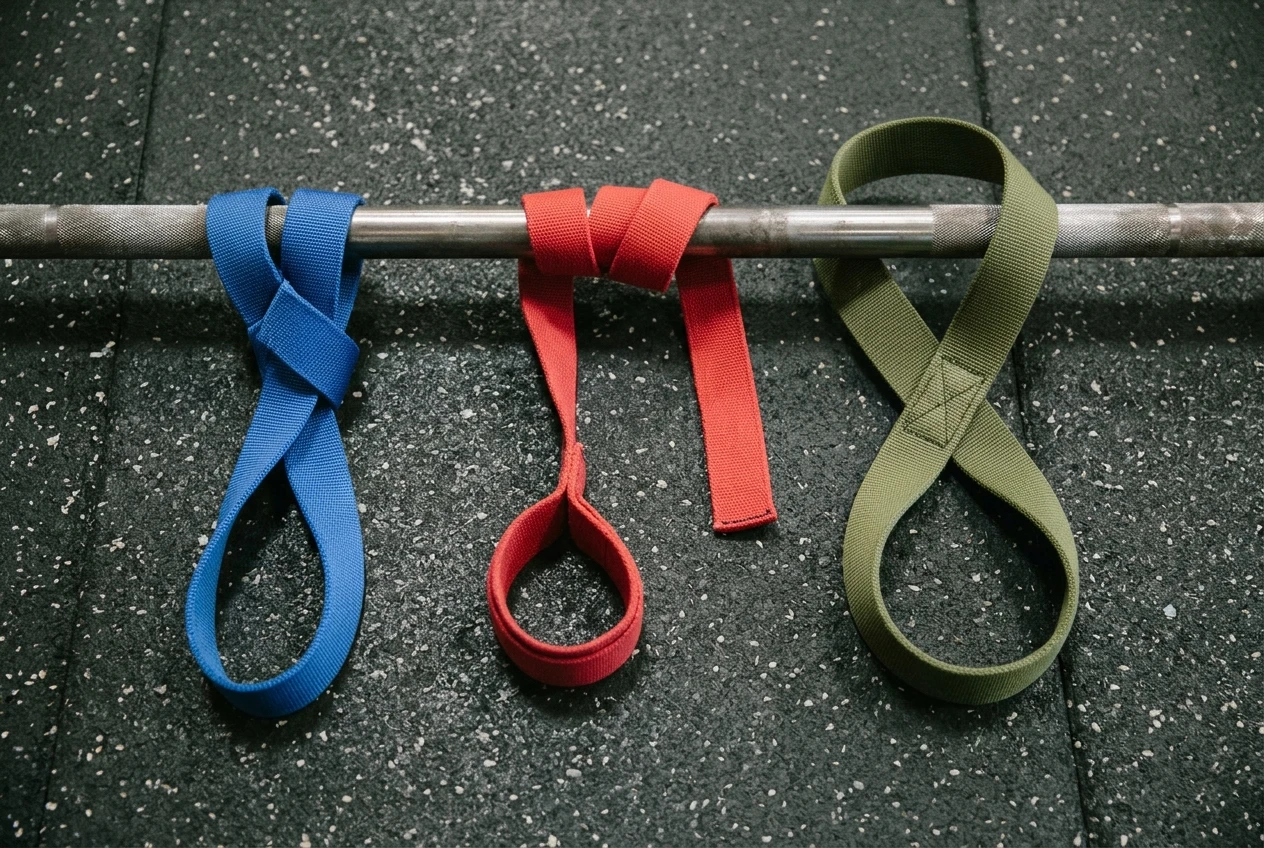
Loop straps are a closed loop. You put your hand through, twist the loop around the bar and hold the twisted section in your fist. They are quick to put on and the bar is fixed only as long as your hand is closed. When you open your hand, the bar is free. For a complex this is the most forgiving behavior, since opening your hand frees the bar and you can bail out of a bad catch. The tradeoff is that the twisted material sits in your palm and can bulk up the catch.
Lasso straps have a loop at one end that tightens around the wrist, with a long tail that you wrap around the bar. The wrist loop stays put through the whole round, which is convenient because you only set it up once. The tail is the issue: it lies around the bar and may unwind or jam as the bar rotates in the catch. Test how much of the tail stays on the bar after the hang clean, not after the first pull.
Figure-8 straps are one piece with two loops. Your wrist goes through both, and the bar sits in the bottom loop. They fix the bar to your hand more firmly than the other two, which is why they are favored for pure pulling. In a complex, that firmness is the cost. The bar is harder to release, and the way the strap runs around the wrist and bar can get in the way of the catch. Be cautious about using them anywhere the bar might need to leave your hands quickly.
None of these is the right answer in the abstract. Which one suits you depends on your complex and your hands, and the test in the next section tells you.
A round-by-round test to run on your own straps before trusting them in a heavy complex
Run this with a light bar and clear space around you. Do not try it first with your working weight.
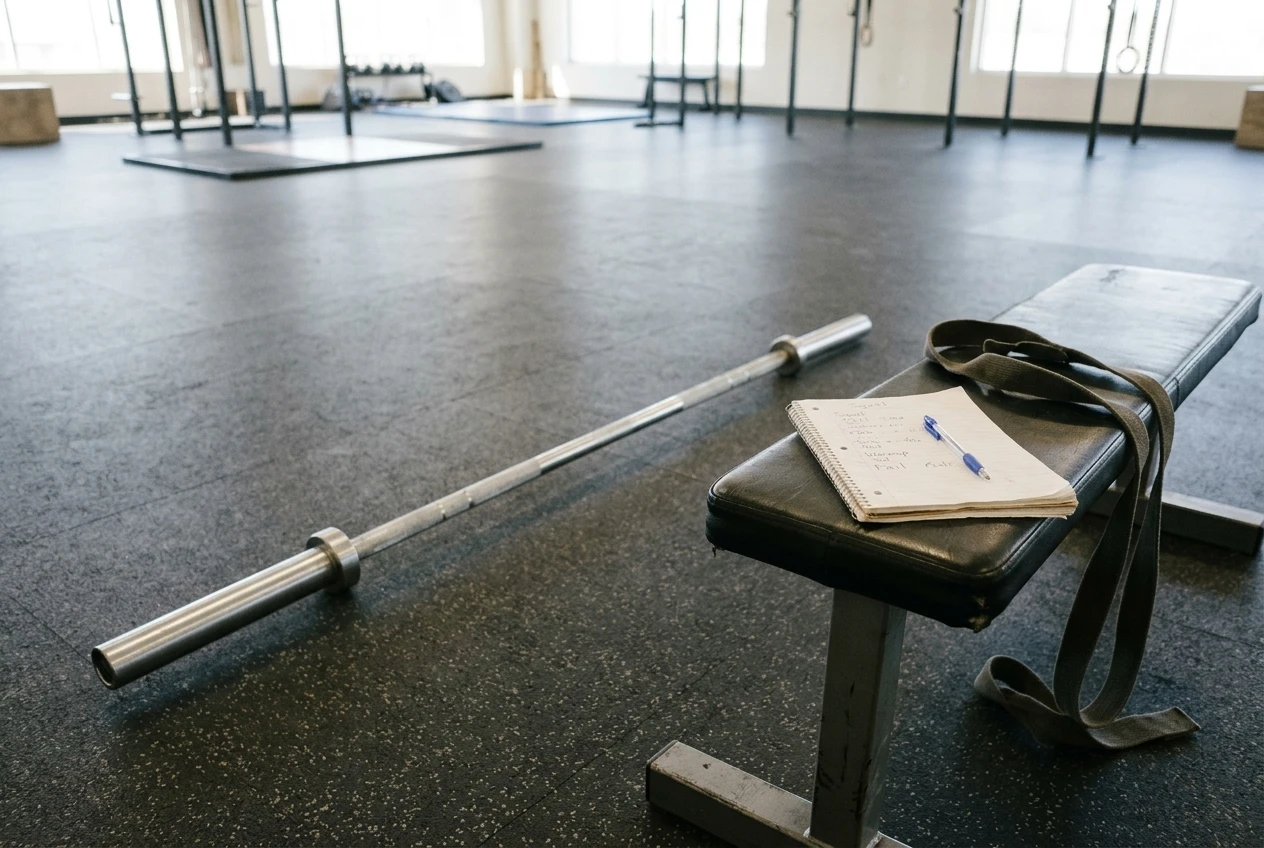
- Round 1, empty bar. Strap up once and run the full complex without re-wrapping. After each movement, write down one word: slipped, bound, fine. Pay attention to what happens at the hang clean and the push press.
- Check the catch. In the front rack, look at where the strap sits. Is the tail under the bar? Is the strap pressing into your palm or against your shoulder? Can you get your elbows to the same height as without straps?
- Check the release. From the overhead position with the empty bar, open your hands and let the bar go where you have planned to drop it. Notice whether the strap holds the bar to your hands even briefly. If it does, that style or wrap is not safe for the overhead part of your complex.
- Round 2, light working weight. Run the full complex again, still without re-wrapping. Compare your notes with round 1. Straps often hold at light weight and slip once the bar is heavier, so the second round matters.
- Round 3, the weight you plan to use. Only continue if rounds 1 and 2 were clean. Run a full round and note whether any position changed. Then run enough rounds to reach the point in your complex where your grip usually gives out, because that is where a strap will be asked to work.
Pass criteria are simple: no slipping, no binding at the catch, no pressure that changes your rack position, and a clean release. If one position fails, that tells you whether to change the wrap, change the strap style, or take the strap off for that part of the complex.
Strap the pull, free the rest: setting up a complex so the strap only works where grip is the limiter
Because grip limits you in the hanging positions and not in the racked ones, the best setup is one where the strap acts only in the hanging positions. A few ways to get there:
- Use a single, light wrap. A short wrap holds the bar for the pull and lets go as soon as your hand opens. A long, heavy wrap is what jams at the catch.
- Order the complex so pulls come first in each round. If your grip-limited movements are grouped together at the start of the round, the strap does its work before the catch and the rest of the round does not depend on it.
- Strap the late rounds only. If your grip holds for the first rounds and fails in the later ones, you do not need straps from round one. Add them when grip is about to limit you. The idea of removing straps by phase is covered in dropping the straps in phases, and the same logic applies inside a single complex.
- Pick the strap style that lets your hand open. For most people running a complex, that points toward a loop or lasso style over a figure-8, though your own test results should decide.
Check each of these against the test above. A change that looks sensible can still bind at the catch, and the only way to know is to run the rounds.
When the straps aren’t the fix: grip work and complex choice
If you need straps in every round of every complex, the strap is covering a gap that training could close. Barbell sets are short compared with the time your grip needs to be loaded to adapt, which is why training your grip in minutes rather than reps is worth a look. Doing that work separately means the complex itself can be trained with fewer straps over time.
The complex choice matters too. If your grip fails in the first rounds, the complex may have too many hanging movements stacked together for your current level. Reordering, cutting a pulling movement or reducing the weight on the pulls are all legitimate changes, and none of them involves buying anything.
If you want a different kind of grip loading, kettlebell work is one option, and kettlebell.monster is the program I recommend for it. Affiliate disclosure: I earn a commission if you buy through that link, at no extra cost to you.
Straps are a tool for the positions where grip limits you. Choose them by what happens at the catch and the release, run the three-round test on your own gear, and keep them out of the positions where your hands are not the problem.