If you can train for 45 minutes and no longer, a standard periodization plan has a problem. Most of them assume the session expands to hold whatever the week calls for: more sets, longer rests, an extra accessory block. When the clock is fixed, something has to give, and it is usually the rest periods or the accessory work, chosen by accident rather than by plan.
Periodization for busy lifters works better when it starts from the clock. Fix the session at 45 minutes, decide what happens inside it, and change one thing at a time across 12 weeks. This article lays out a way to do that, using density as the main progression variable alongside load and volume.
Why a time cap changes how you should periodize
A linear plan adds weight to the bar every session or every week. That works for a while, then stalls, and an intermediate lifter who stalls usually reaches for more sets. More sets take more minutes. With a hard cap, you cannot add sets without removing something else.
The cap does limit you, but it also gives you a constant. When session length never changes, every other variable can be compared fairly from one week to the next. If you finish the same work in 41 minutes instead of 45, or fit one more round into the same window, that is measurable progress.
So the plan has three levers inside a fixed container:
- Load: how heavy the work is, as a weight or an effort rating.
- Volume: how many hard sets and reps you do.
- Density: how much quality work you complete per minute.
A traditional block moves load and volume in opposite directions. In a time-capped block you also decide, week by week, how much of the 45 minutes goes to rest and how much goes to work. If you need help with the scheduling side, such as which days to train when your work calendar keeps shifting, this guide to running strength cycles around a packed work calendar covers it. This piece stays inside the session.
Density as a progression variable: what it is and what it is not
Density is the amount of productive work done in a given time. You raise it in one of two ways: do the same work in less time, or do more work in the same time. Because your session length is fixed, the second version is the one you will use most.
Here is a concrete case. Say you do accessory work in a 15-minute window. In week 1 you complete three rounds of a row paired with a dip. In week 3 you complete five rounds of the same pair, at the same weights, with the same form. Density went up and no weight changed.
Density has limits worth stating plainly:
- It is not rushing. Shortening rest on a heavy squat to save time lowers the quality of your sets. That is a loss of work, not a gain in density.
- It is not conditioning. Being out of breath tells you nothing about whether the work was productive. A set counts only if the reps hit your standard for range of motion and bar speed.
- It is not a replacement for load. Density builds work capacity and lets you carry more volume in a short session. Eventually you still need heavier loads to keep getting stronger, which is why the block below turns toward intensity.
A useful test: if the reps in your last round look the same as the reps in your first, the density gain is real. If they got shorter, faster and sloppier, it is not.
Which lifts get full rest and which can be paired or circuited
Not every exercise should be compressed. Sort your session into two groups.
Lifts that keep full rest
Your main barbell lift of the day, whether that is the squat, deadlift, bench press or overhead press, needs long rests when the load is heavy. Plan on about three minutes between work sets in the accumulation phase and four to five minutes when you move to heavier work. Do not pair these lifts with anything that tires the same muscles or taxes your grip and trunk. Squats followed immediately by deadlifts, for example, give you two compromised lifts.
You can use the rest time sensibly without cutting it. Mobility drills for the joint you are about to load or a few reps of a light unrelated movement are fine, as long as you arrive at the next set fresh.
Lifts that can be paired or circuited
Accessory work tolerates short rests much better. Three pairing styles work well:

- Antagonist pairs: a pushing movement with a pulling movement, such as a row after a bench press or a chin-up after an overhead press. One muscle group rests while the other works.
- Upper and lower pairs: a split squat with a face pull, for example. Neither movement interferes with the other.
- Short circuits of three: a hinge, a pull and a trunk exercise done back to back, then a rest, then repeated.
Pick accessories that fix the weak points in your main lifts. If your lockout is the problem, this guide to accessories for breaking a powerlifting plateau helps you choose them. Keep the list short. Two pairs of accessory work is enough for a 45-minute session.
A 12-week block: accumulate density, then intensify, then deload
Here is the session layout used for the whole block:
- Minutes 0 to 5: warm-up and ramp-up sets.
- Minutes 5 to 25: main lift work sets.
- Minutes 25 to 40: paired accessory block, timed.
- Minutes 40 to 45: buffer, a short finisher or cool-down.
The buffer matters. It absorbs a slow warm-up or a missed rep without making you cut the session short or run over.
Effort is described with RPE, where 10 is a set with no reps left in reserve and 7 leaves about three reps in reserve. Use whatever scale you already know; the point is to keep effort roughly constant while density changes.
Phase 1: accumulate density (weeks 1 to 6)
Week Main lift Accessory block (15 minutes) 1 4 sets of 6 at RPE 7, 3 minutes rest 3 rounds of two paired exercises 2 Same, add 2.5 to 5 kg or the smallest jump you have 4 rounds 3 Same load as week 2 5 rounds, same weights and form 4 4 sets of 6 at week 1 load 3 rounds, easier week 5 4 sets of 5 at RPE 7.5, 3 minutes rest 4 rounds 6 Same load as week 5 5 rounds
The main lift stays at a moderate effort in this phase. Almost all the progress comes from fitting more accessory work into the same window, and from small load increases on the main lift when the reps feel crisp. Week 4 is a planned easier week, which keeps you from carrying fatigue into the second wave.
If you add rounds faster than your joints are used to, you are raising volume quickly. This article on adding sets without wrecking your elbows, knees and lower back gives guidance on how fast to do that.
Phase 2: intensify (weeks 7 to 11)
Now the clock shifts toward the main lift. Density on the accessories drops on purpose so that heavy sets get proper rest.
- Weeks 7 and 8: 5 sets of 3 at RPE 8, four minutes of rest. Accessory block of 3 rounds.
- Weeks 9 and 10: 5 sets of 2 to 3 at RPE 8.5, four to five minutes of rest. Accessory block of 2 to 3 rounds.
- Week 11: work up to a heavy top set of 2 to 3 at RPE 9, then one or two back-off sets at about 5 to 10 percent lighter. Accessories: 2 rounds.
The main lift now takes 25 to 30 minutes, so the accessory window shrinks to 10 or 12 minutes. That trade is the reason for the earlier density work: your capacity to do accessory volume in less time was built in weeks 1 to 6, and you now spend that capacity on the lift that needs the time.
Phase 3: deload (week 12)
Do two or three work sets of the main lift at RPE 6 and one or two rounds of accessories, and finish early if you feel good. Do not use the leftover time to test a max. A deload that includes a test is just another hard week.
After week 12, start the next block from your new working weights, with the accessory rounds reset to 3. You have gained in two ways: you can lift heavier, and you can do more work in 45 minutes than you could before.
How to measure density without a spreadsheet obsession
You need two numbers per session, written in a notebook or the notes app on your phone:
- Main lift: weight, sets and reps, plus the rest length you used.
- Accessory block: how many rounds you finished in the timed window.
That is enough to see whether density is rising. If you want one summary figure, multiply sets, reps and weight for the whole session and divide by minutes. The number only has meaning compared with your own previous sessions, so do not compare it with anyone else’s.
Time your sessions with a single timer on your phone. Start it when you begin your first work set rather than when you walk into the gym, and write down the finish time. If you can do the same session in less time with the same quality, you gain minutes that can go toward another round or longer rests on the next heavy day.
Keep the log short. Tracking more than a handful of numbers tends to make the log the project instead of the training.
When density work stops helping and you need longer sessions
Density has a ceiling. Watch for these signs:
- You have been unable to add a round or a rep for three weeks, even with decent sleep and food.
- You are shortening heavy-set rests to hit your timing target, and your top sets are slowing down.
- Your warm-up and ramp-up sets take so long that the work sets get squeezed.
- The main lift needs more heavy singles or doubles than the 25 minutes allow.
When this happens, you have two options. The first is a longer session once a week, 60 to 75 minutes, used for heavy main-lift work while the other days stay at 45 minutes. The second is to split the main lifts across more days, so each session carries one heavy lift and some accessories. Both change your schedule, not your method. The block structure above still applies.
If you have to choose, add time to the heaviest day first. That is where compressed rests do the most damage.
Adjusting the block when a bad week of sleep or travel hits
Plans like this need rules for the weeks that go wrong. Here are some that keep the block intact.
After one or two short nights. Do the session, but drop one work set from the main lift and keep the weight the same. Keep the accessory rounds at the previous week’s number rather than adding one.
After a week of poor sleep. Cut main-lift load by about 5 to 10 percent and hold density where it was. Do not add rounds. Resume the plan the following week at the load you intended before.
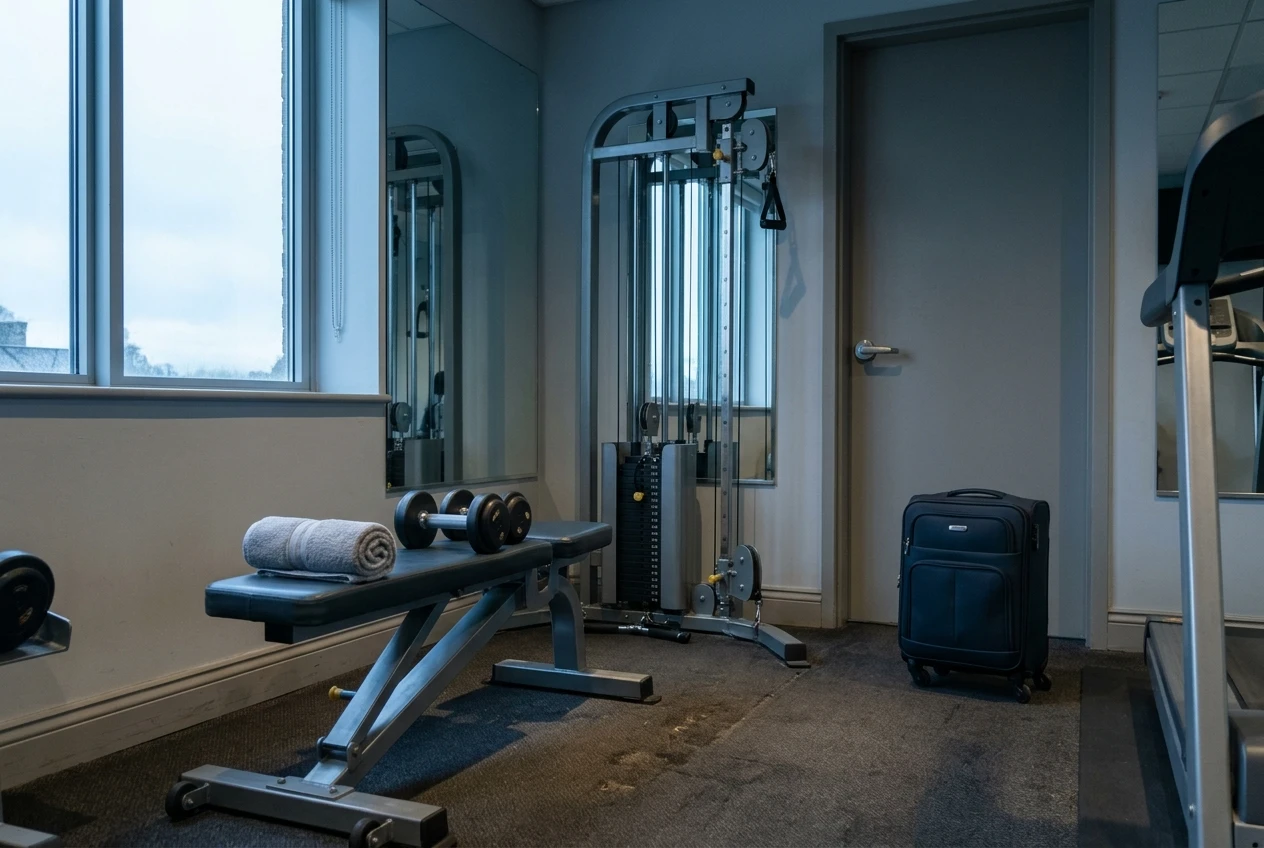
When you travel. A hotel gym often has dumbbells, a bench and a cable stack. Keep the 45-minute structure and swap the main lift for a dumbbell version, such as a goblet or split squat for a back squat, or a dumbbell press for a bench press. Keep the same effort rating and the same density targets for accessories.
When you miss a full week. Repeat the last week you completed rather than jumping ahead. If it happened in the intensify phase, repeat the last good week of that phase and push the deload back by a week.
When illness hits. Skip the sessions. Restart one week earlier in the plan than where you stopped, at RPE 6 for the first session, and build back up.
None of these adjustments require rewriting the block. You shift the dials the plan already has: load, rounds, rest and the order of weeks.
Short, structured sessions you can run at home
If you want short sessions with a clear structure and only home equipment, the Kettlebell Monster review covers what the program teaches and whether the Samsung TV app is worth using. You can see the program and the Samsung TV app at kettlebell.monster (affiliate link: I may earn a commission if you buy through it).