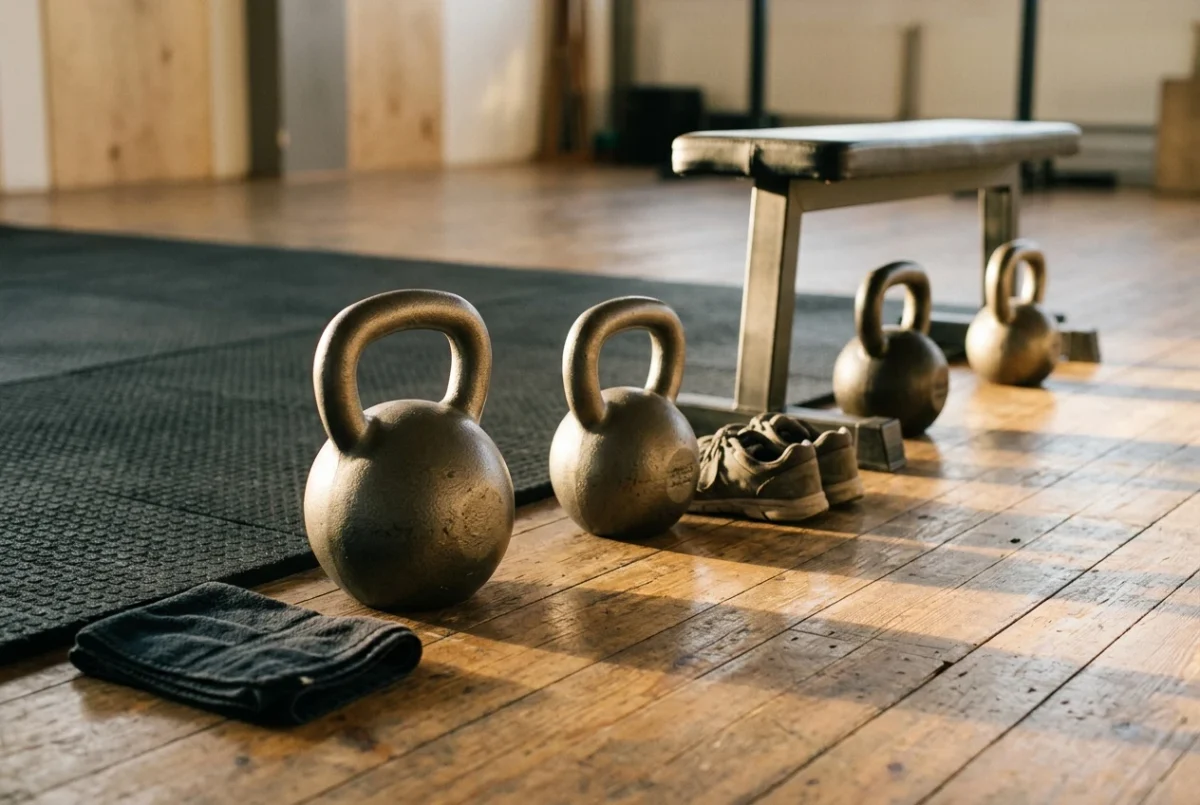
Pause a live coach and ask “is this too heavy for me?” and you get an answer within seconds. A TV program cannot. The trainer on screen keeps moving at the same pace, and the set ends whether your form held or not. Choosing the right weight is therefore your job, and you have to do it before the first session starts.
This article gives you a move-by-move test for answering “what weight kettlebell should a beginner start with” for each exercise in a follow-along workout, instead of one number for everything.
Why the coach on your screen can’t tell you what weight to pick
A coach in the room watches your hips, your back and your breathing, and changes the load when something slips. A recorded program shows one person demonstrating at one weight, and the demonstrator’s bell tells you very little about yours. Their training history, body size and the length of their sets are all different from yours.
Two things decide whether a weight works in a follow-along program: how long each set lasts, and how much of your form survives to the end of it. Many TV and app programs run work intervals or set counts that keep going whether you are fresh or tired. A bell you can move for three reps may be wrong for a set that lasts many more.
So the question to ask is not “what is the heaviest bell I can lift?” It is “what bell can I move well for the whole set, with a little left over?” That question gets a different answer for each movement.
Swings, squats, presses and rows each want a different load
Kettlebell Monster’s workouts are built from familiar kettlebell movements such as swings, squats, presses and rows. Check the program’s own movement list before you buy anything. If it includes a movement not covered here, like a snatch or a Turkish get-up, test that one separately, because it will not share a weight with the others.
Here is why the loads differ:
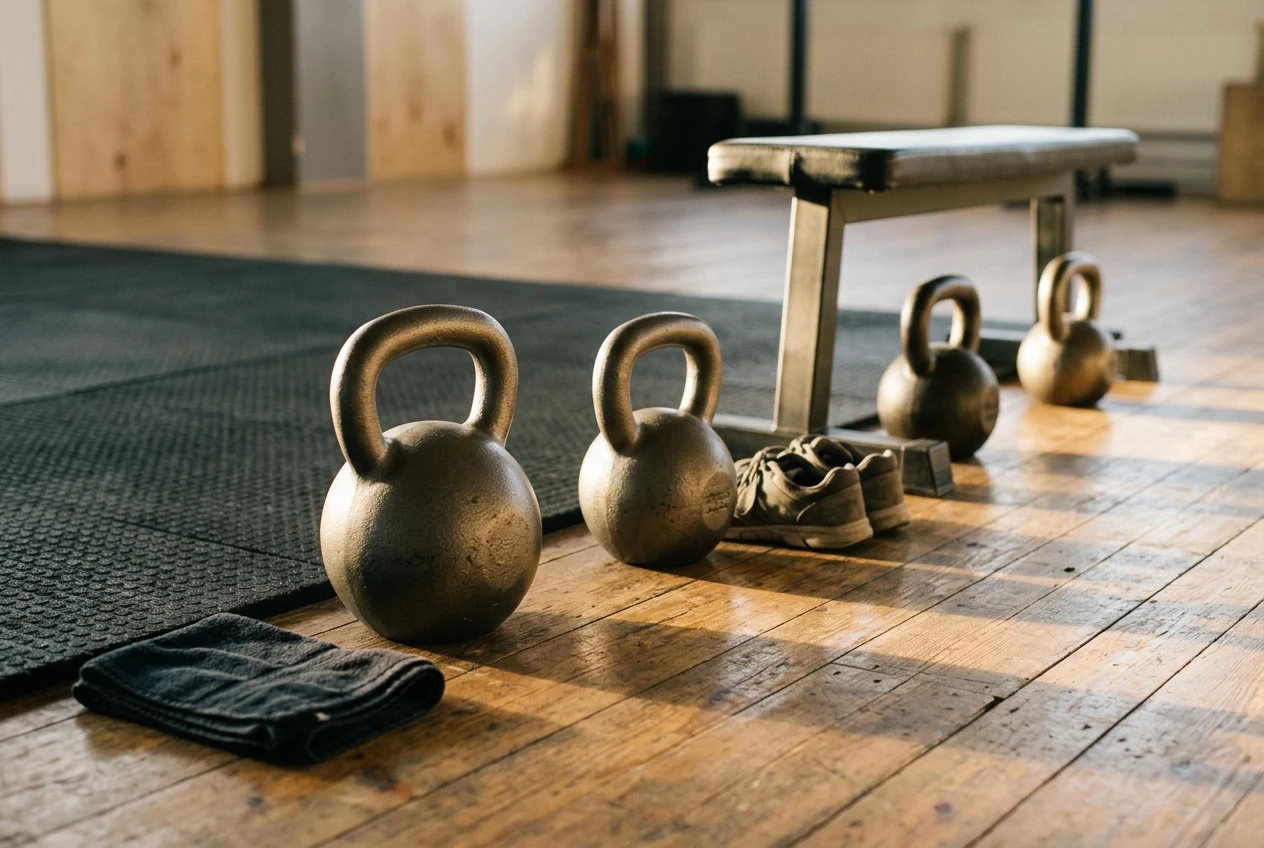
- Swings are driven by the hips and legs, the biggest muscles you have. The bell travels on momentum, so this is usually where you can use your heaviest bell.
- Goblet squats hold the bell at your chest, so your arms, upper back and trunk all work to keep the bell in place. The legs can often handle more than the upper body can hold comfortably.
- Presses put the bell overhead on one shoulder at a time. This is typically the lightest load of the group, and a bell that is slightly too heavy makes you lean back and strain your lower back.
- Rows are supported by your stance or a bench, so you can often use more weight than for presses. The limit is usually grip and keeping your torso still.
If you buy a bell based on how a swing feels and then press it, your form will degrade quickly. If you buy based on the press, the swing will feel too easy. Neither is a mistake as long as you know why it happens, and the test below shows you how large the gap is for you.
For the broader question of which sizes and types of bells make up a full set, see why one kettlebell won’t carry you through a program. This article covers the narrower job of picking a first weight for each movement.
A ten-minute weight test to run before your first session
You need access to a few different bells. A gym, a friend’s set or a fitness shop with display bells all work. If you only own an adjustable bell, run the test with each setting. Wear the shoes you will train in, and clear some floor space.
Minutes 0 to 2: warm up. Do some hip hinges with no weight, bodyweight squats, shoulder circles and a few light swings with the lightest bell available. The test only means something if you are warm.
Minutes 2 to 4: the swing test. Take a bell you expect to be moderate. Do 10 swings in a row. Pass criteria:
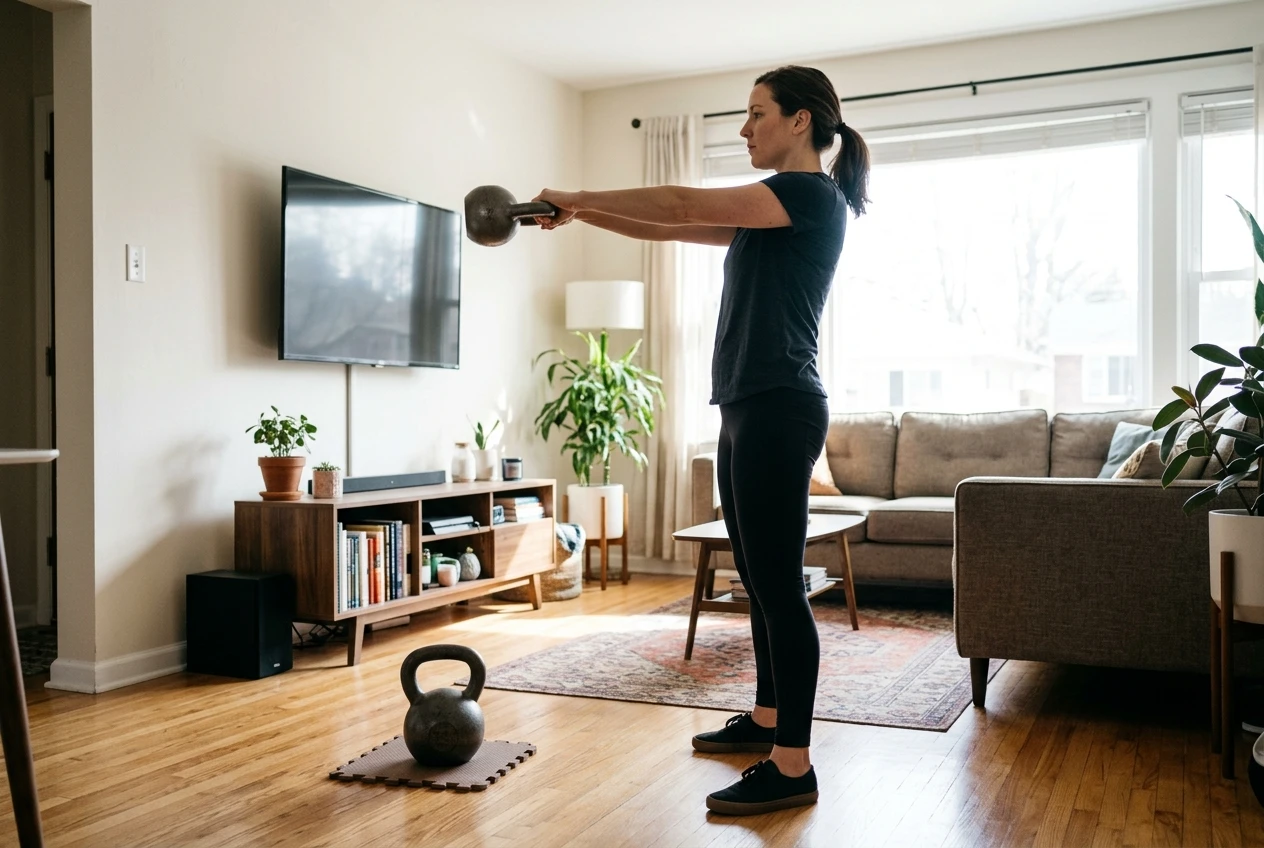
- The bell rises to about chest height without you lifting it with your arms.
- Your back stays flat at the bottom of every rep.
- Your hips snap forward and your arms stay relaxed.
- You could do 3 to 5 more reps at the same quality.
If your arms are pulling the bell up or your back rounds, it is too heavy. If the bell flies up with almost no effort and you feel nothing in your hips, try the next size up.
Minutes 4 to 6: the goblet squat test. Hold the bell at your chest with both hands. Do 8 slow squats, pausing for a second at the bottom of each. Pass criteria: your chest stays up, your heels stay down and the last rep looks like the first. If your torso folds forward by the end, the bell is too heavy for this movement today.
Minutes 6 to 8: the press test. Clean or lift the bell to your shoulder and press it overhead for 5 reps per arm. Pass criteria: your ribs stay down, your lower back does not arch, and the bell goes up in a fairly straight line. If the last rep needs a lean or a push from your legs, go lighter.
Minutes 8 to 10: the row test. Brace one hand on a bench or your knee, keep your back flat and row for 8 reps per arm. Pass criteria: your torso does not twist, your shoulder blade moves back and the bell does not swing. If your grip gives out before your back does, note that, because grip may be your limit and not your strength.
Write down the heaviest bell that passed for each movement. Rest as needed between tests, since a tired shoulder will make the press look worse than it is.
If the program uses long work intervals, repeat your tests with more reps. A weight that passes at 10 swings may fail at 30, and the program’s actual set length is what counts.
Choosing your starting weights and what not to buy yet
Take your test results and set a starting weight for each movement using the “3 to 5 reps left” rule: the weight you will use is the one at which you could have done a few more good reps. Pick this level because you are training alongside a screen that will not slow down for you. A weight that feels easy on rep one is often the right choice, since form tends to slip as fatigue builds.
Your results will probably show the pattern from earlier: a heavier swing and squat, and a lighter press. How to handle that depends on your budget.
If you can buy two bells, get one for the press (and probably the row) and one heavier for the swing and squat.
If you can buy only one, size it to the movement where being too heavy costs you the most, which is the press. Then use the extra reps, slower tempo or a pause in the swing and squat to make the bell harder where it feels too light.
What to hold off on:
- A full set of sizes. You do not know yet which sizes you will use, and the test only covers your first weeks.
- A bell that is “for later.” A bell you cannot use well now will sit in the corner, and it will not teach you the movement.
- Bells for movements the program does not use. Check the movement list first. If the program never snatches, you do not need a bell sized for snatching.
- Very light bells for all work. A bell that is too light for swings teaches your arms to do the job, and that habit is hard to break.
If a program format question is still open, PDF, spreadsheet or TV app: which program format actually gets you through the workout covers how each type affects the way you choose and adjust loads.
Signs the bell is too heavy or too light mid-workout
Because nobody will correct you, you need to catch problems yourself. Watch for these during a session.
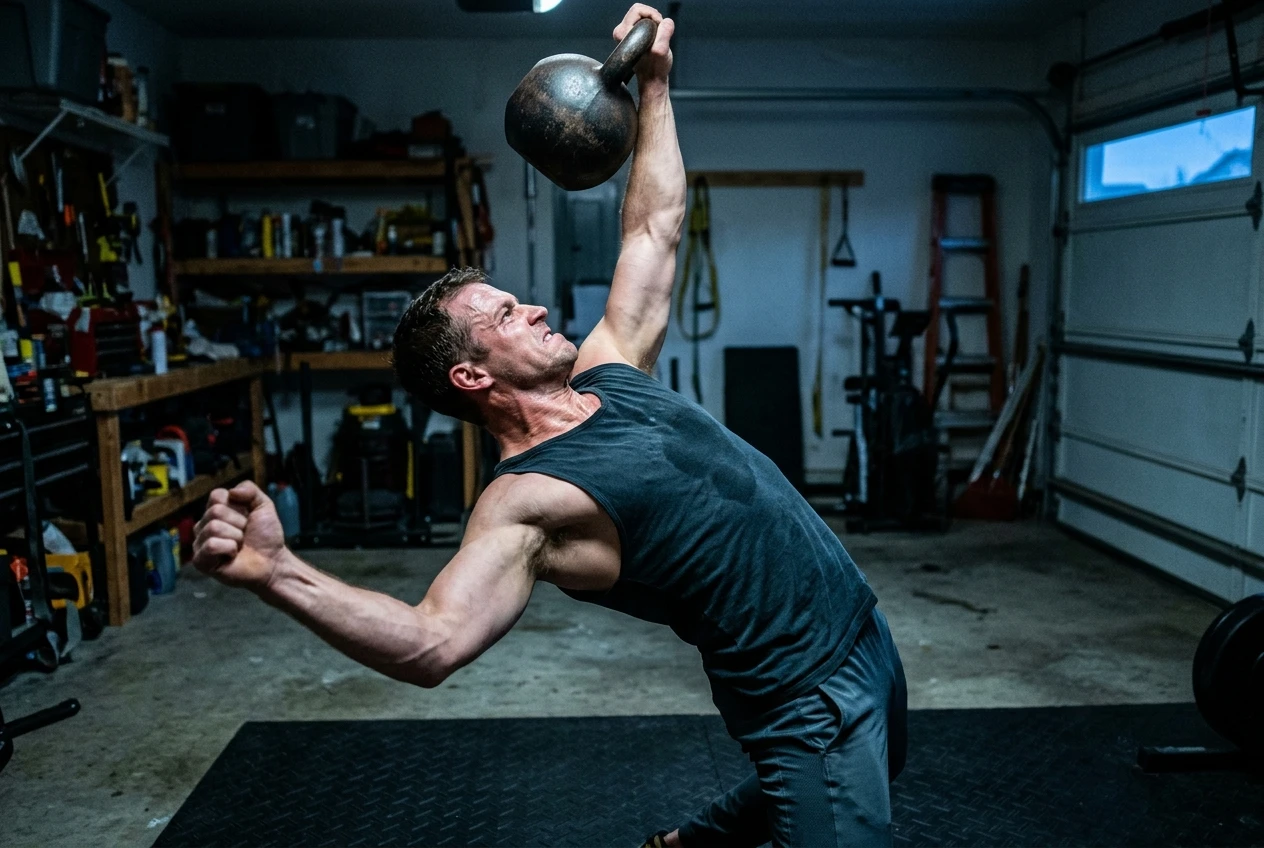
Signs the bell is too heavy:
- Your lower back rounds or arches during swings or presses.
- Your arms start pulling the bell during swings.
- You hold your breath through reps instead of breathing out on the effort.
- Your reps slow down sharply, or you need to rest before the set ends.
- You catch yourself shortening the range, like squatting less deep or pressing with a lean.
- The bell drifts away from your body on the way down.
If you see any of these, stop the set, put the bell down and either use a lighter bell or do the remaining reps with no weight. Skipping a set costs you far less than a back that complains for a week.
Signs the bell is too light:
- You finish the set with 6 or more reps in reserve and your breathing is still calm.
- Swings feel like arm exercises because the bell does not need hip drive.
- You could keep your form perfect for twice as long as the set lasts.
A bell that is a little light is not a problem in the first week, because you are also learning the movements. If it stays light across several sessions with good form, that is the signal to change something, covered next.
When to move up a size and when to add reps instead
Kettlebell sizes go up in steps, and the jump between them can be large relative to what you can handle. Moving up before you have earned it is where most form breakdowns start. Adding reps first is usually the smoother route.
Use this rule:
- Add reps or time first. If you can finish every set of a movement with good form and several reps left, repeat the program with more reps per set, or with a slower lowering phase on squats and presses.
- Wait for consistency. Do this across at least a couple of sessions. One good day does not tell you much.
- Move up when the extra reps stop being challenging. If you are already doing well beyond what the program asks and the bell still feels easy, a heavier bell is the next step.
- Move up one movement at a time. Swings will usually be ready long before presses. Change the load for the movements that are ready, not for all of them.
The same logic applies after your first weeks: add a little challenge, check your form, and only then add more. How to add load week to week when your training app only tells you what to do today goes through that progression in more detail.
Choosing a program once you know your starting weights
If you are still deciding on a program, Kettlebell Monster is worth looking at, and its movement list is the first thing to compare against the tests above. This is an affiliate link, so this site earns a commission if you buy through it.
If you would rather train in front of the TV than a phone, the Kettlebell Monster Samsung Tizen TV workout app runs the workouts on your Samsung screen. This is also an affiliate link, and the same commission applies. For a closer look at whether that format suits you, read whether a Samsung TV kettlebell program is worth it.