
Most apps and video programs hand you a workout for today and say nothing about next month. They prescribe a weight, a rep count and a rest time, then repeat the same plan or swap in a new one. If you want to know how to use progressive overload with a program like that, you need a few decision rules of your own: when to add reps, when to add weight, when to add a set, and when to ignore the prescription for a session.
This article gives you those rules. They work for barbell, dumbbell, machine and kettlebell training, and they work whether the program is an app, a streamed video or a PDF.
What progressive overload actually asks of your body (and what it doesn’t)
Progressive overload means your muscles and tissues get a demand slightly larger than the one they have adapted to. The body responds by getting stronger or bigger so that demand becomes easier. Once the demand stops growing, so does the adaptation.
That does not mean every session must be heavier than the last. Adaptation is slow, and your performance on a given day moves with sleep, food, stress and how long since your last session. Progress shows up over weeks: a set of 8 reps that became a set of 10, a weight that moved from hard to manageable.
It also does not mean training to failure each time, or adding load whenever you feel strong. A demand that is too large too fast produces sloppy reps, sore joints and missed sessions, none of which builds anything. The goal is the smallest increase you can measure, repeated for as long as it keeps working.
The four levers you can pull: reps, load, sets and quality of reps
You have four ways to make the same exercise harder. Each one is useful in a different situation.
- Reps: doing more repetitions at the same weight. This is the safest lever and the one to use first, especially with a new exercise.
- Load: a heavier weight for the same reps. Use it once the reps at your current weight are comfortably inside or above the target range.
- Sets: adding a set to an exercise. This raises total work and also total fatigue, so it suits lifters who recover well and whose sessions are short enough to take it.
- Quality of reps: a fuller range of motion, a slower lowering phase, a pause at the bottom, less bounce or swing. Nothing on the bar changes, but the muscle does more of the work.
Quality is the lever people forget, and it is the one that costs nothing. If you can only add 1 kg by buying microplates, a controlled three-second lowering phase on every rep may be the better week-to-week change. Just change one lever at a time so you can tell what worked.

Double progression: a simple rule for knowing when to go heavier
Double progression uses a rep range instead of a single rep number. You pick a weight, work inside the range, and only add load after you reach the top of the range on every set.
Here is a worked example with a target of 3 sets of 8 to 12 reps on a dumbbell press:
- Start with a weight where you can get 8 reps on the first set with good form.
- Next session, aim for 9 reps on the sets that were at 8. Keep the weight the same.
- Keep adding reps across sessions until all three sets reach 12.
- Next session, increase the weight and expect to fall back to around 8 reps.
- Repeat.
The rule removes the guesswork. You are never asking “should I go heavier today?” You are asking “did I hit 12 on every set last time?” If yes, load goes up. If no, aim for one more rep somewhere.
If your app prescribes a fixed number, such as 10 reps, treat that as the middle of a range. Aim for 8 to 12 or 10 to 14, and use the same rule. The program stays in charge of exercise selection and order, and you take charge of load.
Using reps in reserve to judge a set when the app can’t see you
An app cannot tell whether your last rep was smooth or a grind. Reps in reserve (RIR) fills that gap. It is the number of additional good-form reps you could have done when you stopped the set.
- 0 RIR: you could not have done another rep.
- 1 RIR: one more rep was possible, but it would have been slow.
- 2 RIR: two more reps were possible.
- 3 or more RIR: the set felt easy.
For most working sets, 1 to 3 RIR is a productive zone. It is hard enough to drive progress and leaves enough in reserve that form holds and recovery stays manageable. Sets at 0 RIR are best kept for the last set of an exercise, or avoided on heavy compound lifts where a failed rep is risky.
Judging RIR takes practice, and early on most people underestimate how many reps they had left. Test your estimate occasionally on a safe exercise, such as a machine row or a goblet squat, by continuing until the rep speed drops sharply. After a few sessions your guess gets closer.

Combine RIR with double progression: add load only when you hit the top of the range at 2 RIR or more. Hitting 12 reps with a shaking last rep says the weight is still right.
What to do when your app’s plan is too easy, too hard, or never changes
Three situations come up again and again, and each has a direct response.
The plan is too easy. If every set finishes at 4 or more RIR across two sessions in a row, raise the weight to the next available step. If you cannot raise the weight, add reps within the range or slow the lowering phase. Do not add a lot of extra exercises, because that makes the session longer without making any single lift harder.
The plan is too hard. If you miss the lowest rep target on the first set, or form breaks down before the end of a set, lower the weight by the smallest step you have. Keep the reps and sets as prescribed. A lighter weight done well beats a heavier one done badly, and you can build back up using double progression. If the whole session feels too long to recover from, remove a set or two from the accessory exercises first, and leave the main lifts alone.
The plan never changes. Many video programs repeat the same workout every week and expect you to bring the progression yourself. In that case the workout is a template, not a plan. Use the same exercises, and apply double progression to each one. Log what you did so the following session has a number to beat.
In all three cases, the exercise list from the program stays the same. You change the numbers, not the structure. If the weekly structure itself is what you are unsure about, the piece on running strength training cycles around a packed work calendar covers how to fit sessions around a busy schedule.
Progressing with kettlebells when the next bell size is a big jump
Kettlebells make the load lever awkward. Bells commonly come in steps of 4 kg, which is a large increase relative to a barbell plate, especially on presses, where moving up one size can be a jump of 25 percent or more. Many home lifters own two or three bells, so the next size may also cost money before you know you are ready for it.
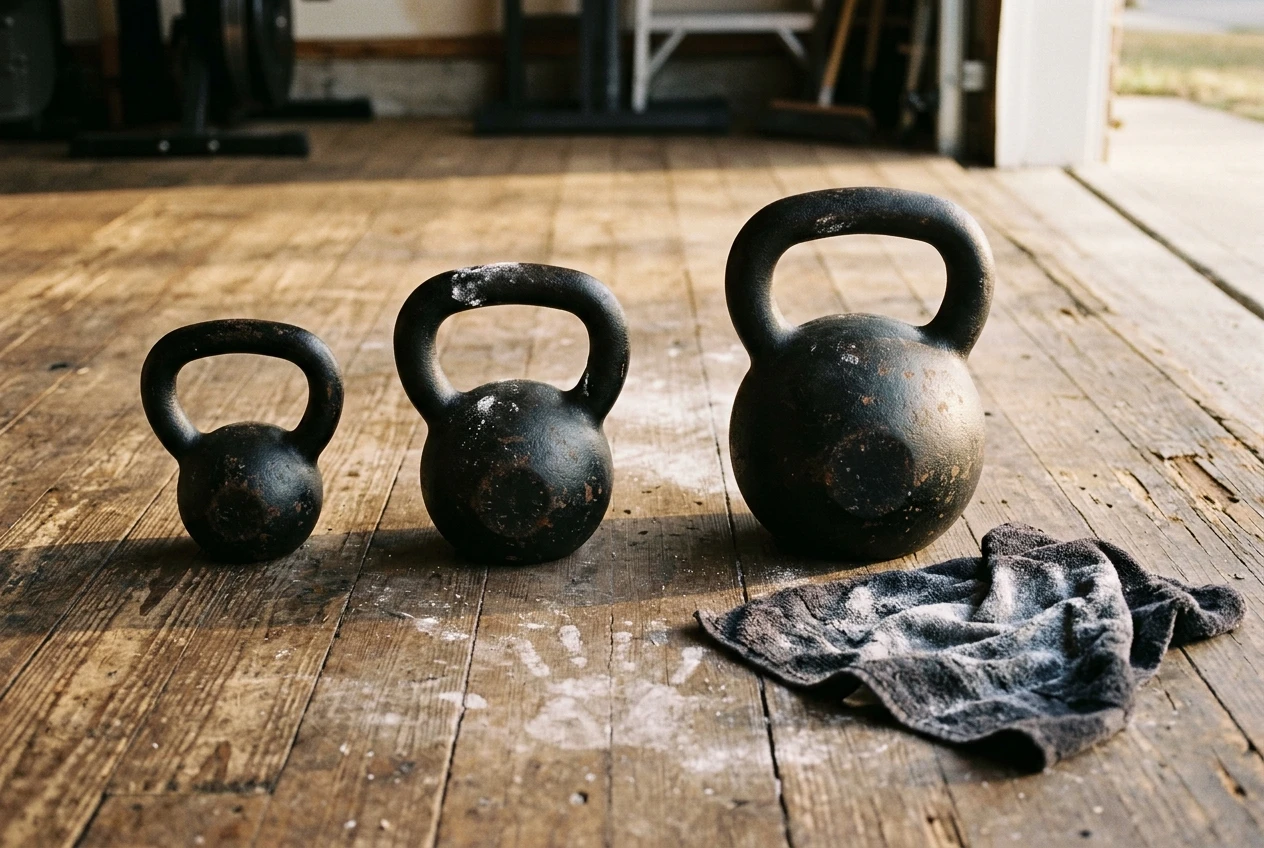
That makes the other levers more important. Some ways to progress between bell sizes:
- Add reps well beyond your usual range. A press that was 5 reps per side can become 8 or 10 before the bell is truly too light.
- Add sets while the weight stays the same.
- Shorten rest. Taking 60 seconds instead of 90 between sets raises the demand without adding weight.
- Slow the tempo on goblet squats and presses, with a pause at the bottom or a slow lowering phase.
- Move from two hands to one on a lift such as the squat or row, which roughly puts the load through a different pattern.
- Change the exercise to a harder version, such as a front squat after a goblet squat or a single-arm press after a double-arm press.
Use the larger bell when you can do the top of your rep range for the smaller bell with 3 or more RIR, and when you can do at least a few clean reps with the new bell. Start with sets of lower reps and use double progression from there. For more on structuring sessions with few bells, see the guide to programming kettlebell sessions for muscle or power.
How to log sessions so the next week’s decision is obvious
A log makes progression automatic, because it tells you what to do before you start. You only need a few fields for each exercise:
- Exercise name and the weight or bell size used
- Reps for each set
- RIR on the last set
- A note if form changed, pain appeared, or the setup was different
Then add one line at the bottom of each exercise that says what you will do next time. For example: “3×10 at 16 kg, RIR 2. Next: aim for 11, 11, 10.” When the next session arrives, you read the line and follow it.

Keep the log where you will actually use it, such as a notes app, a spreadsheet or a paper notebook beside the bench. Write it between sets, not at the end of the day, because numbers like rep counts fade quickly. If the same exercise appears in several programs, keep one log for the exercise, not one per program.
Review the log briefly once a week. Look for the exercises that did not move for two weeks, because those are where a decision is due.
Stalls and deloads: how to tell a bad week from a real plateau
One bad session proves nothing. Poor sleep, a stressful day or a missed meal can lower performance by a few reps. If a session goes badly, repeat the same weights next time before changing anything.
A real stall looks different. It is when reps, load and RIR have not improved for two to three weeks on an exercise, and sleep, food and form are reasonable. Work through these in order:
- Check recovery. If sleep or food has been poor for a stretch, fix that first.
- Check the log. Make sure you tried each lever, such as more reps, slower tempo or an extra set, and did not only wait for the weight to change.
- Change one thing. Add a set, swap to a close variation of the lift, or take a smaller weight step.
- Deload if fatigue is the cause. If several lifts have stalled together, joints ache, and sessions feel heavier than the numbers say, a deload week is the right response.
A deload is a planned lighter week. Keep the same exercises, cut the number of sets by about half, and keep the weights the same or slightly lighter, finishing every set with 3 or more RIR. Then return to your normal plan the week after, starting from the weights you used before the deload.
When only one exercise has stalled and the rest are moving, a deload is not the answer. Change that lift’s rep range, variation or set count instead.
See how a kettlebell program handles progression
If you train with kettlebells and want to see a complete program’s approach to progression, read the Kettlebell Monster review. It covers what the program teaches, how its progression works, and whether the Samsung TV app fits your setup. The program itself is at kettlebell.monster (affiliate link: I may earn a commission if you buy through it).