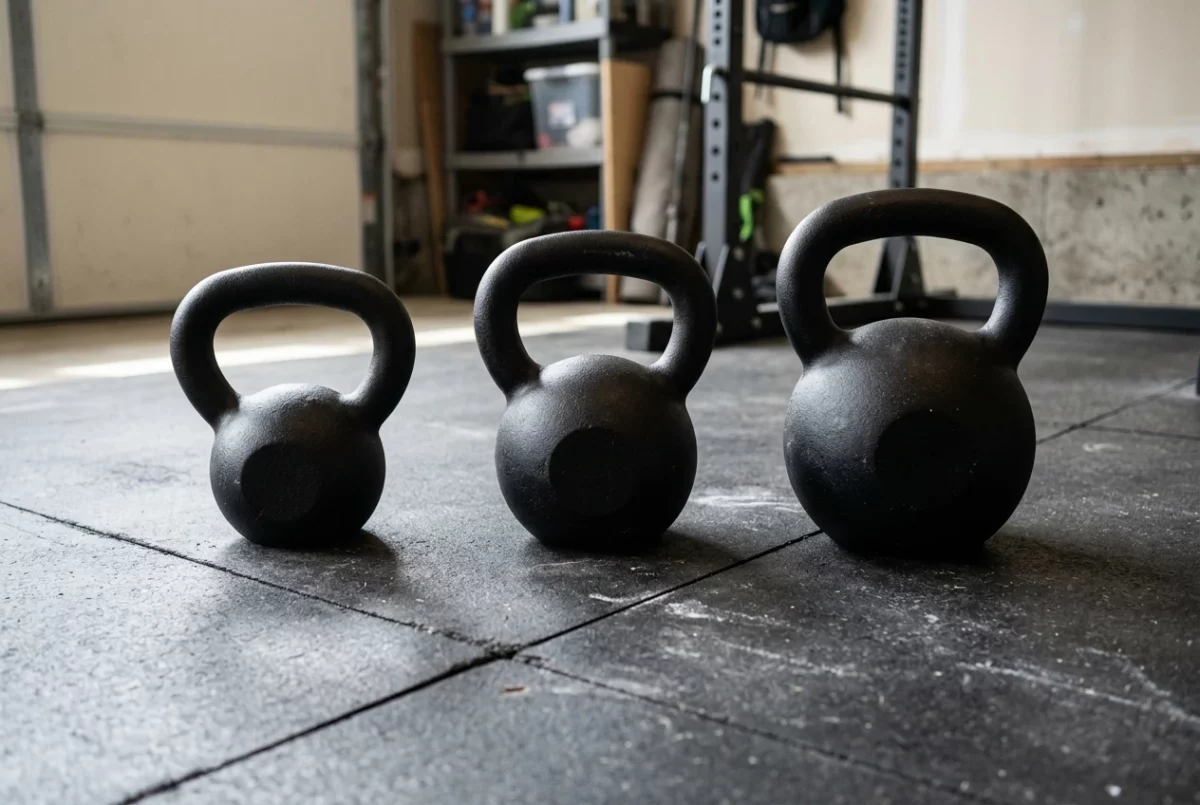
If you already swing, clean, press and squat with kettlebells, you do not need another list of exercises. What usually goes wrong is the structure: a few bells, a lot of variety, and sessions that train a little of everything without building muscle or developing power. Kettlebell programming for hypertrophy and power comes down to one decision made before you pick any exercise, and then a handful of variables you set to match it.
This guide assumes you own somewhere between one and four bells and can already perform the main lifts with good technique. It covers how to choose a goal, how to work around fixed loads, how to build each type of session, how to combine them, and how to keep progressing when you cannot add weight.
Why hypertrophy and power need different kettlebell sessions
A hypertrophy session and a power session look similar on paper because they use the same bells and many of the same movements. They ask for opposite things from your body.
Muscle growth responds to hard sets: sets taken close to failure, with enough total work across the week. Fatigue is part of the process. By the last reps of a set, the muscle is working at its limit and the bell is moving slowly. That is the point of the set.
Power is about moving a load fast and repeating that speed. A swing, clean or snatch trains power only while the hips are snapping with intent. Once the reps get grindy and the bell slows down, the set has turned into conditioning, which is a different adaptation. So power sessions stop sets early and rest long. Hypertrophy sessions push sets late and rest only as long as needed to keep the next set productive.
Trying to do both inside every session leaves you too tired for fast, crisp reps and too cautious to take sets to real effort. Pick one goal as the primary for a block of several weeks, give it most of your hard training, and give the other goal a small maintenance dose. A block of six to eight weeks is a practical length: long enough to see progress, short enough that you can switch if your priorities change.
Working around fixed bell weights: how to make a heavy bell harder and a light bell count
Home kettlebell sets come in fixed jumps. You cannot add a plate, so you change how the bell is used instead of how heavy it is. It helps to treat each bell as having a job rather than asking one bell to do everything.
The same bell can be heavy for one lift and light for another. A bell you can swing for 20 fast reps may be a serious load for a strict one-arm press. Assign bells by movement:
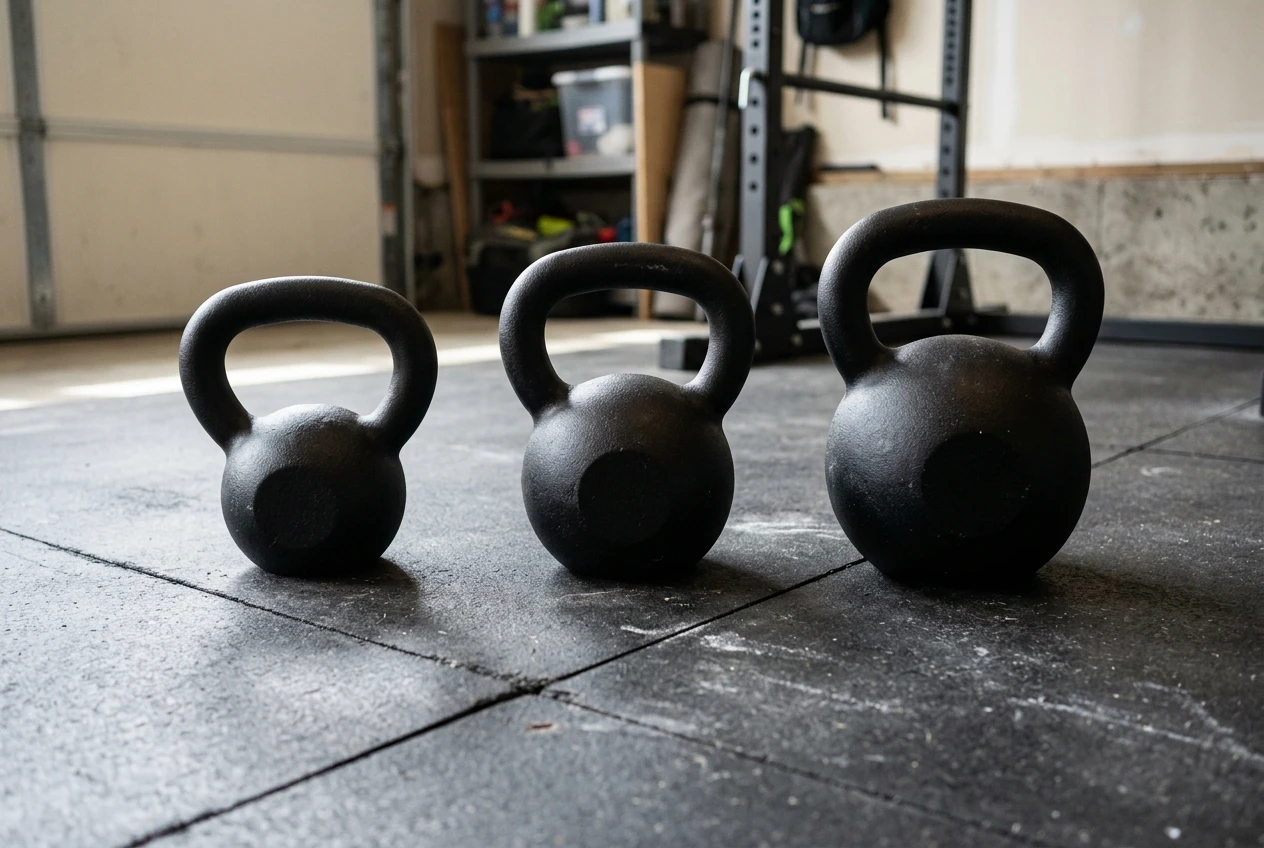
- Presses and single-leg work: use your lightest or middle bell, since small loads go a long way here.
- Squats, deadlift variations and rows: use the heaviest bell you own, often held with two hands or doubled up if you have a pair.
- Swings, cleans and snatches: use the heaviest bell you can still move fast with a locked-out finish.
Making a heavy bell harder
When a bell is too light for a lift, add difficulty without adding weight:
- Slow the lowering phase to three or four seconds.
- Pause for one to two seconds at the hardest point of the rep.
- Switch to a single arm or single leg so the same bell loads fewer muscles.
- Increase the range of motion, for example by elevating the front foot in a split squat or standing on plates for a deeper deadlift.
- Change the leverage: a bell held in the rack position or by the horns behaves differently from one held in the handle, and a bottoms-up hold turns a modest bell into a stability challenge.
- Shorten the rest between sets.
Making a light bell count
A light bell works for hypertrophy when you take sets close to failure with slow tempo and unilateral loading. Sets of 20 to 30 reps carried near failure still produce a growth stimulus. They are just uncomfortable.
A light bell is a poor fit for swings meant to build power, because you cannot generate much resistance and the movement turns into endurance work. If your swing bell is too light, move to single-arm swings, then to cleans and snatches, where the bell travels further and the lift is harder to do fast. If you own two bells of the same weight, double-bell swings and cleans raise the demand considerably.
Building a hypertrophy session: exercise selection, tempo, rep ranges and weekly volume
A kettlebell hypertrophy session should cover the main movement patterns each week: a squat, a hinge, a press, a pull and some trunk or carry work. Choose variations where the bell can be loaded to real difficulty. That usually means unilateral and slow-tempo versions.
Exercise selection
Good options for each pattern:
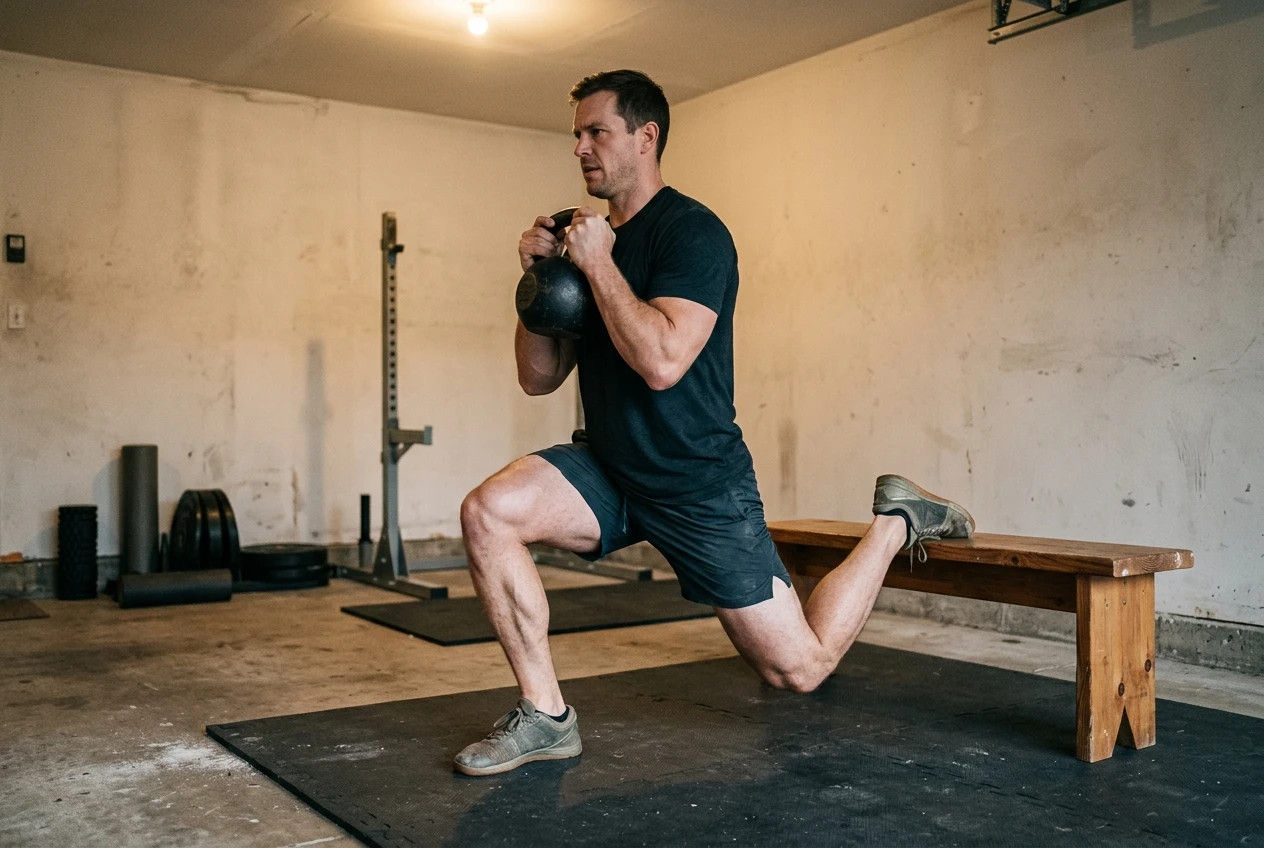
- Squat: goblet squat, double front squat, rear-foot-elevated split squat.
- Hinge: single-leg Romanian deadlift, two-hand deadlift from a raised platform, slow suitcase deadlift.
- Press: strict one-arm press, floor press, push-up with the hands on bells.
- Pull: one-arm row, gorilla row, high pull performed slowly.
- Trunk and carry: suitcase carry, rack carry, bottoms-up carry.
Put the movements that use your heaviest bell first, while you are fresh. Smaller lifts and carries go last.
Tempo and rep ranges
Use a controlled tempo of about three seconds down, a one-second pause, and a firm lift back up. Controlled reps keep tension on the target muscle and reduce the swinging that makes light bells feel easier than they should.
For the main compound lifts with your heaviest bell, work in the 8 to 15 rep range. For presses, rows and single-leg work, 10 to 20 reps is realistic. For anything that feels easy even at high reps, switch to a harder variation instead of grinding out 40 reps. Stop most sets one to three reps short of failure and take the last set of each exercise to or near failure. You do not need to fail every set, and doing so makes the following sets worse.
Weekly volume
A common starting point is roughly 10 to 15 hard sets per muscle group per week. Start at the low end of that range and add a set or two to each movement every week or two while recovery stays good. If performance drops over two sessions in a row or joints start to ache, cut volume back by a third for a week.
Sets per muscle matter more than the number of exercises. Three movements with four hard sets each will usually serve you better than eight movements with two casual sets each.
Building a power session: swings, cleans and snatches with low reps and full rest
A power session is shorter and more deliberate than a hypertrophy session. The goal is to produce fast, forceful hip extension and stop before the quality drops.
Exercise choice
Use the ballistic lifts as the core of the session:
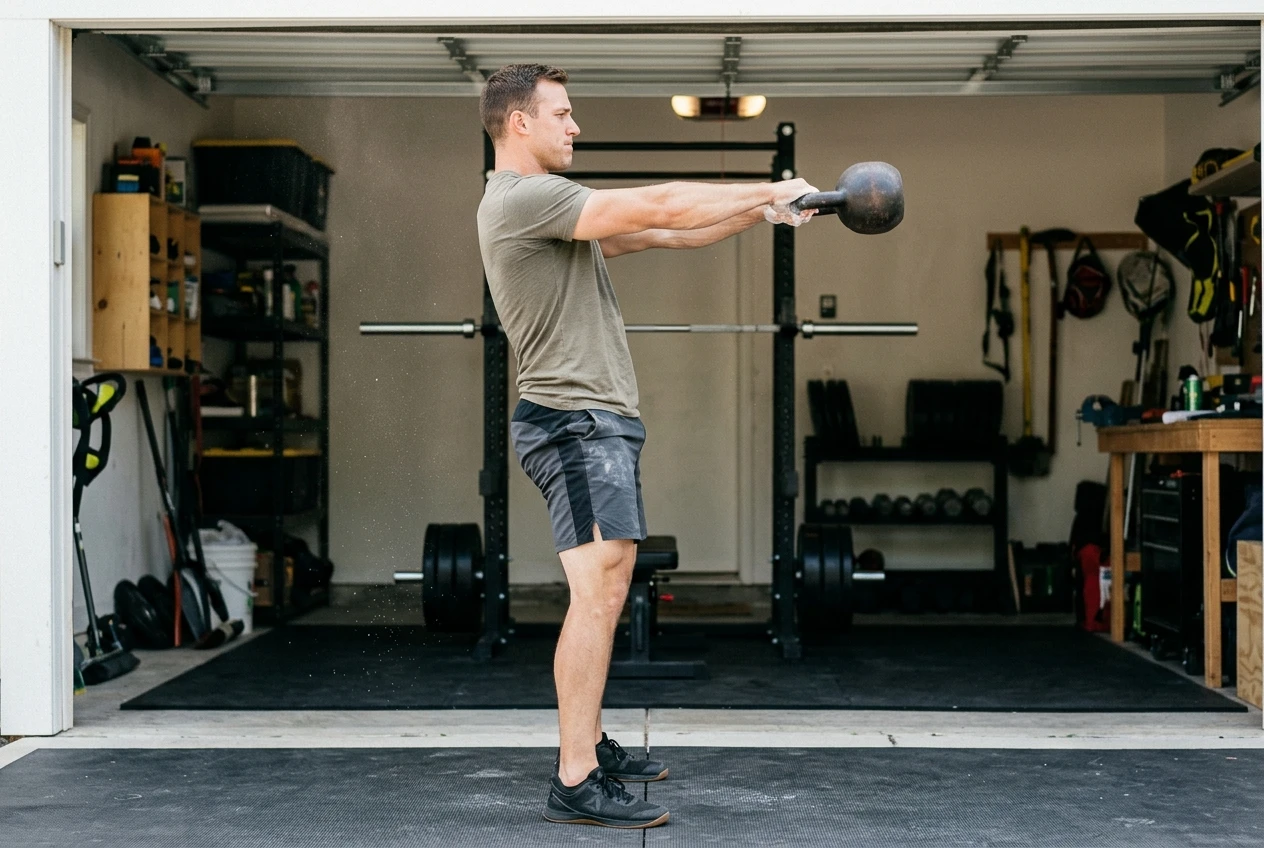
- Swings: two-hand for heavier loads, one-hand once the bell is light enough to move fast.
- Cleans: one arm at a time, with the bell landing softly in the rack.
- Snatches: one arm at a time, with a smooth lockout overhead.
Add one slow strength lift at the start or end, such as a double front squat or a strict press, to keep general strength up. Keep it to a few sets so it does not drain the ballistic work.
Reps, rest and when to stop
Keep sets short. A range of 3 to 8 reps per set works for swings, and 3 to 5 reps per side for cleans and snatches. Rest between sets for 90 seconds to three minutes, enough that your breathing is calm and the next set starts fresh. If you feel like you are exercising for conditioning, the rest is too short.
End a set when you notice any of these:
- The hips stop snapping to full lockout.
- The bell no longer floats at the top of a swing.
- Your grip is tightening more than the lift demands.
- Your back rounds or your technique changes.
Total ballistic work can be modest. Around 30 to 60 high-quality reps of your main ballistic lift in a session is enough for most people. Do the ballistic work first, right after a thorough warm-up, because fatigue hurts power more than anything else.
Running both goals in one week without wrecking recovery
If you want to train both, make one goal the primary and give it most of the hard sessions. The secondary goal gets one short session or a small block inside another session.
A practical split looks like this:
- Hypertrophy primary: three or four hypertrophy sessions plus one short power session of 15 to 20 minutes.
- Power primary: two or three power sessions plus one hypertrophy session covering the full body at moderate volume.
Some practical rules reduce the clash:
- Leave at least 48 hours between a hard lower-body hypertrophy session and a power session that uses heavy swings or snatches. Heavy hinges and high-volume squats leave your hips tired.
- If you combine the two in one session, do the power work first, then the hypertrophy work.
- Watch your hands and grip. High-volume snatches and heavy rows in the same week can leave your hands torn or too tired to hold the bell.
- Limit yourself to four demanding sessions per week at most, unless you have a recovery record that shows you can handle more.
Useful signs that you are overreaching: the bell speed on your swings is dropping from session to session, your sleep is poor, your resting joints are sore, or your usual working weight feels heavier. When two or more show up, drop a session or cut volume for a week.
How to progress when you cannot add 2.5 kg
With a fixed set of bells, progress comes from changing how you do the work. Kettlebell weight jumps are often several kilograms, which is far too big for a weekly increase on most lifts. Use these levers in roughly this order:
- Reps. Pick a rep range, such as 8 to 12. When you hit the top of the range on every set, move to the next lever.
- Sets. Add one set to the exercise, staying within your weekly volume range.
- Density. Complete the same work in less time, or do more work in a fixed window, such as a set of rows and a set of presses back to back for 12 minutes.
- Tempo. Lengthen the lowering phase from three seconds to four, or add a pause at the bottom.
- Unilateral work. Move from a two-hand lift to a one-arm or one-leg version, which makes the same bell much harder.
- Range of motion. Elevate your feet, use a deficit or increase the depth of the movement.
- Leverage. Hold the bell in a harder position, such as offset in the rack, bottoms-up or with one hand on the horn.
Change one variable at a time. If you change tempo, reps and range of motion in the same week, you will not know what worked and your technique may suffer.
For power, the rules differ. Do not add reps if the speed drops. Instead, progress by:
- Moving from two-hand to one-hand swings.
- Moving from swings to cleans or snatches.
- Doing the same number of quality reps with shorter rest, as long as bell speed holds.
- Adding doubles if you own a matching pair.
- Moving to a heavier bell only when you can swing the current one fast for every rep of every set.
Sample weekly layouts for a hypertrophy block and a power block
Treat these as templates. Adjust bell choice to the weights you own, and keep the final set of each exercise close to failure in the hypertrophy block.
Hypertrophy block (four days, six to eight weeks)
Day 1: Lower body
- Double or goblet front squat: 4 sets of 8 to 12, 3-second lowering
- Single-leg Romanian deadlift: 3 sets of 8 to 12 per side
- Rear-foot-elevated split squat: 3 sets of 10 to 15 per side
- Suitcase carry: 3 rounds
Day 2: Upper body
- Strict one-arm press: 4 sets of 6 to 10 per side
- One-arm row: 4 sets of 10 to 15 per side
- Floor press: 3 sets of 10 to 15
- Bottoms-up hold or carry: 3 rounds
Day 4: Lower body
- Deficit deadlift with the heaviest bell: 4 sets of 8 to 12
- Goblet squat with a pause: 3 sets of 12 to 20
- Single-leg hip thrust or glute bridge: 3 sets of 12 to 20 per side
Day 5: Upper body
- Push-up on bells: 4 sets near failure
- Gorilla row: 4 sets of 10 to 15
- Half-kneeling press: 3 sets of 8 to 12 per side
- Short power finisher: 5 sets of 5 swings, full rest
Power block (three days, four to six weeks)
Day 1: Swing and squat
- Two-hand or one-hand swings: 8 sets of 5 to 6, 90 seconds to 2 minutes rest
- Double front squat: 3 sets of 5
Day 2: Clean and press
- Cleans: 6 sets of 3 to 4 per side
- Strict press: 4 sets of 4 to 6 per side
- Carry: 2 to 3 rounds
Day 4: Snatch and hinge
- Snatches: 6 sets of 3 to 5 per side, full rest
- Heavy deadlift variation: 3 sets of 5
- Optional hypertrophy accessory: one-arm row, 3 sets of 10
Keep a rest day or an easy walk between sessions. Do not add extra sessions to a power block just because the sessions are short.
When guided programming makes sense, and when to keep writing your own
Writing your own sessions works well when you understand your goal and have a clear way of tracking progress. It gives you control over your bell choices, your schedule and how fast you progress. It also takes planning time, and plans can drift: weeks pile up with random circuits because the structure stopped being clear.
A guided program makes sense in a few situations:
- You do not want to plan sessions and just want to open a workout and train.
- Your plan keeps changing every week and you are not sure if you are progressing.
- You would train more consistently if someone else set the sessions and the timing.
- You prefer following a coach on a screen to reading a written plan.
Keep writing your own if you enjoy the planning, you have a defined goal and a block structure, and you track your sets and reps. The framework above is enough to run a full block with a few bells.
If you want guided kettlebell sessions, start with the Kettlebell Monster review, which covers what the program teaches and whether the Samsung TV app is worth using, so you can decide before you spend anything.
If you decide to try it, you can find the program at kettlebell.monster. Affiliate link: this site earns a commission if you buy through it.
For people who like to train off the screen, there is also the Kettlebell Monster Samsung Tizen TV workout app. Affiliate link: this site earns a commission if you buy through it.