If your hours jump for a few weeks every year, kettlebell training during busy work season comes down to one question: what is the smallest load that keeps what you have built, and how do you get back to your normal load afterward? Most advice answers it with “train less” and stops there. That leaves you guessing how much less, for how long, and how to restart.
A better approach is to treat your work calendar as the training plan. Sort the year into zones, give each zone its own load, and change the amount of work you do while keeping the bell you already own.
Why a busy work season hits your training harder than the clock suggests
A fifty-hour week does not only cost you ten hours. Long days usually cut sleep, push meals later, add hours of sitting, and leave you mentally tired in the evening when you would normally train. Recovery, the part of training where you actually get stronger, gets worse at the same moment your available time shrinks.
That is why a workout you handle easily in a normal month can leave you flat for days in a peak week. The session did not get harder. Your capacity to recover from it dropped.
Two common reactions both go wrong. Some lifters keep the full program and fall behind on sessions, which turns every missed workout into a small failure. Others stop completely and find, a few weeks later, that their swings feel heavy and their grip gives out early. Either way, the load was never matched to the season.
Mark your work year on a calendar and sort it into three load zones
Open a calendar for the next twelve months and mark the weeks when your hours change. Tax season, quarter-end close, year-end deadlines, a holiday retail rush and a product launch all count. Then sort every week into one of three zones:
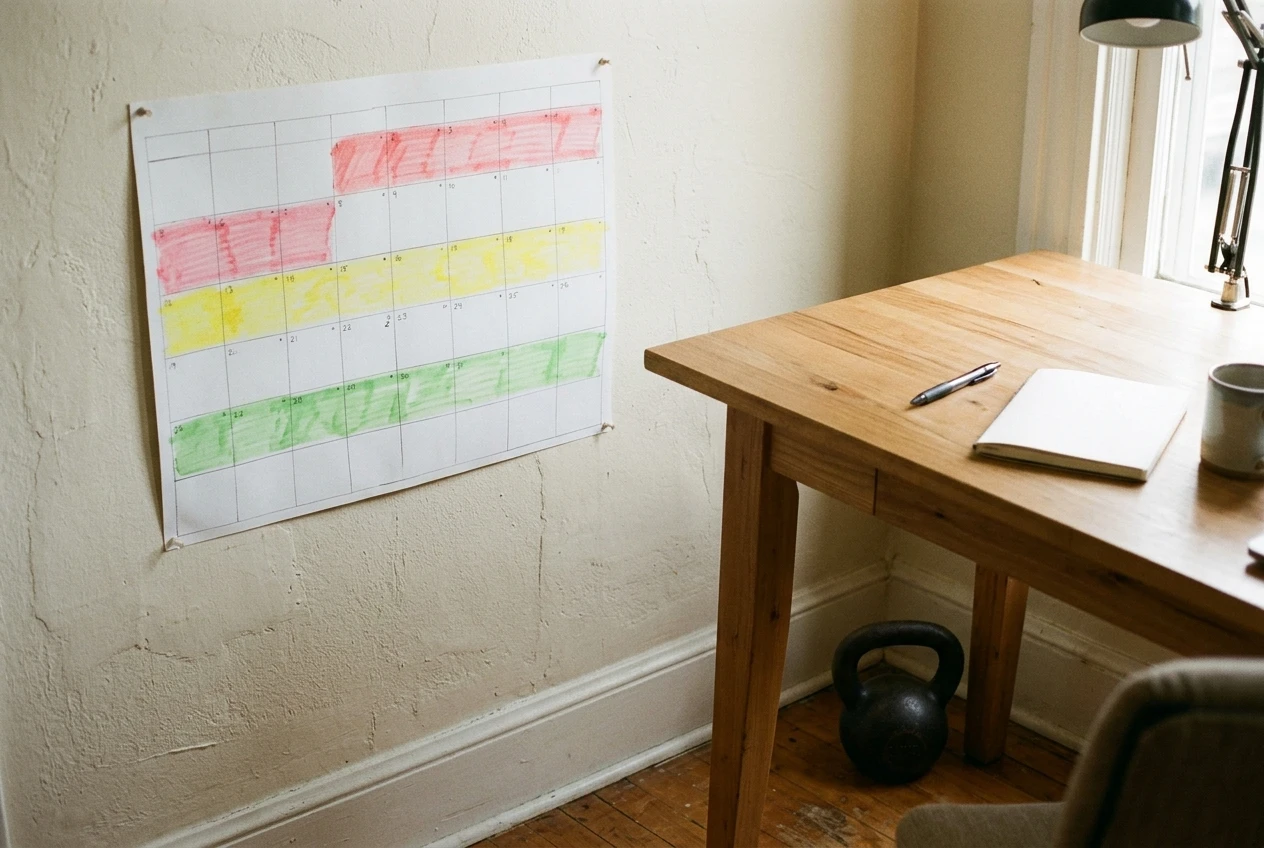
- Peak weeks: long hours, poor sleep, high stress. The goal is to hold your strength.
- Normal weeks: your usual schedule. The goal is steady progress.
- Quiet weeks: shorter days, vacation, slow periods. The goal is to rebuild and add work.
Seeing the year laid out changes how you plan. A crunch of six weeks stops looking like a failure of discipline and becomes a known block with a known load. You can also see how many quiet weeks follow it, which is where your ramp-up happens.
Each zone then gets its own prescription. As an example, say your normal week is three sessions with four sets of eight on each main lift (swings, goblet squats, presses). It might look like this:
Zone Sessions per week Sets per lift Reps per set Peak 2 2 8 Normal 3 4 8 Quiet 3 to 4 4 to 5 8 to 10
Those numbers are only an illustration. Yours depend on your own baseline. The point is that every zone has a written number before the week starts, so you are not deciding at 9 p.m. after a fourteen-hour day.
The three dials you can turn: sets, reps and sessions per week
Your total training dose is the product of three things you control. Each one has a different cost when you turn it down.
Sets are the first dial to turn. Cutting from four sets to two removes half the volume without changing the bell, the technique or the rep range. Each set still feels like your normal training, so the movement pattern stays sharp.
Sessions per week are the second dial. Going from three sessions to two works well when you keep each session full-body, so every main lift still gets trained each week. Dropping to one session is possible but leaves a long gap between exposures. Keep that for the worst week of the year.
Reps are the dial to protect. If you keep your usual bell and cut reps from eight to four, the set becomes easy and the training signal gets weak. If you keep the reps and cut the sets, each set stays demanding. Holding reps near your normal range is what tells your body the bell is still worth adapting to.
So the order is: sets first, sessions second, reps last. In a peak week, you will usually turn down sets and sessions and leave reps alone.
Set a minimum effective dose you can hold through the worst weeks
The minimum effective dose is the smallest session pattern that maintains your current strength. It should be small enough that you can still do it on your worst day at work, and written down before the crunch begins.

A reasonable starting point:
- Two sessions per week, on days that are usually the least busy
- Your usual bell and your usual rep range
- Two hard working sets of each main lift
- Rest between sets as needed, and stop when the sets are done
Treat it as a rule with two sides. If you cannot do your normal session, you do the minimum instead of nothing. If you finish the minimum, you stop, even if you feel good. Extra work in a peak week borrows from recovery you do not have.
Write the plan somewhere you will see it, such as a note on your phone or a row in a log. If you already track your training, a simple sheet is enough, and this piece on whether a spreadsheet can run your kettlebell progression as well as an app covers how to set one up. Logging each minimum session also gives you a record that you kept training through the season, which matters when it ends and you decide how fast to rebuild.
How to ramp back up when hours drop without jumping to a heavier bell
When your hours come back down, the tempting move is to make up for lost time with a heavier bell. That is usually the wrong move. After a stretch of reduced volume, your recovery and your tissues have adapted to less work. A heavier bell adds load on joints, hands and the lower back all at once.
Rebuild in the order you cut, in reverse:
- Return the sessions. Go back to your normal number of weekly sessions, still using minimum sets.
- Return the sets. Add one set per lift, then another, until you are back at your normal volume. A week or two per step is a sensible pace.
- Push the reps. Once volume is normal, work toward the top of your rep range with the same bell.
- Only then consider a heavier bell. When you can finish all your sets at the top of the range with good form, you have a real reason to move up.
That last step is the one most people skip, and it is covered in detail in this reps-first test for deciding when a heavier kettlebell is worth buying. Quiet weeks are the best time to run it, because you have the energy and the time to test properly.
A quiet stretch also gives you room to go slightly above your normal volume, such as five sets instead of four. That extra work builds a buffer for the next peak, though it should come only after your normal week feels easy again.
Adjusting by feel: using sleep, grip and swing speed to decide when to back off
A calendar tells you what to expect, but a week does not always behave as planned. Three quick checks tell you when to move down a zone, and none of them need equipment.
Sleep. If you have slept noticeably less than your usual amount for several nights in a row, run the minimum session even if the calendar says it is a normal week. Sleep loss is one of the clearest signs that recovery is behind.

Grip. Pay attention to when your hands start to give out on swings or carries. If your grip fades earlier than normal, or the bell feels like it is slipping when it did not before, your system is tired. Hold on to the quality of your sets by cutting one of them.
Swing speed. In a good swing, the hips drive the bell up and it floats briefly at the top. When you are tired, the hip snap slows, the arms start to help, and the bell does not reach the same height. If you see that in the first few reps, finish the set early and treat it as your signal to drop to the minimum.
A simple rule works: if one of the three checks is off, keep your plan. If two are off, drop one zone for the week. If all three look normal in a peak week, you still stay with the minimum, because those weeks are not the time to test your limits.
These checks work best when you compare against your own usual numbers, not against some standard. Over a season you will learn what your normal grip, sleep and swing feel like, and the signals become easier to read.
Keep your sessions short and ready when the hours swing
If you would like sessions already sized for light weeks, kettlebell.monster has ready-made kettlebell workouts you can follow, so you do not have to rebuild a plan each time your schedule changes. You can look at them at kettlebell.monster.
Disclosure: that link is an affiliate link, so I earn a commission if you buy through it.