
A kettlebell finisher for powerlifters should be chosen by what your main lift just used up, and it should be short enough that your next heavy session never notices it. Pick the pattern by the lift, set a clock, set a stop rule, and write all three down before the first rep. The sections below cover squat, bench and deadlift days, then the days to skip the finisher entirely.
What a finisher is allowed to cost your next heavy day
A finisher is allowed to cost you nothing on the bar. If your warm-up weights at the next heavy session feel heavier than usual, or your first working set moves slower than it normally does, the finisher cost too much, however good it felt at the time.
That gives you one test to judge every choice in this article: does the finisher load the same muscles and joints that the main lift just loaded, and will you train that pattern again within the next couple of days? If both answers are yes, pick a different finisher.
The simplest way to avoid overlap is to give the finisher the opposite job from the main lift:
Main lift today | What it wore down | Finisher leans on | Leave out |
|---|---|---|---|
Squat | Quads, lower back, trunk bracing | Upper body, carries | Swings, snatches, goblet squats, lunges |
Bench or press | Shoulders, triceps, chest | Hips, light squat pattern | Push presses, snatches, push-up variations |
Deadlift | Hamstrings, glutes, lower back, grip | Knee-dominant work, light pressing | Swings, cleans, snatches, long grip holds |
The table is a starting point. Your own program order matters more, and each lift section below covers the exceptions.
If you want to see how a flow fits around heavy days in general, the piece on kettlebell flow as a finisher and as recovery between heavy days frames the flow itself. This article is about choosing the finisher, lift by lift.
Squat day: choose a finisher that leaves your lower back and quads out of it
After heavy squats, your quads are tired, your spinal erectors have been holding a brace under load, and your trunk has done a lot of work. A finisher built on swings or snatches goes straight back to the lower back and hips. A finisher built on goblet squats or lunges goes straight back to the quads. Both borrow from a tank you need on your next squat or deadlift day.
Better choices on squat day:

- Overhead carries. Walk with one bell held overhead, arm locked out, and switch sides each lap. Your shoulders, upper back and trunk stabilisers work, and your quads do very little.
- Light strict or push presses. Use a bell well under your press max and alternate arms. This works as long as your next pressing session is not tomorrow.
- Bottom-up presses or halos. These use a very light bell and load the shoulder girdle with little effect on your legs. They suit a short, low-effort finish.
Check the order of your week before choosing presses. If bench or overhead press comes the next day, switch to carries, which tax your shoulders less than repeated pressing.
If your lower back is usually the limiting factor on heavy squats, it is worth working out which kind of quit it is before you add anything that loads it afterward.
A workable squat-day finish is a carry circuit: 30 seconds of overhead carry per arm, then 30 seconds of rest, for a few rounds. Keep the bell light enough that your ribs stay stacked over your pelvis and your arm never drifts forward.
Bench and press day: choose a finisher that doesn’t take more from your shoulders
On a bench or press day, your pecs, front delts and triceps have done the work. The elbows and the shoulder joint are usually the first things to complain when pressing volume creeps up. A finisher that adds more pressing, snatching or push-ups adds to that load at the end of the session, when your form is already the worst it will be all day.
Move the work to the hips and legs:
- Two-hand swings with a moderate bell. The movement is driven by the hips, and your shoulders only guide the bell. Grip and lats get involved, so use a bell you can swing with a relaxed arm.
- Goblet squats with a light bell. Keep the weight low enough that you could do ten more reps. The aim is to raise your breathing rate, not to chase a squat PR.
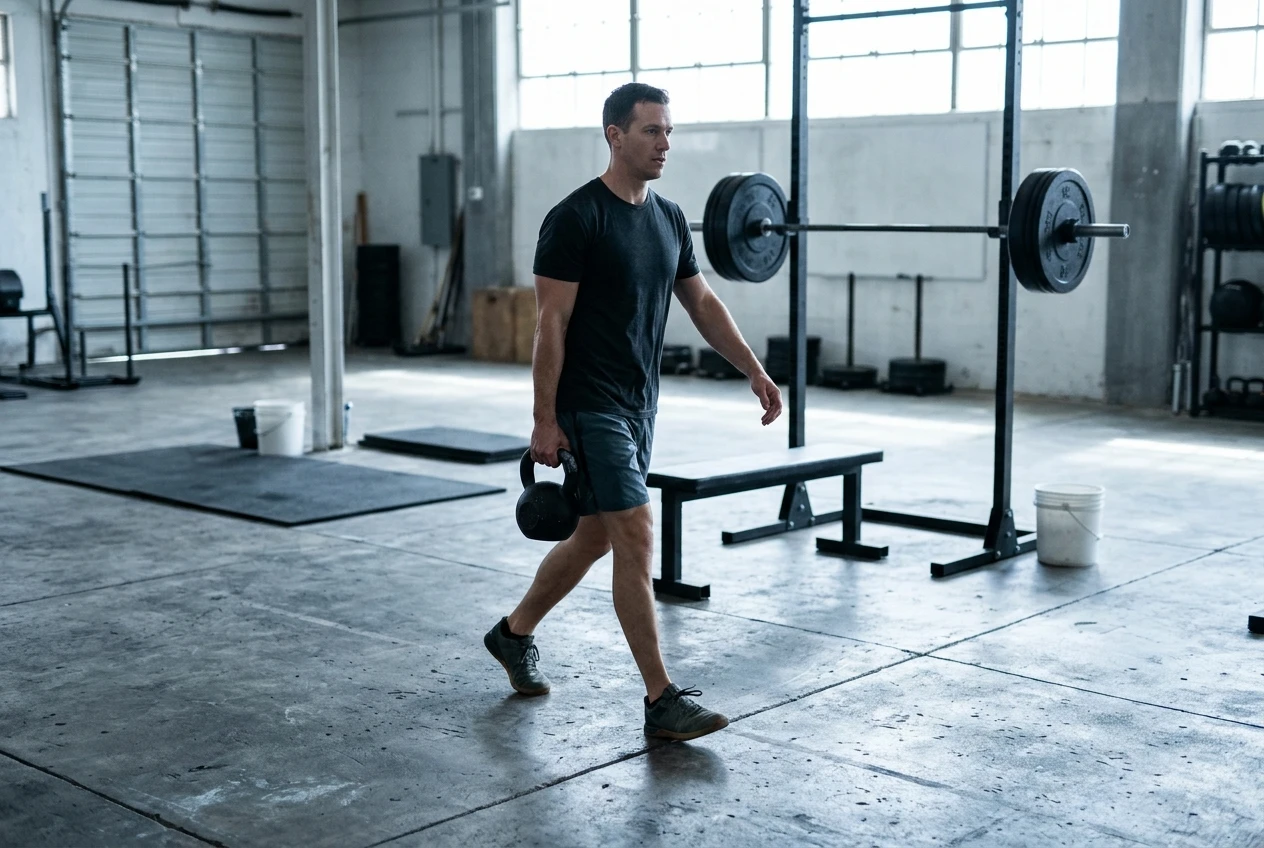
- Suitcase carries. One bell at your side, torso upright, walking steadily. These work the trunk and grip with no pressing.
Check what comes next. If a squat or deadlift day is the next session, keep swing volume low, because swings use the hamstrings and lower back more than most people expect. If your next heavy session is another bench day, a few extra swings cost you much less.
Grip is the other thing to watch. If your swing grip is likely to fail before your hips tire, read where a swing grip can fail and choose the block that fits. A finisher that ends because your hands open is not conditioning your hips.
Avoid push presses, snatches and renegade rows on this day. They all load the shoulder in positions that look a lot like what you just did on the bench or press.
Deadlift day: avoid repeating the hinge you just wore out
Deadlift day is where lifters most often pick the wrong finisher, because swings feel like the natural kettlebell finish. A swing is a hinge, and you have just done heavy hinges. Your hamstrings, glutes and lower back are tired, and your grip has worked hard. Cleans and snatches have the same hinge, with grip added.

Pick work that avoids the hinge:
- Light goblet squats or front-rack squats. The pattern is knee-dominant. Keep the bell light and the tempo controlled so your lower back stays out of it.
- Reverse lunges or step-ups with a light bell. These work the legs without a hinge. Use a short range and a low step if your hamstrings are already sore.
- Strict half-kneeling presses. Upper-body pressing is well away from the muscles that pulled. This works if your next pressing session is not tomorrow.
Be careful with long carries here. A farmer carry is excellent training, but your grip has just held a heavy bar. If your deadlift stalls because your hands, back or hips give out near the top, you want those to recover. The article on fixing deadlift lockout covers three common causes, and a finisher that tires the same structures makes the diagnosis harder.
A simple deadlift-day finish is 40 seconds of light goblet squats with a bell you can handle for all rounds, and 20 seconds of rest, for a few rounds. If your breathing is hard but your back feels fine, the bell weight is about right.
Set the clock and the stop rule before you pick the bell
Choose the clock and the stop rule before you choose the bell. Deciding mid-finisher, while you are breathing hard and want to be done, produces bad choices in both directions.
The clock. Give the finisher a hard cap of eight minutes from first rep to last, rests included. If you want to lengthen it, add a round only after the finisher has not cost you anything for two consecutive weeks. A common mistake is to treat the finisher as extra training instead of a cap on how much you do after the main work.
The stop rule. End the finisher at the first of these:
- The timer reaches your cap.
- Your technique changes: your back rounds, your ribs flare, or your elbow drifts on a carry.
- Your grip opens before the interval ends.
- You can no longer breathe through your nose within a minute of stopping, which tells you the session has become harder than you intended.
- A joint hurts in a sharp or pinching way, as opposed to ordinary muscle fatigue.
The bell. Choose the lighter of two candidates. A finisher bell that feels slightly too easy on round one is usually the right weight by round four. If you can only finish the circuit with sloppy reps, the bell is too heavy.
Write the cap and the stop rule at the top of your training log. This follows the same logic as pricing each accessory by the reps it costs your next main lift: a finisher is one more item on the bill, and you decide the budget in advance.
The days a finisher should be skipped entirely
Skipping the finisher is a legitimate decision, and some days call for it. Leave it out when:
- The main lift went badly. Grinding reps, missed lifts or a top set that moved far slower than usual mean you have less recovery to spend. Go home.
- A heavy day for the same pattern is within about 24 hours. For example, a deadlift session tonight and a squat session tomorrow morning is a poor time for a swing or carry finisher.
- A joint is sore in a way that is not ordinary muscle fatigue. Elbows, shoulders and lower back come first. Do not add loaded work on top of that.
- The session already ran long. If you spent extra time warming up or resting between sets, the finisher goes first. Do not stretch the session by half an hour.
- It is a peak, test or max-attempt day. On days when you are working toward a heavy single or a competition-style attempt, do your warm-down and stop.
- You slept badly or feel unusually run down. Judge this by how your warm-up sets feel, not by your motivation.
A quick decision rule: ask three questions after your last working set. Did the main lift move as planned? Will I train this pattern again within a day or two? Does anything feel sharp? Two clean answers and the finisher goes ahead at its normal size. If any answer is wrong, shorten it, change the pattern, or skip it.
Run it for four weeks and log what changed in your main lifts
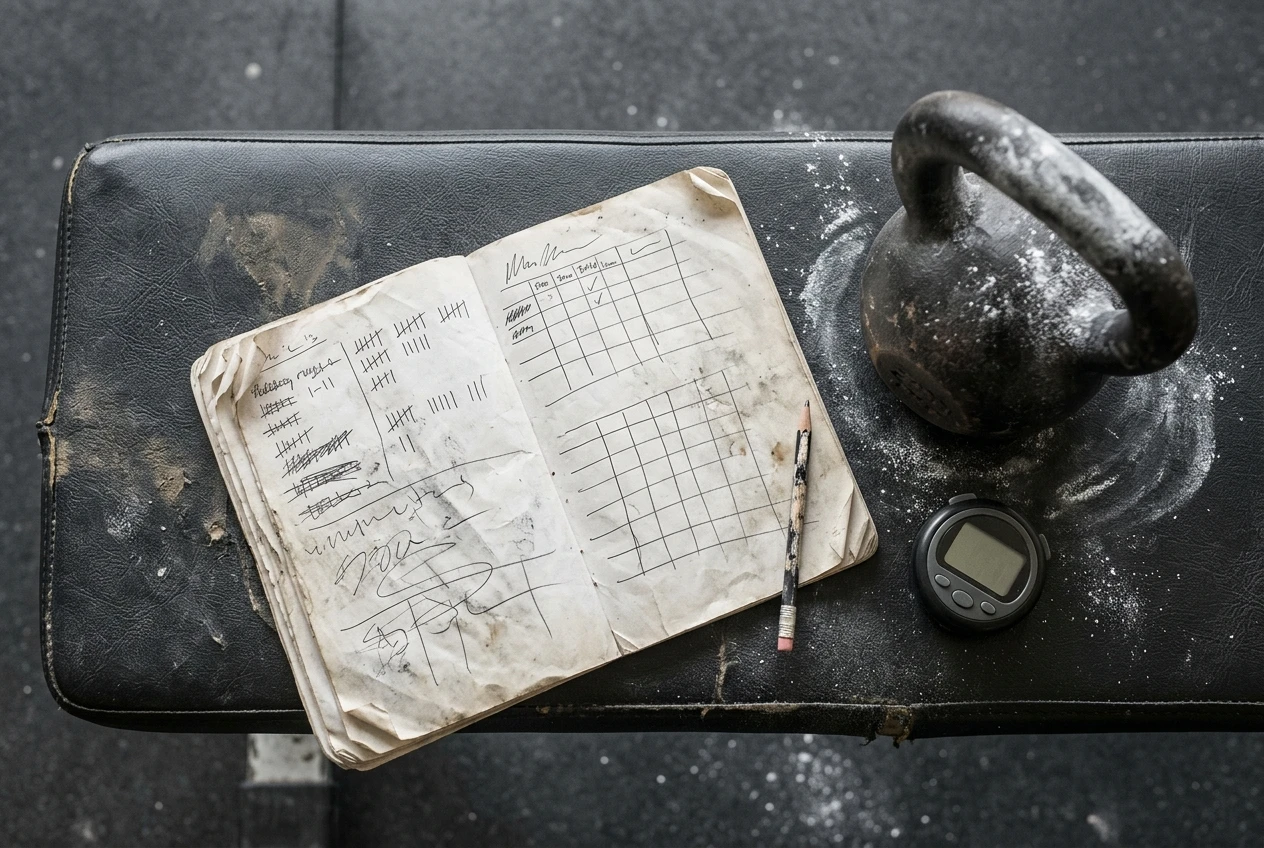
A finisher is only worth keeping if your main lifts hold up. Four weeks is long enough to see a pattern, so log these items for each session:
- The main lift, its top set and your best estimate of how hard it felt.
- The finisher you chose, the bell weight, the rounds and the actual minutes.
- Whether the stop rule ended it early, and which rule it was.
- How your warm-up weights felt at your next session of the same lift.
- Your next top set compared with the previous one.
At the end of four weeks, read the log with these rules:
- Top sets held or improved: keep the finisher, and consider adding a round only on a day where the stop rule never triggered.
- A specific lift slipped: find the finisher that came right before it. Change its pattern or shorten its cap by two minutes, then log another two weeks.
- The finisher ended early on the same rule every time: the bell is wrong or the pattern is wrong. Fix that before touching volume.
Use paper or an app, whichever you will really fill in. If you are weighing them up, the comparison of Kettlebell Monster and a paper workout log helps you choose by the question your goal needs answered.
If you would rather have the finisher laid out as a ready-to-follow routine than build each one yourself, take a look at kettlebell.monster. (Affiliate link: I earn a commission if you buy through it, at no extra cost to you.)
And if you train at home in front of a screen, there is also the Kettlebell Monster workout app for Samsung Tizen TVs, which lets you follow a routine from the TV instead of your phone. (Affiliate link: I earn a commission if you buy through it, at no extra cost to you.)