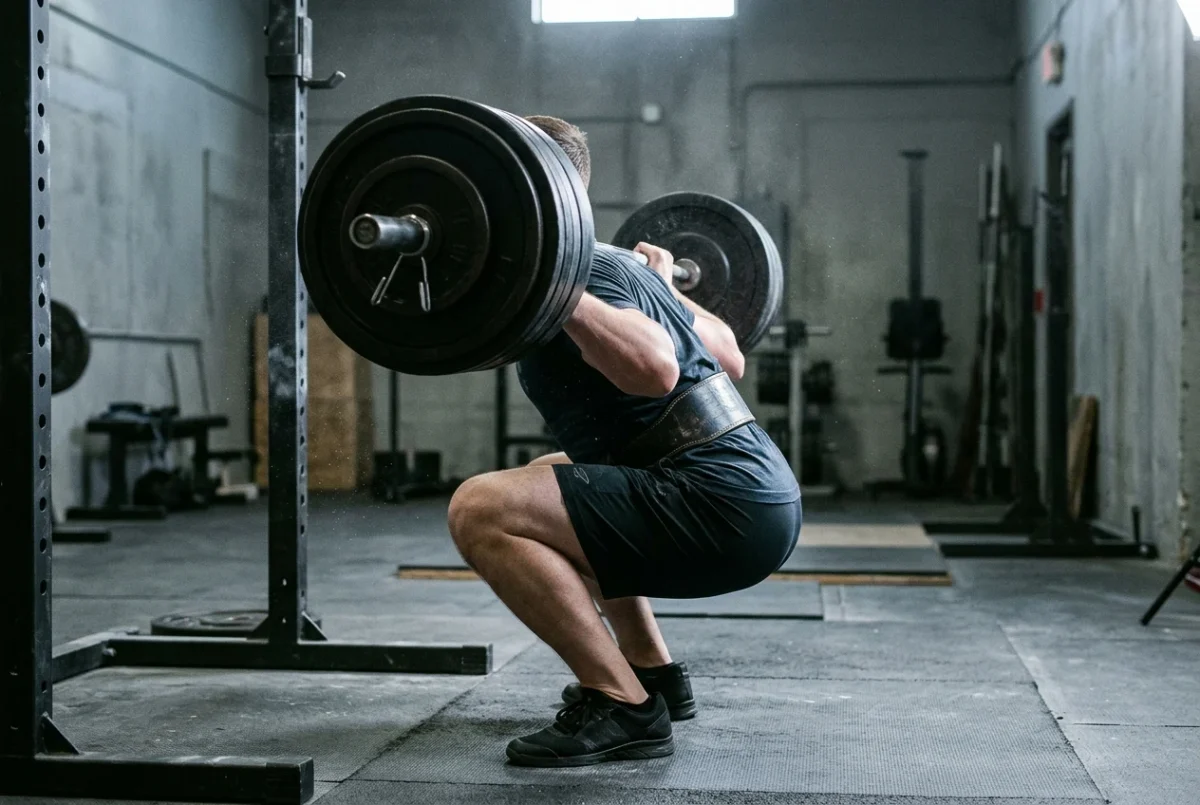
Most belt advice is written around a single heavy set. High-volume squat blocks ask something different of a belt: you wear it for eight or ten working sets a session, three sessions a week, and by week four the details you ignored in the shop start to matter. The best lifting belt for high volume squats is the one that still gives you something to brace against on your last set without making the gaps between sets harder to get through.
Three traits decide that: how wide and thick the belt is, how stiff it is, and how it closes. This article covers each one, then gives you a three-set test you can run on a belt you already own or one you are about to commit to for a cycle.
Why material alone won’t tell you how a belt feels in week four
“Nylon” and “leather” describe what a belt is made of. They say little about where the belt sits on your torso, how much it resists when you push your abdomen into it, or how long it takes to get off between sets. Two leather belts can feel completely different, and a flexible nylon belt can feel more supportive than a poorly shaped leather one.
Material still has a role, particularly in how a belt changes as it breaks in and as you sweat through it. If that is the question you are working on, the nylon vs leather piece on this site covers it by judging a belt on your last set rather than your first. This article picks up from there and looks at the physical traits that apply whatever the belt is made of.
The reason to think in traits is that a belt does one mechanical job. It gives your abdominal wall something firm to push outward against, which helps you build and hold intra-abdominal pressure. How well it does that depends on its shape, its resistance and how reliably you can set it to the same tightness every time. Those are the things worth comparing.
Width and thickness: where the belt meets your ribs and hips at the bottom of a squat
Width decides what the belt touches when you are standing tall versus when you are in the hole. At the top of the squat, a wide belt sits comfortably between your lowest ribs and the top of your hips. As you descend, your torso leans and your hips fold, and the space between ribs and pelvis shrinks. A belt that was fine standing can jam into your ribs or dig into the top of your hip bone at the bottom.
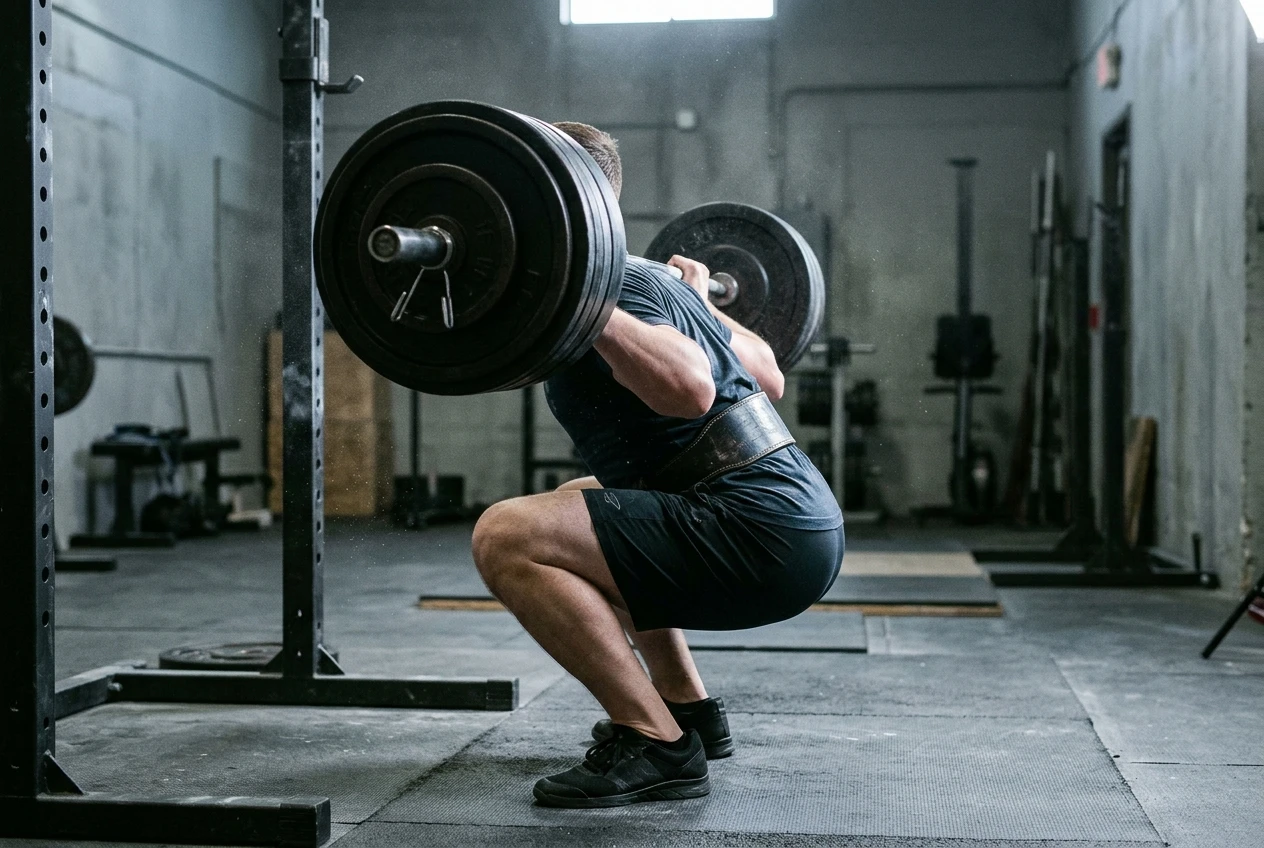
That is why width should be judged at depth, not in front of a mirror. Put the belt on, squat to your working depth with an empty bar or just your bodyweight, and notice three things:
- Does the top edge press into your lower ribs?
- Does the bottom edge bite into the front of your hips?
- Does the belt ride up or roll as you come out of the bottom?
Pain or pinching during one rep becomes a real problem across forty reps. Over a long session, a belt that rubs the same spot on every rep can leave you flinching at the bottom or loosening the belt just to get through the set, and a loosened belt gives you less to brace against.
Thickness works differently from width. A thicker belt is generally more rigid and takes up more room between your torso and the bar, which can change how your brace feels. It also tends to resist bending when you sit into the squat, so it may not conform to your body shape as easily. A thinner belt bends and shapes itself to you more readily, which is often more comfortable, but it gives less resistance to push against.
If you compete, check your federation’s rulebook for belt dimension limits before you buy, since those limits apply on the platform even though they do not matter in a regular training session. For ordinary training, the practical question is only whether the belt fits your torso at depth.
Body shape matters here more than any spec sheet can capture. A lifter with a long torso and a lot of space between ribs and hips has more room to work with than a lifter whose ribs sit close to the pelvis. Compare belts on your own body at the bottom of a squat.
Stiffness is a trade: more to brace against, less room to breathe between reps
A stiffer belt gives your abs a firmer wall to push into. On heavy sets, that can make the brace feel easier to find and easier to hold. The cost is that a stiff belt also resists your breathing. In a high-volume block, you are not doing one rep and walking away; you are taking a breath, bracing, squatting, standing, and breathing again, often for sets of five to ten reps with only a moment between reps.
That moment is where stiffness shows up. With a very stiff belt cinched tight, the reset breath between reps can feel cramped. You may find yourself taking shallower breaths, or you may loosen the belt a notch to make breathing comfortable, which changes how the brace feels on the next rep. A softer, more flexible belt gives you easier breathing but a less defined surface to push against, so the brace may feel vaguer as the sets pile up.
Neither end is correct for everyone. The stiffer option rewards you when the weight is heavy and the reps are few. The more flexible option is easier to live with when the reps are higher and the load is lower. Many lifters on volume blocks find they want something in the middle, but that is a question about your own body and your own sets, which is why the test below matters more than any general rule.
One more point on stiffness: most belts change with use. A new, stiff belt often feels different after it has been worn for a few weeks. If you are buying for a block, judge a stiff belt by how it feels after a few sessions of use, not only in the first session, and treat the first session as a rough guide.
Lever, prong or Velcro: what each closure costs you between sets
Closure type sounds like a convenience detail, but in a volume block it decides how consistently you can set the belt and how quickly you can take it off and put it back on. Each type has a typical trade.
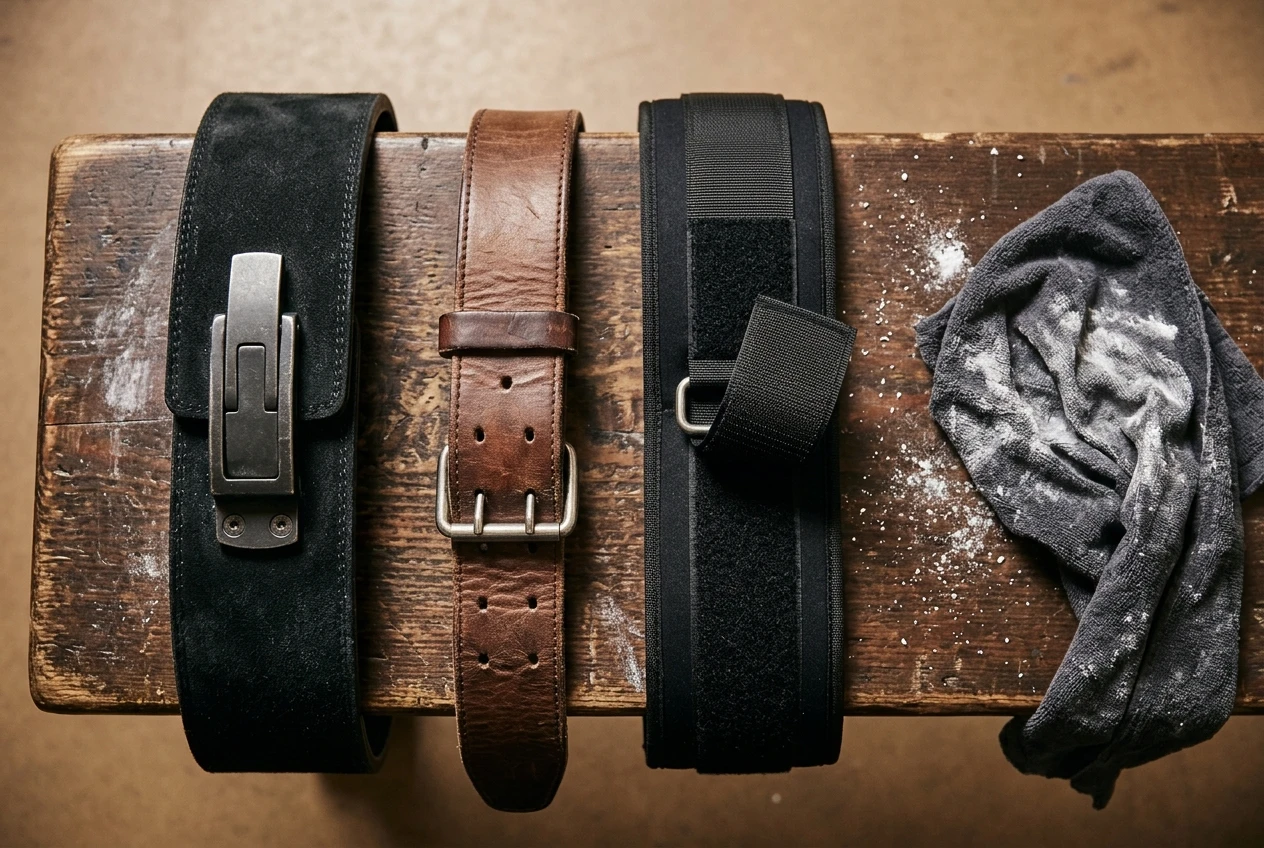
Lever closure. A lever belt clamps shut and releases in a moment, which makes it fast to remove between sets. The tension is usually fixed by the position of the lever mechanism, and changing it often means adjusting the mechanism itself, commonly with a tool. That makes it very repeatable from set to set once you have it dialed in, but awkward to change mid-session. If you want a different tightness for warm-up sets and top sets, a lever belt makes you decide in advance.
Prong closure. A prong belt works like an ordinary belt buckle, with a prong that goes into a set of holes. The holes give you a few fixed tightness settings, and the prong holds the belt firmly once it is in. It takes longer to fasten and unfasten than a lever, and the spacing of the holes limits how finely you can adjust. Between sets, a prong belt is slower to deal with, which can matter if you are trying to keep rest periods tight.
Velcro closure. Velcro belts are the most adjustable: you can set the tightness anywhere along the strap, and change it in seconds. That makes them convenient for loosening between sets and re-tightening before the next one. The trade is consistency. Velcro can shift or creep as you move and sweat, and a belt that loosens a little during a set gives you less to brace against on the later reps.
Think about what your sessions actually demand. If you keep the belt on for the entire block of working sets and want the same tightness every time, a lever or prong closure fits that. If you take the belt off between sets, or adjust tightness through the session, the speed and fine adjustment of Velcro may suit you better.
A three-set test to run on any belt before you commit it to a cycle
You can learn more from one session with a belt than from any description of it. Run this test with the belt you own or one you can borrow or return, using a working weight you would normally use on a volume day, not a max effort.
Before you start: mark the strap with tape or a pen at the point where you fasten it, so you can set the same tightness each time. Write down a quick note after each set.
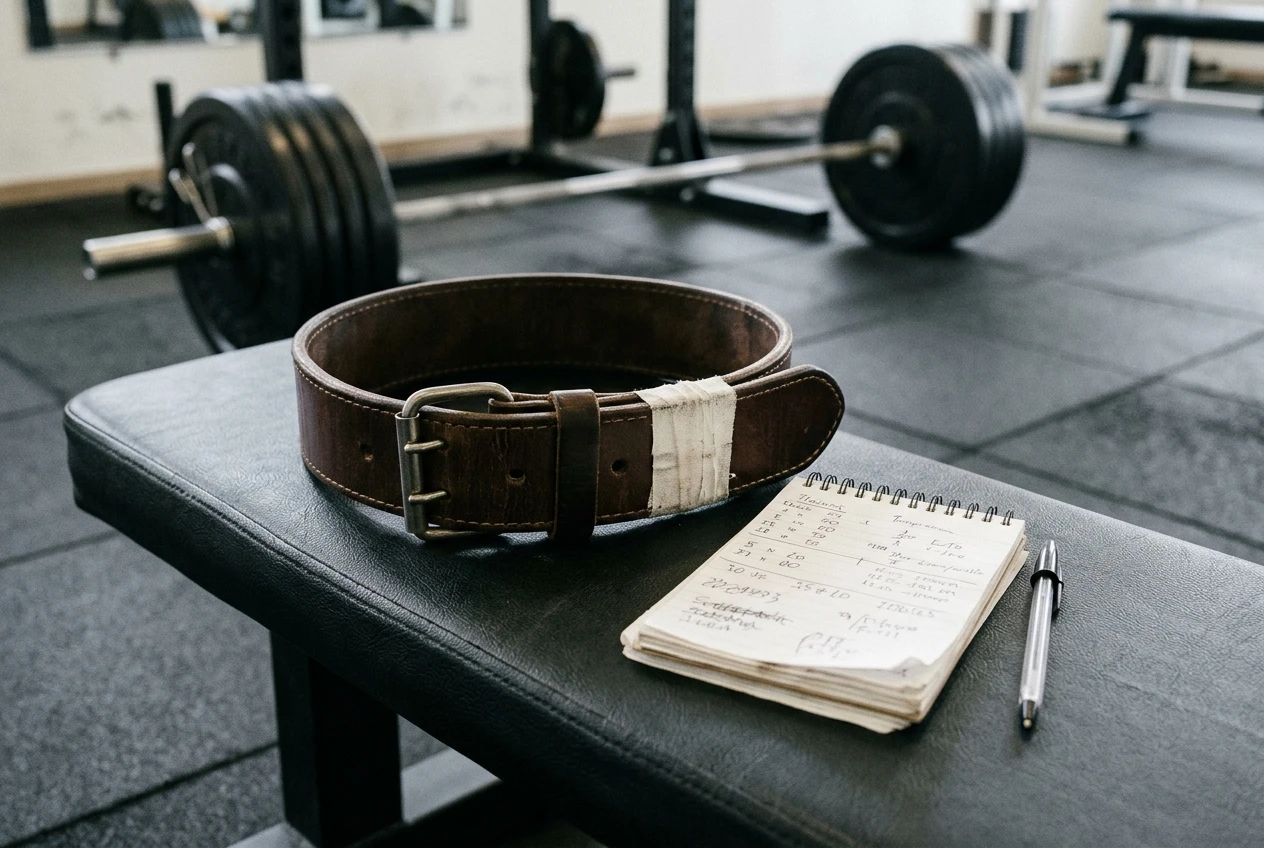
Set 1, the first working set. Fasten the belt where you normally would and squat. After the set, note:
- Where the belt pressed hardest (ribs, hips, or evenly around your waist).
- How easy it was to find your brace, from 1 (hard) to 5 (easy).
- How the belt felt at the bottom of the squat.
Set 2, a middle set. Take the belt off, rest, and put it back on to the same mark. This checks how repeatable the closure is. Note whether you hit the same tightness easily, or whether you had to fiddle with it. Also note whether you needed to loosen it to get a full breath between reps.
Set 3, the final working set of the session. This is the set that matters most for volume work. Note whether the belt shifted or rode up, whether the brace felt as firm as it did on set 1, and whether any pressure point has become uncomfortable.
Then compare your three notes. A belt that scored well on set 1 and badly on set 3 is a belt that works for singles and fails for volume. A belt that needed adjustment on set 2 has a closure that does not suit your routine. A belt that felt the same across all three sets is a strong candidate.
Repeat the test in a later week of the block. Fatigue, sweat and break-in change how a belt behaves, and the week-four version of the test is the one that answers your question. If the belt holds up across both sessions, commit it to the cycle. If it fails the second test, you have learned that before it cost you a block of uncomfortable sets.
Which belt setup suits which phase of the squat block, and when to leave it off
The same belt does not have to be used the same way across a whole block. How you use it can change with the phase.
Early accumulation, higher reps and lighter loads. Here the reps are many and the weight is moderate. A comfortable, easy-breathing setup tends to matter more than maximum stiffness. Some lifters wear the belt only for the heavier sets of the session and leave it off for the lighter early sets, which keeps their own trunk muscles doing more of the work. Whether that suits you depends on how your lower back and midsection respond, and the three-set test will show you.
Middle of the block, loads climbing. As weights rise, the case for a firmer setup gets stronger. A stiffer belt, or a tighter setting, gives you more to brace against when sets are heavy and your trunk is already tired from earlier work. Pay attention to set 3 of the test here, since this is where a belt that breathes badly starts to cost you.
Heavy or peaking phase. Fewer reps, higher loads, longer rests. Closure speed matters less because you have time between sets, and you can take the belt off and refasten it carefully. Stiffness and repeatable tightness matter most.
When to leave it off. Warm-up sets, technique work with light weight, and any set where you are deliberately practising your unbelted brace are reasonable places to go without it. The belt is a tool for the sets where your brace is likely to be the limit, and wearing it for every rep gives you no extra information about where that limit is.
The same timing idea applies outside squats. If you also run kettlebell complexes, the piece on putting the belt on before the round where your brace gives out works through when in a session a belt earns its place.
For your next block, pick one belt, run the three-set test in week one, run it again in week three or four, and keep the notes. Those two sets of notes will tell you which belt to carry into the next cycle better than any comparison chart.