
Choosing between a subscription workout app and a paper workout program usually starts with a feature list: price, exercise library, progress charts. For a lifter who already knows the main lifts, those lists miss most of what matters. A session is a string of small decisions, and the format you pick determines who makes each one: you, the page, or the screen.
This article lists the five decisions a home session forces on you and shows how each format handles them. You then tally which ones you actually hit and let the count point to a format.
The five moments in a home session where a plan has to make a decision for you
Every session, whatever the program, produces some mix of these moments:
- A missed rep target. You planned 5 reps and got 3. The plan has to say whether you drop the weight, keep going, or end the exercise.
- A rest period that drifts. Nobody times rest accurately by feel. Two minutes becomes four while you check your phone or adjust a bell, and the session runs long or the next set suffers.
- A movement you can’t set up from memory. This is an unfamiliar variation, a stance you’ve forgotten, or a kettlebell sequence you haven’t run in weeks. You stop and look it up.
- A day that doesn’t match the plan. You’re short on time, a joint is irritated, or the bar is loaded for something else. The plan has to offer a substitution or a shorter version.
- The next-session load. After the last set, someone has to decide what goes on the bar or what bell you pick up next time, and that decision needs a record of what happened today.
Moments 1, 4 and 5 are judgment calls. Moments 2 and 3 are logistics: timing and information. That split matters later, because paper and apps handle the two groups very differently.
What a paper program handles well, and where it leaves you guessing mid-set
A printed or written program is strongest at fixed structure. The exercises, sets, reps and order are all visible at once, so you can see the whole session and plan your gym layout before you start. Nothing needs a login, a signal or a charged battery, and nothing changes underneath you between sessions.
Paper also handles moment 5 well if you write down the numbers. A notebook column next to each exercise gives you an exact record, and you read it yourself. Because you make the load decision, you can weigh things a generic rule can’t, such as a bad night’s sleep or a grip that gave out before your legs did.

Where paper leaves you guessing:
- Missed targets (moment 1). A page can only say what to do if it wrote the rule in advance. Many programs state a rule such as “if you miss reps, repeat the weight next week,” but plenty don’t, and then you improvise.
- Rest timing (moment 2). The page can say “rest 90 seconds,” but it can’t count them. You need a separate clock, and you have to look at it between sets with chalky or sweaty hands.
- Setup (moment 3). Paper holds a name and maybe a diagram. If the movement is new to you, a name doesn’t tell you where the feet go or how the bell should sit.
- Off days (moment 4). A page doesn’t know your shoulder is cranky. Unless the author printed alternates, the substitution is on you.
Paper works well for a lifter who already knows the movements and wants the plan kept simple. It works poorly for anyone whose sessions include many unfamiliar exercises or who loses track of time between sets.
What a subscription app handles well, and the questions to ask before trusting its coaching
An app’s advantage is that it can be present during the session. It can run a rest timer, show a demonstration at the moment you need it, and store your logged sets without any extra effort from you. That covers moments 2 and 3 more completely than paper can.
Some apps also try moments 1, 4 and 5: adjusting weights after a missed target, offering a swap when you flag soreness, and suggesting next week’s load. This is where you should be careful, because the quality of those decisions varies and the marketing rarely shows how they’re made. Before paying, ask:
- What rule sets the next load? A good answer is a stated progression, such as add weight after hitting all reps, or repeat after a miss. A vague answer such as “personalized to you” tells you nothing you can check.
- Is the coaching from a person or generated by software? Both can be fine, but they fail differently. Find out which one you’re buying.
- Does it know what equipment you own? A plan that assumes a full rack is no use in a garage with a barbell and two kettlebells.
- Can you override it? If the app says to add weight and your last rep was a grind, you need to be able to decline without breaking the program.
- What happens when you stop paying? Find out whether you keep the program, your logs, or neither. If your history lives only inside the subscription, canceling means starting your records over.
- Does a missed session reshuffle the plan or leave it alone? Some apps push the whole schedule back, which may or may not suit you.
If an app can’t answer the first question clearly, treat it as a timer and a video library, and judge it on those two jobs alone.
Pacing and setup cues: why the screen in your home gym matters more than the plan
Moments 2 and 3 depend less on the quality of the plan than on where the information appears. A good timer you can’t see from the floor doesn’t pace anything, and a demonstration on a phone across the room doesn’t help you set up a movement.

Think about the physical layout of your space:
- Sightline from the rest position. Wherever you stand or sit between sets, can you see the clock without moving? A TV on the wall can be read from across a garage; a phone on a shelf often can’t.
- Sightline from the setup position. Demonstrations are useful only if you can glance at them while you’re getting into the starting stance, not after you’ve set the bell down.
- Sound. If cues are spoken, check that you can hear them over a fan, music or the clang of plates.
- Connection. A streaming app needs a reliable signal where you train. Garages and basements are often the weakest spots in a house.
- Hands. With chalk or sweat on your hands, tapping a small touchscreen between sets is a nuisance. Check whether the app runs hands-free.
This is why a mediocre plan on a well-placed screen can pace a session better than an excellent plan on paper. The plan decides what you do; the screen decides whether you do it on time and in the right position.
How to total up your own tally in ten minutes
Take a notebook and think back over your last three sessions. For each of the five moments, write down how many of those sessions it occurred in (0 to 3) and what you did about it. Be literal: if you lost track of rest in two sessions and sat for what felt like six minutes once, that’s a 2 for moment 2.

Then add a second note beside each score: did you handle it quickly, or did it cost you time, focus or a bad set? A moment that happens often but costs nothing doesn’t need fixing.
Now read the result:
Where your high scores sit | What it suggests |
|---|---|
Mostly moments 1, 4 and 5 (judgment) | Check how an app makes those calls before paying. A paper program with clear written rules may serve you equally well. |
Mostly moments 2 and 3 (timing and setup) | A screen solves these directly. The plan can stay on paper if you like it. |
High across all five | A screen-led app that also handles progression is worth a trial, provided it passes the questions above. |
Low across all five | You are already running your sessions well. Keep the paper program and spend the money on gear. |
One caution: score what actually happened, not what you think a disciplined lifter would have done. The tally is only useful if it describes your sessions.
A hybrid setup: paper for the plan, a screen for the clock and the demos
Many lifters find that the tally splits: judgment moments are fine on paper, while timing and setup keep causing trouble. In that case you don’t have to choose one format.
Keep the program on paper or in a notebook. You see the whole session, you log your own numbers, and you make the load decisions with full knowledge of how you feel. Then put a screen where you can see it from your training spot and use it for two jobs only: the rest clock and the movement demonstrations.
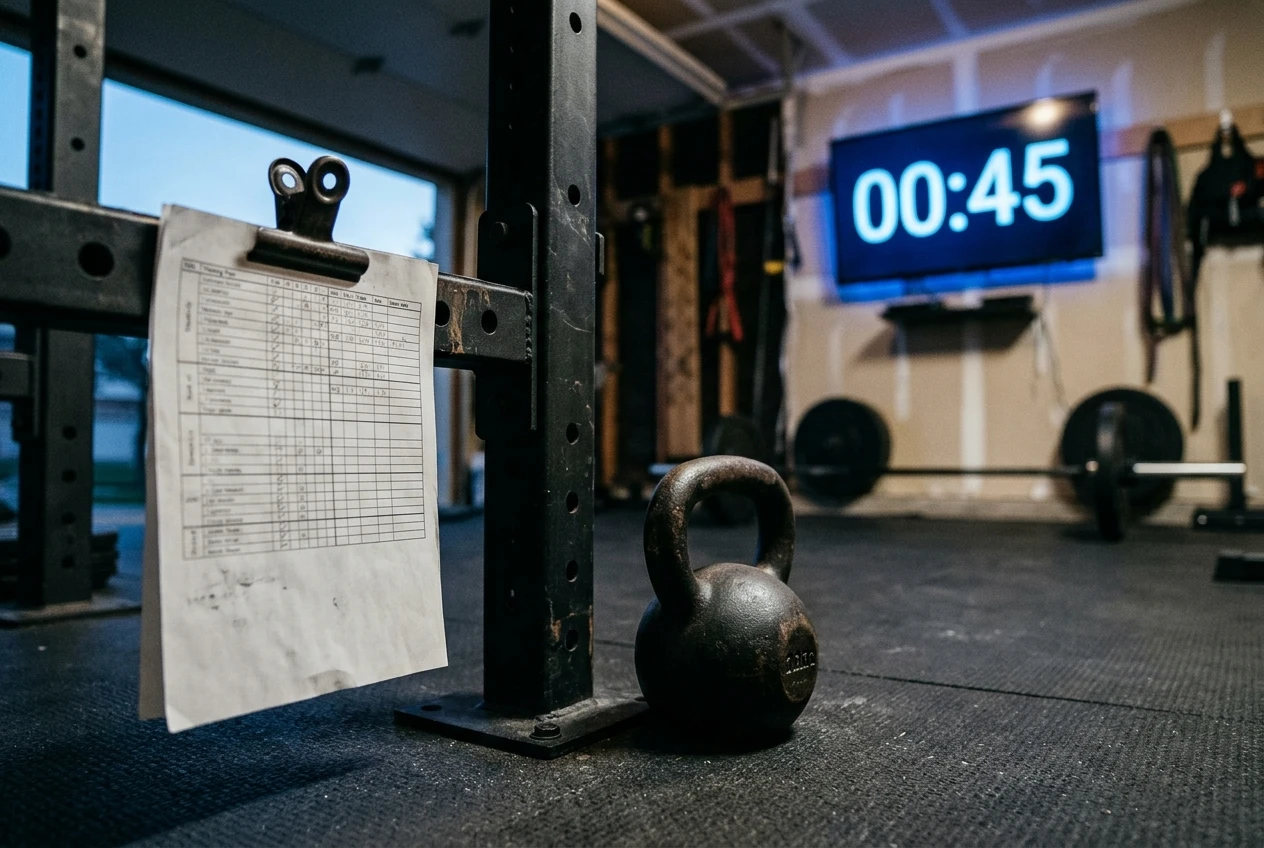
This hybrid keeps your records under your control, so canceling a subscription never erases your history. It also limits what you pay for to the parts of a session that paper can’t do. If you later decide the app’s progression is worth trusting, you can hand that job over after comparing its suggestions against your own logs for a few weeks.
If you also run kettlebell work, the warm-up is one place where demonstrations pay off, since the positions need to be right before load goes on. The 10-minute kettlebell warm-up built around today’s lift is a written routine you can pair with a screen for the setup cues.
If your tally points to a screen
If your highest scores were on pacing and setup, and you have a Samsung TV where you train, the Kettlebell Monster Samsung TV app puts a kettlebell session on the TV. (Affiliate link: I earn a commission if you buy through it, at no extra cost to you.) Check the product page for what the app includes and apply the questions above before you pay. For a closer look at what it offers experienced lifters, read what an advanced lifter actually gets from the app.
For the wider range of programs and gear, see kettlebell.monster. (Affiliate link: I earn a commission on purchases made through it, at no extra cost to you.)