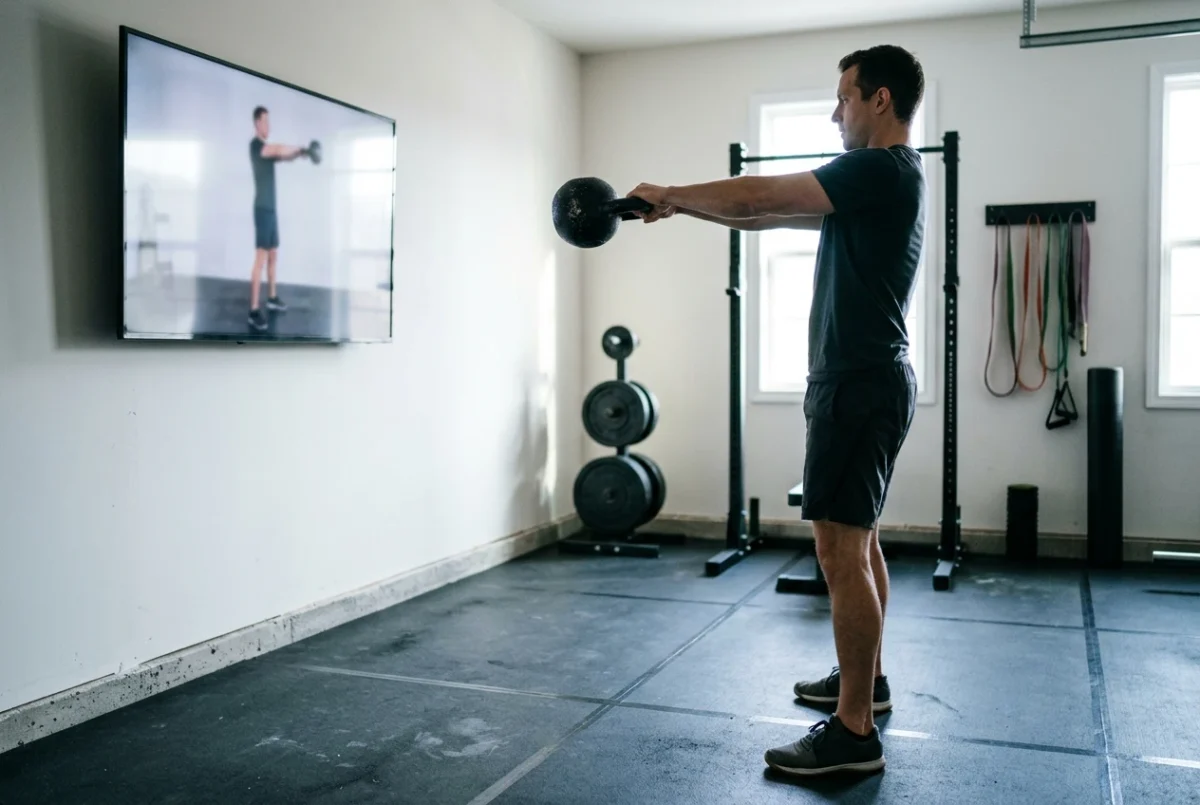
If you already swing, clean and press well, most kettlebell content is aimed at someone else. The question for a kettlebell workout app for advanced lifters is narrower than whether it is good: will a coach on a Samsung TV give you anything your own programming and your own eye don’t already supply? Earlier posts on this site covered whether to switch from your phone to the TV and which lift each screen suits. This one uses a stricter checklist.
The app in question is the Samsung Tizen TV app from kettlebell.monster (affiliate link; I earn a commission if you buy).
One note on scope. This article does not quote session contents or claim specifics about the app’s programming that I can’t back. Where the answer depends on something you can only see by watching a session, I say so and tell you what to look for. A review that invented findings would be worse than useless to someone who trains seriously.
The test: what an advanced lifter needs from a coach on a screen
A beginner needs a coach to show them the movement. An experienced lifter already has the movement and needs a coach for different reasons. Four things decide whether a screen-based coach earns its place:
- Cueing depth: corrections that go past “hinge, don’t squat” and address the faults that survive into intermediate training.
- Load and progression: a way to keep making sessions harder over months, not just repeat them.
- Pacing: work and rest that suit heavy, demanding sets rather than only quick circuits.
- Fit: a place in a week that already contains barbell work, without costing you recovery.
Each section below takes one of these in turn and says what the format can and cannot do. Treat them as pass/fail questions you can answer in your first few sessions.
Cueing: does it correct anything beyond the basics?
A coach on a TV cannot see you. That is a limit of the format, not a flaw in one product. Every cue is delivered to an average lifter at the moment that average lifter tends to go wrong, which means the cueing is useful to you only if it lands on faults you still have.
Advanced lifters rarely fail at the basics. They fail in smaller ways:
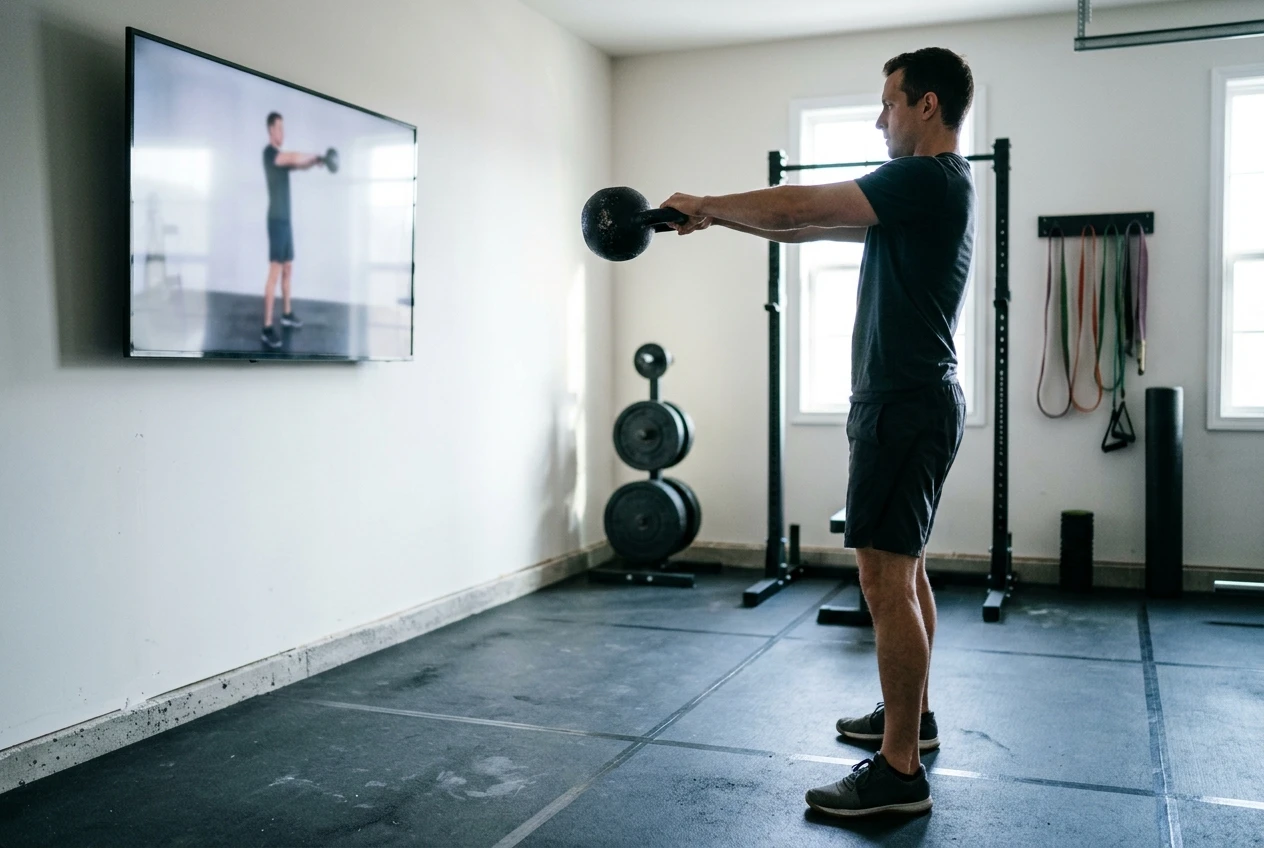
- Pulling the swing up with the arms once the bell gets heavy, instead of letting the hips drive it.
- Leaning back at swing lockout and finishing with the lower back instead of the glutes.
- Letting the bell crash onto the forearm in the clean because the elbow drifts away from the ribs.
- Pressing with a lumbar lean to cover for a weak lockout.
- Losing the rack position by the fifth rep of a long set.
When you watch a session, listen for whether the coach names any of these before they happen, and whether the cue gives a reason (“keep the elbow close so the bell lands on the forearm softly”) or only an instruction. A cue with a reason is one you can apply to a lift the app never mentions. If the cueing stays at the level you would give a friend on their first day, the app is teaching you nothing new, and you can write that down as a fail on this item.
The screen does have one real advantage here. Standing in front of a TV at roughly body height, you can compare your own setup and rack position to the coach’s at full size. That works for lifts where side-on positioning matters. Whether it matters to you depends on which lift you are checking, and the phone versus TV post breaks that down lift by lift.
A related point: if your swing fault is back discomfort afterward, a screen coach will not diagnose it. That needs a look at your swing from outside, ideally filmed from the side, and the right accessory work, which this guide on swing-related lower back pain covers.
Load and progression: can you keep overloading with it?
The app does not know which bell you own, so load is always your decision. What you need to find out is whether the sessions give you a structure that lets you progress without a heavier bell.
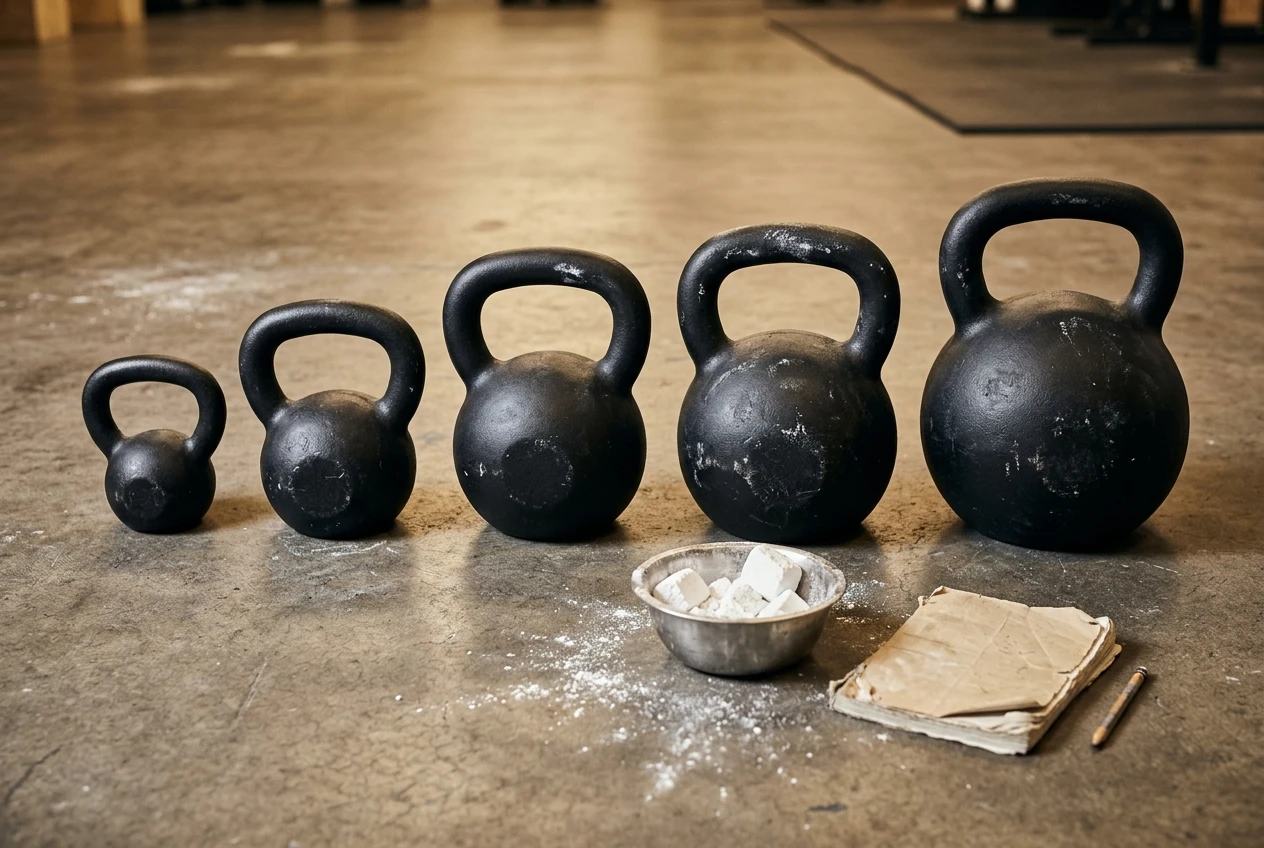
Kettlebells come in large jumps. Moving from one bell to the next is a big percentage increase on a press, even if it feels small on a swing. For an advanced lifter, overload on kettlebells usually comes from some mix of:
- More reps with the same bell.
- Less rest between sets.
- Slower or paused tempo on presses and squats.
- More complex combinations, such as clean to squat to press.
- A heavier bell, when the first four are exhausted.
Check whether the sessions let you move along any of those axes. Do the same workouts return with different rep targets or different density? Is there a clear way to repeat a session and beat it? If every session is a one-off with no thread connecting it to the next, you can still use it, but you will be doing the progression bookkeeping yourself.
If you want a method for deciding when you actually need the next bell, the reps-first test is a good filter. And if you are weighing whether to track progression in an app at all, this comparison of a spreadsheet and an app lays out what each does well.
I can’t tell you from observation how the app structures progression across weeks. Look at the product page and the first few sessions with this question in mind, and decide whether the answer is good enough before you add it to your week.
Pacing and rest on the TV: where the session helps or gets in the way
A coach-led session paces you, and that cuts both ways.
The helpful side: if you tend to skip rest on conditioning days or drift through sets with sloppy timing, an external clock and a voice on screen keep the work honest. Many experienced lifters do their best conditioning when someone else is counting.
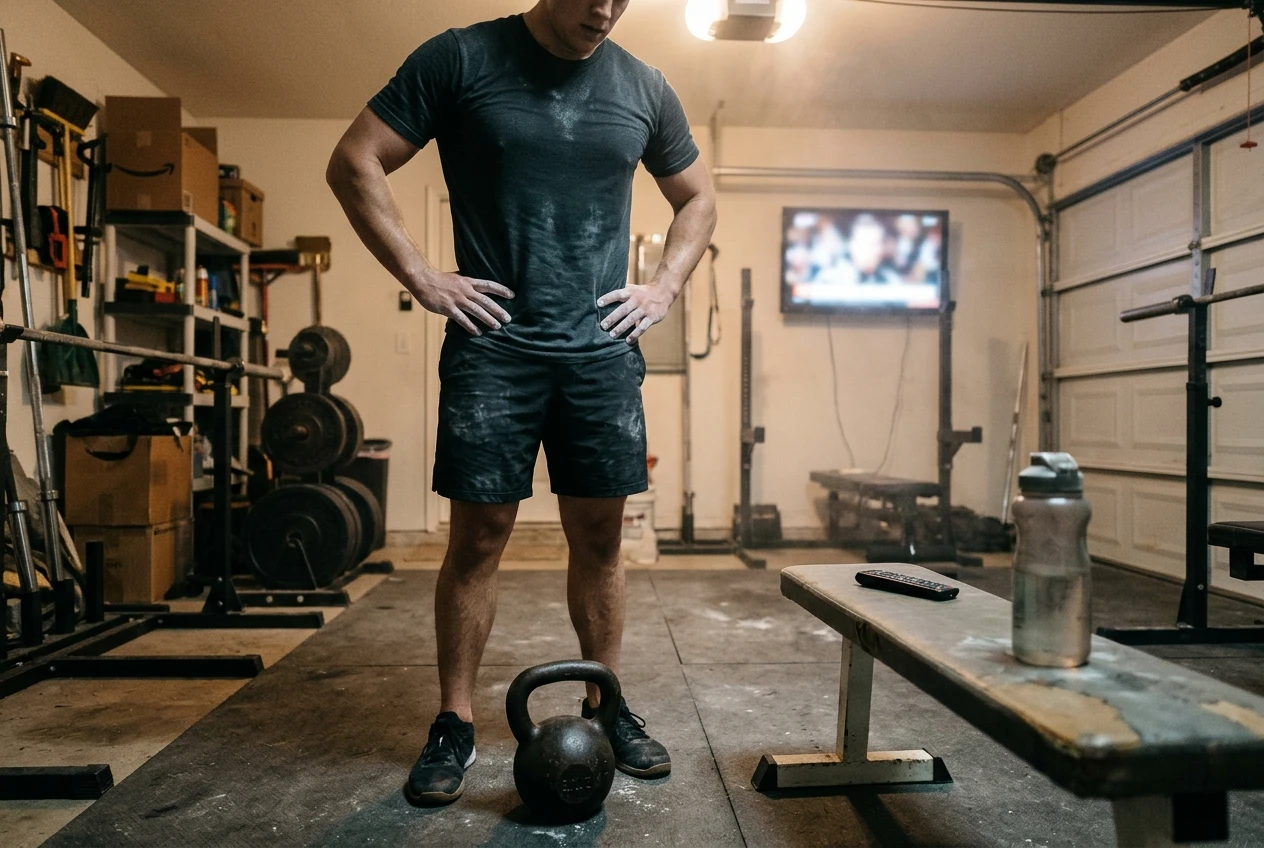
The unhelpful side: heavy sets need rest set by how you feel, not by a timer. If you are doing low-rep heavy presses or a heavy clean-and-press ladder, a session that moves on at a fixed pace can push you into the next set before your grip and breathing recover. Advanced lifters know the difference between rest that is too short for the intent of the set and rest that is simply uncomfortable.
Before you commit, find out two things:
- Can you pause the session from the Samsung remote without losing your place?
- Does the coach prescribe work in a way you can slow down, such as by taking an extra set of rest, without breaking the session?
If you can pause freely, heavy days become workable. If not, the app suits lighter, density-focused sessions better than strength-focused ones. That is a reasonable place for it to sit, as long as you know going in.
Where you put the screen also affects pacing, because if you have to turn your head or step toward the remote between sets, the rest period quietly changes. The screen placement guide covers the setup.
Fitting it around heavy barbell days
For a lifter who also squats, deadlifts and presses with a barbell, the main question is recovery. Kettlebell work is not free: high-volume swings load the hamstrings, glutes and lower back, and grip work stacks on top of deadlift pulling.
A sensible way to place a TV-guided session:
- Keep it away from your heaviest lower-body day. A session heavy on swings the day before a heavy deadlift or squat will usually cost you on the barbell.
- Put the conditioning-style or technique-style sessions on lighter days, or on days after a rest day when you have capacity to spare.
- Treat it as a supplement, not a replacement, unless your barbell training is already in a deload.
- Watch your grip. If your pulls are limited by grip, a long session of cleans and swings will make that worse on your next pull day.
Where these sessions go in a strength-focused week is a placement problem, and this piece on kettlebell sessions in a powerlifting week walks through it. If grip is your weak point, giving it its own block usually works better than letting every session eat into it.
Where it falls short for advanced training
Some limits come from the format itself, and they hold for any TV-based coach:
- No view of you. Nothing on screen can correct a fault it cannot see. You supply the feedback, by filming yourself or training with a partner.
- No autoregulation. A fixed session cannot adjust to a day when your sleep was bad or your back is tight. You have to make that call and scale the work yourself.
- No link to your barbell numbers. The app cannot program around your squat or deadlift cycle, so you have to fit it in.
- A ceiling set by your bells. Strength work with kettlebells stops where your heaviest bell stops. A barbell can keep going up in small increments, and a kettlebell cannot.
- A single platform. This is a Samsung Tizen app, so it only matters if you have a compatible Samsung TV in or near your training space.
Some things I can’t speak to, because I have no observations to base them on: how the app’s coaching evolves over a long run, how its programming compares with a coach who knows your history, or whether its cues change as sessions get more advanced. If those matter to your decision, they are the things to find out on the product page before you buy.
If you are still deciding whether to run a purchased program or build your own, how to pick for the next two years is the better frame than any single feature.
Who should switch, who should stay with their own programming
A TV-based coach suits you if:
- You train alone and want an external voice setting the pace of conditioning work.
- Your barbell programming is already set, and you want kettlebell sessions you do not have to write.
- You like a large screen for checking rack position and setup against a coach.
- You have a compatible Samsung TV near where you train.
Stay with your own programming if:
- Your kettlebell work is tied closely to a barbell block and needs to flex week by week.
- You want to run heavy, low-rep strength sets with rest you control completely.
- Your main need is form correction from someone who can see you, which a screen cannot provide.
- You already have a progression system that works and see no gap for a coach to fill.
A middle path is also reasonable: keep your own strength programming and use a guided session for the days when you want conditioning without planning it. That uses the format for what it does best and leaves the decisions that depend on how you feel with you.
Check it against your own list
Write down your four answers on cueing, progression, pacing and fit before spending anything. If they line up with what this review covered, look at the Kettlebell Monster Samsung TV app here (affiliate link; I earn a commission if you buy).