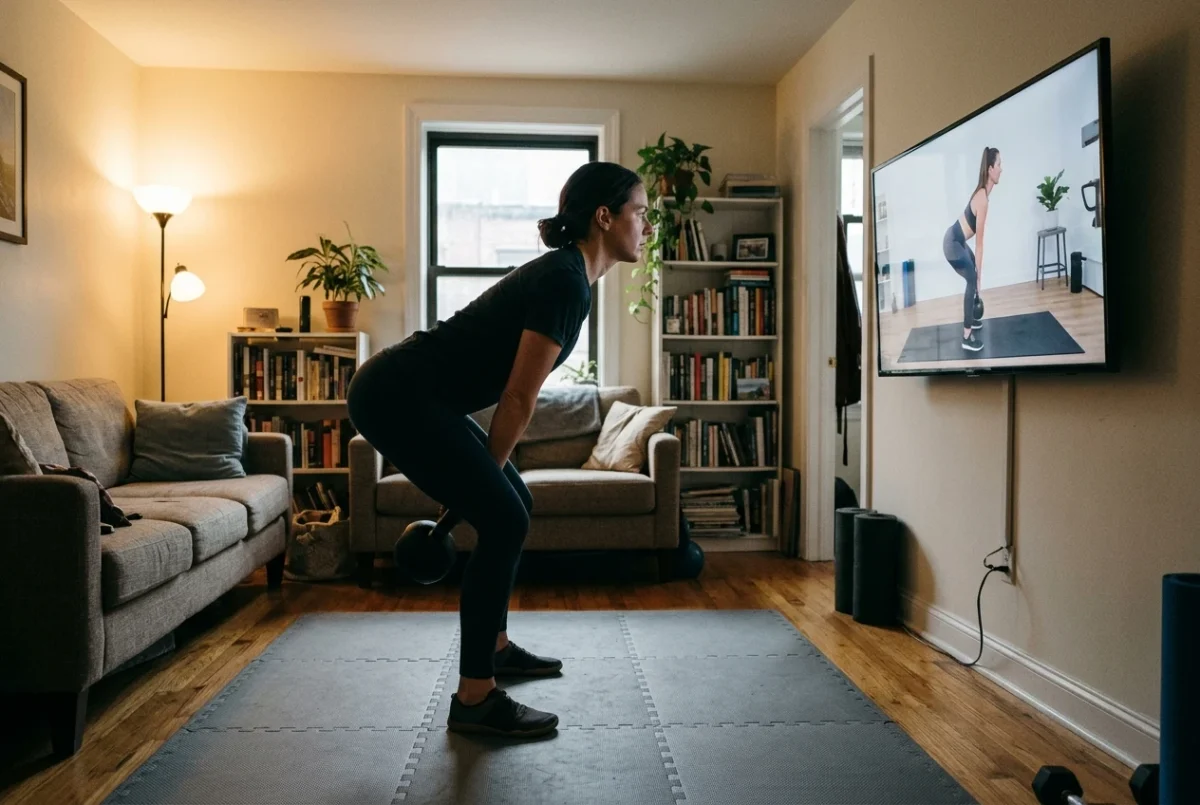
Most advice about kettlebell form focuses on the lifter: brace harder, hinge deeper, keep the ribs down. Before any of that can help, you have to see what the demonstration is showing you. Whether you workout on TV or phone for better lifting form depends less on the device and more on whether it puts the right cue in front of your eyes at the right moment of the rep.
Different lifts hide their cues in different places. A swing’s key cue is the angle of the hip hinge, a clean’s is the path of the bell around your forearm, and a press’s is the lockout overhead. A Turkish get-up has several, and many happen near the floor. One screen position cannot show all of them equally well, so this article goes lift by lift.
Form is a viewing problem before it is a strength problem
If you follow a video workout, your technique starts as imitation. You watch a coach, form a picture of the movement, and try to reproduce it. If the picture is blurry, too small, or taken from an angle that hides the important part, you will copy the parts you can see and guess the rest.
Beginners often guess wrong in the same places. They squat the bell down instead of hinging, because the hinge is easy to miss when the screen is small and the instructor’s hips are a few pixels wide. They let the bell drift forward in the rack because the elbow position was out of frame. The weight was not the problem. The reference picture was incomplete.
So the first question about any screen is simple: from where I stand, can I see the specific thing this lift asks me to copy?
What your eyes can and can’t do mid-rep (and why the screen has to fit the lift)
You cannot study a screen during a set. Mid-rep, you get a glance, and in some lifts you get almost none. During a swing, your head is usually level and your gaze points forward, so a screen straight ahead at roughly eye height gets a quick look without any change to your posture. A screen set low on the floor makes you tilt your head down, which changes your neck position and can pull the rest of your posture with it.
A few things follow from this:
- Glances should not change your position. If you have to turn your head, tilt your chin, or twist your shoulders to see the screen, you are altering the very form you are trying to check.
- Size matters more than sharpness. A sharp image you cannot read from your lifting spot is less useful than a larger, softer one. Distance shrinks everything, and a hand-sized phone at the far end of the room shows less than it seems to.
- Some lifts have nowhere good to look. In a get-up, your eyes belong on the bell for most of the movement. The screen is a reference you check between reps, not during them.
The right screen for a lift is the one that fits how your eyes already behave in that lift.
Lift by lift: where a TV wins, where a phone wins
If you are new to kettlebell training, the Kettlebell Monster program (affiliate link) is one place to follow video workouts for these lifts. Whatever you follow, the viewing question is the same for each movement.
Swing
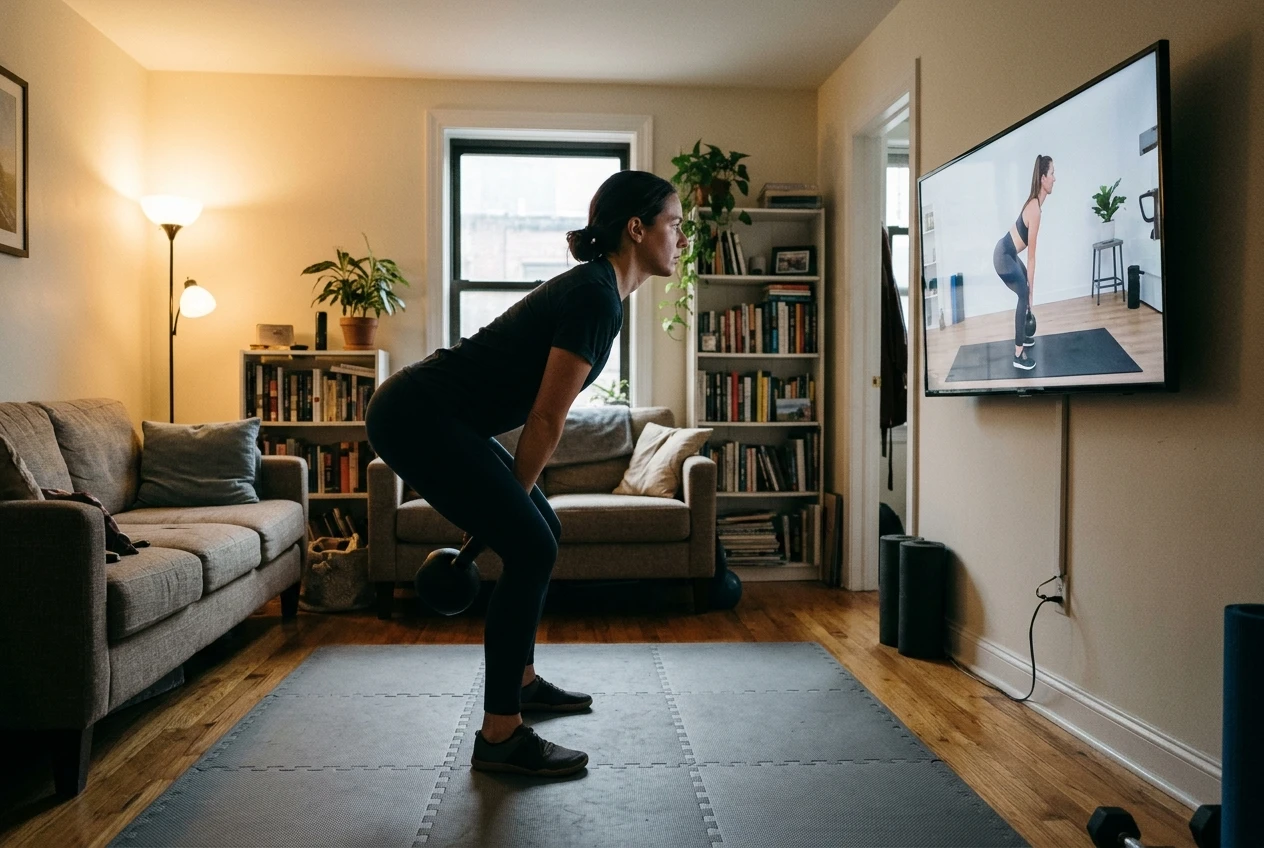
The cue is the hinge: hips pushing back, shins staying close to vertical, a flat back, and a stand-tall finish where the bell floats to about chest height. These are big, whole-body shapes, which suits a TV. At a typical couch-to-floor distance, a large screen shows the hinge angle clearly, and straight ahead is where your eyes already point. A phone can work if it sits at eye level and close enough to read, but the TV usually has the advantage here, provided the instructor is filmed from an angle where the hinge is visible. If the video only shows the front, the hinge depth is harder to read on any screen.
Goblet squat
The cues are an upright torso, the bell held close to the chest, elbows tracking inside the knees, and heels staying down. A front view helps with the knees and elbows, and a side view helps with torso angle. A TV wins for the front view because you can see the whole body at a readable size. A phone wins when you want to check your own depth, because you can put it to the side and record.
Clean
The clean is where a small screen struggles most. The bell has to rotate around the hand and land softly on the forearm, and when it is done badly it slams the wrist. That path is quick and close to the body, and a small screen at a distance makes it nearly unreadable. The rack position at the end, with the elbow near the ribs and the bell resting on the forearm and chest, is a still shape. A larger screen shows it better. For the clean, favor the biggest image you can get, and slow it down if your player allows it.
Press
The cue is lockout: wrist stacked over elbow, elbow over shoulder, biceps near the ear, ribs down instead of flared. It is a vertical line. A tall, narrow view on a phone held in portrait could show the line well, but a TV shows the instructor’s full body, which helps you see whether the ribs flare as the arm goes up. You need to see the whole torso, so the TV tends to win.
Turkish get-up
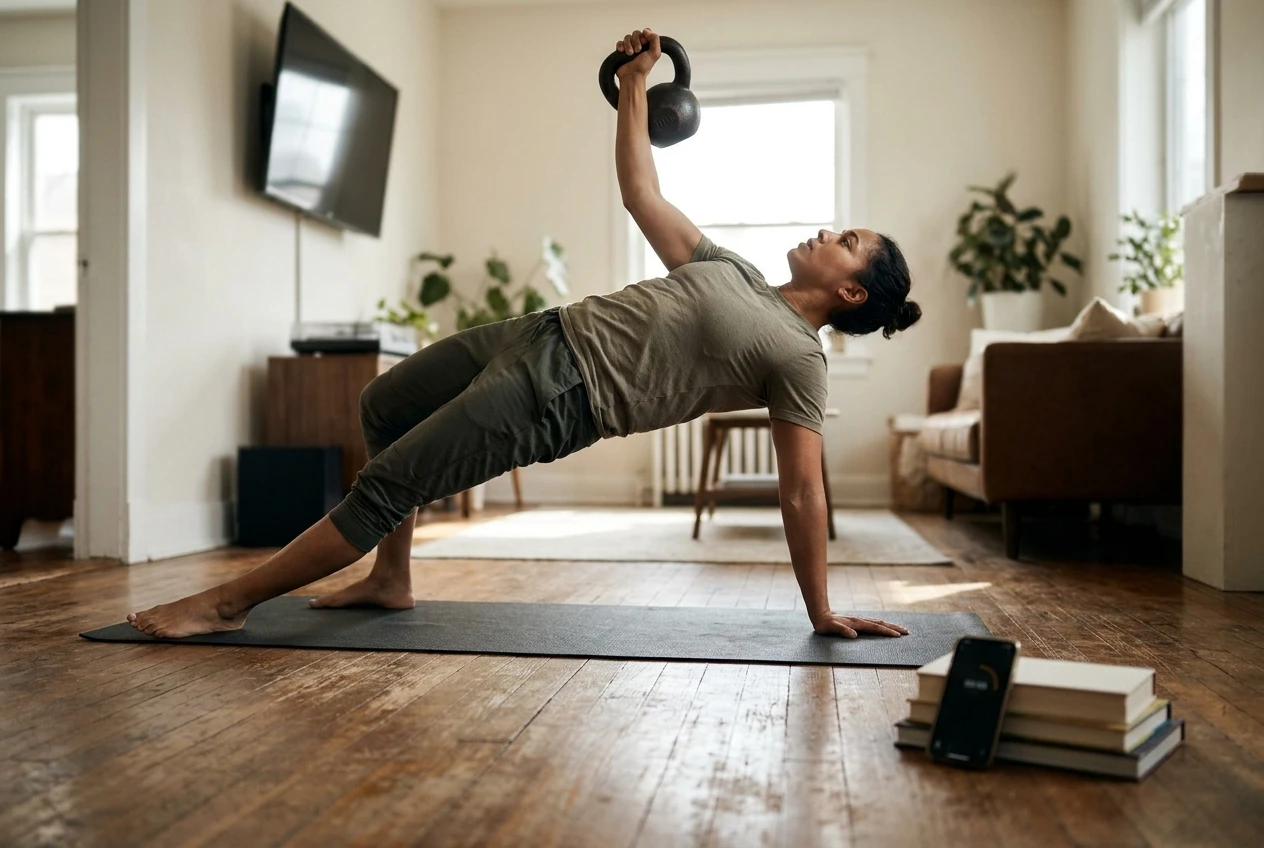
Here the screen is a reference rather than a live guide. The get-up has stages, such as roll to elbow, post to hand, bridge, sweep the leg, and lunge, and many of them happen at floor level. Neither screen is easy to watch while you are lying down. A TV on a wall or stand is often too high to see from the floor, so you end up looking past your own feet. A phone propped near floor level can sit where your eyes are during the floor stages. Learn the stages by watching first, then use a low phone placement when you practice.
The placement test: three setups to try in your own room
You can test this without buying anything. Pick one lift you do often and run it through three setups, using a light bell or an empty hand to mimic the movement. Give each setup a few sets before you judge it.
Setup 1: TV straight ahead. Stand where you would normally train and face the TV. Note how far you are from it and where your eyes land during the movement. Ask yourself whether you can read the instructor’s hips, elbows, and bell from your lifting spot, and whether you had to move your head to see them.
Setup 2: Phone at eye level, straight ahead. Prop the phone on a shelf, stand, or stack of books at about eye height, as close to your lifting spot as is safe. This tells you whether proximity makes up for a smaller image.
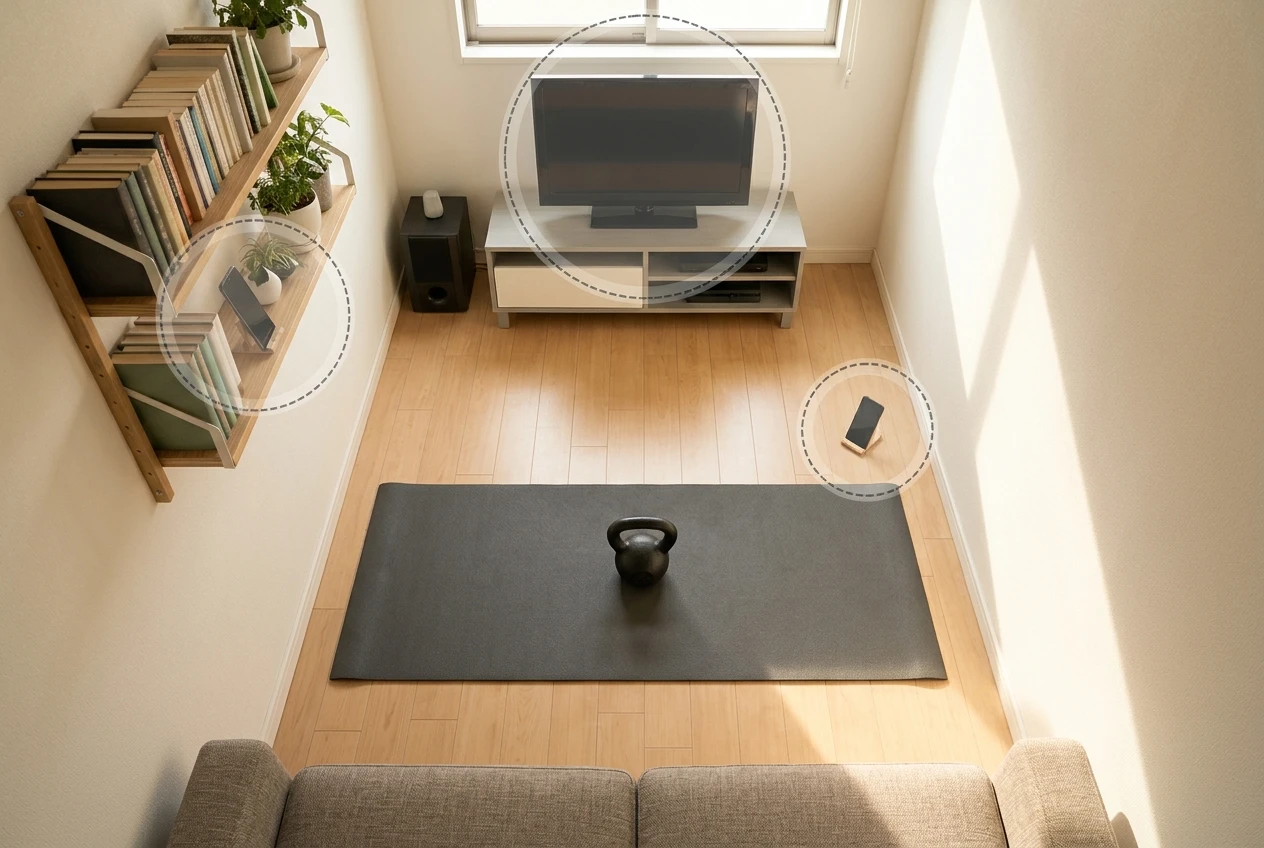
Setup 3: Phone low and to the side. Place the phone near floor level or off to one side, angled toward you. This is the setup for floor work and for checking your own form, and it is the one most people skip.
For each setup, answer three questions:
- Can I see the key cue for this lift without changing my posture?
- Can I still read the screen at the bottom of the rep, when my head and torso are lowest?
- Does the setup force me to stand somewhere awkward or too close to furniture?
Write the answers down for each lift. The pattern that comes out is your own placement rule, and it is more reliable than a general recommendation because it reflects your room, your eyesight, and your equipment.
What a phone does better that people overlook
A phone has advantages that have little to do with the video you are following.
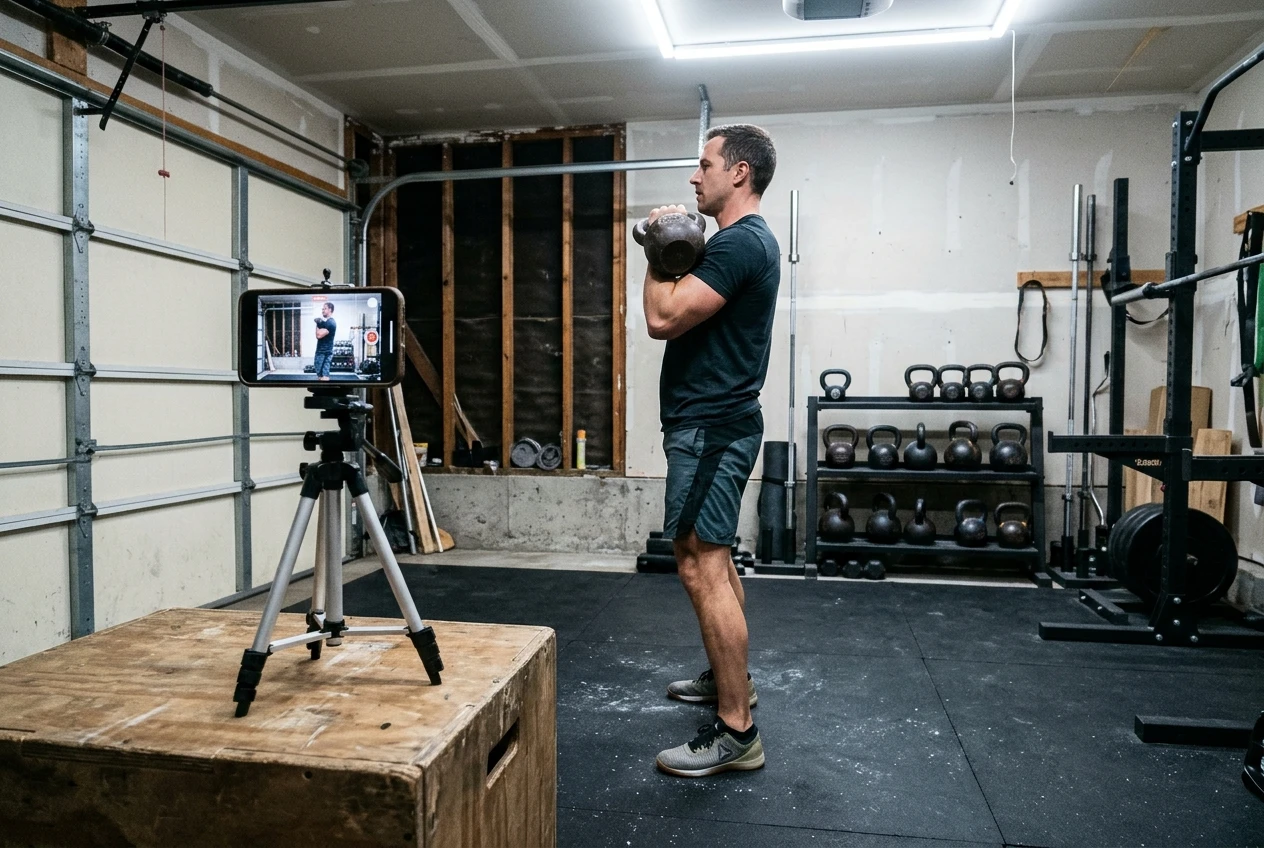
It is a camera. Recording a set from the side and watching it back shows you the hinge angle, the lockout, and the rack position from outside your own body. You can then hold your clip next to the demonstration and compare. A TV cannot do this.
It moves to wherever the cue is. A TV stays where it is mounted. A phone can go to the floor for a get-up, to the side for a squat depth check, or behind you for a back angle. In a small room, where the TV may sit on a wall that does not face your training spot, that flexibility can matter more than screen size.
It handles replay at close range. If you want to pause a rack position and study the elbow before your next set, a phone in your hand puts the image a foot from your eyes. That is a useful way to learn a position, though it is a poor way to follow a workout.
For the written side of this question, what a written exercise guide cannot teach you about a kettlebell swing covers what moving video adds and where text falls short.
Choosing your screen: a short decision rule by space, lift, and experience
Use these three questions in order.
1. Space. If your training spot faces a TV from a workable distance, start there for any lift where you need to see the whole body. If the TV is on the wrong wall or too far to read, a phone at eye level and close range is probably the better main screen.
2. Lift. Match the screen to the cue. Choose the TV for the swing, clean, press, and the front view of the goblet squat, because those cues are large and read best at a bigger size. Choose a low phone for floor-level get-up stages and for recording yourself.
3. Experience. Beginners are still building the reference picture, so a large screen that shows the whole body helps most. Intermediate lifters usually know the shapes and are looking for small errors, so a recorded clip of their own set tells them more than another look at a demonstration.
Many people end up using both: the TV to follow the workout and a phone on a stand or shelf to record a set now and then.
Trying the Samsung Tizen TV app without rebuilding your routine
If you own a Samsung TV that runs Tizen, you can try the app without changing your program. Keep the workouts you already do, keep your usual bell weights, and change only where the video plays.
Choose one week and a handful of sessions. For each session, run the placement test on the lifts in that day’s workout. Note which cues you could see on the TV, which ones you could see on your phone, and where you wished you had the other one. At the end of the week, you will have a short written record of what each screen showed you.
For a fuller look at what the app offers and who it suits, see the full review of the Kettlebell Monster Samsung TV app.
If you have a Samsung Tizen TV, try the Kettlebell Monster TV app for one week using the placement test from this article, and compare it with your phone. (Affiliate disclosure: this is an affiliate link, so I may earn a commission if you buy through it, at no extra cost to you.)