If you wear a belt for a whole kettlebell complex, you never find out how much of the work your own trunk can handle. If you never wear one, the last rounds may be done with a brace that has already failed. A better answer to when to wear a lifting belt for kettlebell complexes is to find the round where your brace gives out and put the belt on just before it.
That moment is specific to you, your complex and your load. This article shows how to find it, how to use the belt once it is on, and how to move the point later over time.
Why a complex tests your brace differently from one heavy set
A heavy set of squats or deadlifts is one long effort. You brace, grind out a few reps, and rest for several minutes while your trunk recovers. The brace has to be strong, but it only has to last a short time.
A complex strings several movements together without setting the bell down. A typical example is a deadlift, a clean, a front squat and a press, repeated for five or six rounds. Each movement loads the trunk differently. The hinge pulls your torso forward, the front rack pushes it toward the floor, and the press tries to bend your lower back into extension.
Your brace has to change shape at every transition, and you have to rebuild it with less rest than a barbell session gives you. The weakest link is usually not the heaviest movement. It is whichever movement arrives when your trunk is most tired, and that is often the press in the last rounds.
This is why a belt worn from the first rep tells you little. You cannot see the failure point because the belt covers it.
Run one complex beltless and mark where your core lets go
Pick a complex you already know well and run it with no belt. Use a load you can move with clean technique when fresh, and a number of rounds that will tire you without being a max effort. Keep a notebook or phone note beside you.
After each round, write down two things:
- How the round felt in your midsection, on a scale you define yourself (solid, soft, or gone).
- Which movement in the round felt worst.
Stop the complex at the first round where you see one of the signs in the next section, or where your lower back feels loaded in a way it did not in round one. Do not push through to finish the planned rounds. The aim of this session is information, and a rep done with a failed brace is the rep most likely to irritate your back.

If you can, film the session from the side with your phone propped at hip height. Watching your own torso is more reliable than remembering it. A tired lifter rarely notices a rib flare or a hip shift while it is happening.
Four signs your trunk pressure has failed mid-round
Look for these in your notes and on the video:

- Your ribs lift and your lower back arches during the press. The bell goes up, but your torso leans back to get it there. A solid brace keeps your ribs stacked over your pelvis.
- The hinge turns into a back movement. In the deadlift or the swing, your hips stop leading and your lower back starts rounding or bending to move the bell. You may also feel the effort in your back rather than your hamstrings and glutes.
- You lose your breath pattern. You start taking small, quick breaths, or you hold one breath through several reps and then gasp. Your belly goes soft between movements because you no longer have time to re-brace.
- Your torso position drifts in the squat or the rack. The bell pulls your chest forward, your elbows drop, or your trunk folds at the bottom of the front squat in a way it did not in round one.
One sign by itself might be a technique habit. Two or more in the same round is a reliable mark that your trunk pressure has failed, so note that round and that movement as your failure point.
Put the belt on before that point, not for the whole session
Say your notes show the press getting loose in round five, with the first signs appearing in round four. Put the belt on after round three. You want it in place before the brace weakens, because tightening a belt on a trunk that has already let go does not bring the brace back.
Some practical points:
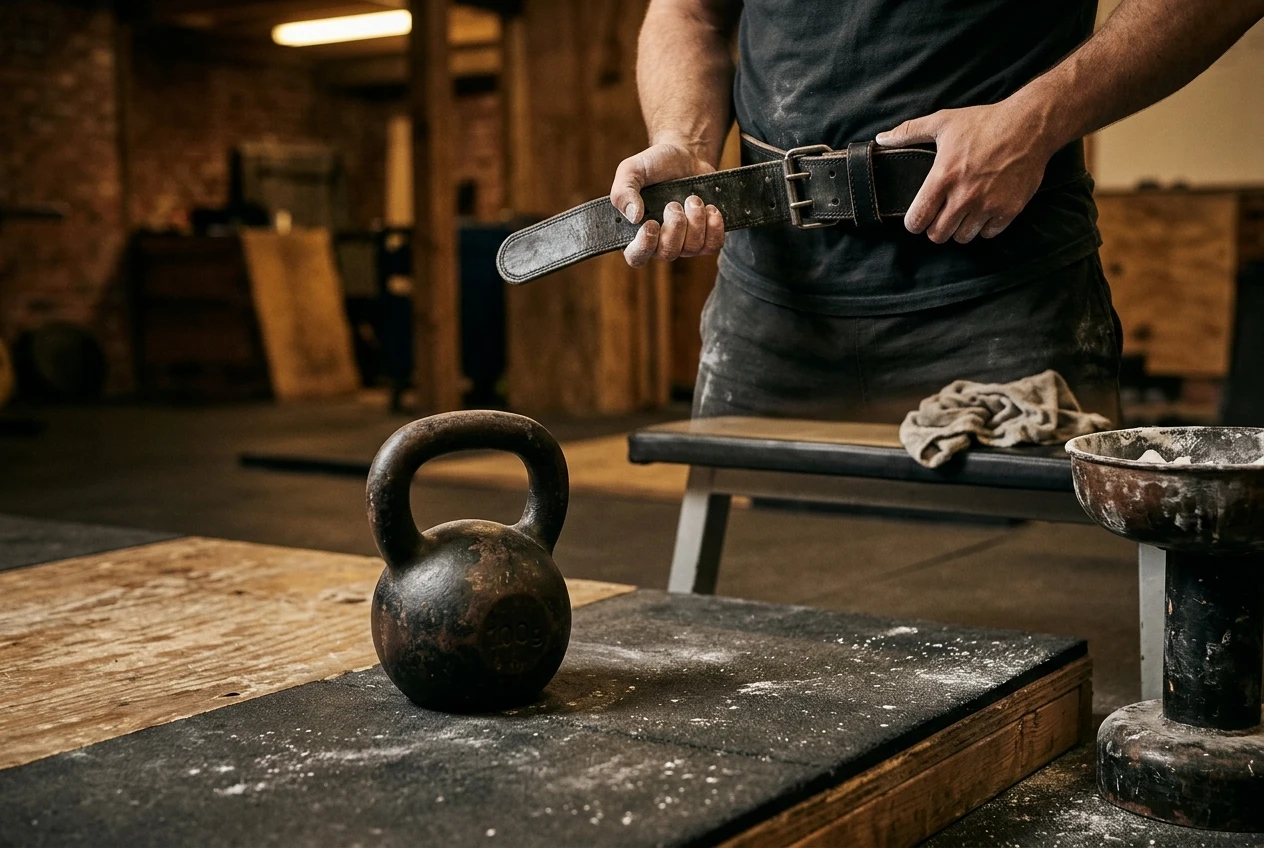
- Plan the pause. Fastening a belt takes a few seconds. Set the bell down, put the belt on, take a breath, and carry on. That short break is also a small rest, so keep it consistent between sessions or your comparisons will be unreliable.
- Keep the belt within reach. Leave it on a bench or a box beside your platform so you are not searching for it mid-complex.
- Think about closure. A belt you can fasten quickly suits this method better than one that takes a minute of adjustment. The piece on width and closure for kettlebell complexes covers that choice in detail.
The rounds before the belt-on point are done with your own brace. That is where the long-term benefit comes from: your trunk keeps doing the work it can do, and the belt only supports the part it cannot.
How to breathe into the belt so it adds to your brace instead of replacing it
A belt works because you press your abdomen outward against it. The harder you push into it, the more pressure builds inside your trunk, and the stiffer your spine becomes. If you let the belt hold you in and push nothing back, you get almost none of that effect.
Practice the breath before you use it in a complex:
- Stand with the belt snug but loose enough that you can still take a full breath.
- Inhale low, into your belly and the sides of your waist, not up into your chest.
- Push your abdomen and sides firmly into the belt, then hold that pressure.
- Brace, lift, and breathe out only once the movement is past its hardest point.
In a complex you will not have time for a full reset at every rep, so build the breath into the transitions. Take your breath as you set up for a movement, hold it through the reps, and exhale as you move to the next one. If your complex runs the reps continuously, breathe between movements and not within them.
Check that the belt is not so tight that you can only breathe shallowly. You should feel your abdomen press against it on every inhale. If you feel nothing pushing back, loosen it a notch.
When the belt is hiding a load or volume problem, and you should cut the dose instead
A belt is a support for a brace that is mostly working. It cannot repair a brace that is overloaded from the start.
Take your complex back to the notebook and check these three things:
- The failure point is in round one or two. If your trunk lets go that early, the load is too heavy or the movements are too demanding for where you are now. Reduce the bell weight, or drop to fewer reps per movement.
- The belt-on point keeps moving earlier. If you used to need it from round four and now need it from round two, the weekly volume or your recovery is the likely cause. Cut a round or two, or give the session more rest between rounds.
- You feel pain rather than fatigue. A trunk that is tired feels like effort. A sharp or lingering ache in the lower back is a different signal. Stop the complex, and if it persists, get it assessed by a qualified professional. The article on lower back aches after kettlebell swings covers matching a swing fault to the movement that trains it.
When you find one of these, reduce the dose first. Wearing the belt through the entire session to finish the same planned work is how the belt becomes a crutch.
Moving the belt-on point later, a few weeks at a time
Once you have a belt-on point you trust, the goal is to push it back. Keep the complex, the load and the rounds the same for two to three weeks. Each session, note whether the four signs show up at the same round.
If they appear later than before, or not at all in the round just before your belt goes on, move the belt-on point one round later. Hold that for a few weeks before moving again. Changing the belt-on point, the load and the rounds all at once makes it impossible to tell which one helped.
Every so often, run the complex beltless again as a check, with the same stopping rule as before. If the failure point has moved later, your brace is getting stronger. If it has moved earlier, treat that as a prompt to cut the dose, not to put the belt on sooner.
Over time, you may find the belt goes on only for the last round or two of your hardest complexes, and stays in the bag for lighter days. That is a good result. It means the belt is covering the end of your capacity and your own trunk is doing the rest. If you are placing complexes inside a squat cycle, the guide on which kettlebell complex belongs in which phase helps you decide where the harder ones should go.
If you want a complex to test your brace with, try the programming at kettlebell.monster. This is an affiliate link. If you buy through it, I may earn a commission at no extra cost to you.