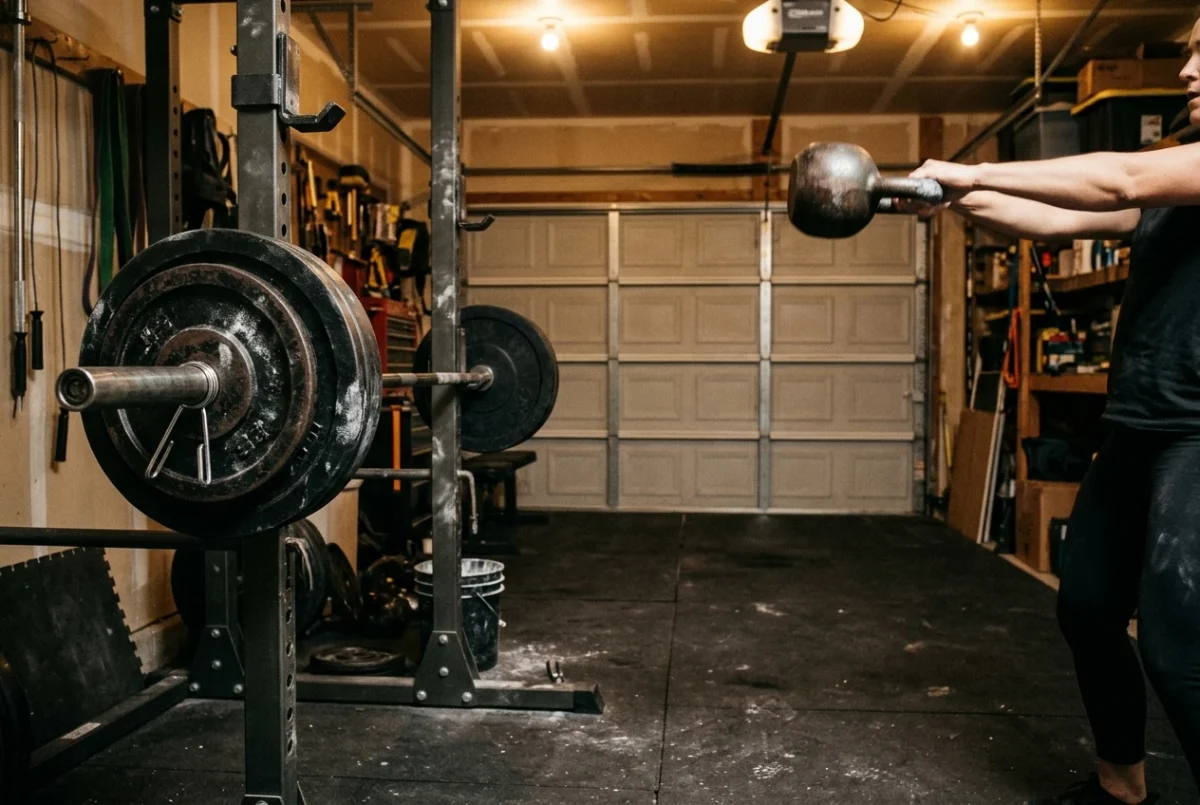
Most lifters who ask how to add kettlebell complexes to a squat program get an answer about scheduling: which weekday, how many hours after squats. Timing matters, but the bigger decision is which complex you pick. A long, grinding clean-squat-press complex suits a different phase than ten crisp swings, and both can hurt a squat cycle if they land in the wrong block. This article maps complex types to the four phases of a squat cycle: volume, strength, peak and deload. For weekday placement, see where kettlebell sessions go in a powerlifting week.
A complex here means a short chain of kettlebell movements done back to back without setting the bell down, such as swing, clean, front squat and press. You do a set number of reps of each movement, then rest.
What heavy squats train and what ballistic kettlebell work adds
A heavy barbell squat trains force production against a load that moves slowly. The bar is heavy enough that you cannot accelerate it much, so the adaptation leans toward maximal strength in the quads, glutes, adductors and trunk, plus the skill of staying braced under a load that tries to fold you in half. Rep speed is slow by necessity, and the bar sits on your back, so your grip is barely involved.
Ballistic kettlebell work such as swings and cleans trains something different. The bell is light relative to your squat, so you accelerate it hard, and the hips drive a fast extension followed by a fast decelerating phase. This builds hip extension speed, posterior chain endurance and, in longer sets, conditioning. It also loads your grip and forearms, which a back squat does not.
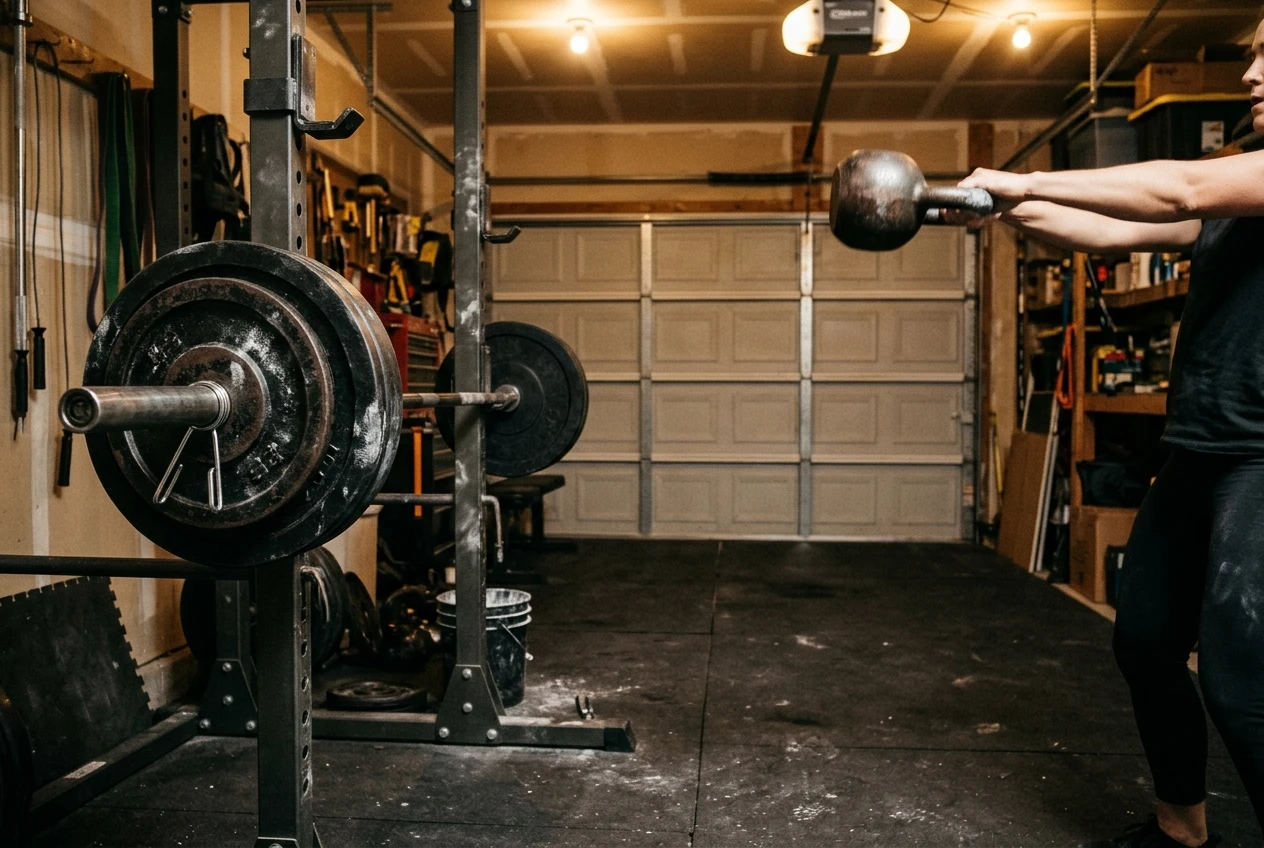
The two overlap in the hips and the trunk and differ in speed, load and fatigue cost. A set of heavy squats is expensive for the nervous system and for recovery. A set of ten swings with a moderate bell is much cheaper, but a long complex can still run up a large amount of total work. The same complex that is a good addition early in a cycle can cost you a good top set when the barbell is near your max.
Same session or separate days: what the pairing research does and does not show
Research on combining heavy lifting with explosive work in the same session is mixed. Some of it falls under post-activation potentiation: the idea that a heavy lift briefly makes a following explosive movement better. Results vary with rest interval, training level, the load used and the individual lifter. Some studies show a short-term boost in explosive output, and others show fatigue winning out. None of it was designed around a kettlebell complex after a squat day, so it cannot tell you what a particular complex will do to your next squat session.
There is also the general literature on concurrent training, which mostly compares strength work with endurance work. It suggests that piling up a lot of conditioning can blunt strength gains, particularly when volume is high and recovery is short. How much that applies to a few kettlebell rounds is not settled.
What follows from this is cautious rather than dogmatic:
- Separate days are the safest default, because they keep fatigue from one session out of the other.
- If you pair them in one session, put the squats first and keep the complex short, so the heavy work is done fresh.
- Do not put a fatiguing complex before heavy squats and expect a potentiation effect to cover the cost. The evidence does not support that bet.
- Treat your own bar speed and your own recovery as the deciding data. If squat sessions get worse after you add a complex, the complex is the variable to change.
Volume phase: complexes that build work capacity without eating recovery
The volume phase has the lowest squat intensity and the most sets, so it has the most room for complex work. This is where longer, more demanding complexes belong. The aim is work capacity: being able to do more total work per session and recover faster between sets, which later lets you handle more squat volume.
Good choices in this phase:

- Clean, front squat, press complexes with a moderate bell, for example 3 to 5 reps of each movement and 4 to 6 rounds, resting between rounds.
- Swing and clean ladders, adding a rep each round and stopping before form breaks down.
- Timed rounds at a pace you could hold for the whole session, for example a complex every minute for 8 to 12 minutes.
Keep the bell light enough that every rep looks the same as the first. Front squats inside the complex overlap with your barbell squat pattern, so count them as squat volume and trim the barbell work if recovery suffers. Two complex sessions a week is a reasonable ceiling in this phase for most intermediate lifters; one is enough if your squat volume is already high.
Grip often fails before the legs do in long complexes. If that is your limit, give it its own block rather than letting it cut your sets short; the article on grip strength training for kettlebell work covers how.
Strength phase: short, low-fatigue swing and clean work that stays away from your top sets
When squat intensity climbs and sets get heavier and lower in reps, the complex should shrink. The job changes from building capacity to keeping the hips fast and the body conditioned without adding fatigue to your heavy days.
Choose complexes that are short and crisp:
- Two-hand swings in sets of 5 to 8 reps, with long rests.
- Swing to clean pairs, or a single clean variation, in low-rep sets.
- Two to four rounds total, stopping while every rep is still fast.
Avoid complexes built around grinding movements, such as slow presses or multiple front squats, in this phase. They add fatigue in the legs and trunk with little to show for it when your squat is the priority. Also avoid doing the complex within a day of your heaviest squat session. If a swing session leaves you tired or sore for the next squat day, move it away from that day or cut it down.
If your lower back complains after swings, the cause is usually a technique fault rather than the bell, and this guide matching swing faults to accessory work is the place to look.
Peak weeks: when to cut the complex to a primer or drop it entirely
Peak weeks put the heaviest weights of the cycle on the bar, with the lowest volume. Recovery is the limiting factor, and anything that competes for it can cost you a rep or a kilo on the day that counts.
You have two options.
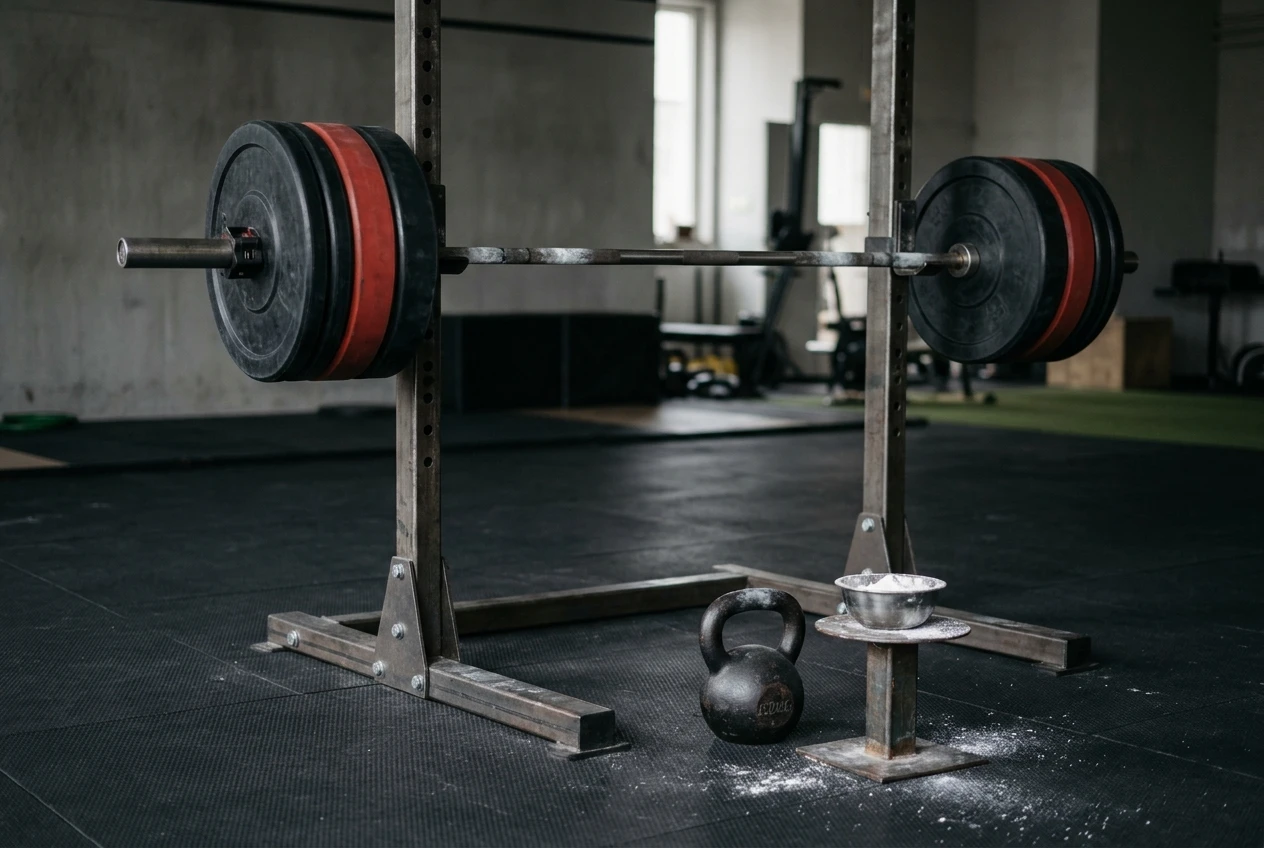
Primer. Before a squat session, do 2 or 3 sets of 3 to 5 swings with a moderate bell, resting fully between sets. This is a warm-up, not a workout. You should feel warmer and looser and no more tired. If it makes the first warm-up squats feel heavier, drop it.
Drop it. If your recovery is already stretched, or squat numbers are slipping, leave kettlebells out for the last two or three weeks. A short break from complexes costs you very little conditioning, and the fitness comes back quickly when you restart in the deload.
A reasonable rule: the closer the session is to a true max attempt, the smaller the complex. In the final week before testing a max, most lifters are better off with nothing beyond a few primer swings.
Deload week: using the complex as your main conditioning
The deload is the best time for a more demanding complex, because the barbell work is light and recovery has room. Keep the squat training at reduced volume and intensity, and let the complex carry the conditioning.

Use a complex you enjoy and have done before, at an effort where you finish each session feeling better than when you started. Something like 6 to 10 rounds of swing, clean and front squat at a conversational pace works. Avoid going to failure or chasing a new best time, since a deload that ends with heavy soreness defeats its purpose.
This is also a good week to learn a new complex or clean up technique. A coach on screen helps with that; the sections below cover options for guided sessions.
A sample 12-week squat cycle with the complex dose written into each phase
This template shows how the doses fit together. Adjust it to your own recovery, since the numbers are starting points and not prescriptions.
Weeks 1 to 4, volume phase
- Squat: higher sets and reps at moderate intensity.
- Complex: two sessions a week, 8 to 12 minutes each, using clean, front squat and press or swing and clean ladders at a moderate bell.
- Progress by adding a round or a rep, not by raising the bell.
Weeks 5 to 8, strength phase
- Squat: heavier sets in lower rep ranges.
- Complex: one or two short sessions a week of swings and cleans, 2 to 4 rounds, long rests, kept away from the day before heavy squats.
- No grinding movements in the complex.
Weeks 9 to 11, peak phase
- Squat: heaviest work, lowest volume.
- Complex: week 9 can keep one short swing session. Weeks 10 and 11 use a primer of 2 or 3 sets of swings before squats, or nothing.
- Drop the primer if warm-ups feel worse for it.
Week 12, deload
- Squat: reduced volume and intensity.
- Complex: two or three sessions of 15 to 20 minutes at an easy to moderate effort, using the complex as your main conditioning.
Signs the complex is costing you squat performance, and how to scale it back
Watch for these patterns, ideally across two or more sessions, not one bad day:
- The same squat weight moves more slowly than it did a week or two earlier.
- Warm-up sets feel heavy, or your hips and hamstrings stay sore into squat day.
- Reps you normally hit drop off, or you miss a set you expected to make.
- Your grip or lower back is tired at the start of a squat session.
- Complex sessions leave you more drained as the cycle goes on, even though the weights have not changed.
When you see them, scale back in this order:
- Cut rounds or total time first.
- Swap the complex for swings only.
- Use a lighter bell.
- Reduce frequency, or move the session further from your heavy squat day.
Give each change a week or two before judging it. If the squat recovers, you found the dose that fits that phase. If not, the problem may be elsewhere in your programming or recovery.
Where to get guided complex sessions
Lifters who want guided complex sessions to slot into these phases can try kettlebell.monster, which has coached kettlebell workouts you can follow along with. For following a coach on a big screen, there is also the Samsung Tizen TV workout app. Both are affiliate links, so I may earn a commission if you buy through them, at no extra cost to you.