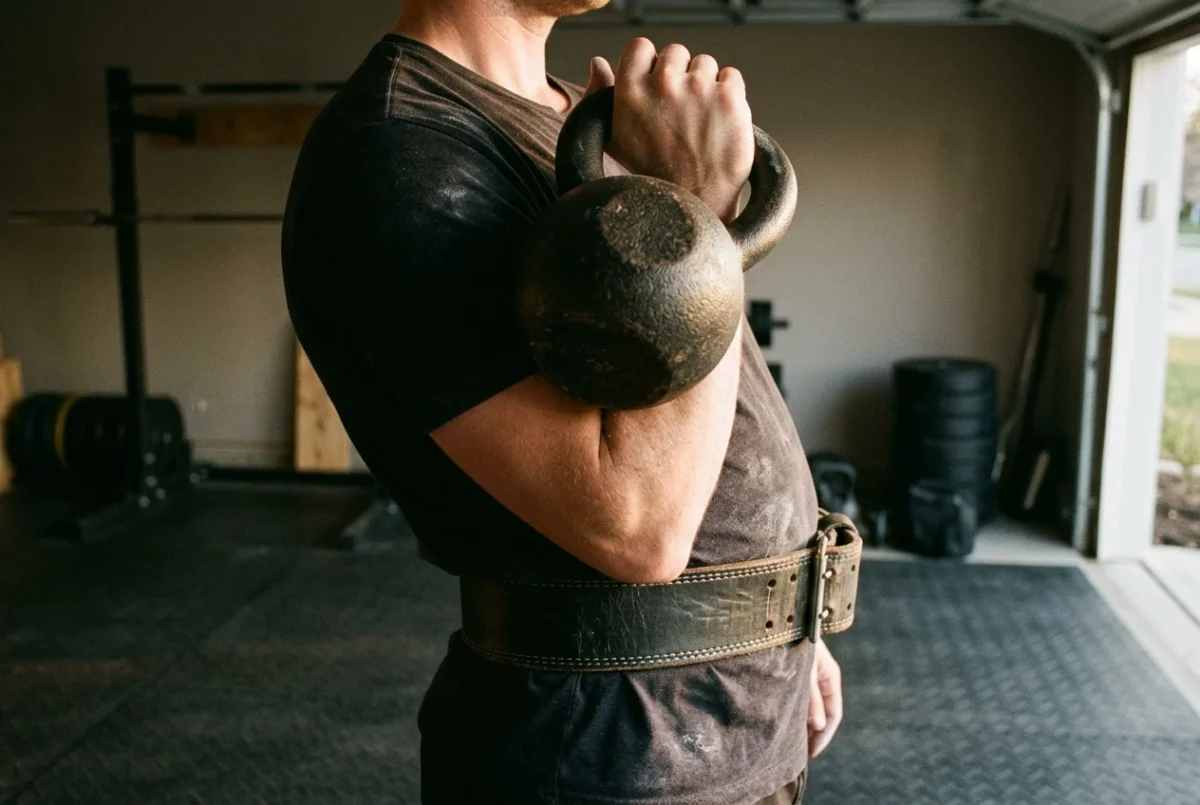
Most belt advice is written for a barbell squat or deadlift, where the weight never touches the belt. A kettlebell complex works differently. The bell travels past your hips, lands on your forearm and chest, and rests against your ribs before it goes overhead or back down. A belt that suits a barbell can sit exactly where the bell wants to land.
That changes what to look for. For the best lifting belt for kettlebell complexes, width, taper and closure matter most, and material comes well behind them. The sections below give you a way to choose based on where the bell touches you and how quickly you change positions.
Do kettlebell complexes need a belt at all, or only some of them?
Some complexes do not need one. A belt gives your abs something to press outward against when you brace, which is useful when the load is heavy relative to what you can control. If the bell is light enough that bracing feels easy and your lower back feels fine at the end of a round, a belt adds a piece of gear to manage and little else.
The case for a belt gets stronger as the bell gets heavier, the rounds get longer, or the complex includes moves where you hold the weight in front of you while bracing: the racked press and the racked or goblet squat. These positions load your trunk for several seconds at a time. A swing loads it for a fraction of a second, over and over.
A useful way to decide is to look at each move in your complex and ask how long your trunk is under load and whether the bell touches your midsection. Swings and cleans pass quickly through the hips. Presses and squats hold the bell against your torso. If your complex is mostly the first kind, a belt has less to do. If it is mostly the second kind, a belt has more to do and more ways to get in the way.
Where the bell meets the belt: rack, clean and swing contact points
A belt sits across the same part of your body that a kettlebell touches, so each move in the complex needs checking separately.
Swing. At the bottom of the swing, the bell passes between your thighs and your forearms brush your inner thighs. At the top, the bell is out in front of you and touches nothing. The belt matters in two ways here. A belt that is wide at the front can catch on your thighs when you hinge deep. And a closure that sticks out at the front can be hit by your wrists or the handle as they pass.
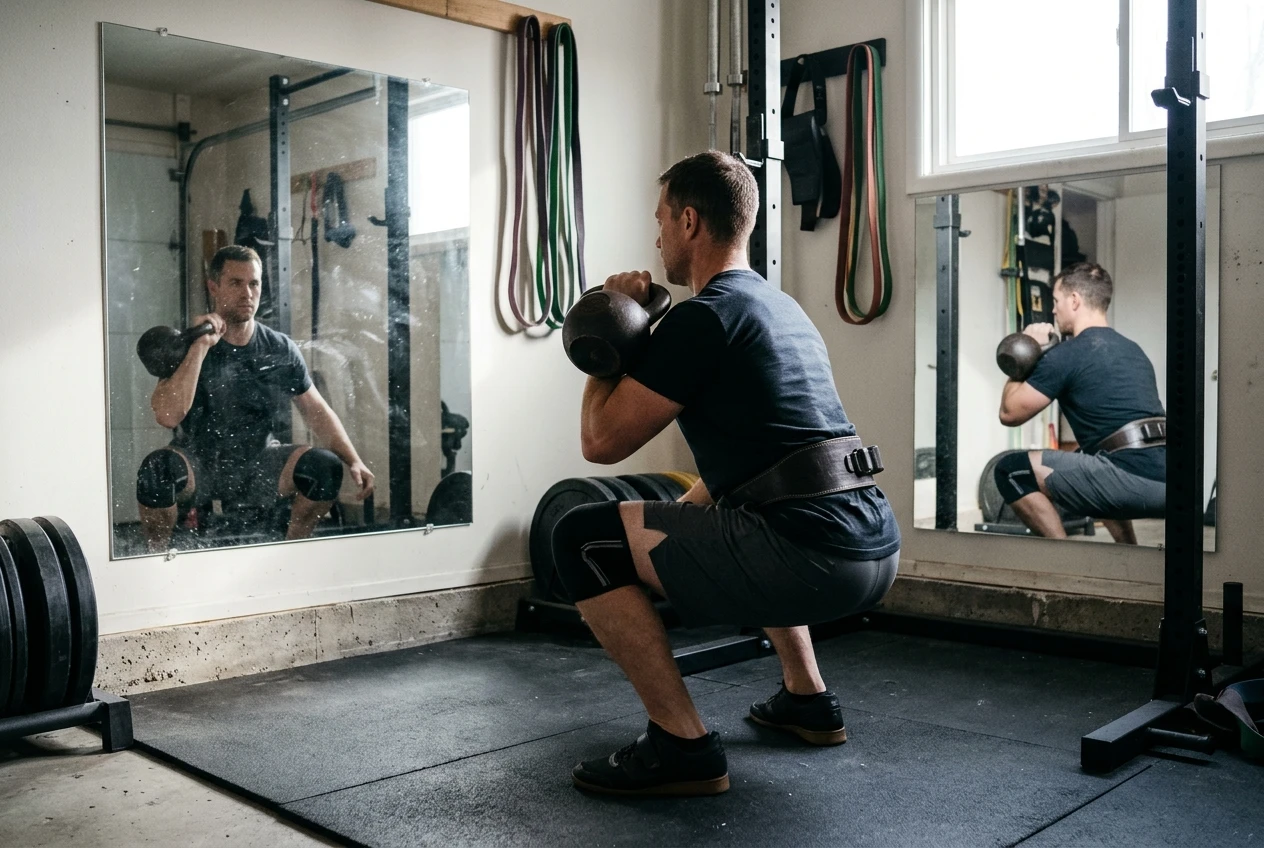
Clean. The bell travels up close to your body and ends in the rack position, with the handle in your hand, the bell resting on the back of your forearm, and your elbow near your ribs or hip. This is the move most likely to run into a belt. A thick or stiff belt edge can catch the bell on its way up, and a tall belt can leave the bell landing on the belt instead of on your forearm and chest.
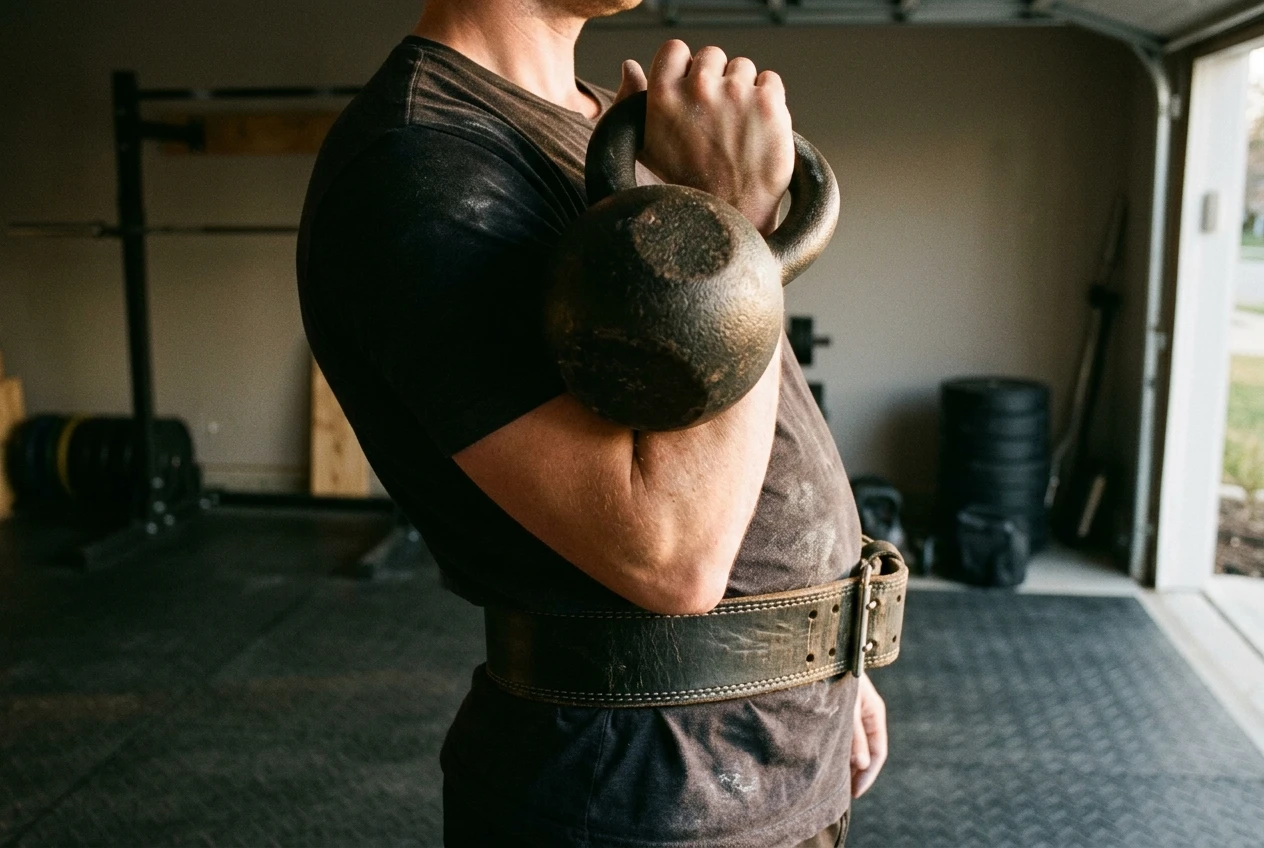
Rack, press and squat. In the rack, your elbow usually rests against the side of your torso, often near the top of the hip. The belt’s upper edge sits in that area. If the belt is too tall at the sides, the elbow lands on the belt and your forearm angle changes. If the belt is too tall at the front, it can press the bell away from your chest, or the belt can dig into your ribs when you inhale. In the squat, your elbows travel toward your thighs and the belt can block them from reaching their normal depth.
Write down the contact points for your own complex. For each move, note where the bell, forearm or elbow touches your torso. Those are the places where belt shape and hardware will matter.
Width and taper: how much belt your ribs and hips tolerate in the rack position
Belt width is the distance from the top edge to the bottom edge. Many lifting belts keep the same width all the way around. Others taper, meaning they are narrower at the front and wider at the back, or the reverse. In a barbell lift, a wide, even belt is fine because nothing interacts with the front edge. In a complex, the front and side edges are where the bell and elbow land.
Two things set how much width you can tolerate.
- The distance between your ribs and hips. Some lifters have a long gap between the bottom of the ribcage and the top of the hip bone. Others have a short gap. A belt that fits comfortably in a long gap can jam into the ribs or the hip bone in a short gap, and this shows up most when you bend or rack the bell.
- How you rack the bell. If your elbow rests on your hip, the belt’s top edge matters at the side. If the bell sits mostly against your chest and upper abs, the belt’s front height matters more.
A narrower belt, or one that tapers toward the front, leaves more room for the rack. A wider belt gives your abs more surface to press against, which helps bracing but takes up the space where the bell and elbow want to be. Neither is correct for everyone. What you are looking for is the widest belt that still lets you rack, clean and squat without it moving or bunching when the bell touches it.
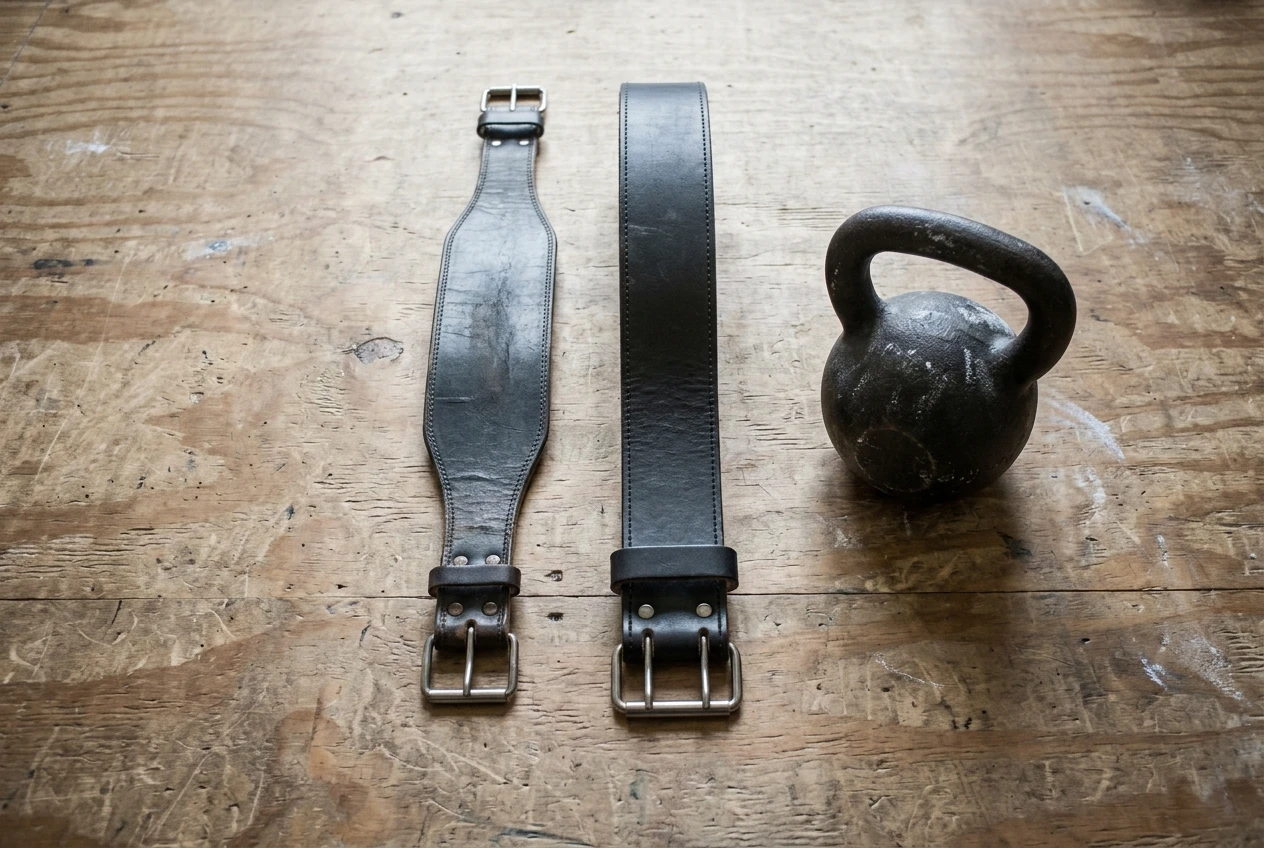
Taper in the other direction, wider at the front and narrower at the back, is the least suited to complexes, because the front is where the bell touches. If you are buying online and cannot see how the belt is cut, look for a product description that gives the front width and the back width separately.
Closure type: lever, prong or velcro when you can’t stop between rounds
In a barbell set, you put the belt on, do the set, rest, and take it off. In a complex you may do five or six moves in a row with a bell in your hand, and the belt has to stay put the whole time. Closure matters in three ways: how it adjusts, how quickly it comes off, and what it does to the area where the bell lands.
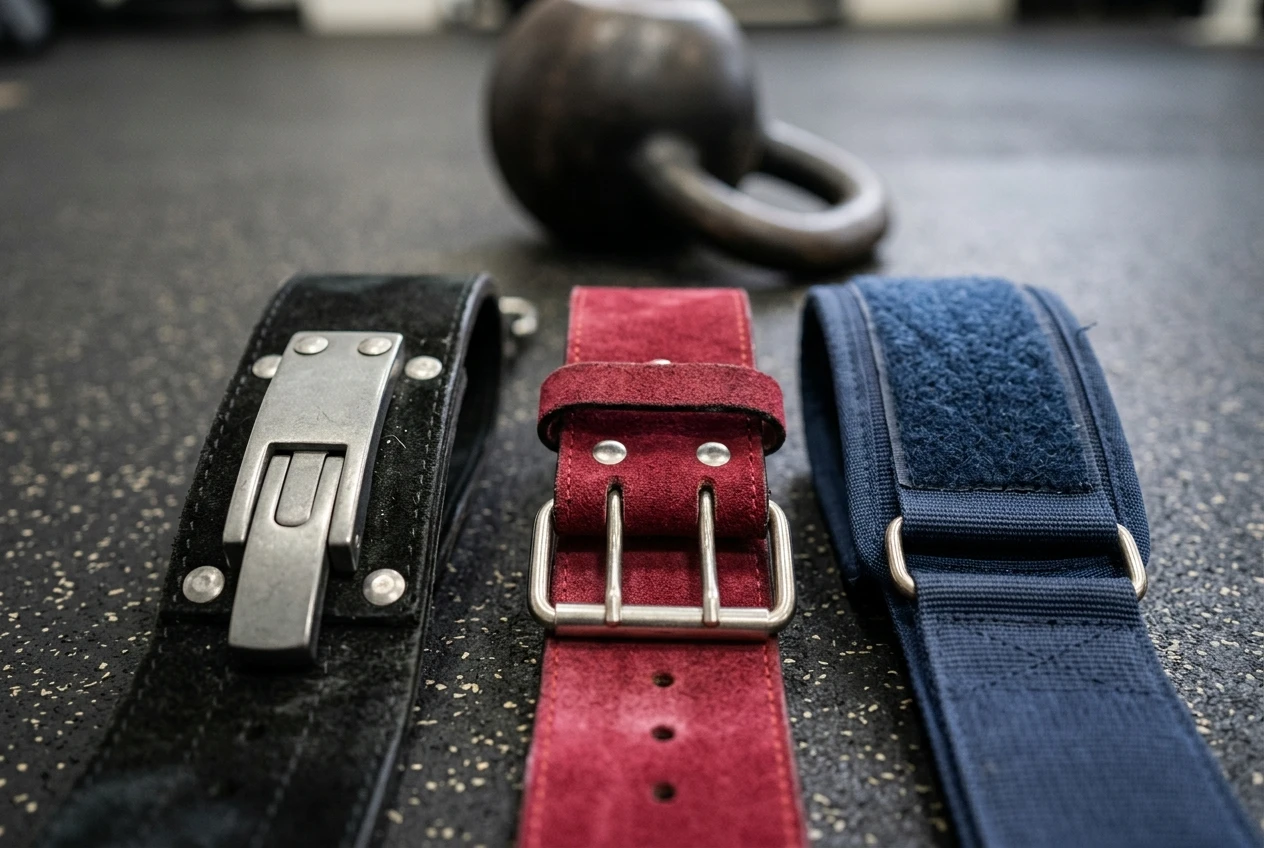
Lever. A lever closure clamps shut and holds a set tightness. It is quick to open and close once you have set it, but changing the tightness usually requires a tool or some fiddling with a screw. The lever body is a solid lump that sits at one spot on the belt. If it sits at the front or side where your forearm or elbow lands, you will feel it. Rotate the belt so the lever sits at the back or behind your hip if you can.
Prong. A prong closure works like a regular belt buckle, with holes spaced along the belt. It is simple and adjusts in fixed steps. It takes longer to put on and take off than a lever, and the buckle is a metal piece that can press against the forearm or ribs in the rack. It suits complexes where you put the belt on once and keep it on for the whole session.
Velcro. Hook-and-loop fastening is the quickest to adjust, and it adjusts continuously rather than in steps, so you can tighten it a little between rounds. Its closure is flat, so it does not leave a hard lump under your forearm. The tradeoffs are that it is more likely to loosen over a long session if the hook-and-loop surfaces wear, and it can catch on clothing.
If you stop between rounds and have a minute to adjust, any of the three works. If you move from swings into cleans into presses without putting the bell down, a flat closure that does not sit where the bell lands is worth more than a closure that is slightly stronger. Position matters as much as type: a lever worn behind the hip can be less intrusive than velcro worn on the side where your elbow rests.
Material in one paragraph, and where to read the full comparison
Leather, nylon and suede all work for a complex belt. Leather and suede are stiffer and hold their shape, which also means they can be harder on the ribs in the rack. Nylon is lighter and more flexible, which can make it easier to fit around a bell, at the cost of less rigid support. Which one lasts longest in a home gym is a separate question from which one fits a complex, and it is covered in the full comparison of leather, nylon and suede lifting belt materials.
A fit check you can do at home with a bell in the rack
You can check a belt against your complex in a few minutes with a single bell. Do this before you decide a belt is wrong for you, since a belt that feels bad when it is too loose or too high can feel different once adjusted.
- Set the belt. Put the belt on at a snug but not maximum tightness, with the closure at the back or hip if the belt allows it.
- Rack the bell on each side. Hold the bell in the rack position and notice where your elbow lands. Check whether it rests on your hip or on the belt. Check whether the bell touches the belt, and whether you can still breathe into your belly.
- Run a slow clean. Bring the bell up from the hang position and watch for the bell catching on the belt’s upper edge. Note any scraping or snagging.
- Press and lower. Press the bell overhead and lower it back to the rack. Check that the belt does not shift upward or bunch.
- Squat with the bell racked. Go to your normal depth and check whether your elbow hits the belt before it reaches your thigh.
- Run a few swings. Check the bottom of the hinge for belt contact with your thighs and the bell handle, and look for any closure hardware in the path of your wrists.
- Time a change. Do a full complex round, then loosen and tighten the belt. If you cannot do this without putting the bell down for a long time, the closure is too slow for how you train.
Any step where the belt interferes tells you which feature to change: width if the edge is the problem, closure type or position if hardware is the problem.
Matching a belt to your complex: swing-heavy, clean-and-press heavy or mixed
Once you know where the contacts are, the choice follows from which moves dominate your session.
Swing-heavy complexes. Most of the work is hinging, and the bell stays off your torso. Prioritize freedom at the front and thighs: a belt that is narrow at the front, with no closure hardware where the wrists pass. A belt may not be needed for the swings themselves, so consider wearing one only for the heavier moves, if your complex has them.
Clean-and-press heavy complexes. The rack position is where you spend most of your time. Choose the belt with the least height at the front and sides, and the flattest closure, which usually points to a narrower belt with velcro or a lever worn at the back. Check the elbow rest carefully, because the rack is where a bad fit shows up on every rep.
Mixed complexes. If you run swings, cleans, presses and squats back to back, pick a belt that works acceptably in the rack, since that is the position that conflicts with a belt most. A tapered belt with a flat closure positioned away from the bell’s landing spot is the safest compromise. If a belt that suits the rack feels too thin for the squats, the difference is something you can judge during the fit check above.
Your experience level changes what you want from a belt, and the lifting belt you need at 6 months is not the one you need at 6 years goes into that. If your complex is limited by grip rather than by your trunk, read whether to strap up for kettlebell complexes, move by move before you spend money on a belt.
Run the complexes with a coach on screen
If you want complexes you can follow set by set, so that you spend your attention on where the bell lands and not on what comes next, take a look at kettlebell.monster. It gives you a structured workout to check your belt against.
Affiliate disclosure: the kettlebell.monster link is an affiliate link, so I may earn a commission if you buy through it.