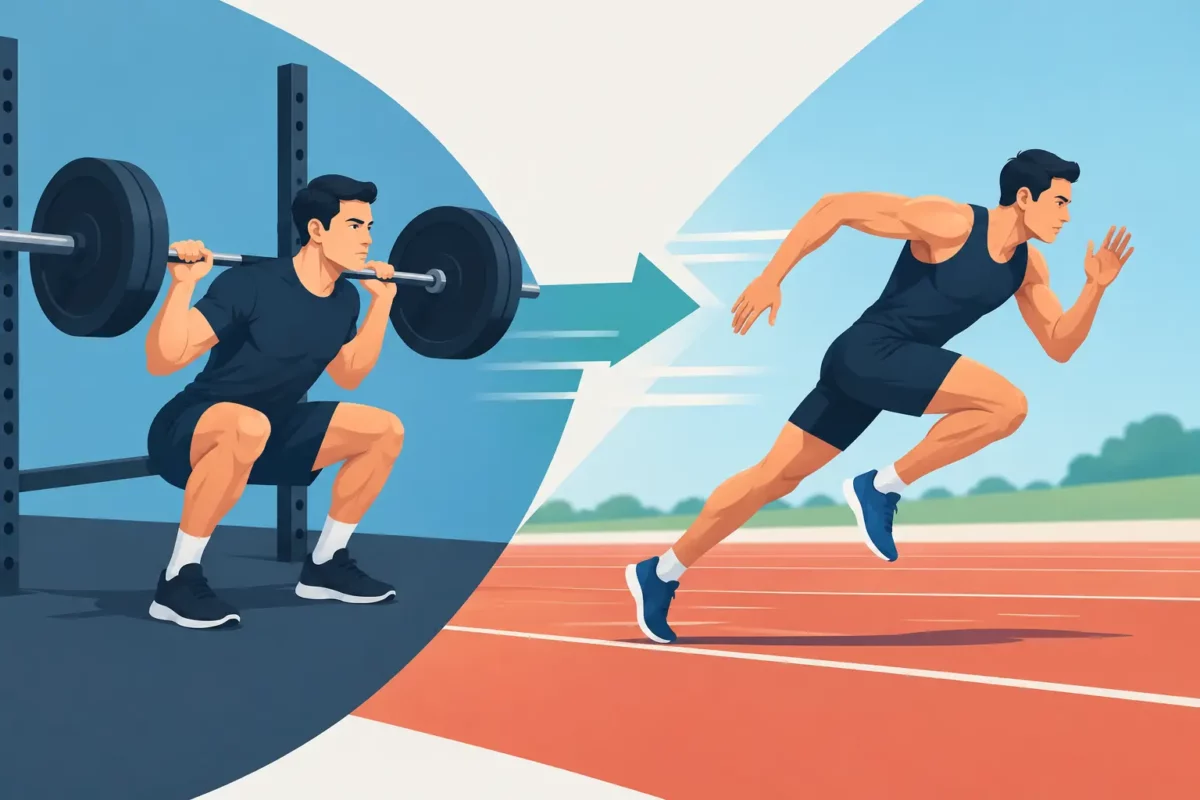
A faster 40-yard dash is not built by running tired reps until your mechanics collapse. It is built by producing more force into the ground, in less time, while maintaining positions that let that force move you forward. So, does lifting improve sprint speed? Yes, when the lifting develops qualities that transfer to sprinting instead of simply adding fatigue or body mass.
The weight room cannot replace sprint practice. But for athletes who lack lower-body strength, force production, or the ability to hold strong positions at speed, purposeful lifting can raise the ceiling on what their sprint work produces. The goal is not to become a powerlifter who occasionally runs. The goal is to become a stronger, more explosive athlete whose strength shows up in every stride.
Does Lifting Improve Sprint Speed for Every Athlete?
Lifting has the greatest effect when strength is a limiting factor. A newer athlete who cannot squat, hinge, or lunge with control usually has a large amount of usable progress available. Stronger hips and legs can improve acceleration, improve the ability to resist collapse at the knee and pelvis, and create a more forceful push into the ground.
For a well-trained sprinter, the return can be smaller and more specific. An athlete who already has high levels of strength may need more sprint exposure, technical work, elastic qualities, or speed-focused power training rather than another heavy squat cycle. More weight on the bar is not automatically more speed.
Body mass also matters. Adding 15 pounds of muscle may help an under-muscled athlete produce more force, but it can hurt sprint performance if force production does not rise faster than body weight. Sprinting rewards relative strength: how much force you can produce compared with the mass you must accelerate.
Why Strength Carries Over to the Track
During acceleration, the athlete needs time to apply force because the body is angled forward and ground contacts are longer than they are at top speed. This is where foundational strength work often has its clearest transfer. A stronger athlete can push more effectively through the ground and continue accelerating over the first several steps.
At maximum velocity, ground contact is extremely brief. Raw strength still matters, but the athlete also needs stiffness, coordination, timing, and the ability to express force quickly. That is why a big squat alone does not guarantee a fast 100 meters. Sprint speed is strength expressed under a strict time limit.
Lifting supports sprinting through several practical adaptations. It builds the force capacity of the glutes, hamstrings, quads, calves, and trunk. It improves the athlete’s ability to maintain posture under force. It can strengthen tissues that take repeated high-speed loading. And when explosive lifts and jumps are used intelligently, it teaches the athlete to produce force with intent rather than slowly grinding every rep.
The transfer is strongest when training respects the demands of sprinting. Heavy strength work builds capacity. Explosive work helps convert that capacity into usable power. Sprinting itself teaches the body to apply it at sprint-specific speeds.
The Lifts That Matter Most
The best exercises are not necessarily the most complicated. Start with movements that build force through the hips and legs while allowing consistent progression.
Squats Build Lower-Body Force
Back squats, front squats, safety-bar squats, and trap-bar deadlifts can all be productive choices. Squats develop the legs and trunk through a deep range of motion, while trap-bar deadlifts often allow athletes to load heavily with a more athletic, upright position.
The right variation is the one you can perform hard, safely, and consistently. If a back squat irritates your hips or turns into a lower-back exercise, forcing it is not a badge of honor. Use a front squat, safety-bar squat, or split squat and keep progressing.
Hinges Strengthen the Posterior Chain
The hamstrings and glutes are major contributors to sprinting, particularly when driving the leg backward and controlling the limb at high speed. Romanian deadlifts, conventional deadlifts, good mornings, and hip thrusts can build these qualities.
Romanian deadlifts are especially useful because they load the hamstrings at longer muscle lengths. That does not make them a substitute for sprinting or hamstring-specific preparation, but they are a strong foundation for athletes who need more posterior-chain strength.
Single-Leg Work Exposes Weak Links
Sprint mechanics happen one leg at a time. Bulgarian split squats, reverse lunges, step-ups, and single-leg Romanian deadlifts can help address side-to-side differences while building hip and knee control.
Do not turn every session into a balance challenge. The point is to load the movement with enough resistance to drive adaptation. A stable split squat done hard is more useful than a wobbly circus variation done light.
Olympic Lift Variations Build Explosive Intent
Power cleans, hang cleans, clean pulls, high pulls, and jump shrugs can teach rapid extension through the ankles, knees, and hips. These movements work well for athletes who have coaching access and enough skill to perform them safely.
They are not mandatory. A heavy trap-bar deadlift paired with loaded jumps can develop power effectively without requiring the technical learning curve of a clean. Exercise selection should serve the athlete, not the coach’s ego.
How to Program Lifting for Faster Sprinting
Sprint training has to remain the priority if sprint speed is the goal. Put high-quality sprint work on days when your legs are fresh, then lift after sprinting or later that day. This concentrates high-intensity stress and preserves true recovery days.
For most athletes, two to three lifting sessions per week is enough to gain strength without burying the sprint work. During an off-season strength phase, three sessions may fit well. As races, combines, or field-sport competition approach, reduce lifting volume and keep enough intensity to maintain strength.
A practical two-day setup might look like this:
- Day 1 after acceleration work: squat for 3 to 5 sets of 3 to 5 reps, Romanian deadlift for 3 sets of 5 to 8 reps, then a controlled single-leg exercise.
- Day 2 after maximum-velocity work: power clean or jump shrug for 3 to 5 sets of 2 to 3 reps, trap-bar deadlift for 3 to 4 sets of 3 to 5 reps, then hamstring and calf work.
The loading should match the training phase. Heavier sets of three to five reps are effective for building maximal strength without the excessive volume of long bodybuilding-style sets. Explosive movements should use loads that allow sharp, fast reps. When bar speed drops and technique degrades, the power work is finished.
Accessory work has a place, especially for hamstrings, calves, adductors, and trunk strength. Keep it productive and recoverable. Two hard sets of Nordic hamstring curls or calf raises can be valuable. Six extra exercises performed to failure after a heavy sprint session usually are not.
What Commonly Stops the Transfer
The most common mistake is treating leg day as the main event and sprinting as an afterthought. Crushing your legs with high-volume squats, lunges, and machine work can leave you too sore to sprint with quality. You may get stronger in the gym while your actual speed work becomes slow, fatigued, and technically poor.
Another mistake is avoiding heavy lifting completely in favor of light, fast exercises. Jump squats and kettlebell swings can be useful, but they do not replace the force-building value of progressive loading. If you cannot produce much force in the first place, moving a light load quickly has a limited ceiling.
Finally, do not confuse exhaustion with power development. Sprinting and explosive lifting require intent, precision, and adequate rest. A fast rep has value because it is fast. Once every rep becomes a grind, you are training fatigue more than speed.
Build Strength That Shows Up When You Run
Track your sprint times, your body weight, and your key lifts over months, not just workouts. If strength is rising while acceleration improves and you can recover between sessions, the plan is working. If your legs stay flat, your sprint times stall, and your lifting numbers rise only because you are gaining nonfunctional mass, adjust the workload.
Train the barbell with purpose, then give that new force a place to go. Stronger legs matter, but the finish line only rewards the athlete who can apply that strength fast.