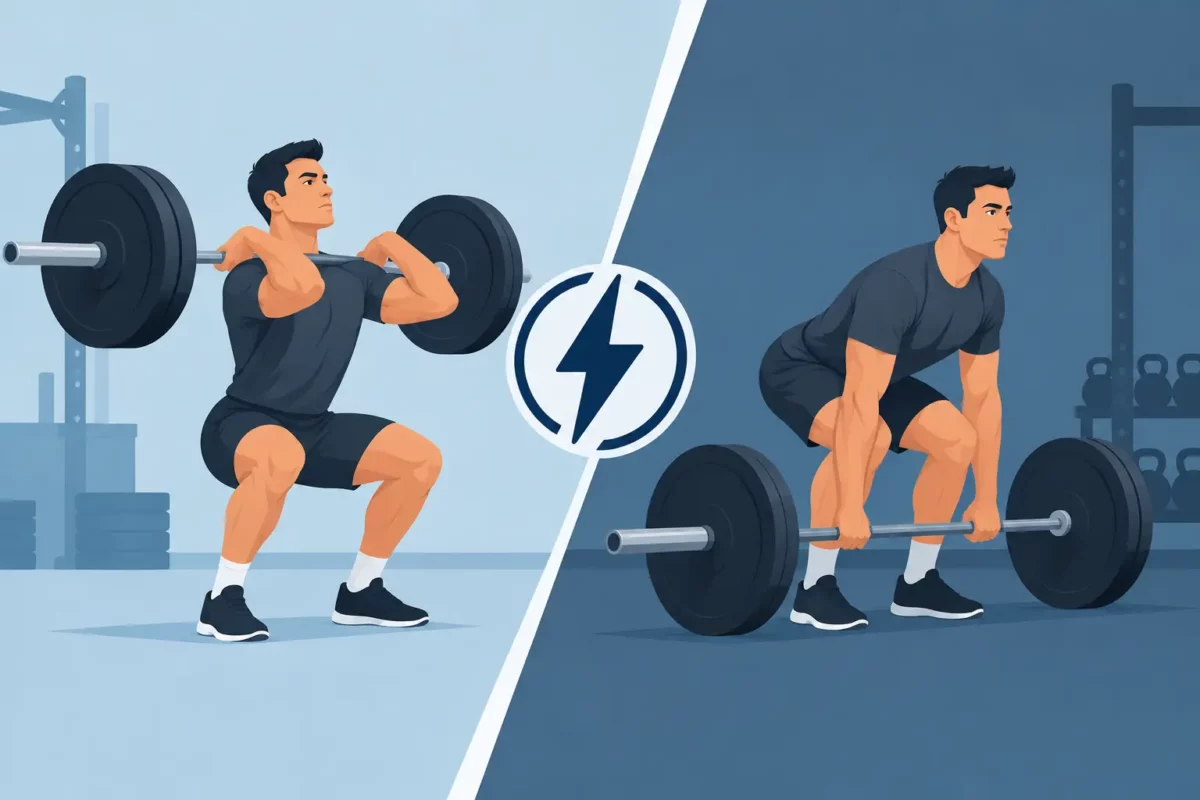
A heavy deadlift can make the bar feel glued to the floor. A sharp power clean teaches you to make that same bar move fast enough to rise to your shoulders. That difference is the center of power cleans versus deadlifts: both are serious posterior-chain lifts, but they develop different qualities and demand different things from the athlete.
If your goal is practical strength, explosive force, and better transfer to sprinting, jumping, contact sports, or hard physical work, this is not a choice between a “good” lift and a “bad” one. The better question is which quality you need most right now, and whether your program has room to train both.
Power Cleans Versus Deadlifts: The Core Difference
The deadlift is a strength lift. You pull a loaded barbell from the floor to a standing lockout under control. It places a large demand on the glutes, hamstrings, spinal erectors, upper back, grip, and trunk. The goal is simple: produce enough force to overcome a heavy, stationary load.
The power clean is an explosive weightlifting movement. You pull the bar from the floor or a hang position, accelerate it violently through the hips, then receive it on the front of the shoulders in a partial squat. The goal is not merely to lift the bar. The goal is to create force quickly, direct the bar efficiently, and coordinate the catch.
That means the deadlift generally lets you use much more weight. The power clean requires much more speed, timing, mobility, and technical precision. A lifter may deadlift 405 pounds yet struggle to power clean 185 pounds correctly, not because they are weak, but because explosive lifting is a distinct skill.
Neither movement is automatically superior. Deadlifts raise your ceiling for force production. Power cleans train you to express force faster. Athletes and performance-focused lifters often need both capacities.
What the Deadlift Builds
The deadlift is one of the most direct ways to build total-body pulling strength. Since the bar begins from a dead stop, every repetition requires the lifter to establish position, create tension, and push the floor away without relying on a stretch reflex.
Heavy deadlifts build the raw material behind powerful movement: stronger hips, stronger legs, a more resilient trunk, and the ability to maintain position under load. For field athletes, combat athletes, and general strength trainees, that force base matters. You cannot express force you do not have.
Deadlifts also offer a relatively short technical learning curve compared with power cleans. A good coach should still teach the setup carefully, but most beginners can learn a productive hinge pattern and make steady progress sooner than they can learn a clean. This makes the deadlift a valuable early-program strength exercise.
The trade-off is speed. A maximal or near-maximal deadlift moves slowly by necessity. It can improve strength that supports power, but it does not train rapid force development as directly as an explosive lift. If your training consists only of slow, heavy grinding, you may become stronger without becoming as athletic as your strength level suggests.
Deadlift variations change the emphasis
A conventional deadlift is a strong general option for posterior-chain strength and full-body tension. A trap-bar deadlift often allows a more upright torso and may be easier to load aggressively for athletes. Romanian deadlifts emphasize the hamstrings through a longer eccentric range, while clean-grip deadlifts can reinforce positions that carry over to the clean.
Choose the variation that fits your body, equipment, training history, and goal. The lift should challenge you without turning every session into a recovery problem.
What the Power Clean Builds
Power cleans train triple extension at the ankles, knees, and hips, followed by a fast, disciplined catch. When performed well, they develop explosive hip drive, rate of force development, barbell coordination, and the ability to apply force in a brief window.
That matters because most athletic actions happen fast. A jump, sprint stride, tackle, throw, or change of direction does not give you five seconds to build force. Your body must organize and apply force quickly. The power clean is not a perfect copy of any sport movement, but it is a useful loaded expression of explosive intent.
Power cleans also teach a valuable performance lesson: effort is not enough. You can pull hard and still miss a clean if the bar drifts away, if you bend the arms too early, or if you fail to move under the bar. The movement rewards precise positions and aggressive acceleration.
The limitation is that technique can become the bottleneck. Poor front-rack mobility, limited ankle range, weak receiving positions, or inconsistent timing can prevent a lifter from training the movement effectively. In that case, forcing heavy power cleans is not productive. A hang power clean, high pull, clean pull, jump shrug, or loaded jump may be a better bridge while you build the required skill.
Do not confuse a clean with an upright row
A real power clean is driven by the legs and hips. The arms guide the bar and help secure the rack position after extension. If every repetition looks like a slow deadlift followed by an arm pull, the load is probably too heavy or the lifter has not learned the sequence.
Good power cleans are aggressive, but they are not reckless. Start each rep from a repeatable position, keep the bar close, finish the pull hard, and meet the bar with stable elbows and feet. Technical discipline is what lets explosiveness become trainable rather than random.
Which Lift Has Better Athletic Transfer?
For pure maximal strength, the deadlift wins. It allows greater loading, more straightforward progressive overload, and a large stimulus for the muscles responsible for hip extension and bracing.
For direct explosive-power training, the power clean has the advantage. It requires high bar speed and trains force production under the time pressure that heavy slow lifts cannot fully replicate.
But athletic transfer is not a contest decided by one exercise. A stronger athlete with no speed work may be powerful only in slow conditions. A fast athlete with little strength reserve may lack the force to capitalize on their speed. The most durable answer is usually to build strength with foundational lifts and train speed with explosive movements.
Your sport and training age matter. A newer lifter often gets a bigger return from improving squat, hinge, push, pull, and trunk strength before chasing advanced clean numbers. An experienced athlete who already has a strong deadlift but feels slow may benefit more from power cleans, jumps, sprints, and medicine-ball throws.
How to Program Power Cleans and Deadlifts Together
You can use both lifts in the same weekly plan, but avoid treating both as maximal tests in the same session. Power work depends on freshness. If you are fatigued from heavy deadlifts, your clean technique and bar speed will usually suffer.
A practical approach is to perform power cleans first on one lower-body day, then train squats or accessory strength work afterward. Place deadlifts on a separate day, or use a lower-volume deadlift variation after cleans if recovery and experience allow it.
For power cleans, use loads you can move fast and catch consistently. Sets of one to three reps are usually effective, with full rest between sets. A common starting range is three to six total work sets, stopping before technique deteriorates. The goal is quality acceleration, not exhaustion.
For deadlifts, use a rep range that matches the phase of training. Heavy sets of one to five reps develop maximal strength, while moderate sets of five to eight can build muscle and reinforce the hinge with less absolute loading. You do not need to pull near maximum every week to get stronger.
A simple two-day lower-body structure might look like this:
- Day 1: Power clean, squat variation, single-leg work, trunk training.
- Day 2: Deadlift variation, upper-body pull, hamstring work, loaded carries.
As your deadlift intensity rises, reduce extra hinge volume. As your power-clean volume rises, protect your wrists, shoulders, and lower back by keeping catches crisp and repetitions low. Progress comes from productive exposure repeated over time, not from cramming every hard variation into one week.
When to Choose One Over the Other
Choose deadlifts as the priority when you need foundational strength, have limited coaching access, are returning from a training break, or cannot yet perform a clean safely and consistently. A strong hinge will support nearly every other athletic quality you build later.
Choose power cleans as the priority when you already possess basic strength, have enough mobility to reach a stable front rack, and need more explosive output. They are especially useful in off-season or performance phases where speed and force expression matter more than chasing a new deadlift record.
If you have a history of low-back irritation, neither exercise should be prescribed automatically. Technique, loading, range of motion, exercise selection, and medical guidance all matter. A trap-bar pull, block pull, hang clean, or alternative power exercise may fit better than the standard version.
Train the deadlift to build the force your body can produce. Train the power clean to teach that force to show up fast. When your program respects both jobs, you stop treating strength and explosiveness as competing goals and start building a body that can actually perform.