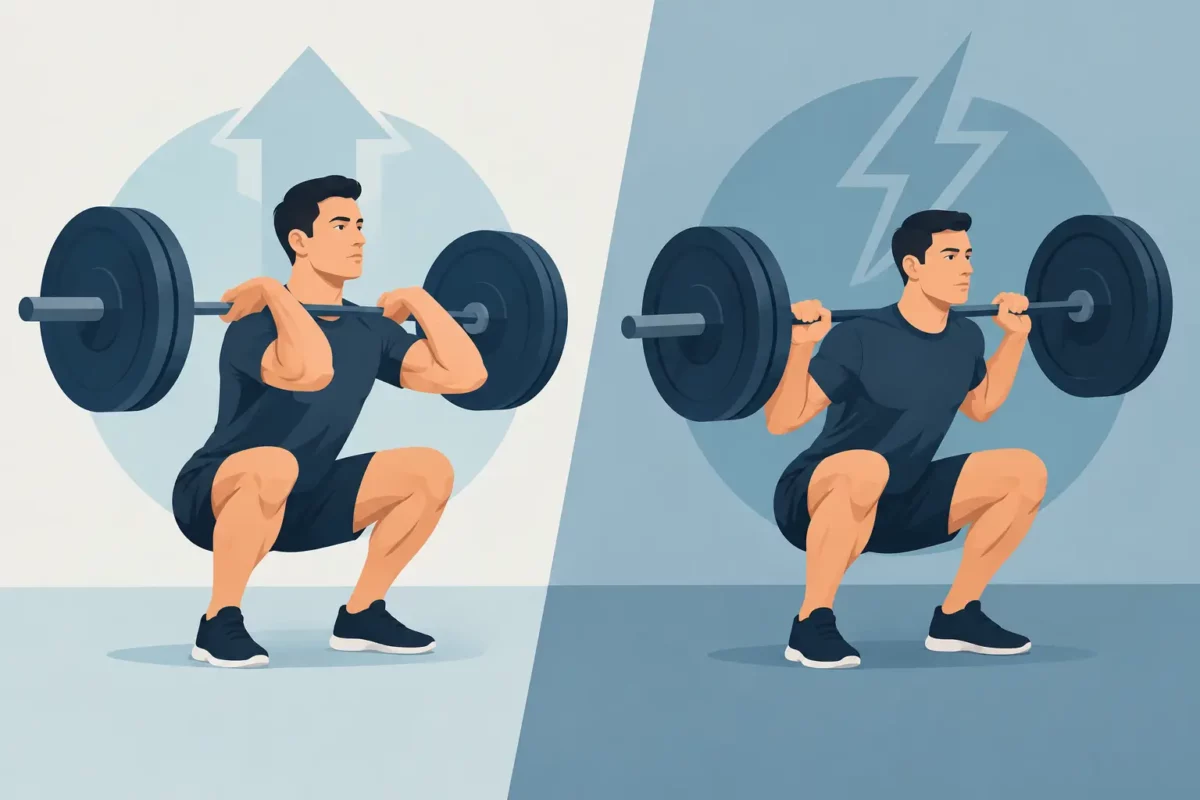
The front squat versus back squat question is not settled by declaring one lift superior. Both build serious lower-body strength. The better choice depends on the position you can control, the quality you need to develop, and where the lift belongs in your training week. A strong front squat can reinforce the rack position and upright posture that carry over to weightlifting. A heavy back squat can build the total leg and trunk strength that raises your ceiling in nearly every barbell sport.
For athletes and committed lifters, the useful question is this: which squat variation gives you the most productive force training right now? That answer can change as your mobility, technique, sport demands, and training phase change.
Front Squat Versus Back Squat: The Mechanical Difference
The bar position changes the entire lift. In a front squat, the bar sits across the front deltoids, supported by the hands in a clean-style rack or a crossed-arm variation. Because the load is in front of your center of mass, you must keep your torso relatively upright to keep the bar balanced over the midfoot. As you descend, the knees usually travel farther forward, and the quadriceps take on a large share of the work.
In a back squat, the bar rests on the upper traps in a high-bar position or farther down the rear deltoids in a low-bar position. The bar sits behind the torso, allowing more forward torso inclination while keeping the system balanced over the midfoot. That generally increases the contribution from the hips, glutes, adductors, and spinal erectors, especially with a low-bar style.
Neither pattern is more “functional” by default. They simply distribute stress differently. Front squats demand a more vertical posture and punish a weak upper back or collapsing brace quickly. Back squats usually allow more loading and provide more room for lifters with limited ankle or wrist mobility to find a stable position.
Which Squat Builds More Strength?
For absolute lower-body strength, the back squat usually wins. Most lifters can back squat substantially more weight than they can front squat because the bar position creates a more favorable leverage profile and does not require the same upper-back and rack-position endurance. More load means a strong case for back squats when the goal is raising maximal force production.
That does not make the front squat a light accessory movement. A hard front squat taxes the quads, trunk, upper back, and bracing system with remarkable efficiency. It also creates high demands at the bottom of the movement, where the lifter must maintain posture while reversing the load. If your front squat is weak because you fold forward, lose the elbows, or cannot stay balanced through the midfoot, improving it can expose and correct a real strength limitation.
Think of the back squat as a primary tool for building a large strength base. Think of the front squat as a highly specific tool for building strength in a more upright, knee-dominant position. Most performance-focused lifters benefit from both, but not necessarily with equal emphasis year-round.
The role of high-bar and low-bar back squats
Back squat style matters. A high-bar back squat has a more upright torso and greater knee travel than a low-bar back squat, so it often feels closer to a front squat in its quad demand. A low-bar back squat tends to shift more work toward the posterior chain and permits heavier loads for many lifters.
If you are comparing a front squat to a low-bar back squat, the contrast is large. If you are comparing it to a high-bar back squat, the difference is narrower. Do not let labels replace observation. Watch your bar path, torso angle, depth, and ability to maintain position under hard sets.
The Power Connection
Squats build power indirectly by increasing the force you can apply. Stronger legs and hips give you more raw material for jumping, sprinting, pulling, and Olympic lift derivatives. But a squat is not automatically a power exercise just because it is heavy. Power requires force expressed quickly.
Front squats often fit well beside cleans, clean pulls, and jerks because the receiving position mirrors the clean catch. They teach the athlete to stay tall under load, keep the elbows moving up, and drive out of a deep knee bend. For an Olympic weightlifter, that carryover is obvious. For field and court athletes, the upright posture and quad strength can also support force production in positions that look more like acceleration or deceleration than a hip-dominant hinge.
Back squats earn their place through loadability. A stronger back squat can raise overall lower-body force potential, particularly when programmed through progressive overload with sound technique. For athletes who need more general strength, have a low training age, or are simply under-muscled and underpowered, the back squat is often the more efficient main lift.
The transfer is not automatic. If you want to jump higher or move faster, pair squat strength with actual explosive work: jumps, loaded jumps, Olympic lift variations, sprints, throws, or sport-specific acceleration. Keep the explosive work technically sharp and fresh rather than burying it after exhausting squat volume.
Mobility and Technique Decide More Than Preference
The front rack is the main barrier for many lifters. Limited wrist extension, tight lats, restricted triceps, or poor thoracic extension can make a clean grip uncomfortable. Do not force a painful wrist position. Use straps around the bar temporarily, use a crossed-arm hold if needed, and work to improve the clean rack over time. The bar must rest on the shoulders, not hang from the hands.
Front squat depth also requires usable ankle dorsiflexion and hip flexion. Weightlifting shoes with an elevated heel can help many lifters reach depth while keeping the torso controlled. They are not a substitute for mobility work or sound bracing, but they are a legitimate equipment choice for a lift that demands a deep, upright position.
Back squats are not free of technical demands. Common failures include knees collapsing inward under loads you cannot control, hips shooting up before the chest, excessive lumbar movement, and a bar path that drifts away from the midfoot. The solution is rarely more weight. Reduce the load, use a repeatable setup, brace before every rep, and own the depth you train.
A useful standard for either variation is simple: the bar should travel over the midfoot, your whole foot should stay connected to the floor, and your trunk should remain rigid enough that the hips and shoulders rise together out of the bottom.
How to Program Both Without Diluting Progress
If your priority is maximum general strength, make the back squat the primary lift for a block of training. Use front squats as a secondary movement after back squats or on another day at lower volume. For example, back squats might occupy the heavy strength day for sets of three to six reps, while front squats appear later in the week for controlled sets of four to eight reps.
If you are focused on the clean, reverse that emphasis. Front squat first, often for doubles, triples, or sets of four to five reps that preserve posture and speed. Use back squats to add volume and build the broader strength base, especially in phases when clean practice volume is lower.
You do not need to max both lifts frequently. Testing is useful only when it informs training. A better indicator of progress is whether you can add load, repetitions, or cleaner execution over several weeks while recovering well enough to train explosively.
Volume also needs to match the rest of your work. Heavy squatting, sprinting, jumping, deadlifting, and high-volume Olympic lifting all compete for recovery. When your legs are constantly flat, your bar speed drops, and your positions degrade, adding more squat work is not disciplined training. It is poor load management.
When to Choose One Over the Other
Choose the front squat as your main squat when clean performance matters, when you need more quad and upright-position strength, or when your back squat pattern has become excessively hip dominant. It is also a strong choice when you want demanding leg work with somewhat lower absolute spinal loading, provided the front rack is secure.
Choose the back squat as your main squat when you need to build total lower-body strength, can recover from heavier loading, and need a straightforward way to apply progressive overload. It is especially useful for lifters whose front squat is limited more by rack position than by leg strength.
The front squat versus back squat decision is not an identity test. Train the variation that attacks your current limitation, then keep the other available as your needs shift. Build positions you can trust, add load with purpose, and let stronger squatting serve the explosive work that makes strength useful.