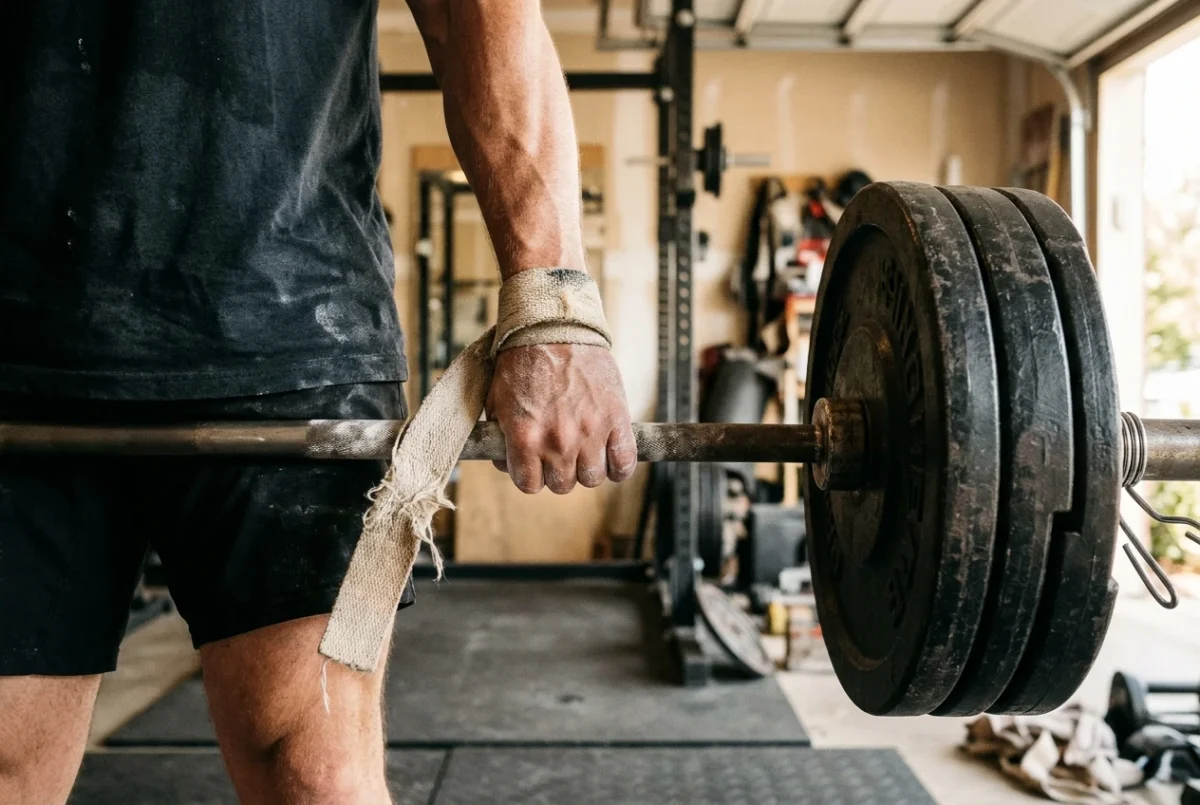
Straps do one job: they take your hands out of the equation so the muscle you are training can work until it is tired. Whether that helps or hurts depends on the set in front of you. A strap on a set where your back is the limit does nothing useful. A strap on a set where your grip gives out at rep six while your lats feel fresh lets you finish the work you came for.
This guide covers when to use lifting straps by lift and by type of day, when to leave them in your bag, and how to keep your grip from falling behind if you use them regularly.
The one question that decides whether to strap up: what fails first, your grip or your back?
Ask it at the end of a hard set. Where did the set stop? If the bar started slipping, your fingers opened, or your forearms burned so badly you had to put it down while your back or legs could have done more reps, grip failed first. If your form broke down at the lats, hamstrings, or lower back and the bar still felt secure in your hands, the target muscle failed first.
That answer sorts the set into one of two cases:
- Grip failed first and you wanted to train something else. Straps let the target muscle do its full share of the set.
- The muscle failed first, or grip is the quality you are building. Straps add nothing, and bare hands give your grip real work.
Most of the disagreement about straps comes from people answering different questions. Someone building a stronger back and someone building a stronger grip need opposite things from the same bar.
A quick test: do the same lift for the same reps once with straps and once without, on separate days. If the rep count or the feel in the target muscle changes a lot, grip was the limit. If the sets feel the same, you did not need them.
Back day lift by lift: rows, pulldowns, shrugs and Romanian deadlifts
Each lift loads your hands differently, so the answer changes with the exercise.
Barbell and dumbbell rows
Rows hold the weight for the whole set, and the weight is often heavy enough to tax your fingers well before your lats tire. Strap up for working sets, especially anything past about eight reps. For warm-up sets and lighter work, bare hands are fine and keep a little grip stimulus in the session. Chest-supported rows with moderate loads often need no straps at all.
Pulldowns and pull-ups
Grip rarely limits a pulldown at normal weights, so start bare. Straps become useful on long sets, on heavy sets, or if your forearms tire before your lats on the last few reps. For pull-ups, bodyweight is usually well within what your hands can hold, and hanging from the bar trains your grip directly. Save straps for weighted pull-ups where your hands give out first.
Shrugs
Shrugs are the clearest case for straps. The trapezius can handle a lot more weight than your fingers can hold for a set of ten or fifteen. If you go bare, the set ends in your hands and the traps get only a fraction of the work. Strap every working set, and keep the weight where you can hold the top of each rep for a moment.
Romanian deadlifts
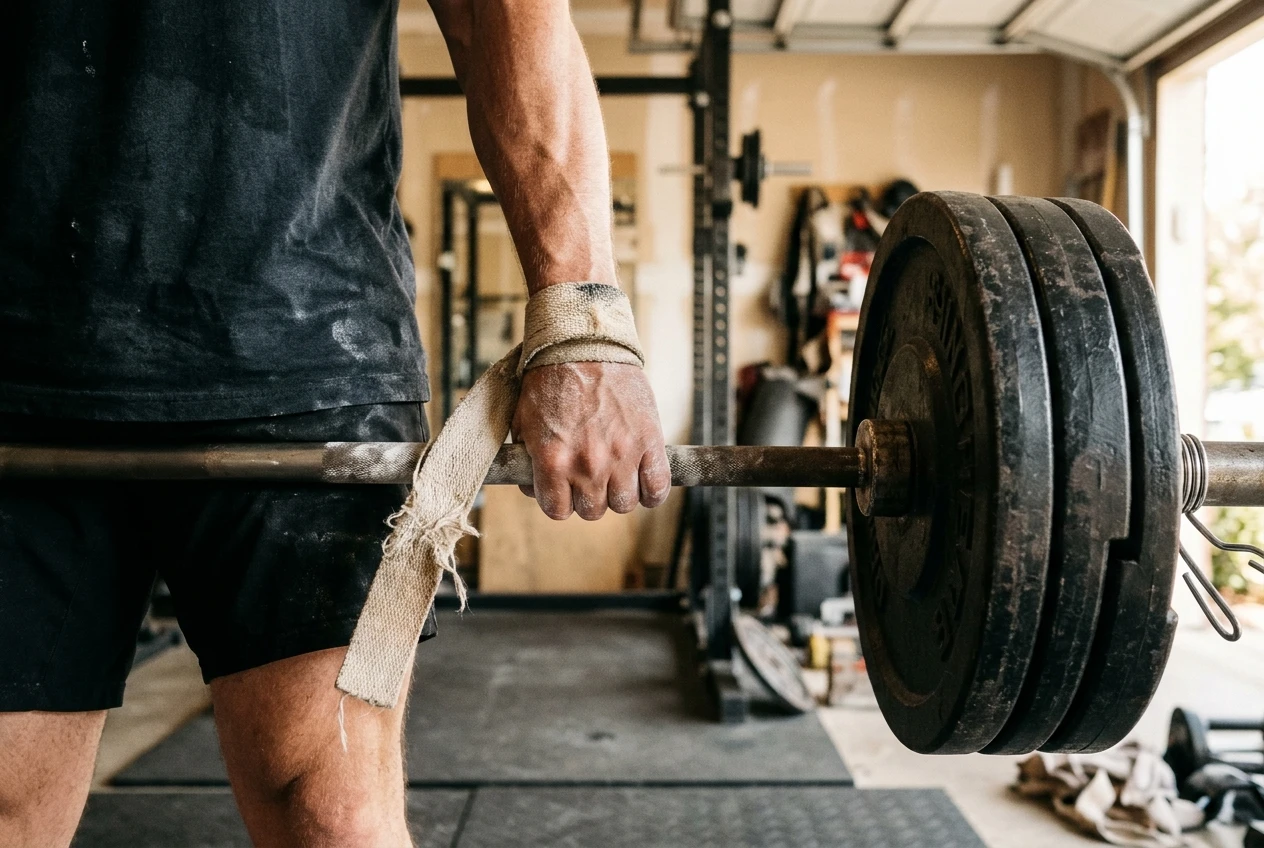
The Romanian deadlift is a hamstring and glute lift, and its load is limited by how long your hips and hamstrings can control it. On heavy or high-rep sets, your grip can quit first. Strap the later working sets when that happens and keep lighter sets bare. The bar travels a short distance, so it is easy to compare the same weight with and without straps and see where the set really ends.
Heavy deadlift days: which sets get straps and which stay bare
A deadlift session has several kinds of sets, and they do not all need the same treatment.
- Warm-ups and early ramp sets: bare. The weight is light enough to hold, and these sets give your grip steady, low-stress practice.
- Top sets and heavy back-off sets: strap if grip is the weak point. If your hands fail before your legs and back, straps let the lift itself train.
- High-rep sets: strap. A set of eight or more rarely tests how hard you can pull, but it does test how long you can hold on.
- A final heavy single or double: bare, if you want to know where your grip actually is. Keep this to one or two sets so it does not eat into the rest of your session.
If you compete in powerlifting, check your federation’s rulebook. Most federations do not allow straps on the platform, so the deadlifts that matter for competition need to be trained bare, with chalk, a hook grip, or a mixed grip, often enough that your hands are ready. In that case, straps are a tool for volume and back-focused accessory work, not for your primary heavy sets.
If your pulls fail at the top rather than in your hands, grip is not the issue. In that case the piece on how to fix deadlift lockout is the better place to look.
When to leave the straps in your bag and train your grip on purpose
Skip the straps when your hands are the thing you are building, and in a few other cases:
- Grip is your sport or job. Climbing, grappling, strongman events, and many manual jobs depend on hand strength. Training those qualities bare is the point.
- You compete in a federation that bans straps. Your hands need to hold the same weight on meet day that they hold in training.
- The set is light enough to hold. A set of rows at a moderate weight that your grip can handle gives you free grip work. Strapping it adds nothing.
- Your grip is already behind your back. If your back and legs routinely outpace your hands, more strap time widens the gap. Do more bare work until they are closer.
- You are in an early training phase. Beginners handle small weights, and hands strengthen alongside everything else. Straps are rarely the limit yet.
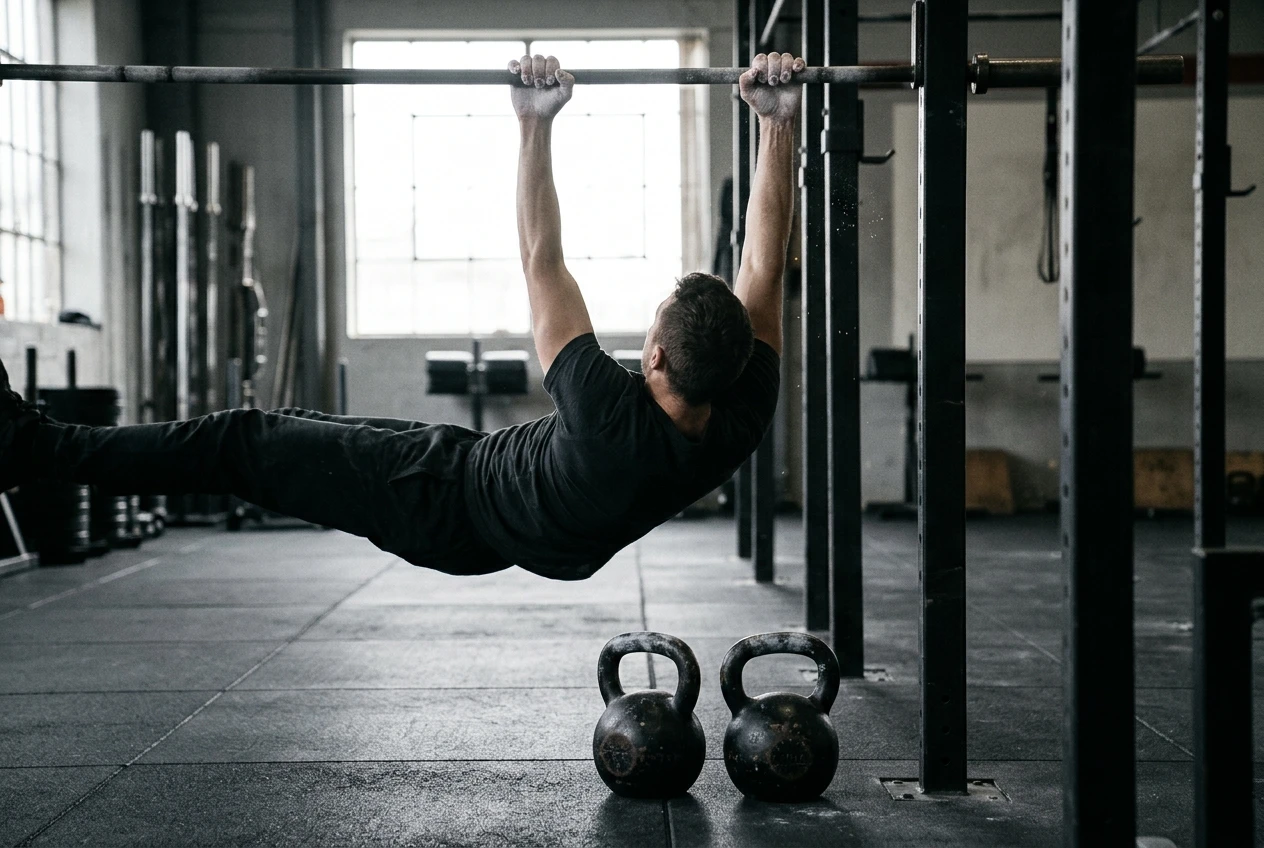
Training grip on purpose is simple. Dead hangs from a pull-up bar, farmer carries with heavy dumbbells or kettlebells, and heavy holds at the top of a deadlift all work. Add them at the end of a session, two or three times a week, and progress them like any other lift: more time, more weight, or a thicker handle.
How to add straps to a program without letting your grip fall behind
Straps work best as a switch you flip partway through a session, not a permanent setting.
- Go bare first. Do your first working sets without straps and put them on when grip starts to limit the set. You get the grip work while your hands are fresh, then the target muscle gets the rest.
- Strap the last sets, not the first. The final sets are where grip gives out, and that is where straps pay off.
- Schedule grip work separately. Put dead hangs or carries on one or two days each week so grip training is not a leftover.
- Track which sets used straps. Note “S” next to strapped sets in your log. Over a few weeks you can see whether your bare numbers are keeping pace.
- Add volume gradually. Straps often let you do more back work, and more sets mean more load on elbows and lower back. The guide on how to increase training volume safely walks through adding sets without overloading joints.
Check your bare numbers every few weeks. If your bare rows or deadlifts stay level or improve while your strapped numbers rise, your grip is keeping up. If your bare numbers stall while strapped work climbs, shift more sets to bare and add another grip day.
Setup mistakes that make straps feel useless or unsafe
Most complaints about straps come from setup, not from the straps.
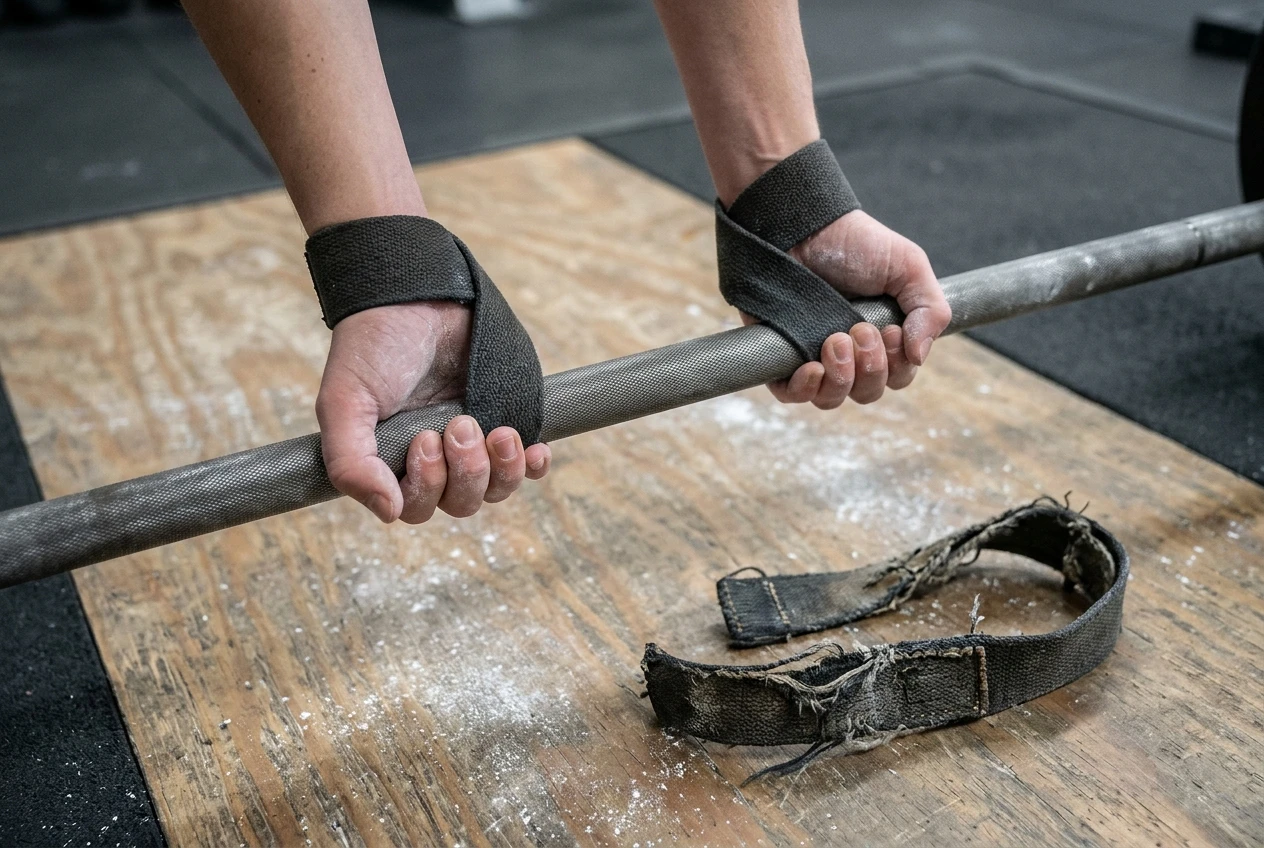
- Slack in the wrap. If the strap has loose loops around the bar, your hand slips inside it and the bar rolls. Take out the slack before you lift.
- Wrapping the wrong direction. The strap should tighten as the bar tries to roll out of your hand. If it loosens when you pull, unwrap it and wrap the other way.
- Holding the bar in your fingers. The bar should sit in your palm, closer to the base of your fingers, with the strap wrapped around it. A bar held in your fingers pulls them open under load.
- A loop that sits too low on the wrist. The loop should sit snug at the wrist, so the strap lies close to the back of your hand. A loop that dangles gives you extra slack to manage.
- Frayed or stretched straps. Cotton and nylon wear out. Replace any pair with fraying edges or stitching that is pulling loose.
- Strapping everything. Using straps on every set, including warm-ups, takes away the grip training you would otherwise get for free.
- Using them on lifts you cannot release. Straps belong on lifts where you can let go of the bar safely, such as pulls from the floor, rows, and shrugs. Avoid them on any movement where a bar could trap you if you lost control.
Fit and style matter too. Figure-eight and lasso straps behave differently under heavy loads, and the comparison is covered in the guide linked at the end of this article.
Straps, chalk, hooks and mixed grip: a quick way to choose between them
Each option solves a different problem. Pick by what is actually going wrong.
- Chalk helps when your hands slip because of sweat. It keeps you bare-handed, so it is the first fix to try. Some gyms ban it, so check before you bring it.
- Hook grip wraps your fingers over your thumb. It holds heavy barbell pulls securely without a strap, but it is uncomfortable on the thumbs at first and takes weeks of practice.
- Mixed grip puts one palm over and one under the bar. It is easy to learn and holds heavy deadlifts well. It also loads your shoulders and biceps unevenly, so alternate which hand is underhand from set to set.
- Straps hold the weight regardless of your grip. They suit back work, shrugs, high-rep sets, and any lift where your hands fail before the target muscle.
A practical order: try chalk first, then hook or mixed grip for heavy deadlifts, and bring in straps when volume or load outgrows what your hands can hold.
A simple strap rule you can write at the top of your training log
Copy this into your log:
Bare until grip is the limit. Strap the sets where the muscle still has more to give. Train grip on its own days.
Add one line for your own case, such as “Deadlift top sets bare, back-off sets strapped,” or “All shrugs strapped.” After a few weeks, review where your hands are failing and move the line accordingly.
Ready to pick a pair? Read Figure-Eight or Lasso Straps for Heavy Deadlifts? How to Pick the Right One.