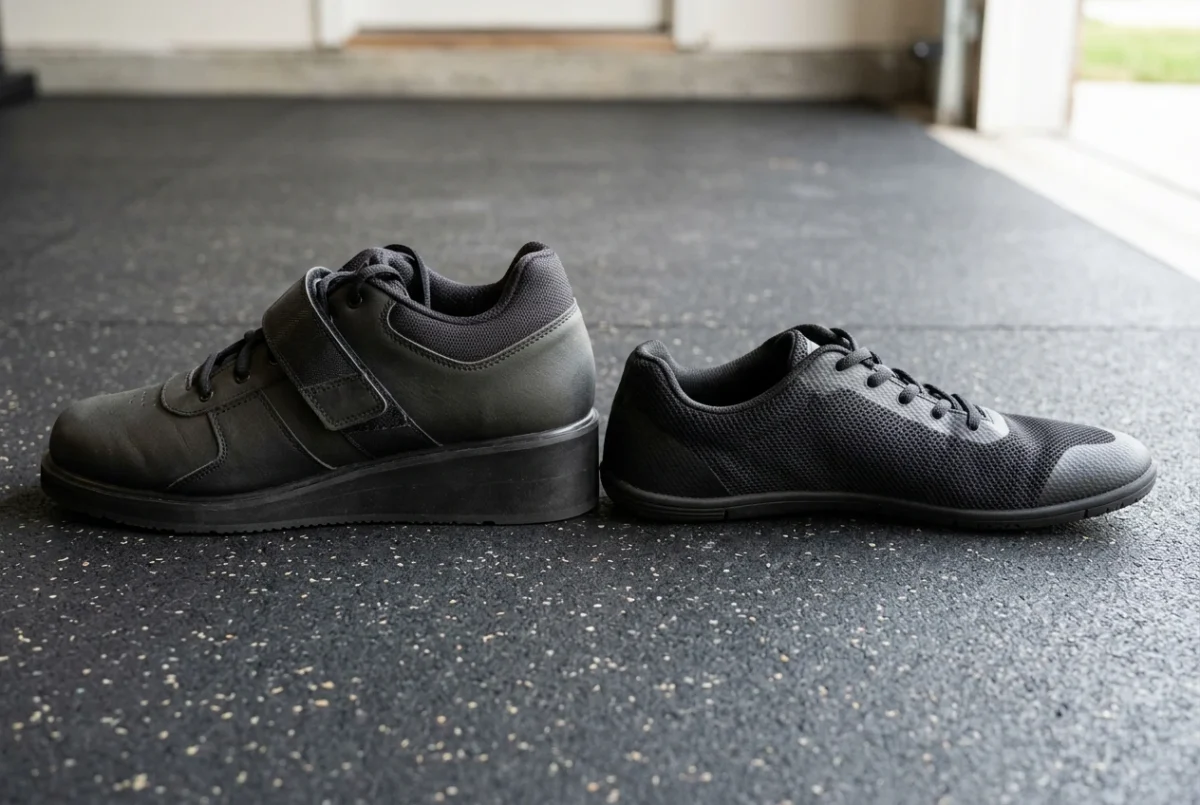
If you already own a pair of raised-heel lifting shoes, the question comes up the first time you program swings after your squats: do they stay on? The answer depends on which block of the session you are in. Lifting shoes for kettlebell workouts are a poor default, but they are the right choice for the heavy squatting that often shares the same session.
This article gives you a simple swap rule built on what each block asks of your feet, a three-question check to apply it, and a point inside the session where the changeover should happen.
Why the shoe that helps your squat can get in the way of a swing
A lifting shoe has a firm, raised heel. In a squat, that heel lets your knees travel forward, and your torso stays more upright at depth, without your heels lifting or your ankles running out of range. The hard sole also gives the load a solid platform, so none of your force goes into squashing foam.
A kettlebell swing wants something different. It is a hip hinge: the hips travel back, the shins stay fairly vertical, and the bell is driven forward by a hard hip extension. Your weight should sit through the middle of the foot and the heel, with the whole foot staying in contact with the floor. A raised heel tilts your shins forward and moves your weight toward the front of your foot. That works against the hinge, and it can encourage a squatty swing where the knees bend more than the hips move.
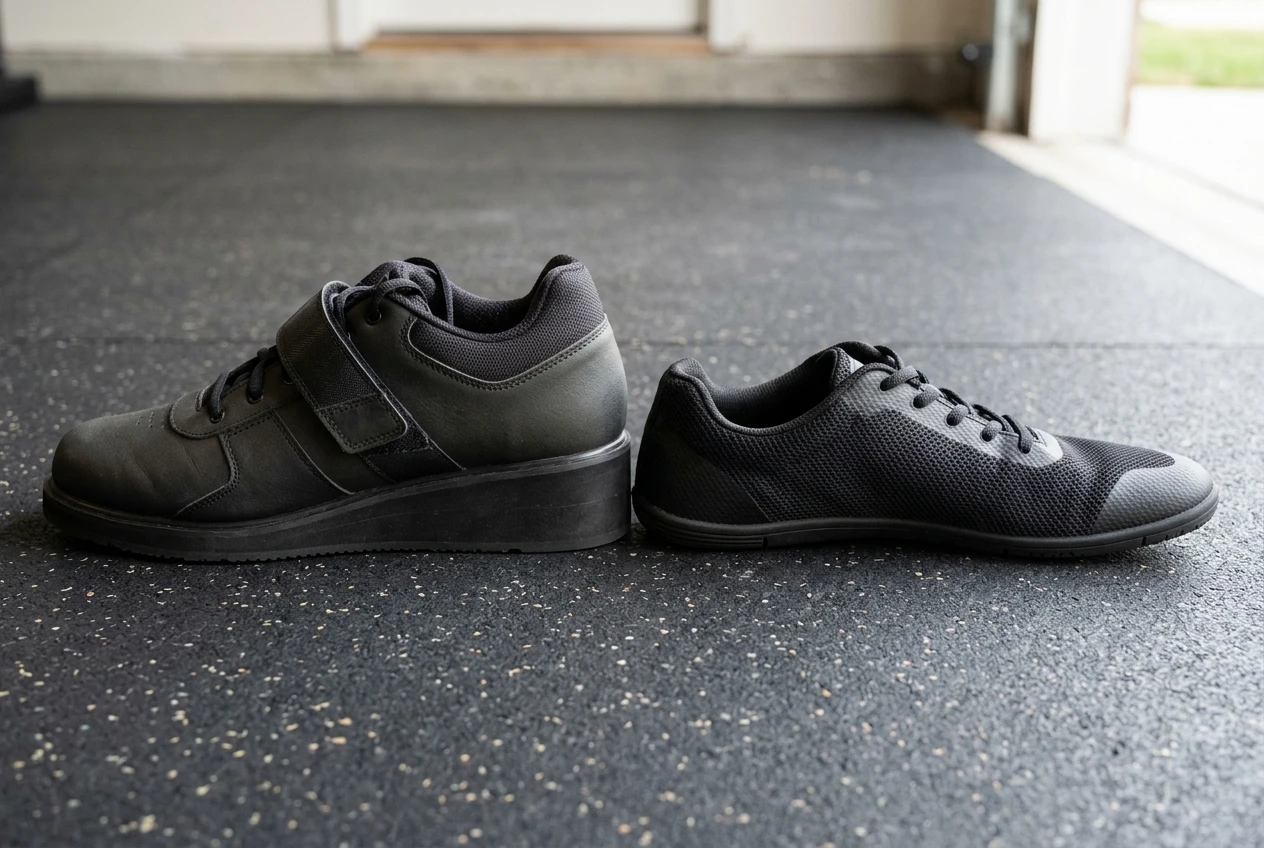
Cleans and flowing complexes add a second problem. Between swings, cleans, presses, and squats, your feet shift, pivot, and reset. A thick, rigid, elevated sole gives you a high platform to turn on, and it makes it harder to feel where your weight is. If you finish a flow with sore arches or a sense that your balance is slightly off, the shoe is worth checking before the technique.
None of this makes the lifting shoe a bad shoe. It is a good tool that suits one block of the session better than the next.
Three questions that decide which shoe a block of training needs
Run these questions on each block of your session. They take a few seconds once you have done them a couple of times.
- Is this a knee-dominant movement under heavy load? Heavy back squats, front squats, and paused squats are. If yes, the raised heel earns its place. If the movement is a hinge, as in swings, deadlift variations, and high pulls, the heel adds little.
- Do my feet stay planted for the whole set? A working set of squats starts and ends in one stance. A kettlebell flow involves stepping, pivoting, rotating, and changing stance mid-set. The more your feet move, the more you want a flat, low, stable sole under them.
- Do I need to feel the floor? In a heavy squat, you are pushing down hard through a stiff platform, and a firm sole helps. In a swing or a clean, you want to sense pressure moving across the foot as the bell travels. A thinner, flatter sole gives you more of that information.
Score each block by how many answers point to the lifting shoe. Three yes answers (heavy, planted, platform needed) means keep the lifting shoes on. Two or more no answers means change to the flat shoe. A block that splits down the middle, such as light goblet squats used as a warm-up, can go in either shoe, so follow whichever pair is already on your feet instead of swapping for it.
Where to swap a session that mixes heavy squats and kettlebell work
The cleanest structure is to put the heavy squatting first and the kettlebell work second. That gives you one changeover instead of several. You start the session in lifting shoes, finish your last working set, then change shoes before you pick up the first bell.
The swap point is the rest period after your final heavy squat set. Use that time to unstrap, sit down, change shoes, and put the lifting shoes by the rack where you will find them next session. Do not swap in the middle of a squat block, for instance, between your top set and your back-off sets. A few extra minutes of rest on the squat side is rarely a problem, but a changed platform halfway through a progression is.
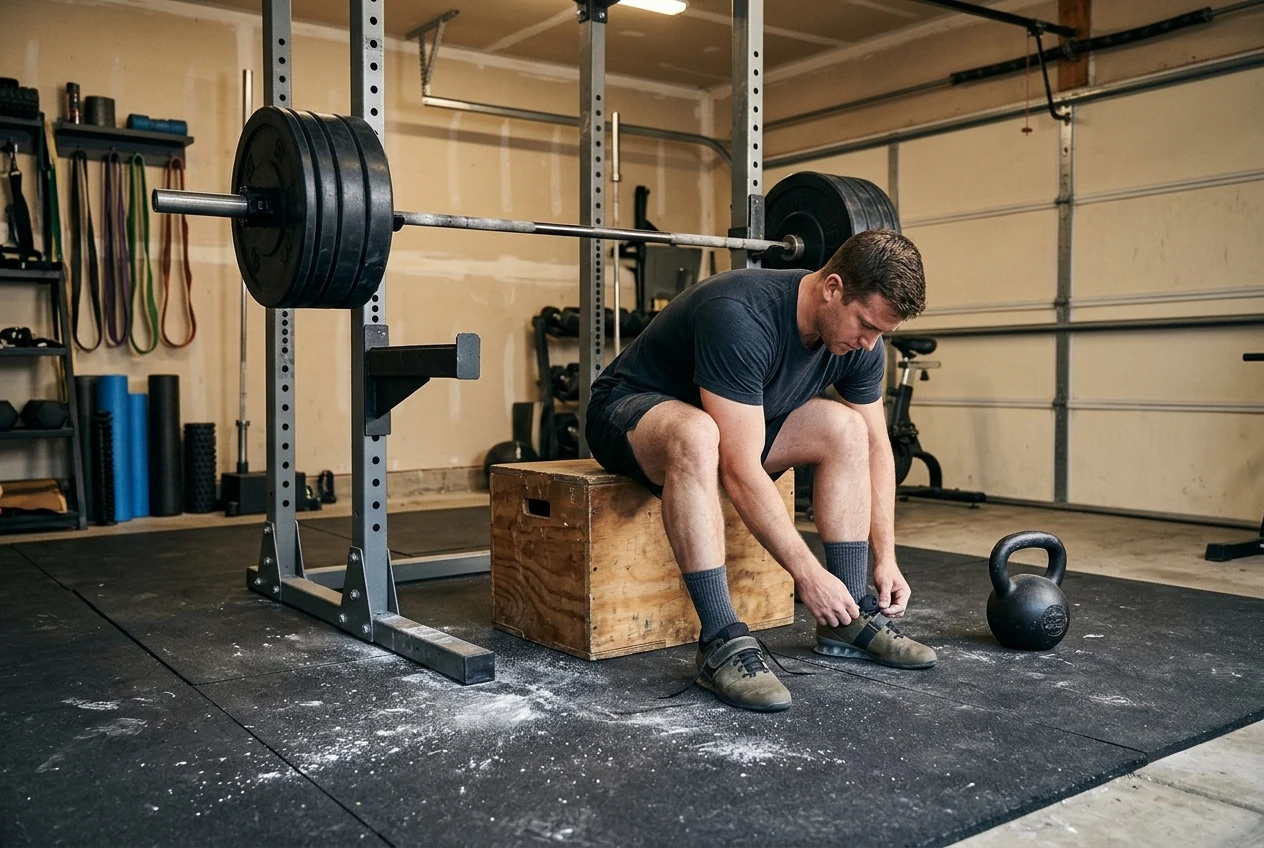
If your kettlebell work comes first, for example, swings as a warm-up or a short complex before squats, you have two options:
- Do the swings in the flat shoes, then change into lifting shoes before your first warm-up squat.
- If the warm-up swings are few and light, keep the lifting shoes on and accept a slightly imperfect hinge for that short block.
Pick one and keep it consistent. The changeover only works if you actually do it every session, and a plan with three swaps will be skipped by the second week.
If you are working out where complexes belong relative to squat phases in the first place, the piece on how to add kettlebell complexes to a squat program covers that placement. The shoe rule sits on top of it: wherever the complex lands in your week, the shoe follows the block.
What a stable shoe for a kettlebell flow needs to do, and what it can skip
A shoe for the kettlebell half of the session has a short list of jobs.
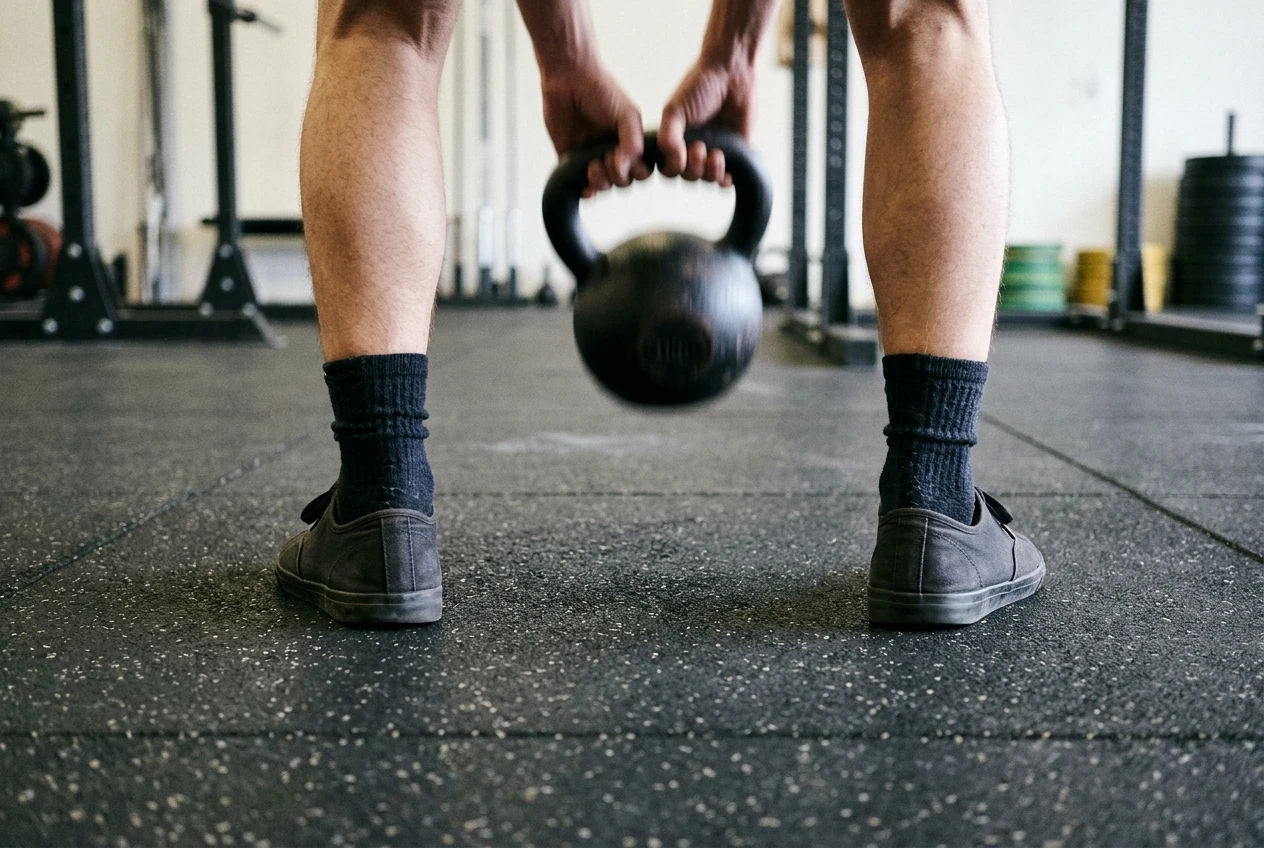
What it needs:
- A flat sole. The heel should sit at roughly the same height as the forefoot, so the hinge is not tilted forward.
- A firm midsole. Soft, thick foam compresses unevenly when you push hard through one side of the foot, and it makes pivoting feel wobbly. A thin, dense sole is more predictable.
- Grip on your floor. Rubber on mats, rubber on concrete, and rubber on wood all behave differently, so judge the sole on the surface you actually train on.
- A snug fit through the heel and midfoot. Your foot should not slide inside the shoe when the bell swings back between your legs or when you pivot.
- Room for the toes to spread. A wide toe box helps your foot stay planted and balanced through the whole flow.
What it can skip:
- A raised heel. It is the exact feature you took off the list.
- A metatarsal strap. Squat shoes use it to lock the foot down for heavy pulls on the platform. A flow benefits from a foot that can move a little.
- Cushioning. Running shoes are built to absorb impact over distance. A thick cushioned sole under a loaded kettlebell makes the stance less stable.
- Any heavy marketing about “kettlebell” on the box? A plain flat-soled training shoe, or any flat, firm-soled shoe that fits well, does the job.
Check the shoe by doing a few unloaded hinges and a few light swings in it. If your weight sits in your heels and midfoot, and the shoe does not squash or roll, it passes.
When barefoot or minimal footwear is the better call, and when it isn’t
Going barefoot, or wearing socks or a minimal shoe, is a legitimate choice for the kettlebell block. It gives you the flattest possible platform and the most feedback from the floor. Many lifters like it for swings, cleans, and getups because they can feel exactly where the weight sits across the foot.
It suits you best when:
- The floor is clean, level, and has enough grip, such as a rubber mat.
- You are comfortable with the bell’s path and not at risk of dropping it near your feet.
- Your gym or home allows it, and your feet feel fine on the surface.
It is the weaker choice when:
- The floor is slick or gritty. Bare feet or socks on smooth concrete, polished wood, or a dusty garage floor can slip, and sweat makes it worse. A grippy sole is safer.
- Your feet are tired or sore. A very thin sole gives you less protection, and a long session on a hard surface can leave your feet sore the next day.
- You are moving a lot. Fast pivots and stance changes can punish bare skin on rough surfaces, and a shoe with a grippy sole handles them better.
- Do you have any foot, ankle, or balance issues? Check with a qualified professional before changing what is on your feet. This article cannot judge that for you.
Barefoot or minimal footwear also does not belong under heavy squats unless that is how you already squat and your mobility allows it. The raised heel in the lifting shoe is there because of depth and positioning demands on the squat, and the flat option is for the blocks, where those demands go away.
Setting up a changeover spot in a garage or spare-room gym so you actually do the swap
A swap you have to hunt for shoes to do will get skipped. Make it effortless.
- Put the changeover spot next to the rack. A bench, a low box, or a stool within one step of where you finish squatting works well. You sit down, swap, and stand up already facing the kettlebells.
- Keep both pairs at the spot. The lifting shoes go there after the squat block, and the flat shoes sit there when you start. Neither pair should live in a bag across the room.
- Stage the kettlebells first. Set your bell or bells at the edge of the mat before the session begins. When you stand up from the swap, you start the next block immediately.
- Use a clean patch for your stocking feet. If your garage floor is dusty, a small mat or a folded towel at the changeover spot stops grit from getting inside the shoes or onto your socks. If you have not covered the floor yet, the article on what a home gym floor costs if you skip the mats helps you work out how much protection your own space needs.
- Make the shoes quick to put on. Flat shoes with simple closures save you time when your hands are tired and chalky.
Write the swap into your session notes or your program sheet, at the exact line between the squat block and the kettlebell block. A written line is harder to ignore than a good intention.
Get the kettlebell half of the session structured
Once your feet are sorted, the next question is what to do with them. If you want a kettlebell flow laid out for you instead of improvising swings and complexes after your squats, kettlebell. Monster offers structured kettlebell workouts. If you want to follow along on a screen in your home gym, there is also the Kettlebell Monster workout app for Samsung Tizen TVs.
Affiliate disclosure: I may earn a commission if you buy through these links.