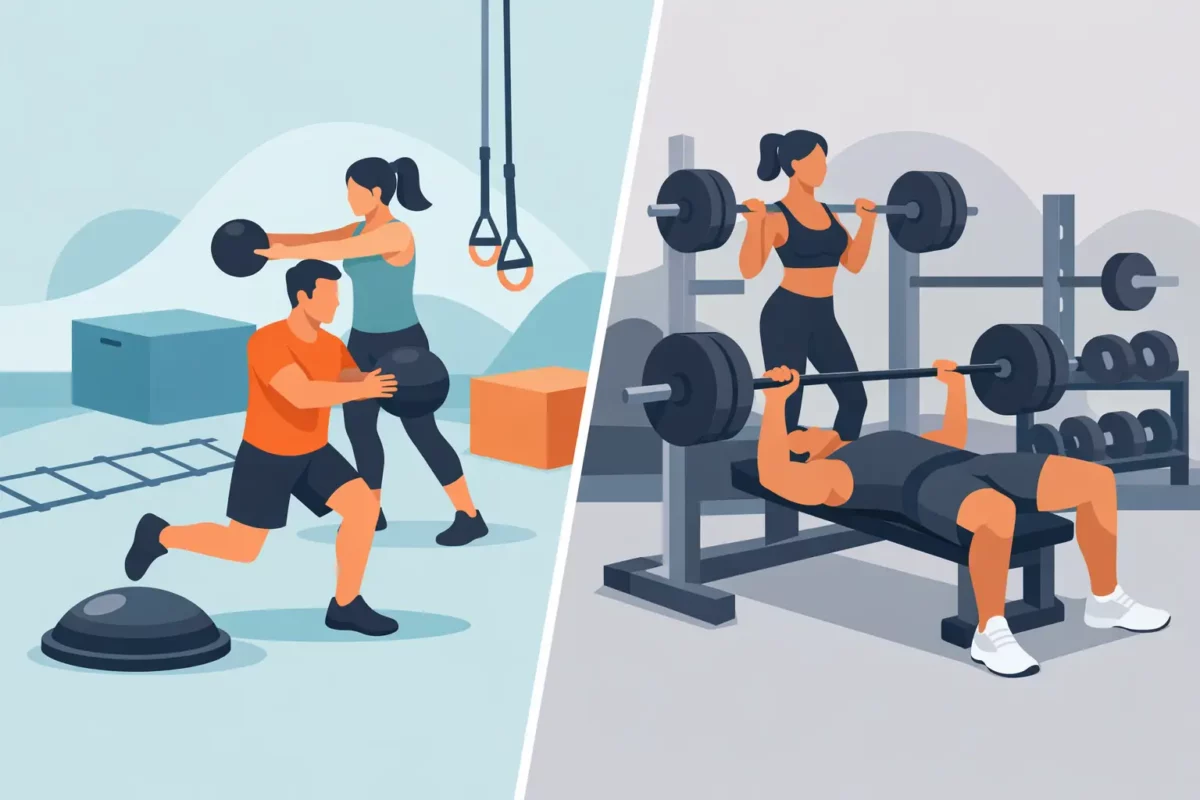
A loaded carry across the gym floor, a heavy back squat, a kettlebell swing, a set of split squats – all can build useful strength. That is why the question, what is functional strength training vs traditional strength training, is often answered poorly. The difference is not whether an exercise looks athletic or whether it uses free weights. It is whether the training method develops the specific force, movement skill, and physical qualities you need to perform better.
For lifters and athletes, this is not a debate about picking the more exciting style. Traditional strength work builds the raw force ceiling. Functional strength work can help organize that force into positions, movements, and demands that matter outside a single lift. Train either one badly and progress stalls. Train both with a clear purpose and your strength starts to carry over.
What Is Functional Strength Training?
Functional strength training is resistance training designed around a movement task or performance demand. It typically emphasizes coordinated, multi-joint movement; control through multiple planes of motion; unilateral work; carrying, bracing, rotating, resisting rotation, and producing force quickly.
The word “functional” gets abused in commercial fitness. Standing on a wobble board while doing light dumbbell presses is not automatically functional. Neither is turning every exercise into a circus act. A movement is functional when it improves a function you actually need: accelerating, changing direction, jumping, throwing, carrying, controlling your body, or maintaining position against external force.
For a field athlete, functional strength may include single-leg work, sled pushes, loaded carries, jumps, and rotational medicine-ball throws. For a firefighter, it may mean carries, drags, step-ups, pulls, and trunk strength under load. For a lifter, it can mean front squats that reinforce an upright torso, pauses that build positional control, and unilateral accessories that address force leaks.
The defining feature is not the exercise itself. It is the intended transfer.
Functional does not mean light or unstable
A common mistake is treating functional training as a high-rep circuit with bands, balance drills, and fatigue for its own sake. Balance and coordination matter, but they do not replace progressive loading. If you need more force, you must regularly produce force against meaningful resistance.
A heavy trap-bar deadlift can be highly functional for an athlete who needs lower-body force production. A weighted chin-up can be highly functional for someone who must climb, grapple, or control their bodyweight. The movement does not need to look like a sport skill to support sport performance.
What Is Traditional Strength Training?
Traditional strength training centers on progressive overload through established resistance exercises. It often uses barbells, dumbbells, machines, and bodyweight movements to increase maximal strength, muscle mass, and technical competence. The major patterns are familiar: squat, hinge, press, pull, lunge, and carry.
In practice, traditional training usually gives priority to measurable lifts. You add weight to the bar, perform more quality reps, improve range of motion, or tighten your execution at a given load. Squats, deadlifts, bench presses, overhead presses, rows, pull-ups, and Olympic lift variations all fit comfortably within this approach.
Traditional strength training is sometimes criticized as too isolated from real life or sport. That criticism misses the point. A stronger squat will not automatically make you a better basketball player, but greater leg strength gives you more potential force to apply when you jump, sprint, cut, and absorb contact. The sport-specific work still has to happen. Strength training supplies more horsepower.
Traditional work also makes progress easier to track. If your deadlift rises from 315 pounds to 405 pounds with sound mechanics, you have clear evidence that your capacity has changed. That matters when you are trying to build a stronger, more powerful body instead of chasing the feeling of a hard workout.
Functional Strength Training vs Traditional Strength Training: The Real Difference
The real difference is emphasis. Functional training asks, “What task must this person perform well?” Traditional training asks, “How can this person become stronger through progressive resistance?” Those questions should work together, not compete.
Traditional strength training generally makes it easier to overload the major muscle groups and movement patterns with precision. A barbell squat is stable, repeatable, and simple to load over months. That makes it excellent for building leg and trunk strength. A deadlift develops whole-body tension and force production in a way few exercises can match.
Functional strength training often introduces more movement variability and more direct connection to an athletic or occupational demand. A single-arm carry challenges grip, trunk control, gait, and shoulder stability. A rear-foot-elevated split squat can expose side-to-side weakness and build strength in a unilateral stance. Sled work may allow hard leg drive with less eccentric soreness than heavy squatting.
But variability has a cost. The more complex or unstable an exercise becomes, the less load you can usually use and the harder it is to measure progression. That does not make the exercise useless. It means it should earn its place in the program.
If your main goal is a bigger squat, you need to squat. If your goal is faster sprinting, stronger cutting, and better contact tolerance, you still need a strength base, then you need training that expresses and applies it. The right balance depends on the outcome.
Why Barbell Training Is More Functional Than Many People Think
The idea that traditional barbell work is not functional usually comes from confusing specificity with imitation. Strength training does not need to mimic every detail of a sport to improve performance. In fact, trying to copy sport movements with added load can sometimes create poor mechanics and unnecessary risk.
A clean pull does not look exactly like a sprint stride, yet it can develop aggressive hip extension and rapid force production. A front squat does not replicate a tackle, yet it can strengthen the legs and torso positions that help an athlete absorb and deliver force. Heavy presses and pulls do not recreate a throw, but they can build the upper-body strength that supports higher output when combined with skill work.
Barbells are especially valuable because they allow substantial loading, consistent technique, and long-term progression. Those qualities are functional for anyone who needs more usable force. The transfer becomes stronger when the lift is selected intelligently and placed alongside speed, jumping, throwing, sprinting, or sport practice.
How to Combine Both Methods for Power
For most performance-minded trainees, the best program is built around traditional strength work and supported by functional choices. Start with the lifts that deliver the largest return: a squat or deadlift pattern, a press, a pull, and, when appropriate, explosive weightlifting derivatives.
Then use functional exercises to address the demands the primary lifts do not fully cover. A football player may add sled work, carries, and single-leg training. A recreational lifter who wants to move better may use split squats, step-ups, loaded carries, and controlled rotational work. A weightlifter may include front-rack carries, unilateral leg work, and trunk exercises that reinforce stable receiving positions.
A simple week might include heavy squats and presses on one day, then clean pulls, split squats, and carries on another. The heavy work drives force production. The supplemental work improves positions, exposes weak links, and gives that strength more places to show up.
Keep the hierarchy clear. Explosive work requires quality, so perform it early while you are fresh. Heavy compound lifts should receive enough volume and intensity to progress. Assistance work should solve a problem, not just make the session longer.
Choose Training by the Result You Need
If you are new to lifting, do not rush to fill your program with complex functional drills. Learn to squat, hinge, press, pull, brace, and carry with control. Build strength steadily. Those fundamentals will do more for your long-term athletic potential than random novelty ever will.
If you already have a respectable strength base but feel slow, uncoordinated, or limited in a specific sport demand, add targeted functional work without abandoning the lifts that built your base. Test whether it is working. Are your sprint times, jump height, work capacity, movement quality, or performance under load improving? If not, adjust the training rather than defending the label.
The goal is not to collect exercises that look functional. Build enough strength to move serious weight, then teach your body to use that strength with speed, control, and intent. That is where practical power is earned.