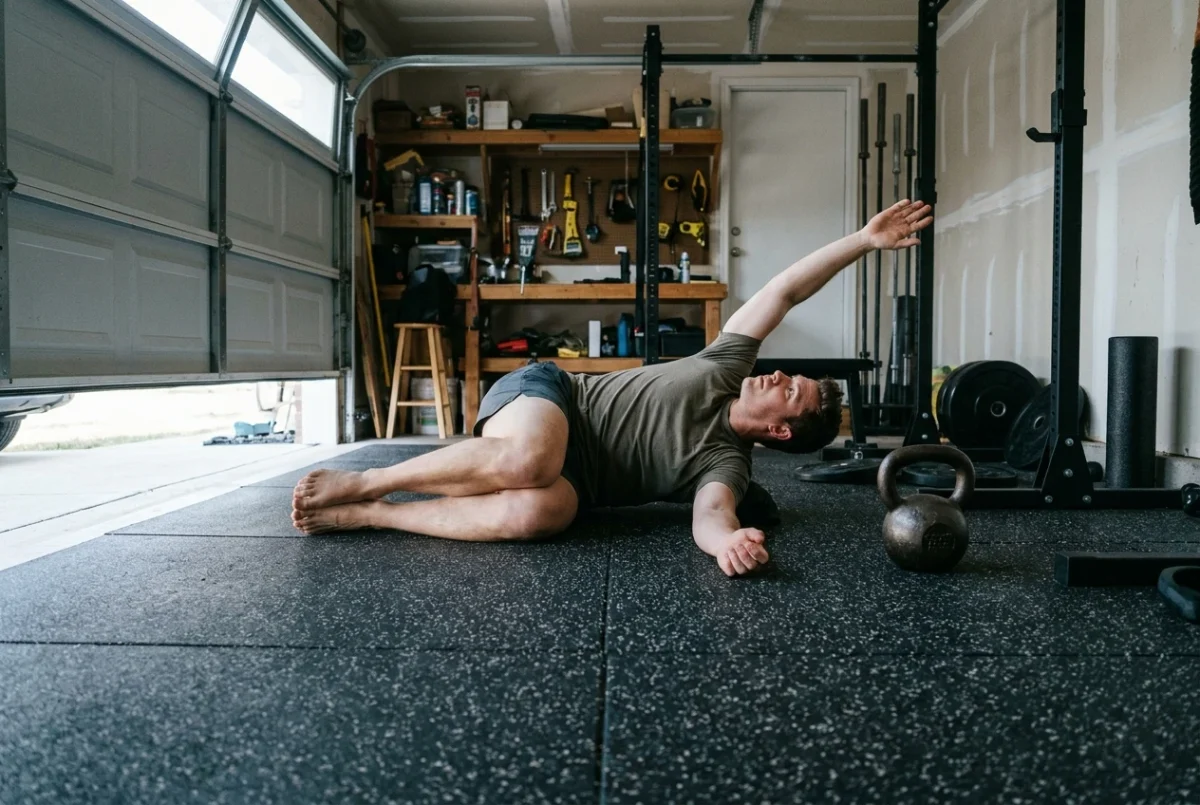
A kettlebell warm-up routine that says “do some mobility and a few light swings” has no endpoint, so it shrinks. You start with good intentions, the first two exercises feel fine, and by the third, you’re looking at the bell and deciding you’re warm enough. The warm-up gets shorter on the days you most need it, when you’re stiff, tired, or short on time.
This routine has a fixed length of ten minutes, split into five blocks of two minutes. Each block has one job, and you move on when the time is up, whether or not you feel finished. That keeps the whole warm-up inside the time you set aside for it.
Why most warm-ups get cut at minute three, and what a timed block fixes
An open-ended warm-up asks you to make a decision every thirty seconds: is this enough, should I do another round, can I start now? Each decision is an opportunity to skip something. A timed block removes the decision. The block has a job, a length, and a small number of movements, so you only have to do what is in front of you.
Blocks also make the warm-up easier to adjust. If a lift needs more hip work, you can see which block to change. If you’re short on time, you can see which blocks to shorten. A loose list of exercises doesn’t give you that.
Here is the full structure:
- Minutes 0 to 2: Raise your temperature
- Minutes 2 to 4: open the hips, ankles, and upper back
- Minutes 4 to 6: groove the hinge with the bell
- Minutes 6 to 8: brace and set your shoulders and grip
- Minutes 8 to 10: ramp up with the bell you’ll train with
You need one kettlebell lighter than your working bell if you have it, plus your working bell. If you only own one bell, use it for everything and keep the early reps slow and easy.
Block one (minutes 0 to 2): raise your temperature without wasting the bell
The job of this block is to get your heart rate up and your body warmer before you ask any joint to move through its full range. The bell stays on the floor. Swinging a bell to get warm uses up your best reps on the least prepared version of you, and it asks your lower back to work before your hips have moved.
Run three bodyweight movements for 40 seconds each, back to back, with no rest between them:
- Step jacks or easy jumping jacks. If your garage floor is hard or you’re sharing a wall with someone, step jacks keep the noise down.
- Bodyweight squats at a steady pace, standing fully tall at the top of each rep.
- A walking hinge, where you push your hips back with a long spine, reach toward the floor, then stand and step forward.
The pace should be brisk enough that you’re breathing harder by the end, but you shouldn’t be tired. If you’re sweating before the block is over, you went too hard. This block is only the entrance to the session.
Block two (minutes 2 to 4): open the hips, ankles, and upper back that your lift needs
Block two finds the joints that limit your lifts and moves them through a comfortable range. For most kettlebell work, three areas matter: the hips, the ankles and the upper back. Hips decide how deep you can hinge and squat. Ankles affect how your knees track in a squat. The upper back affects how well your arms get overhead and how the bell sits in the rack.
Pick one movement for each area and spend 40 seconds on each, which leaves 20 seconds to change position:
- Hips: a deep bodyweight squat hold, elbows pushing gently against the inside of your knees, rocking side to side.
- Ankles: a knee-over-toe rock, one foot a short distance from a wall, driving the knee forward while the heel stays down. Do 20 seconds per side.
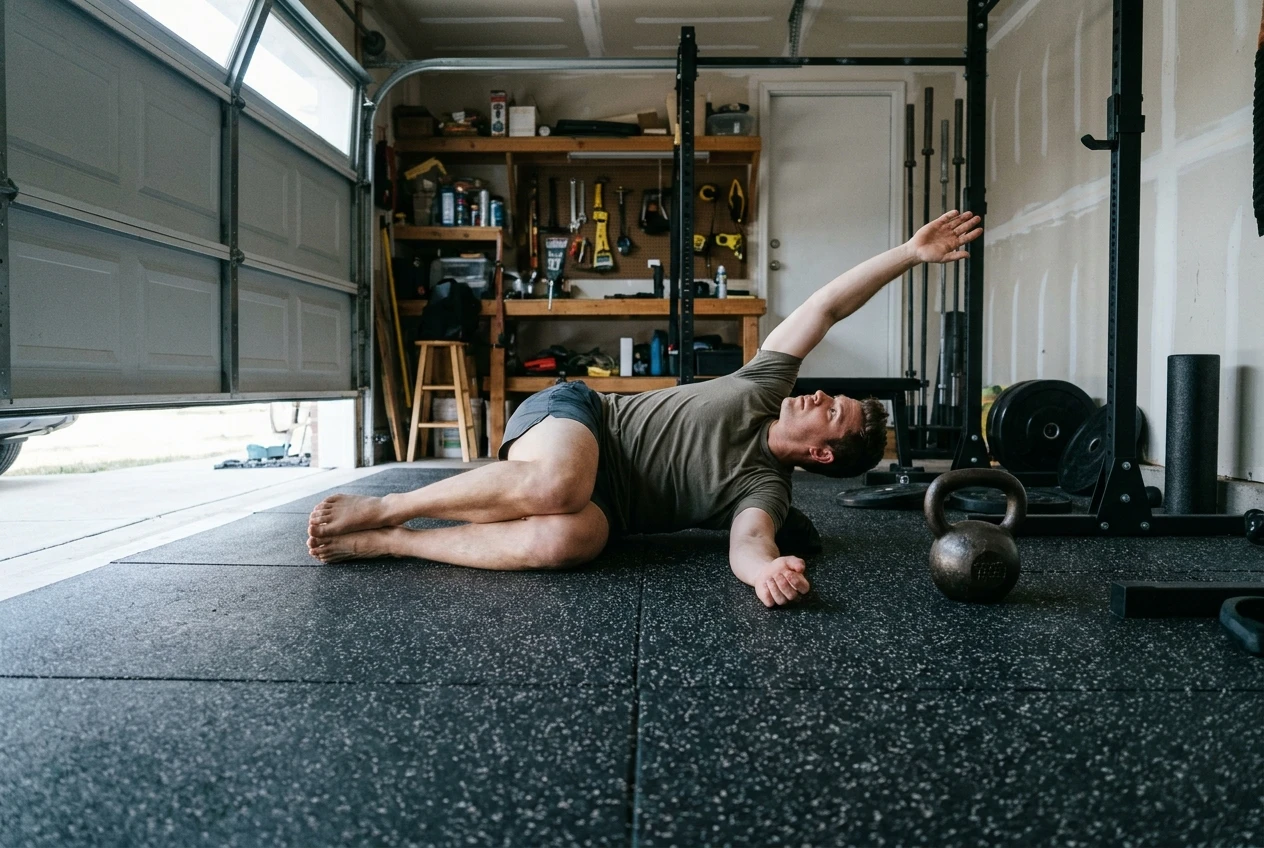
- Upper back: an open-book rotation on the floor, lying on your side with knees bent and rotating the top arm and chest toward the ceiling and back. Do 20 seconds per side.
Move smoothly and stop short of anything that pinches. This block is for moving in range, not for forcing it. If you find you can’t get into one of these positions at all, that is a different problem from warming up. The five mobility checks cover how to test that before you put a load on the position.
Block three (minutes 4 to 6): groove the hinge with the kettlebell before it carries the load
Now the bell comes off the floor. This block rehearses the hip hinge, which sits underneath swings, deadlifts, cleans, and snatches, with a light or easy load so your hips and back practice the pattern before the working sets.
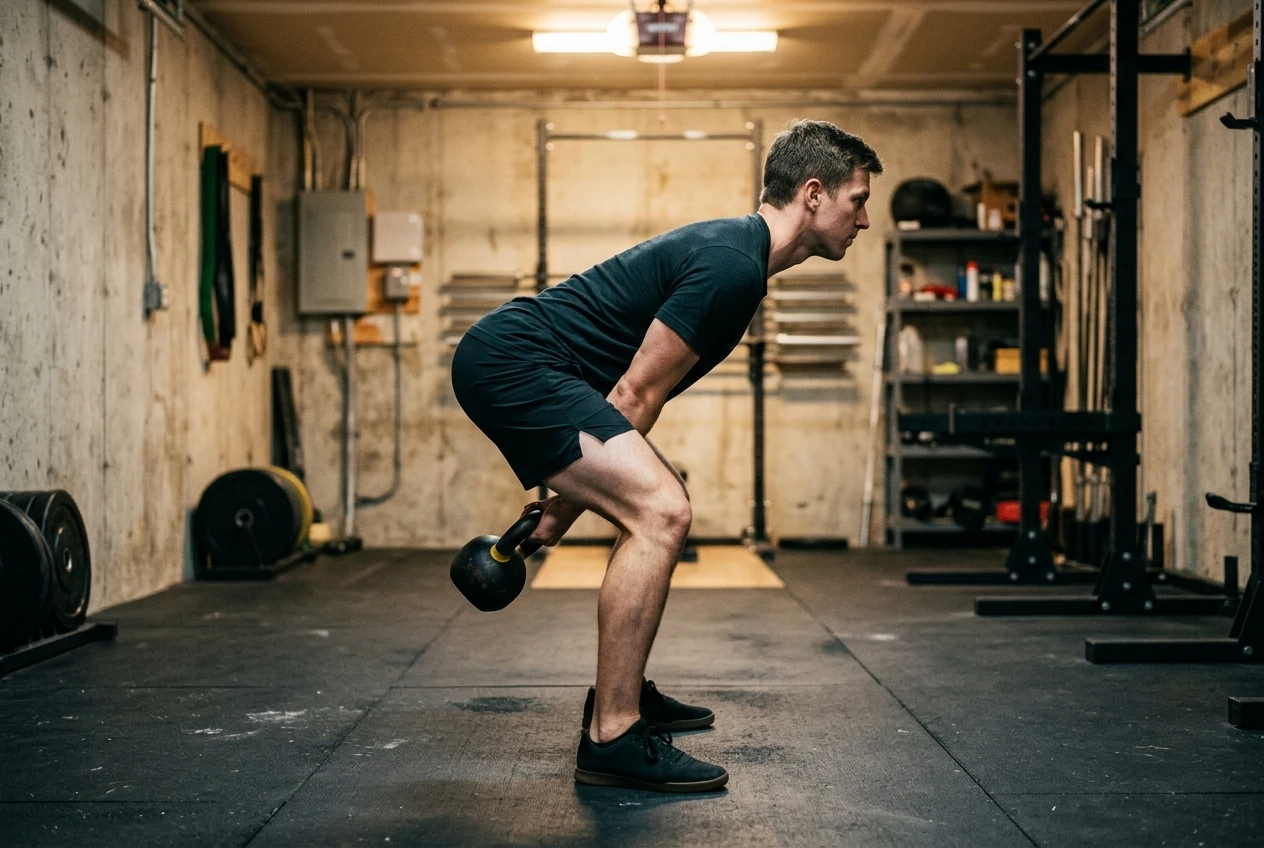
Use your lighter bell if you have one. Work through this sequence twice, spending about a minute on each pass:
- Five kettlebell deadlifts with a one-second pause at the bottom of each rep. Push the floor away, stand tall, and squeeze your glutes at the top.
- Five hike passes, where you tilt the bell back between your legs with your hips pushed back, forearms against your inner thighs, then stand.
- Five dead-stop swings. Start each rep from the floor, swing to chest height, set the bell down, and reset.
The cue for the whole block is that your hips move and your back stays long. The bell should travel because your hips drive it, not because your arms lift it. If you feel the swing in your lower back instead of your hips and glutes, slow down and go back to the deadlifts. The article on matching a swing fault to the accessory that trains it goes into what each kind of fault means.
Block four (minutes 6 to 8): brace and set your shoulders and grip
This block teaches your trunk, shoulders, and hands to hold tension, so the working sets start with a stable position instead of finding it while the bell is moving. Bracing means tightening your midsection around a held breath, as if someone were about to tap your stomach, without pulling your ribs up or flattening your lower back.

Run these four holds for 25 to 30 seconds each:
- 360 breathing: stand tall, breathe in through your nose so your belly, sides, and lower back expand, and hold the breath for a few seconds before you let the breath out.
- Front plank: ribs down, glutes tight, and your hands or forearms pressing into the floor.
- Rack position hold: the bell resting on your forearm and chest at one side, elbow tucked, shoulder pulled down away from your ear. Do 15 seconds per side.
- Suitcase hold: the bell hanging at your side while you stand tall, without leaning toward it. Do 15 seconds per side.
Grip often fails before legs do on kettlebell days, and this block gives your hands a first, light exposure. If grip is a regular limiter for you, the piece on giving grip its own block goes further than a two-minute warm-up can.
Block five (minutes 8 to 10): ramp-up sets with the bell you will actually train with
The final block moves you from prepared to ready. You pick up the bell you’ll train with and do short sets that build toward the first working set. The point is to rehearse the real lift at the real weight, with enough volume to feel the pattern and little enough to stay fresh.
A simple ramp for any lift:
- Set one: three reps, slow and controlled, at about half your normal effort.
- Set two: three reps at a working tempo and about three-quarters of normal effort.
- Set three: the first few reps of your first working set, stopping two or three reps short of what you plan to do.
Rest 15 to 20 seconds between sets and use the time to check one cue, such as hips back or ribs down. If you train with one bell, effort is your only variable, so keep the first set deliberately easy. When set three feels smooth and crisp, the warm-up has done its job, and you can start the session.
Swap one block to match the day: swings, squats, presses, or complexes
The routine only needs one change from day to day: block three. Blocks one, two, four, and five stay the same because they prepare you for almost any kettlebell session. Block three is where you rehearse the movement pattern, so that is the block to replace.
Today’s lift | Block three becomes |
|---|---|
Swings | Keep the hinge block as written |
Squats | Goblet squats with a two-second pause at the bottom, then five squats with the bell held in the rack, two rounds |
Presses | Halos, then five strict presses with a light bell per arm, plus wall slides if your shoulders feel tight |
Complexes | One slow, light pass through the complex, one bell, three reps per movement, paying attention to each transition |
For squats, the pause shows you whether your heels stay down and your chest stays up. For presses, halos move the shoulder joint around the head, and the light presses check that the bell goes straight up. For complexes, running the whole sequence slowly shows you which transition needs attention before fatigue arrives. If complexes are new to your programming, which complex belongs in which phase of your squat cycle explains where they fit.
Changing only one block keeps the routine familiar. You aren’t relearning a warm-up every day, and the other four blocks run on habit.
Following it on a screen instead of watching the clock: what a guided warm-up changes
Running a ten-minute routine from memory takes more attention than it sounds like. You’re tracking the time, remembering what comes next, counting reps, and trying to hold the cues for each movement. That’s a lot to carry before you’ve lifted anything, and it’s why steps get skipped. You lose track of the clock, forget the third movement in a block, and decide to move on.
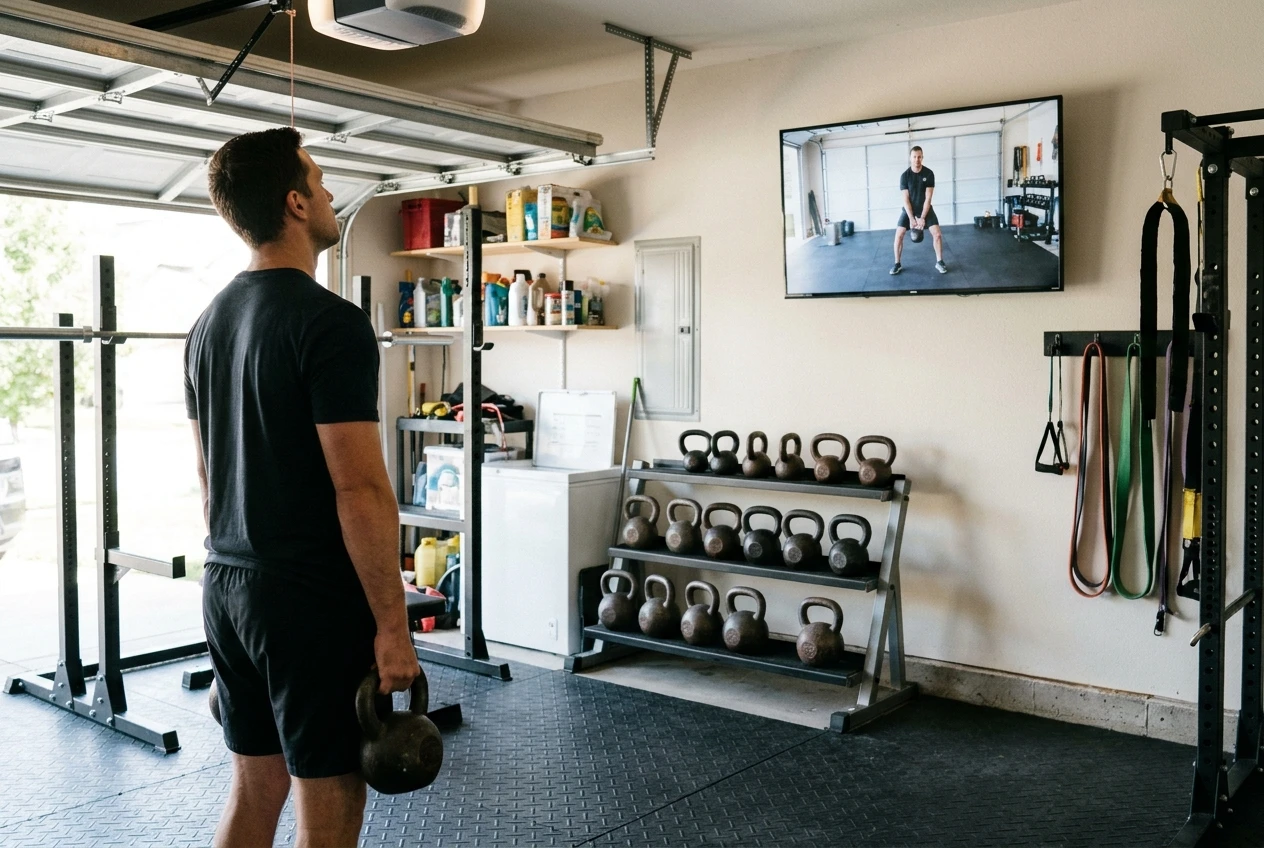
A guided screen takes the clock and the order of exercises off your hands. The timer decides when a block ends, the next movement appears without you having to remember it, and the form cues are on the screen instead of in your head. Your attention goes to how the movement feels. It also helps that your hands are free: chalky or sweaty hands are a poor fit for a phone.
Where you put the screen matters as much as having one. If you have to twist your neck to see it, you’ll either stop looking or compromise your position. The article on where to put the screen covers, placing it so you can follow along while keeping your posture.
What to do on the days you have only five minutes
On a short day, keep all five jobs and shrink the time on each. Dropping a whole block leaves a gap in the preparation. Shortening every block keeps the structure the same, which also keeps the habit intact.
Here is a five-minute version:
- Heat up (1 minute): step jacks and bodyweight squats, 30 seconds each.
- Open the joints (1 minute): one movement for the area your lift needs most. Use the deep squat hold for squats and swings, or the open-book rotation for presses.
- Groove the pattern (1 minute): the block three movement for the day, one round only.
- Brace (30 seconds): 360 breathing, five breaths, then a 15-second plank.
- Ramp up (1 minute 30 seconds): two ramp sets with the working bell, then start.
This version is rougher than the full one, and it’s fine to use it when time really is short. If you find yourself using it most days, the problem is probably how much training you plan. The piece on changing the dose when your work hours spike is a better place to look.
If you’d like the warm-up to run on a guided screen, Kettlebell Monster (affiliate link, I earn a commission if you buy) offers kettlebell workouts with a coach on screen, and its Samsung Tizen TV workout app (affiliate link, I earn a commission if you buy) puts them on your television, so the clock and the cues are in front of you while the bell is in your hands.