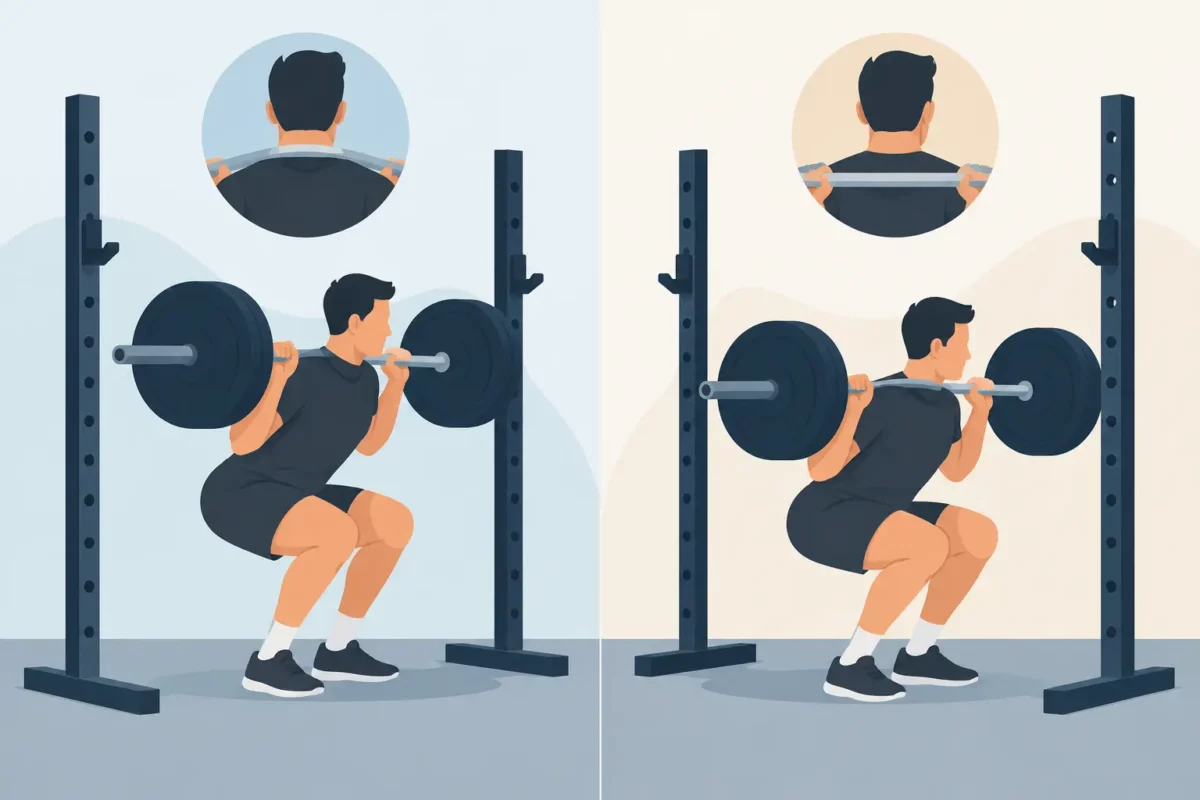
A squat can look like a squat from across the gym, but bar position changes the lift before you even take the bar out of the rack. In the high bar versus low bar discussion, the real question is not which variation is tougher or more legitimate. It is which position lets you build the strength, force, and movement quality your training actually requires.
Both styles deserve a place in serious strength training. Both can add size to the legs, improve squat strength, and build the ability to produce force against the floor. The difference is in how the load is organized over your body, where the work tends to accumulate, and what limitation each style exposes.
High Bar Versus Low Bar: The Mechanical Difference
A high bar squat places the bar on top of the upper traps. The bar sits high on the torso, which usually allows the lifter to stay more upright as they descend and stand. To keep the bar balanced over the middle of the foot, the knees generally travel farther forward and the hips stay more directly under the bar.
A low bar squat places the bar lower, across the rear delts and just below the spine of the scapula. This position moves the load slightly down and back. The lifter must lean forward more to keep the bar over the midfoot, creating a longer hip moment arm and a more pronounced hip hinge.
Neither pattern is automatically better. The bar still needs to travel over the middle of the foot, the trunk still needs to stay rigid, and the lifter still needs enough depth and control to use the legs effectively. But the way you reach those positions changes the muscular emphasis.
High bar squatting generally asks more from the quads because of the greater knee flexion and forward knee travel. It also demands strong upper-back positioning so the torso does not collapse forward out of the bottom. Low bar squatting generally places more demand on the hips, glutes, adductors, and spinal erectors because the torso angle is more horizontal and the hip extension requirement is larger.
What the High Bar Squat Builds
The high bar squat is often the more natural choice for athletes, Olympic weightlifters, and lifters who want a squat that resembles the posture of a clean recovery. Its upright position can make it easier to reach a deep, controlled squat while keeping the chest tall and the knees active.
That does not mean a high bar squat is only a quad exercise. Your glutes, adductors, trunk, and back still work hard. The point is that the lift tends to distribute more of the challenge toward the front of the thighs. If your quads are underdeveloped, your knee drive is weak, or you lose power when rising from a deep position, high bar work can be a direct solution.
High bar squatting also teaches a useful training skill: staying stacked under a load. When the bar is high on the traps, even a small loss of upper-back tension can pitch you forward. That makes the movement valuable for lifters who need better posture and bracing in front squats, cleans, jerks, and other upright strength positions.
The trade-off is that many lifters cannot move quite as much absolute weight with a high bar position. A more upright torso and greater knee demand may limit the number on the bar, especially if the lifter has a strong posterior chain and relatively weaker quads. That is not a reason to avoid it. It is a reason to understand what the variation is training.
What the Low Bar Squat Builds
The low bar squat is a powerful tool for building maximal squat strength. By shifting more of the work toward the hips and allowing a forward torso lean, many lifters can handle heavier loads. This can make low bar squatting highly effective for strength-focused phases where progressive overload is the main objective.
The movement requires serious control through the upper back, lats, trunk, hips, and hamstrings. If the bar position is secure and the lifter maintains tension, the low bar squat lets the posterior chain contribute aggressively on the way up. For powerlifters, field athletes, and lifters who want to develop forceful hip extension, that can be highly productive.
But heavier does not automatically mean more useful. A low bar squat can become a poor choice if it forces your shoulders into painful external rotation, aggravates the elbows or wrists, or causes you to lose position at depth. The bar belongs on a stable shelf created by the rear delts and upper back. If you are supporting it with your hands, cranking the wrists back, or feeling sharp shoulder discomfort, the setup needs work or the variation may not suit you right now.
Low bar also demands that you respect the hinge. Some lifters hear “sit back” and turn the squat into a good morning. The knees still need to bend, the quads still need to work, and the bar must remain balanced over the midfoot. Excessive forward lean may let you descend, but it will make the ascent slower and less stable.
Which Bar Position Is Better for Power?
For developing power, your choice should reflect the rest of your training. If you train cleans, snatches, jump variations, or sport movements that demand an upright receiving position, high bar squats often fit cleanly into the program. They reinforce leg drive from deep knee flexion and train posture that carries over well to Olympic lifting.
If your program centers on maximal strength, heavy pulls, sprint work, and forceful hip extension, low bar squats can provide a strong foundation. The ability to progressively load the movement can drive meaningful gains in lower-body strength, provided your technique stays consistent and recovery can support the work.
For many athletes, the answer is not one position forever. A primary low bar squat can build raw strength during an off-season strength block, while high bar squats can be used later to emphasize depth, quads, and more upright leg drive. A high bar primary squat can also be paired with Romanian deadlifts, deadlifts, and hip thrusts to make sure the posterior chain continues to develop.
Power comes from more than the bar position. It comes from applying force quickly, building enough strength to produce that force, and practicing movements with intent. Your squat should support that process rather than become a loyalty test to one style.
How to Choose Your Primary Squat Style
Start with your goal, then assess your position. If you compete in powerlifting, the low bar squat may be worth mastering because it can improve your competitive total. If you are training for weightlifting, high bar should usually be your primary back squat because it matches the positions you need under cleans and snatches.
For general athletic development, look at the weak link. Lifters who fold forward, struggle to keep their knees driving, or lack quad strength often benefit from more high bar work. Lifters with strong quads but weak hips, poor posterior-chain strength, or limited confidence under heavy loads may benefit from learning a sound low bar pattern.
Your structure matters too. Femur length, torso length, ankle mobility, hip anatomy, and shoulder mobility all affect what feels natural. A tall lifter with long femurs may still squat high bar effectively, but they may need heel elevation, focused ankle mobility, and patient technique work. A broad-shouldered lifter with stiff shoulders may find a low bar grip frustrating enough that the extra load is not worth the cost.
Pain is also useful feedback. Muscle fatigue and effort are part of training. Joint pain, numbness, or persistent irritation are not badges of discipline. Adjust the bar position, grip width, hand position, stance, or exercise selection before forcing a pattern your body cannot tolerate.
Program Both Without Diluting Your Progress
You do not need to rotate squat styles every week. Strength is built through repeated exposure, technical consistency, and progressive overload. Pick a primary style for a training block of at least six to eight weeks so you can measure progress honestly.
Use the secondary variation with a clear purpose. A low bar lifter might perform high bar paused squats for three to four sets of five to eight reps after heavy work to build quads and improve bottom control. A high bar lifter might use low bar squats for moderate sets of three to six reps during a strength block, provided the added loading does not interfere with their Olympic lift training.
The same standard applies to both positions: brace hard before the descent, maintain pressure through the whole foot, control the bottom, and drive up with intent. The bar path should stay efficient, but the rep should never be rushed at the expense of position.
Choose the squat that allows you to train hard, recover well, and progress with purpose. The best bar position is the one you can load with disciplined technique while it moves you closer to stronger lifts and more usable power.