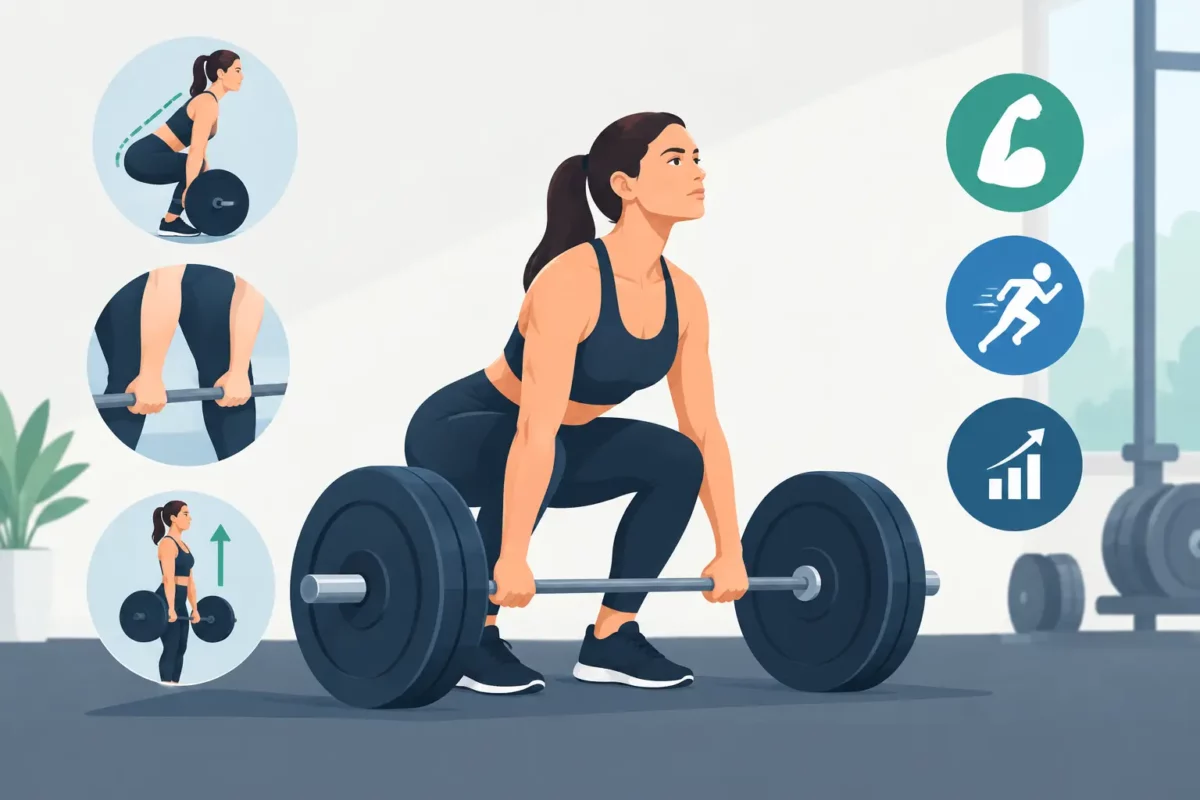
A missed rep rarely starts at the sticking point. It usually starts earlier: a loose brace before the squat descends, a bar drifting away from the shins on the deadlift, or a rushed pull that turns a clean into a forward chase. Weightlifting technique is not a cosmetic concern reserved for advanced lifters. It is the system that lets force reach the bar efficiently, repeat after repeat.
Better positions do not make hard training easy. They make hard training productive. When your movement is organized, you can apply more force in the right direction, handle progressive overload with less unnecessary wear, and build strength that carries into sprinting, jumping, contact sports, and demanding physical work.
Weightlifting Technique Is Force Applied With Control
Technique is often reduced to a list of cues: chest up, knees out, stay tight. Cues can help, but they are not technique by themselves. Good lifting is the ability to create stable positions, maintain balance over the foot, control the bar path, and produce force without losing the posture needed for the next phase of the lift.
That definition changes how you train. A technically sound squat is not simply one that looks upright. It is one where the lifter stays balanced, maintains a braced trunk, controls depth, and drives out of the bottom without the hips shooting up ahead of the bar. A technically sound deadlift is not just a bar leaving the floor. It is a pull that begins with the bar close, the lats engaged, pressure through the floor, and the spine held in a strong position as the bar rises.
The goal is not to chase a single textbook appearance. Limb lengths, mobility, injury history, and sport demands all affect what an individual’s best position looks like. The non-negotiables are balance, bracing, bar control, and repeatability under load.
Build Positions Before You Chase Speed
Power depends on speed, but speed without position is wasted effort. This matters most in explosive lifts such as cleans, snatches, jerks, high pulls, and push presses. If the setup is loose or the bar starts away from the body, trying to move faster often makes the error larger.
Start by owning the positions that produce the movement. In a clean, that means a balanced start, patient separation from the floor, a controlled transition past the knees, violent extension through the hips and legs, and a fast, stable receiving position. In a push press, it means a vertical dip, a disciplined brace, and force directed straight into the floor before the bar accelerates overhead.
Speed should rise from a consistent setup, not replace one. Use submaximal loads to practice acceleration while maintaining the same positions you would use on a heavier attempt. If the bar loops forward, you jump early, or your receiving position collapses, reduce the load and earn clean repetitions again.
The Bar Should Travel With a Purpose
Every major barbell lift has a bar path that supports efficient force production. In the squat, the bar should remain over the middle of the foot. In the deadlift, it should stay close to the body rather than drifting forward. In pressing, the bar should move around the face and finish stacked over the shoulder, hip, and midfoot.
A small drift can become a major strength leak. When the bar moves away from your base of support, your body must spend energy correcting it instead of driving it. That is why a deadlift that feels glued to the floor may not be a leg-strength problem at all. The bar may be starting too far forward, or the lifter may be losing lat tension before it breaks from the ground.
Use video from the side and from a slight front angle when possible. You are not looking for perfection in every frame. You are looking for repeated patterns: Does the bar move forward? Does your balance shift to your toes? Do your hips rise faster than your shoulders? Video gives you evidence instead of guesswork.
The Four Technical Priorities That Carry Over
Most lifters improve faster when they stop trying to fix ten things in one session. Focus on the highest-value technical priorities first.
- Brace before the rep. Take in air, lock the trunk, and create pressure before the bar moves. A brace is not just holding your breath. It is using the trunk to transfer force between the legs and the bar.
- Own the whole foot. Keep pressure balanced through the foot. Heels may feel heavy in a squat or clean, but the goal is not to roll backward. Stay connected from heel to forefoot so you can produce force without losing balance.
- Keep the bar close. Whether you are pulling from the floor or pressing overhead, avoid unnecessary distance between your body and the bar. Distance increases the demand on smaller stabilizers and weakens leverage.
- Finish the rep under control. Stand tall, lock out when the lift requires it, and reset with intention. Rushed resets turn one technical error into a string of poor repetitions.
These priorities are simple, but they are demanding under real load. That is why technique practice belongs in every training block, not only during a warm-up phase or after something goes wrong.
Use Load as a Technical Tool
There is a common mistake on both ends of the spectrum. Some lifters add weight even when every rep is different. Others stay light indefinitely, calling it technique work without ever learning to maintain positions under meaningful resistance.
The right load is the one that challenges your ability to hold the intended positions while still allowing correction. For a newer lifter, that may be a light barbell, dumbbells, or a controlled variation such as a goblet squat, Romanian deadlift, or hang power clean. For an experienced lifter, it may be 70 to 85 percent work performed with strict standards, pauses, or a reduced-rep format.
Use a simple rule: if you cannot describe what changed when the rep went wrong, the load may be too high for productive technical practice. A missed lift can teach you something, but only if the error is clear enough to correct on the next attempt.
Pauses are especially useful because they expose weak positions. Pause just below the knee in a deadlift to feel lat tension and bar proximity. Pause at the bottom of a squat to build control and confidence out of depth. Pause in the dip of a push press to eliminate the habit of folding forward. The pause does not need to be long. One or two disciplined seconds can reveal more than another set of rushed reps.
Practice One Correction at a Time
Technical change works best when it is specific. “Lift better” is not a useful instruction. “Keep the bar against the laces through the first pull” is useful. “Finish the deadlift with the ribs down instead of leaning back” is useful.
Choose one primary correction for a training block or at least a full session. Give yourself a short cue before each work set, then judge the result afterward. During a squat session, your focus may be maintaining pressure over the midfoot. During clean practice, it may be staying patient from the floor to the knee. Do not stack five cues in your head and expect an athletic movement.
This approach also keeps coaching feedback productive. If your squat is unstable because of poor bracing, limited ankle motion, and an inconsistent descent, begin with the issue that most limits safe, repeatable loading. Better bracing may improve the descent immediately. Then you can determine whether mobility work or a stance adjustment is actually needed.
Train Technique When You Are Fresh Enough to Use It
Heavy fatigue changes movement. That does not mean fatigued training is useless. Strong athletes must sometimes produce force when tired. But skill acquisition and high-fatigue conditioning are different goals.
Place your most technical and explosive work early in the session, after a specific warm-up. Cleans, snatches, jumps, throws, and fast presses need attention and intent. Heavy squats and deadlifts can follow, provided the movement quality remains high. Assistance work belongs later, where fatigue is less likely to teach poor barbell habits.
You should also separate productive strain from technical breakdown. A hard final rep that slows down while staying in position can build strength. A rep that turns into a rounded pull, a knee cave with lost foot pressure, or a press that finishes with the low back overextended is different. End the set or reduce the load when the pattern changes substantially.
Make Better Reps Your Standard
Strong technique is built through standards, not occasional motivation. Film key work sets. Track the loads where your positions begin to fail. Use variations that directly address your weak link. Repeat the work long enough to improve rather than changing exercises every week.
There will be sessions when the bar feels heavy, your timing is off, or recovery is not where it should be. On those days, the disciplined choice is often to adjust the load and keep the movement sharp. That is not backing down. It is protecting the quality of the work that builds real power.
The barbell gives immediate feedback. Respect it, refine the rep in front of you, and let every technically sound lift become proof that you are building strength you can use.