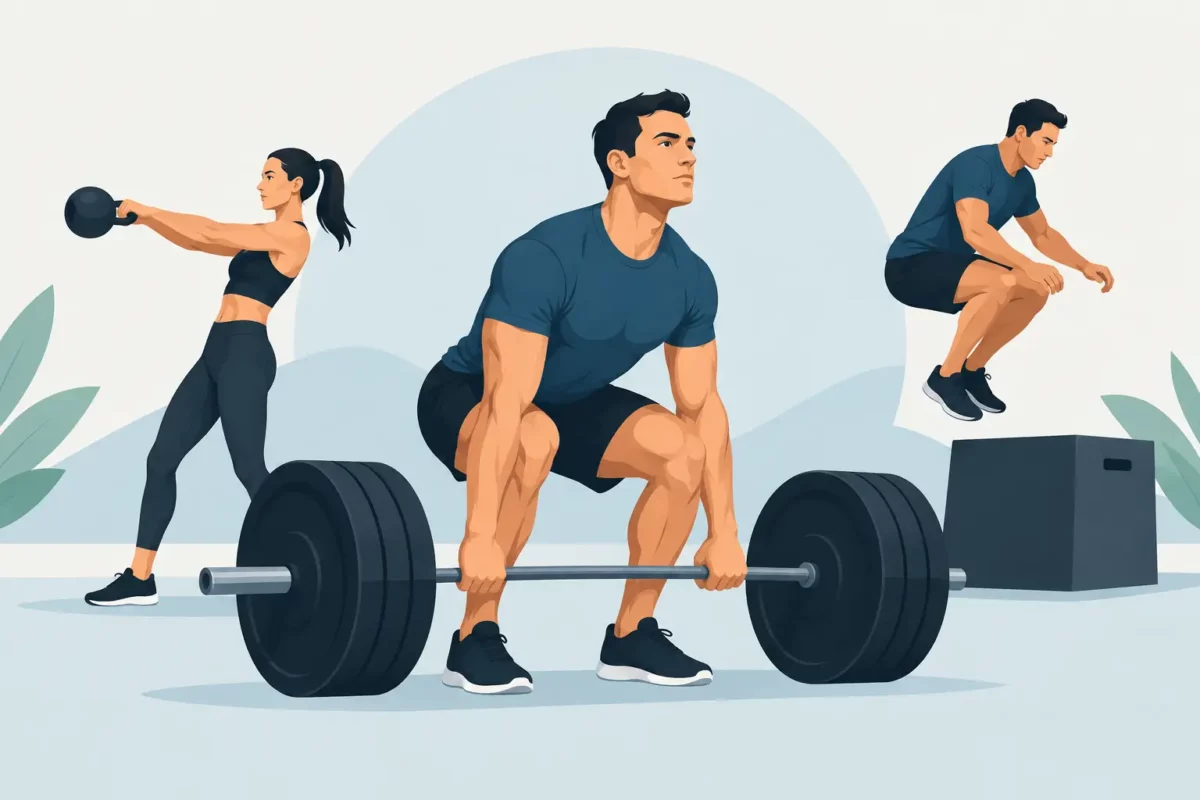
A bigger lift is useful. A lift you can apply fast is more useful. That is the purpose of force production exercises: teaching your body to create high levels of force, direct it well, and express it when a sport, a loaded task, or a competitive lift demands it. Random sweat sessions do not reliably build that quality. Productive power training does.
Force production is not limited to Olympic weightlifters or field athletes. If you want a stronger deadlift, a faster first step, more pop off the floor, or the confidence that comes from being physically capable, you need to train force deliberately. The answer is not chasing fatigue. It is choosing movements that build strength, then learning to apply that strength with speed and control.
Force Production Exercises: What Actually Qualifies?
Force is the product of mass and acceleration. In the gym, that means you can raise force output by moving a heavy load, moving a moderate or light load quickly, or combining both qualities across a training week. Power adds a time element: it is force expressed rapidly. A lifter who can grind through a heavy squat is strong. A lifter who can stand up with that same strength quickly, jump high, sprint hard, or drive a clean aggressively has a better ability to express power.
The best force production exercises usually have a few traits in common. They allow meaningful loading, require coordinated use of multiple joints, and give you room to progress over time. They also demand intent. A barbell does not know whether you are trying to move it violently or simply complete another rep. Your nervous system does.
That does not mean every set should be fast. Heavy strength work often moves slowly because the load is heavy, even when your intent is aggressive. The point is to push or pull with maximum purposeful effort while maintaining position. Speed work uses lighter loads so actual bar speed can stay high. Both belong in a serious plan.
The Main Lifts That Build a Stronger Base
Squats and deadlifts
Back squats, front squats, deadlifts, trap-bar deadlifts, and Romanian deadlifts are foundational because they train the legs, hips, trunk, and upper back to transmit force under substantial load. They are not glamorous, but they give explosive work something to draw from. A bigger strength reserve means a given jump, sprint step, or clean requires a smaller percentage of your maximum capacity.
Squats are especially valuable for athletes and lifters who need strong knee extension and upright leg drive. Front squats demand a more vertical torso and often carry well into clean recovery strength. Back squats generally allow more loading and are excellent for accumulating lower-body strength. The right choice depends on your structure, sport, equipment, and ability to recover, not on internet loyalty to one variation.
Deadlift patterns build hip extension and total-body tension. A conventional deadlift rewards strong positioning from the floor. A trap-bar deadlift can be an outstanding option for athletes because it often permits forceful reps with less technical complexity and a more upright position. Romanian deadlifts build hamstring and hip strength through a longer range of motion, making them valuable support work rather than a replacement for all heavy pulling.
Presses, pulls, and carries
Force production is not only a lower-body conversation. Bench presses, overhead presses, weighted pull-ups, rows, and loaded carries create the upper-body and trunk strength needed to transfer force through contact, throwing, climbing, lifting, and barbell sport.
The bench press builds pressing force when the upper back is stable, the feet are planted, and the bar path stays repeatable. The overhead press demands whole-body bracing and shoulder strength. Weighted pull-ups and heavy rows develop the lats and upper back, which matter for pulling mechanics, shoulder control, and keeping a bar close during explosive lifts.
Carries deserve more respect than they get. Heavy farmer carries, front-rack carries, and suitcase carries teach you to produce force while resisting unwanted movement. They are not a substitute for squatting or pulling, but they build the trunk stiffness and grip strength that keep force from leaking away when a load gets heavy.
Olympic lift derivatives
Power cleans, hang cleans, high pulls, power snatches, and clean pulls train rapid extension through the ankles, knees, and hips. They also demand timing, posture, and a decisive finish. For lifters with sound coaching and enough mobility, these movements are among the most direct ways to train explosive barbell power.
The trade-off is technical demand. A poorly timed power clean is not automatically a power exercise just because it is fast and looks athletic. If catching the bar limits your position or confidence, clean pulls and high pulls can deliver much of the explosive extension with a simpler learning curve. Hang variations also reduce the complexity of pulling from the floor while letting you train forceful hip and leg drive.
Jumps, throws, and loaded ballistic work
Jumps and medicine ball throws have low external load but high intent. A countermovement jump trains rapid force development. A box jump can be useful when it is treated as a jump, not a test of how high you can pull your knees. Broad jumps challenge horizontal projection, while medicine ball chest passes, scoop tosses, and overhead throws train upper-body and rotational power without the deceleration demands of heavy lifting.
Kettlebell swings and jump squats can fit here as well. Swings reward a sharp hip hinge, but they should not become a loose squat-and-arm-raise. Jump squats work best with a light load that lets you leave the ground explosively. Once the load slows the movement into a heavy grind, you are doing a different job.
How to Program Force Production Exercises
Start by deciding what quality needs the most attention. A newer lifter usually needs more basic strength and movement skill. An experienced athlete with a solid strength base may benefit from greater emphasis on speed, plyometrics, and Olympic lift derivatives. The mistake is treating every exercise as equally important in the same session.
A practical lower-body training day might begin with jumps or throws while you are fresh, then move into a primary strength lift such as a squat or trap-bar deadlift. Follow that with an explosive barbell movement or a targeted accessory such as Romanian deadlifts. The exact order can change, but high-skill and high-speed work should generally happen before fatigue blunts your output.
Heavy strength sets often live in the one-to-six-rep range. Explosive barbell work is commonly performed for one to three reps per set, with enough rest to protect speed and technique. Jumps and throws should stop before height, distance, or sharpness falls off. There is no prize for turning power work into exhausted conditioning.
Progression does not always mean adding weight. You can improve by adding a rep within a planned range, improving bar speed at the same load, using cleaner technique, increasing jump height, or completing the same work with less strain. Track the measures that match the exercise. Your squat may be judged by load and position; your jump may be judged by quality and output.
Mistakes That Drain Your Power
The first mistake is doing explosive exercises when already exhausted. Power depends on high-quality effort. If your warm-up jumps are sluggish after a long circuit, the session is training fatigue tolerance more than explosive ability.
The second is using load that destroys the purpose of the movement. Heavy training builds force, but not every movement benefits from being loaded to the limit. A slow, ugly jump squat is not superior because it has more plates. Keep the exercise honest.
The third is skipping strength work in favor of novelty. Plyometrics and dynamic lifts are useful, but they cannot fully replace progressive squats, pulls, presses, and rows. If your base is weak, build it. Explosive work becomes more productive when it rests on measurable strength.
Finally, do not confuse soreness with progress. Force production improves when you repeat quality efforts, recover from them, and gradually raise the demands. Training should be hard enough to require discipline, not so chaotic that it prevents adaptation.
Build Power With a Purpose
The best force production exercises are the ones you can perform with intent, progress for months, and connect to your goal. A powerlifter may prioritize squats, deadlifts, and targeted jumps. A field athlete may lean harder into trap-bar pulls, cleans, sprint work, and throws. A general lifter who wants real capability can build an impressive base with squats, hinges, presses, pulls, carries, and a small dose of explosive training.
Do not chase the most complicated exercise in the room. Own the basics, move them with purpose, and earn the right to add speed and complexity. Real power is built one disciplined rep at a time.