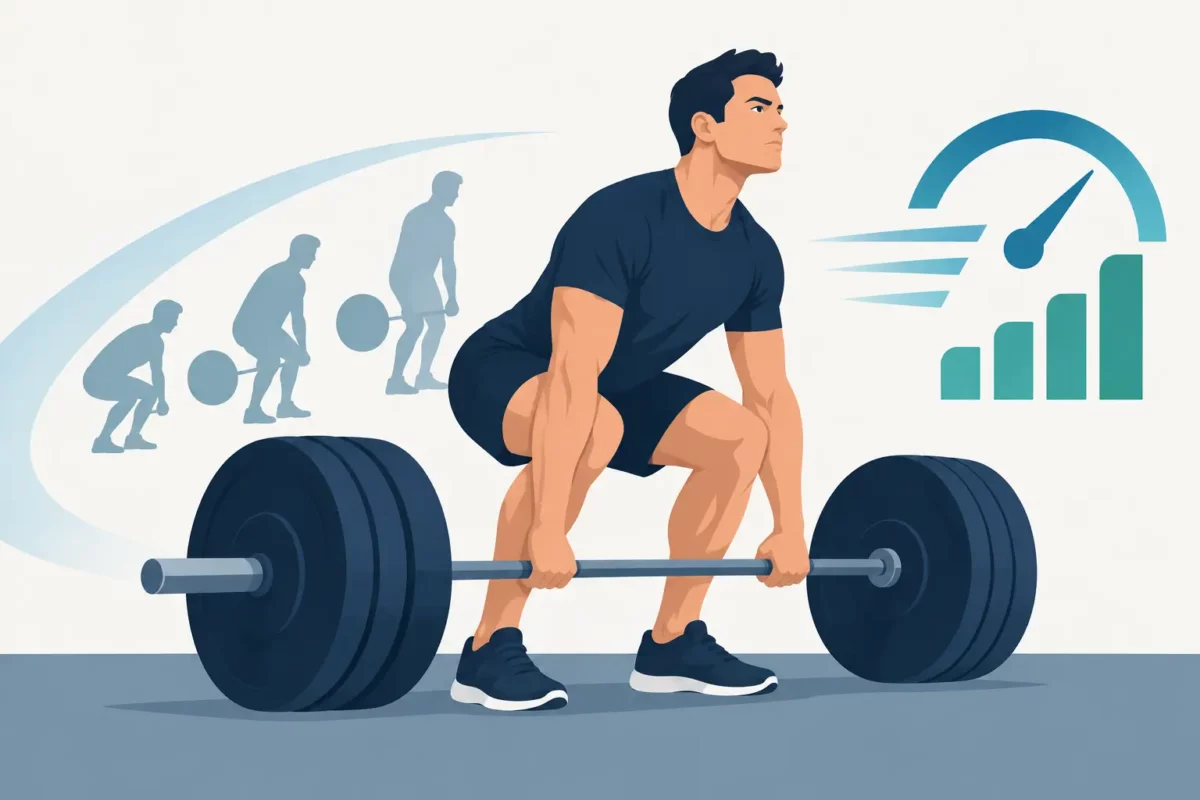
A heavy squat proves you can create force. A fast jump, clean pull, or first step proves how quickly you can apply it. This rate of force development guide shows how to train that second quality without sacrificing the strength foundation that makes explosive training work.
Rate of force development, usually shortened to RFD, matters whenever you have limited time to produce force. That includes sprinting, jumping, changing direction, throwing, catching a clean, and moving a loaded bar with intent. You may have enough raw strength to move a weight eventually, but sport and explosive lifting rarely give you unlimited time to use it.
What Rate of Force Development Means
Rate of force development is the speed at which force rises after you begin a movement. In simple terms, it is how fast you can turn muscle action into useful force. A lifter who can build high force quickly will usually be better equipped to accelerate their body, move a bar aggressively, and react to changing demands.
RFD is not identical to strength. Maximal strength is the highest force you can produce, while RFD is how quickly that force becomes available. The two are closely connected, particularly for newer lifters. Getting stronger often improves power because a stronger athlete has a larger force ceiling. But once basic strength is in place, simply chasing heavier slow lifts may not fully address the ability to express force rapidly.
Power is related but not interchangeable either. Power is force multiplied by velocity. RFD describes the rise in force over time. In the gym, you do not need a force plate to use these ideas. You need to understand the training outcome: apply force hard, fast, and with sound positions.
Why Fast Force Production Changes Performance
Most athletic movements happen too quickly for you to reach maximum force. Ground contact in a sprint is brief. A vertical jump starts and finishes before you can grind. Even in weightlifting, a clean or snatch rewards force applied at the right moment, not slow effort that arrives after the bar has drifted away.
This is why a lifter can own a respectable squat but still feel slow off the floor, late in a jump, or flat during athletic work. They have developed capacity, but not enough practice expressing it at speed. The answer is not to abandon strength work for endless box jumps. It is to organize training so strength and speed reinforce each other.
The exact priority depends on the athlete. A novice with a low squat, poor bracing, and inconsistent landing mechanics needs more foundational lifting before high-volume plyometrics. An experienced strength athlete who has become slow under moderate loads may benefit from a dedicated speed block. An athlete close to competition needs enough explosive work to stay sharp without creating soreness that takes away from practice.
Build the Strength Base First
Heavy compound lifts remain a major part of power development. Squats, deadlifts, presses, pulls, split squats, and loaded carries build the tissue tolerance, coordination, and high-force capacity behind explosive movement. If force is the raw material, strength training increases the supply.
Train the main lifts with disciplined progression. Use full ranges of motion that fit your structure and sport, maintain repeatable technique, and spend enough time with challenging loads to get stronger. For many lifters, sets of three to six repetitions on major lower-body lifts are productive strength work, provided bar path and bracing hold up.
Do not confuse heavy training with slow intent. A loaded squat will move slowly because the load is demanding, but you should still drive upward with maximum purposeful intent. That intent improves recruitment and keeps strength work connected to power rather than turning every hard set into a deliberate grind.
There is a limit. Repeated maximal efforts, missed lifts, and ugly reps create fatigue that can blunt speed work. Leave the all-out testing for planned occasions. Most training should build strength without making every week a recovery problem.
Rate of Force Development Training Methods
A productive plan uses several tools, each with a different job. Choose the tools that match your experience, equipment, injury history, and sport demands.
Olympic Lift Variations
Cleans, snatches, jerks, high pulls, and their variations train aggressive extension, timing, and coordination under load. They are highly useful when coached well, but they are not mandatory for every athlete. If receiving a clean is limited by wrist, shoulder, or technique issues, clean pulls from the floor or blocks can deliver much of the explosive pulling benefit with less complexity.
Keep quality high. Sets of one to three crisp repetitions usually fit explosive lifts better than long sets that turn into fatigue practice. Stop the set when speed, positions, or bar path deteriorate.
Jumps and Plyometrics
Jumps teach you to apply force into the ground quickly. Countermovement jumps, broad jumps, hurdle hops, and low-depth landings can all have a place, but the landing is part of the exercise. Own a quiet, stable landing before adding height, distance, or more reactive drills.
Use low repetition counts and complete rest. Three to five sets of two to five jumps is often plenty. If jump height falls noticeably, end the work. Plyometrics are not conditioning, and piling on tired contacts is a poor trade for power.
Speed Strength With Lighter Loads
Loaded jumps, kettlebell swings, medicine ball throws, and fast barbell work allow you to practice force at higher movement velocities. The correct load is not the one that creates the biggest burn. It is the one you can move explosively while maintaining the intended pattern.
For barbell speed work, moderate loads often work well, but there is no magic percentage that applies to every lift and athlete. Record video when possible. If the bar slows into a grind, lower the load or end the set. If it flies up with no meaningful resistance, add load until you can still express force aggressively.
Isometrics and Overcoming Positions
Isometric training can help when you need force in a specific joint angle or want high intent without much movement stress. A paused squat against pins, an isometric mid-thigh pull, or a hard split-squat hold can develop positional strength and intent. Overcoming isometrics require maximal effort against an immovable object, so keep efforts brief and use secure equipment.
How to Program Power Work Without Diluting It
Put explosive work early in the session, after a thorough warm-up and before heavy fatigue. Your nervous system and technique are freshest then. A useful lower-body session might begin with jumps or clean pulls, continue to a squat or deadlift variation, then finish with unilateral strength and trunk work.
Do not cram every power method into one day. Two to four exposures each week can work well, but exposure does not mean crushing volume. A short jump series on two days, one Olympic lift variation, and one medicine ball throw session may be enough alongside serious strength training.
Pairing an explosive movement with a strength movement can be effective for experienced lifters. For example, perform two broad jumps, rest, then complete a heavy set of squats. The contrast can sharpen intent, but it also raises session demands. Beginners should usually keep the work simpler: jumps first, strength second, full recovery between sets.
Progress by improving execution before adding volume. Jump farther with the same clean landing. Move the same pull load faster. Add a small amount of weight while preserving bar speed. These are meaningful performance gains, even when they do not look dramatic on a spreadsheet.
Measure What You Can Repeat
You do not need laboratory testing, but you do need feedback. Use repeatable tests under similar conditions every four to six weeks. Four practical options are a standing vertical jump, broad jump, light loaded jump, and a timed sprint over a fixed short distance. Choose one or two tests and keep the warm-up, equipment, and test order consistent.
Track strength numbers alongside those tests. If your squat rises while jump performance stays flat for months, your training may need more speed-focused work or less accumulated fatigue. If jump performance drops while your joints ache and bar speed feels poor, recovery is likely the first problem to solve.
Sleep, calories, protein, and stress management are not separate from explosive performance. Fast force production depends on fresh coordination and recovered tissue. You cannot out-program poor recovery with more intensity.
Train heavy enough to become stronger. Train fast enough to express that strength when time is short. Then keep the work precise enough that every jump, pull, and lift teaches your body to produce force with purpose.