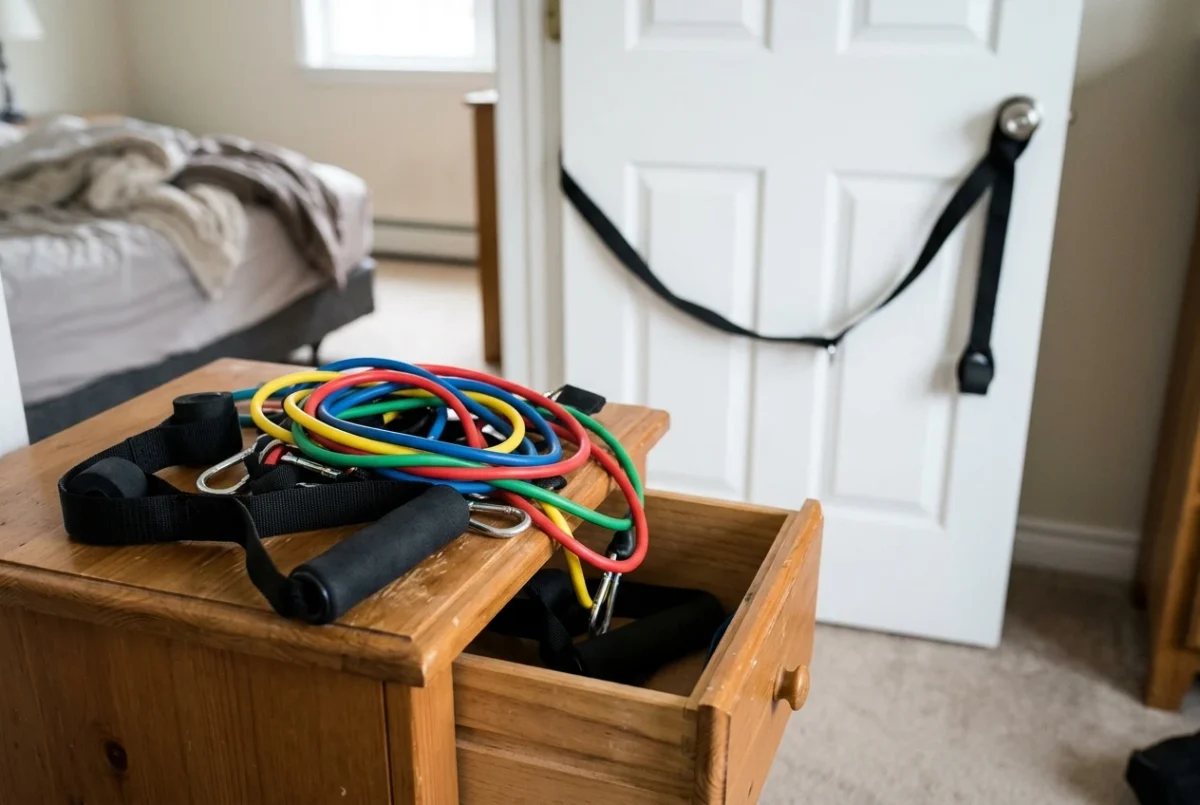
If you are choosing between resistance bands vs weights for a small home gym, the usual comparison of muscle activation and strength carryover leaves out the practical question: what will this equipment do to the room you live in? A rack that works perfectly in a garage bay is a poor purchase for a corner of a bedroom.
This article judges both options by four things a small-space lifter deals with every week: the floor area in use during a workout, the space needed to store the gear, the setup time before the first set, and how far the load can rise before you outgrow it. It ends with one specific recommendation instead of “it depends”.
Why floor space changes the bands-versus-iron question
In a large space, the question is which tool builds more strength, and the answer is usually “whichever you progress on consistently.” In a small space, a second set of costs appears. Equipment that takes ten minutes to move out of the way will eventually not get used, however good the exercise is.
Four measures matter more than they do in a big gym:
- Working footprint: the floor area you need while the lift is happening, including room to fall back, step out, or swing.
- Resting footprint: what the gear occupies when you are not training, which is where it lives in a shared home.
- Setup time: how long between deciding to train and starting your first working set.
- Load ceiling: how much resistance you can add before the equipment stops being enough.
Bands win the first three by a wide margin. Iron wins the fourth. Everything else in this article is about how to split the difference.
What a band setup actually takes up, and what it can’t do
A full set of bands, a door anchor, and a pair of handles fit in a single drawer or a small bag. Working footprint is roughly the space you stand in, plus the length of the stretch. Setup means looping a band around a sturdy post, closing a door on an anchor, or stepping on one end. Most people can be working within a minute or two.
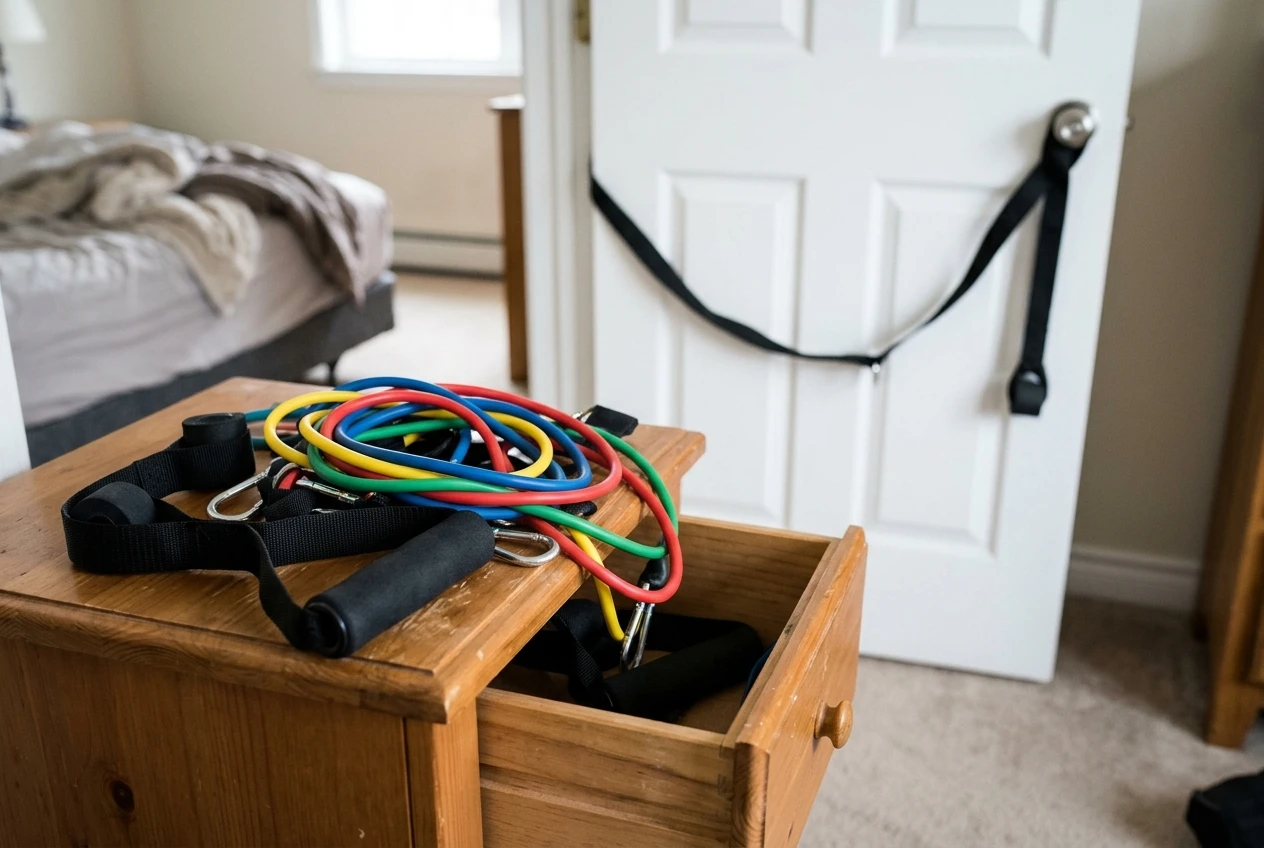
Bands also do things that are awkward in a tight room. You can pull horizontally for rows and face pulls, press from any angle, and add resistance to push-ups without any weight sitting on you. Many of these movements work the upper back and shoulders, which are the areas that a lot of home lifters neglect.
Bands have real limits, and they are worth knowing before you buy:
- The load changes through the movement. A band is lightest where it starts to stretch and heaviest at the end of the range. That suits some exercises, such as pushdowns and pull-aparts, and fits others poorly.
- The numbers are approximate. A band’s rating comes from the manufacturer and shifts with how far you stretch it and how worn it is. You cannot know the load the way you know a plate.
- Bands wear out. Check them for nicks, thin spots, and cracks before each session and replace any that look damaged, because a band that snaps can hit you.
- Anchors need checking. A door anchor only works on a door that closes against the direction of pull, and a post or rail must be solid.
None of these rules bands out. They define the jobs bands should do, which I come back to in the split below.
What iron takes up: racks, plates, dumbbells, and the kettlebell exception
Iron costs space in several ways at once. A standard barbell is about seven feet long, and you need room on both sides to load and unload plates. A rack adds its own footprint, and a bench adds more. Plates stack neatly but are heavy, so wherever they are stored is where they stay. In a spare room, that can be fine. In an apartment where you share the floor with a partner or a landlord’s carpet, it is a serious commitment.
Dumbbells are more flexible. A fixed set takes a rack or a long section of wall, and an adjustable pair compresses that into one spot on the floor, at the cost of slower changes between loads. Either option works with limited room as long as the area is cleared when you train.
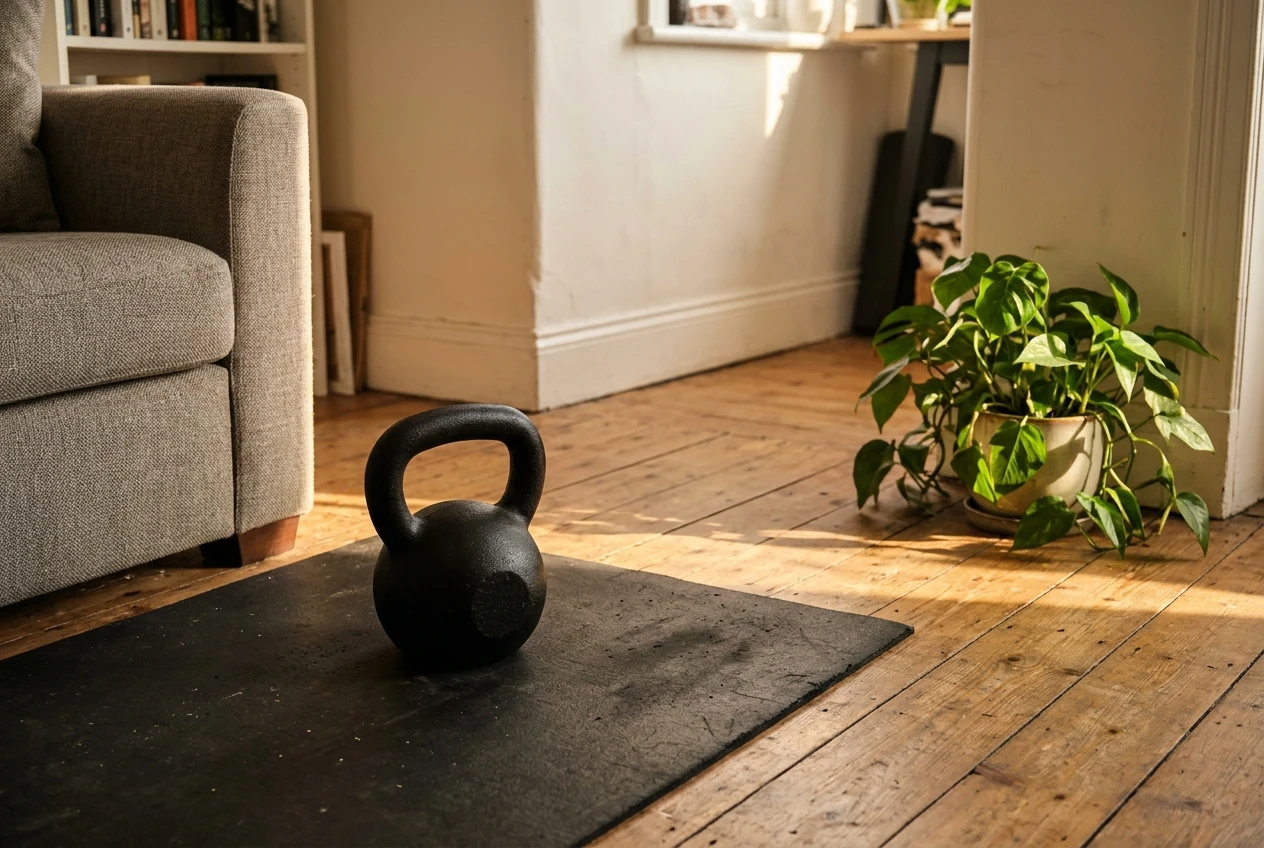
The kettlebell is the exception, because a single bell is one object with its own handle. It stores in a corner, and one bell supports a swing, goblet squat, press, row variations, and loaded carries. The working footprint is a few feet around you. It is the only piece of iron in this comparison that behaves like a band in storage and like a weight in resistance.
If you want a compact kettlebell setup with guided sessions instead of piecing workouts together yourself, Kettlebell Monster is built around exactly that. (Affiliate link: I earn a commission if you buy through it.)
Where bands run out: progressive overload and heavy leg and back work
Progressive overload is the first place bands strain. Each band is a fixed step, and the gap between one band and the next is often large relative to what you can add in a week. You can bridge it in several ways: add reps, slow the lowering phase, pause at the hardest point, stack two bands, or shorten the anchor so the band starts under more tension. These work, and they also make the exact load harder to record.
That recording problem matters, because you can only progress what you track. Whether you use bands or a kettlebell, a simple log of the load, reps, and tempo does the job, and tracking kettlebell progression in a spreadsheet is one way to do it without another app.
Heavy leg and back work is the second limit, and it is harder to get around. Squats and deadlifts reach loads that stacked bands only approximate, and the bands become unwieldy long before you reach them. A band-resisted squat or a band pull-through will train the movement, but for a lifter whose legs are already strong, those versions will feel light well before the muscles stop adapting.
Single-leg variations help, since splitting the load across one leg raises the demand without raising the equipment. They extend the useful life of light gear and do not remove the ceiling.
Where iron runs out: noise, storage, and training in a shared room
Iron has its own failure points, and they have nothing to do with strength. They are about the room and the people in it.
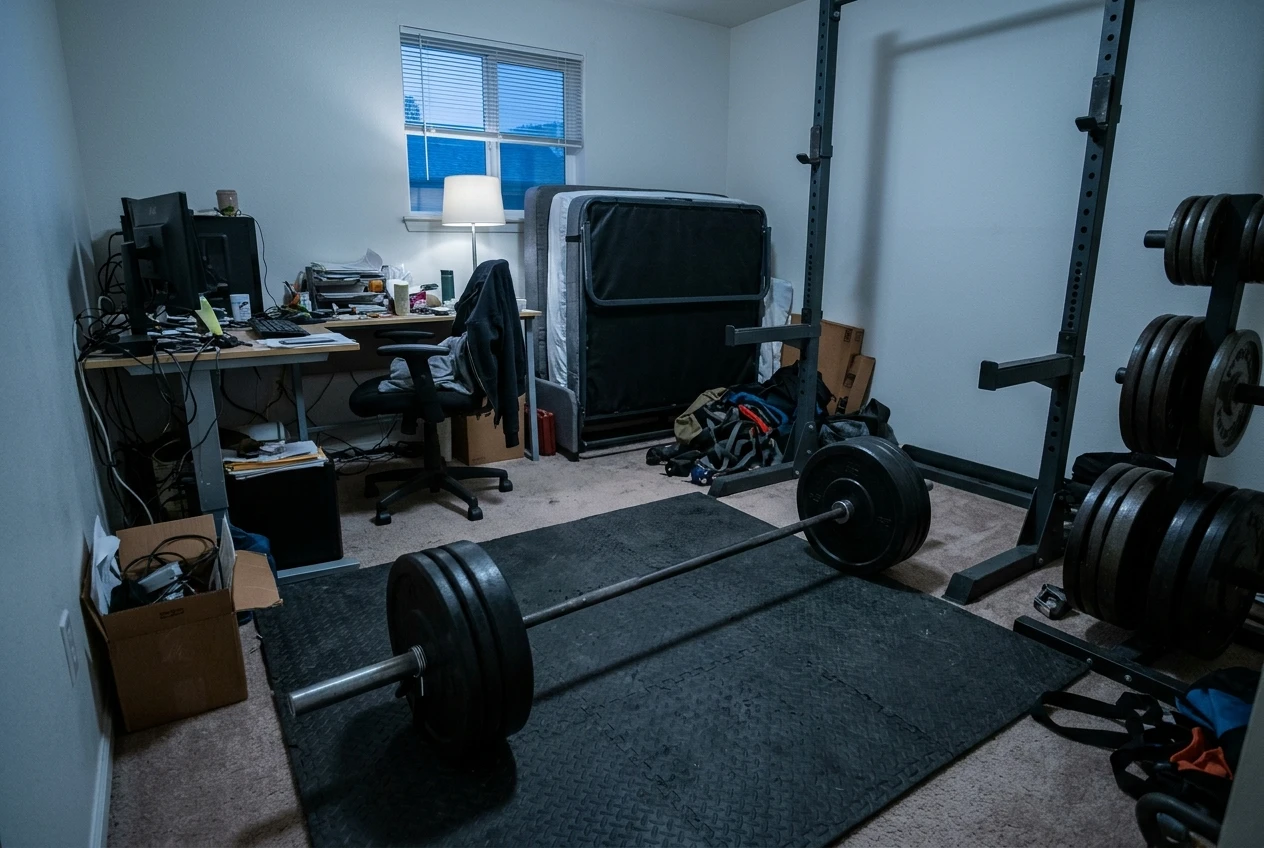
Noise. Dropping a loaded barbell, setting down a kettlebell, or clanking plates carries through floors and walls. In an upstairs apartment, that can end a training habit faster than any plateau. A rubber mat or a thick piece of flooring reduces the impact and helps protect the surface underneath. Bands make almost no noise at all, which makes them the sensible choice for early mornings and late evenings.
Storage. A rack and bench cannot be put away. If the room has to serve as a bedroom or an office as well, permanent equipment either dominates the space or does not belong in it. Adjustable dumbbells and a single kettlebell can be stored, and a barbell setup generally cannot.
Shared rooms. If you train in a space other people use, setup and teardown time becomes part of every session. A kettlebell and a bag of bands take seconds to bring out and put away. A bar loaded for squats does not.
The pattern is consistent: the more iron you own, the more the room is a gym first and anything else second. For some people, that is the right trade. For most people with limited floor space, it is better to own less and use it more often.
A small-space split: which lifts to give to bands and which to give to a kettlebell
Because bands and a kettlebell fail in different places, you can divide the work so each does what it is good at.
Give the kettlebell the heavy, whole-body patterns:
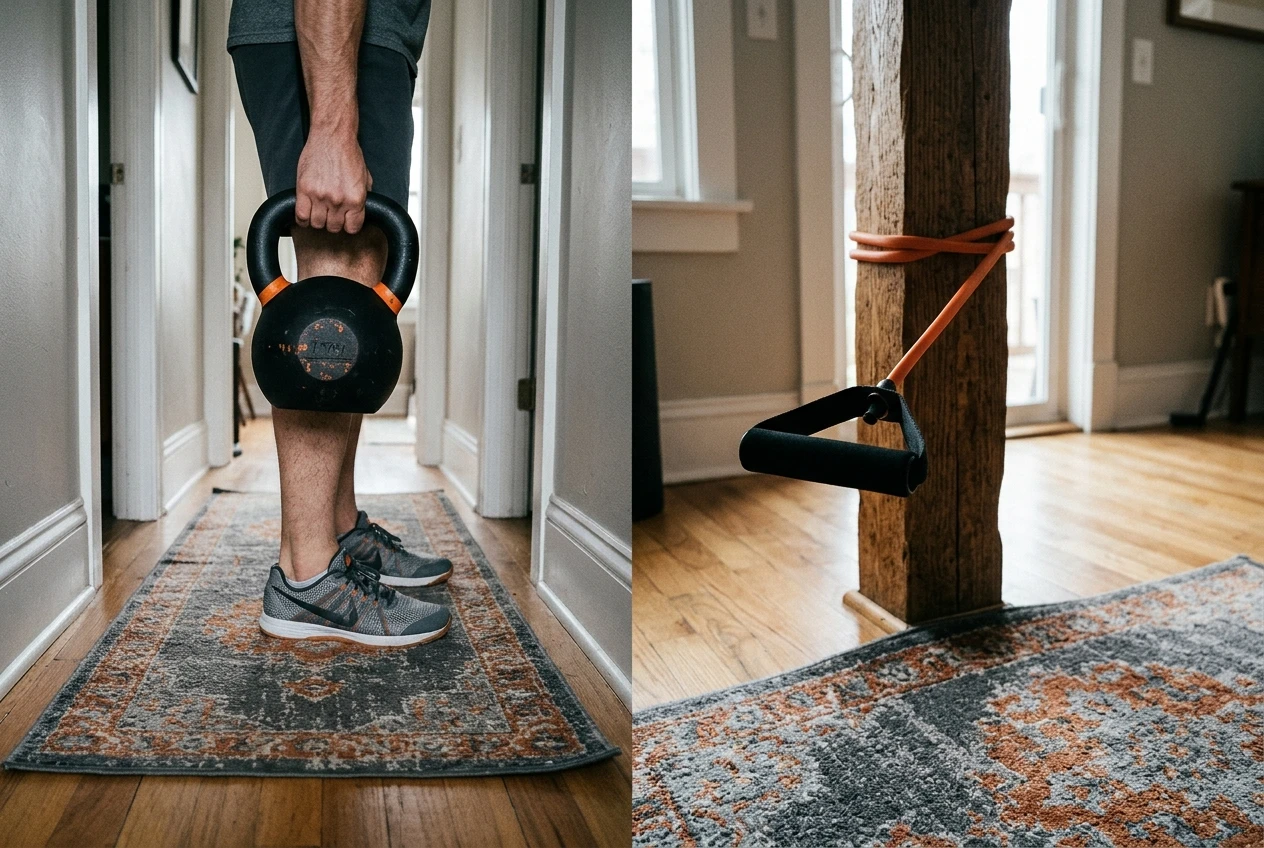
- Swings and deadlift-style hinges for the hamstrings, glutes, and back
- Goblet squats and single-leg squat variations for the legs
- Overhead and single-arm presses
- Loaded carries, which train grip, trunk, and posture in a very small area
These are the movements where a real, known weight matters, and where bands are weakest.
Give the bands the lighter, higher-rep, and isolation work:
- Face pulls and band pull-aparts for the rear shoulders and upper back
- Rows and pulldowns from a door anchor or post
- Triceps pushdowns and biceps curls
- Lateral raises
- Added resistance for push-ups
These movements are easier to do from an anchor than with a single bell; they are lighter, and they are the ones for which an approximate load causes the least trouble.
The kettlebell will have its own ceiling. A goblet squat that once left you shaking will eventually get easier, and a single bell will not carry a strong lifter’s legs indefinitely. When that happens, slower lowering, paused reps, and single-leg variations extend its life, and a heavier bell is the next purchase.
How to build the hybrid setup in stages, and when to add more gear
Buy in the order that you will notice a gap, not all at once.
- Start with one kettlebell and a small number of bands. Choose a bell where the last reps of a goblet squat are hard, but your form holds. Add a light band for pull-aparts and a medium one for rows. This covers a full week of training for most beginners and takes up one corner.
- Add band variety and an anchor. Once rows and pushdowns become routine, a set of bands at different tensions and a door anchor give you more ways to progress upper-body work without buying iron.
- Add a second kettlebell, or a heavier one. When your first bell stops challenging you on swings, squats, and presses, even with a slower tempo and pauses, buy a heavier one. A pair also allows double-bell work, which raises the load in the same footprint.
- Add a larger gear only when a specific limit shows up. If you have stalled for several weeks despite progressing reps, tempo, and single-leg work, and your goals call for heavier squats or deadlifts, that is the point to consider adjustable dumbbells or a barbell setup. Check the working footprint, the storage, and the noise before you buy anything.
Each stage in this sequence addresses a limit you have actually reached, so you never carry gear you are not using. That matters in a small home more than anywhere else.
For a compact setup with sessions to follow, a kettlebell. Monster pairs one piece of equipment with guided training. (Affiliate link: I earn a commission if you buy through it.)