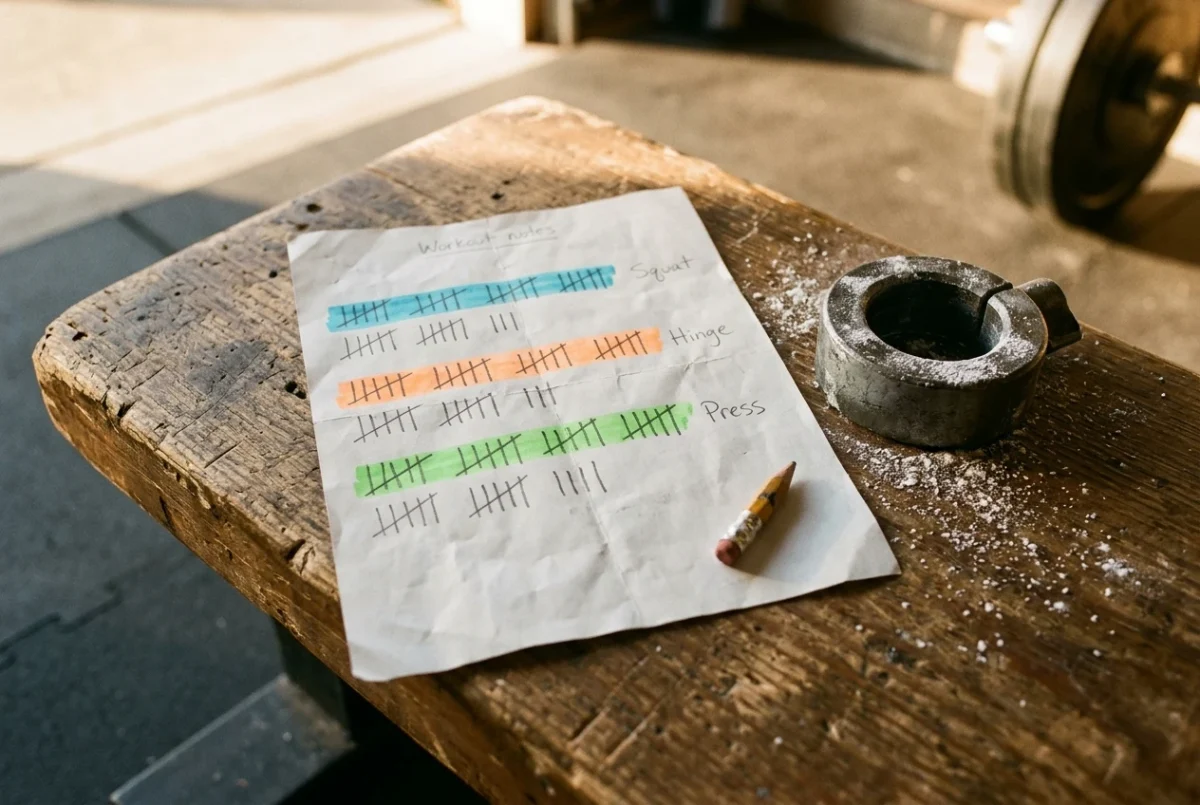
A week of accessory work can look reasonable one exercise at a time and still add up to more than a single movement pattern can recover from. If you want to know how to tell if you are doing too much accessory work, tally the whole week by pattern instead of judging each exercise. This audit takes one sheet of paper and one training week of logged sets.
Write down last week’s sets and tag each one by the pattern it loads
Pull last week’s log and list every set you did, main lifts and accessories both, including warm-up work that was heavy enough to count. Next to each exercise, write the movement pattern it loads. Use a short list of tags so the sheet stays readable:
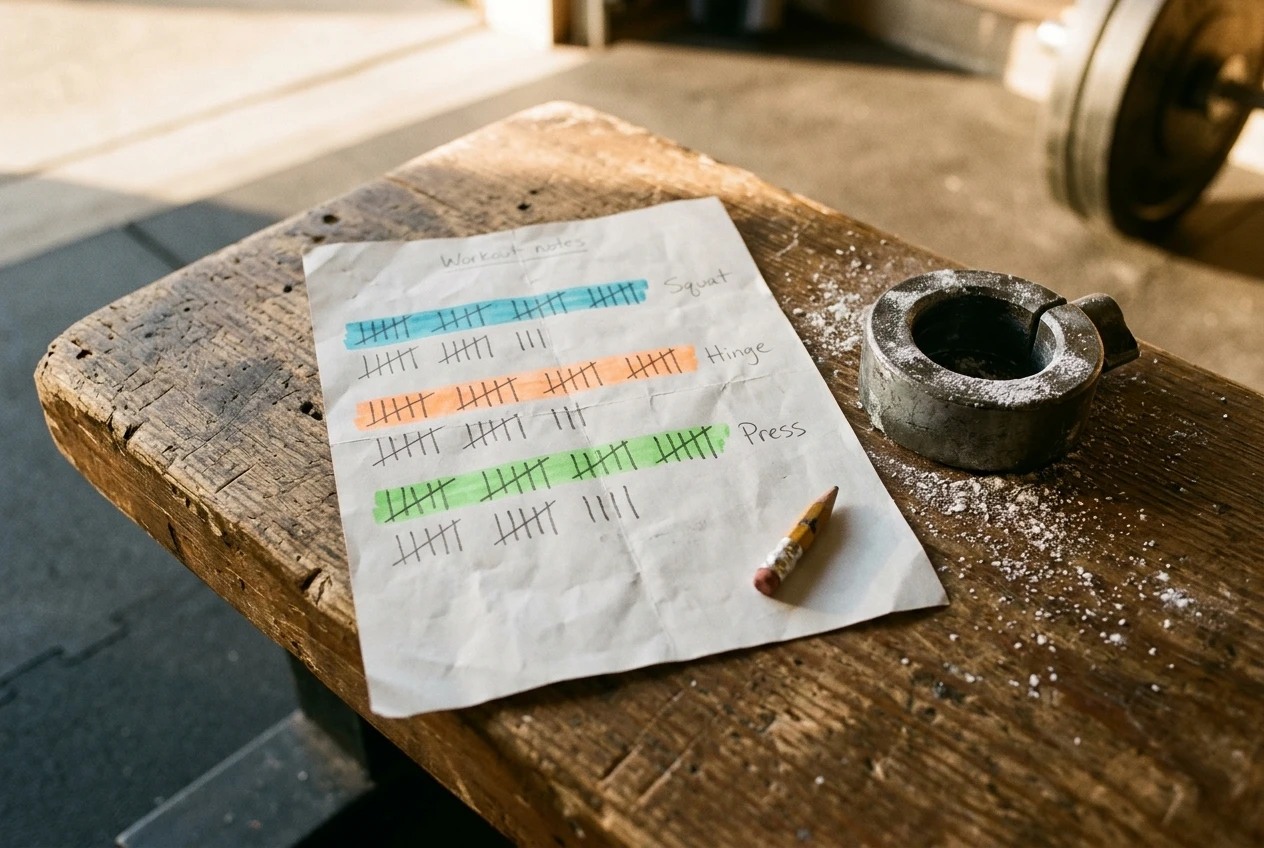
- Squat: anything where the knees and quads do most of the work (leg press, split squats, leg extensions, front squats)
- Hinge: anything where the hips and lower back do most of the work (Romanian deadlifts, back extensions, good mornings, swings)
- Horizontal press: bench variations, dips, push-ups, flyes
- Vertical press: overhead presses, push presses, landmine presses
- Pull: rows, pulldowns, pull-ups, face pulls
- Trunk and grip: carries, leg raises, ab wheel work, hangs
Some exercises load two patterns. A barbell row is a pull, but your lower back also holds a hinged position for the whole set, so tag it as pull and hinge. Triceps pushdowns assist both press patterns, so tag them with the press they support on your bench day. Where an exercise loads two patterns, count its sets in both columns. The overlap you are looking for lives in those double counts.
Here is an illustrative week, so you can see how the sheet looks once it is filled in. It is an example layout, not a recommendation.
Day | Exercise | Sets | Pattern tags |
|---|---|---|---|
Squat day | Back squat | 5 | Squat |
| Leg press | 3 | Squat |
| Bulgarian split squat | 3 | Squat |
| Leg extension | 3 | Squat |
Bench day | Bench press | 5 | Horizontal press |
| Incline dumbbell press | 3 | Horizontal press, vertical press |
| Overhead press | 3 | Vertical press |
| Dips | 3 | Horizontal press |
| Triceps pushdown | 3 | Horizontal press |
Deadlift day | Deadlift | 4 | Hinge |
| Romanian deadlift | 3 | Hinge |
| Back extension | 3 | Hinge |
| Barbell row | 4 | Pull, hinge |
Add up each pattern in two numbers: main-lift sets and accessory sets. In the example, the squat pattern has 5 main sets and 9 accessory sets. The hinge pattern has 4 main sets and 10 accessory sets once the rows are counted. The horizontal press pattern has 5 main sets and 12 accessory sets.
Count the overlap: where three accessories are quietly doing one job
Look down your accessory column for any pattern where three or more exercises load the same muscles in roughly the same way. In the example, leg press, split squats and leg extensions all load the quads through knee flexion and extension. Each one was probably added for a good reason, and each one feels like a separate decision. Together they ask the same tissue to do the same work three times after the squats already did it.
Two checks help you separate real overlap from useful variety:
- Same joint action, same muscle: if swapping one exercise for another would feel like a minor change, they overlap.
- Same end of the rep range, same failure point: if all three leave you tired in the same place (quads burning, lower back cooked, front delts fried), they are one job split across three exercises.
Then compare the two numbers for each pattern. As a working flag for this audit, mark any pattern where accessory sets are more than double the main-lift sets. This is a rule of thumb for finding the likeliest culprit, not a research threshold, so adjust it to your own recovery. Many lifters will find that one or two patterns stand out far more than the rest, and those are the ones to examine first.
Pay attention to hinge overlap in particular, because it hides well. Romanian deadlifts, back extensions and heavy rows all load the lower back and hamstrings, and the rows rarely get counted as hinge work. A deadlift that stalls while the hinge column is the biggest number on the sheet is a strong signal.
Read your main lift for the signs the tally is too high
A high tally only matters if the matching main lift is showing it. Check each flagged pattern’s main lift against the signs below, looking back over the last three to four weeks of your log rather than one bad day:
- Reps slip at the same weight. You hit a set of five in week one and a set of four at the same load in week three, with no change in sleep or food to explain it.
- Warm-ups feel heavy. The bar speed on your first working sets is slower than it was earlier in the block.
- The top set needs more effort for the same load. The weight did not change but the set feels harder.
- Form breaks earlier. Your hips shoot up out of the hole, your bench bar path drifts, or your lockout gets ragged on the last reps.
- The same joint or spot aches before you lift. Knees on squat day, elbows on bench day or low back on deadlift day, felt during the warm-up rather than only after.
If a flagged pattern shows two or more of these, the tally is a likely cause. If the tally is high but the main lift is progressing, leave it alone for now. The audit is meant to explain a stall, and a lift that is still moving does not need an explanation.
If the main lift is stalling but the pattern’s tally is low, look elsewhere. Sleep, calories and the programming of the main lift itself are the usual places, and for a stuck deadlift lockout specifically, find which of three failures it is is the better starting point, though that is a separate question from this audit.
Cut in a fixed order: duplicates first, then sets, then swaps
When a lift is slipping and its pattern is flagged, cut in this order and stop as soon as the main lift recovers. A fixed order stops you from deleting the exercises you like least instead of the ones that cost the most.
- Remove duplicates. In each flagged pattern, keep the one accessory that targets your weakest point and drop the others that do the same job. In the example, keep the split squat and drop the leg press and leg extension.
- Remove sets. If the pattern is still above your flag line after the duplicates are gone, take one set off each remaining accessory in that pattern. Keep the reps and the load the same. Fewer sets at the same quality is easier to judge than the same sets done tired.
- Swap for lower-cost versions. Only after the first two cuts, change an accessory for a version that costs less recovery. A chest-supported row replaces a barbell row because it takes the lower back out of the movement. A machine press replaces a dumbbell press if shoulder stability is the limiting factor.
Make the cuts for one or two flagged patterns at a time, not for the whole program at once. If you change everything, you will not know which cut helped. Give each round of cuts two to three weeks of training before you decide whether the main lift responded.
Count kettlebell finishers and carries as volume too
Finishers and carries are easy to leave off the sheet because they feel like conditioning rather than lifting. Your body does not make that distinction. A set of swings loads the hinge pattern and the grip. Goblet squats load the squat pattern. Farmer’s carries and suitcase carries load the trunk and grip, and heavy ones add to what your back and hips are already holding after deadlifts.

Go back through your log and tag every finisher and carry exactly as you did the barbell accessories. A finisher of 100 swings after a deadlift session adds a lot to the hinge column, so tally it by sets or rounds and write the pattern next to it. If the hinge pattern was already flagged, the finisher is a candidate for the same cut order. Reduce the rounds before you remove it, or move it to a day that does not follow a heavy hinge session.
How to match a finisher to the lift you just did is covered in picking your kettlebell finisher by the lift you just did, and if you are looking for kettlebell workouts to choose from, you can look at kettlebell.monster. Affiliate disclosure: that is an affiliate link, so I may earn a commission if you buy through it, at no extra cost to you.
Re-run the tally in four weeks and write one line of verdict per lift
After you have trained with the cuts for four weeks, build the same sheet from your new log. Compare each flagged pattern’s accessory total with the first sheet, and compare your main-lift numbers over the same period: top-set reps at the same load, how the warm-ups felt, and whether the aches in the warm-up went away.
Then write one line per lift, in one of three verdicts: keep, trim further, or restore. Here is the format, with example wording:
- Squat: accessory sets dropped from 9 to 4, top set back to five reps at the old load. Verdict: keep.
- Bench: accessory sets dropped from 12 to 8, reps still down a rep. Verdict: trim further, drop the dips.
- Deadlift: hinge total dropped from 14 to 9, lockout speed unchanged. Verdict: restore the back extensions and look at sleep instead.
One line per lift forces a decision. A vague note like “feels better” cannot be compared with your next audit, while a sets total and a verdict can. Keep the sheets together, and after two or three rounds you will see which patterns you can load heavily and which ones need a lighter accessory week.
Next step for the sets the audit flags
The audit tells you where your accessory sets pile up. It does not tell you which of the flagged exercises earns its place. For that, price each accessory by the reps it costs your next main lift and decide which of the surviving sets stay.