If you train with a barbell, you already know how to make a lift harder: add 2.5 kg and try again. Kettlebells do not allow that, and the gap between one bell and the next is the main reason barbell lifters stall on them. Kettlebell progressive overload works when you treat the bell as the last variable you change, not the first.
This guide covers how to match kettlebell work to a barbell weak point, how much to start with, a three-step ladder for progressing it, and six-week examples for swings, goblet squats and presses.
Why plate-style progression breaks when your next kettlebell is a big jump up
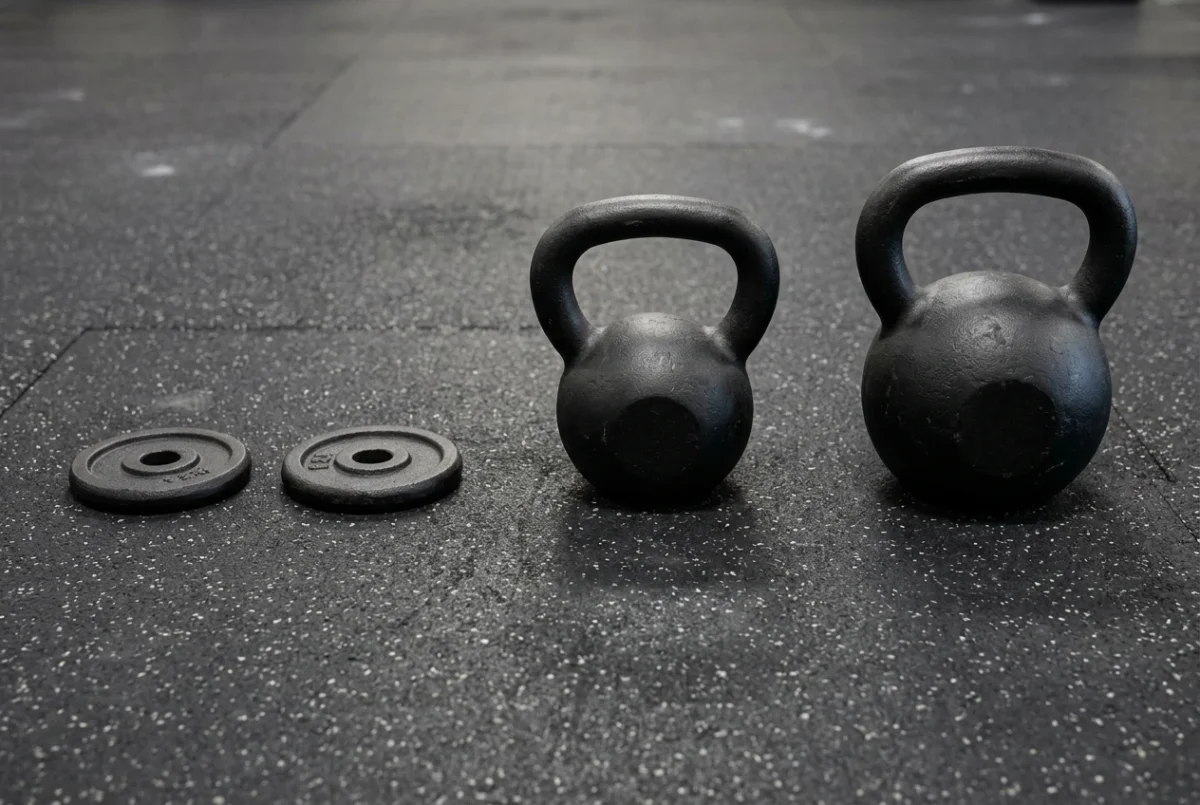
A barbell lets you add a pair of small plates. Putting 2.5 kg on a 100 kg bar changes the load by 2.5 percent. Moving from a 16 kg kettlebell to a 20 kg one changes it by 25 percent, and from 20 kg to 24 kg is 20 percent. That is eight to ten times the barbell’s jump, in a single step.
A change that large alters the movement. A swing with a bell that is much too heavy turns into a lumbar-driven pull, a goblet squat gets shallower, and a press leans back. The lifter then logs “progress” that the barbell never sees.
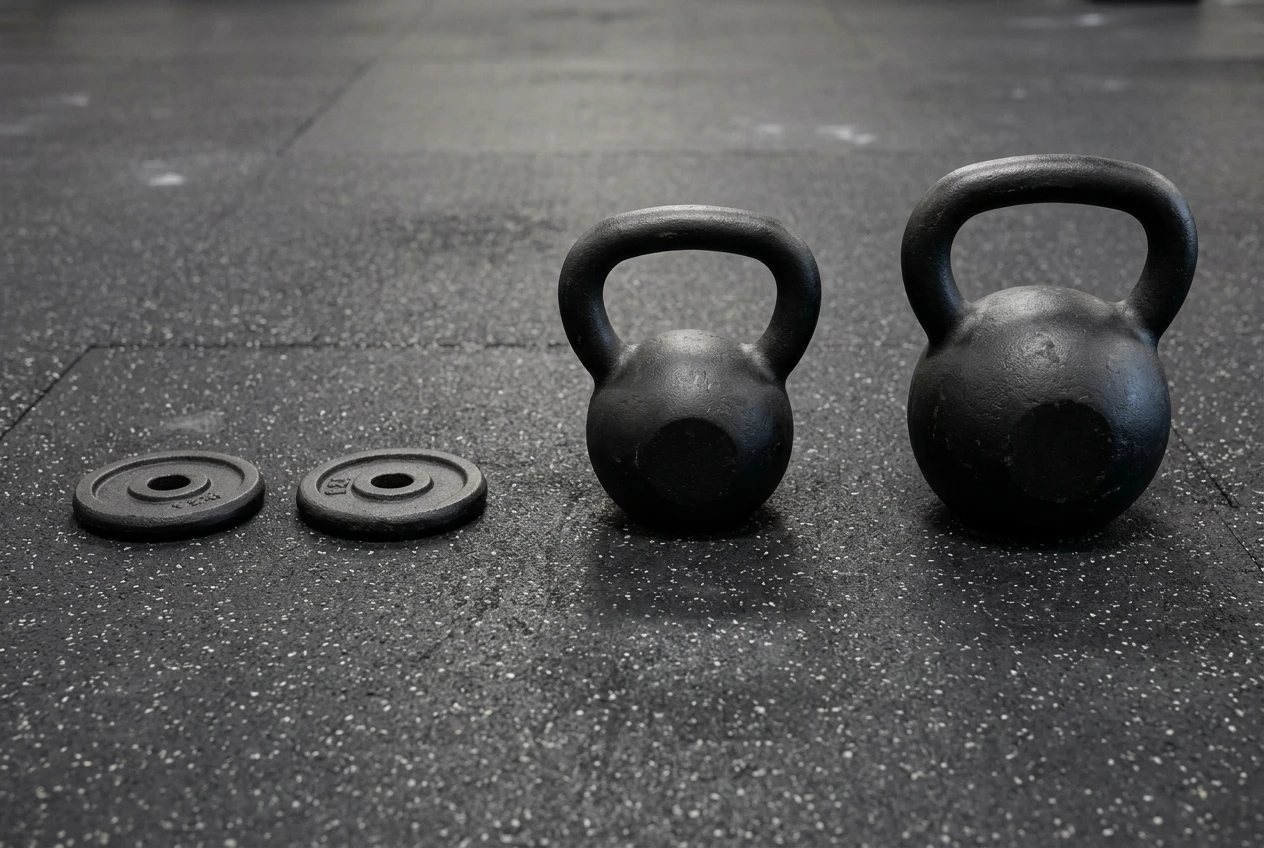
Plates also make you think load is the only thing to progress. With kettlebells you have three other levers: repetitions, sets and rest time. Load is the last one to change, not the first.
If you are still deciding which sizes to own, choosing kettlebell sizes by movement and training level covers that separately. The rest of this article assumes you already have a bell for each movement and want to get more from it.
Pick the barbell weak point first, then the kettlebell movement that trains it
Kettlebell work earns its place when it targets a specific failure in a barbell lift. Pick one weak point per lift, not a general “make me stronger” plan.
- Deadlift lockout: the bar moves well off the floor and slows or stops near the knees or at the top. The matching movement is the kettlebell swing, which trains fast, forceful hip extension.
- Squat drive: you reach the bottom and slow down or fold forward on the way up. The matching movement is the goblet squat with a slow lowering phase and a pause, which keeps the trunk upright and works the quads under control.
- Overhead press: the bar stalls at the midpoint or you cannot hold a stable lockout. The matching movement is the single-arm kettlebell press, which exposes side-to-side differences and demands shoulder and trunk stability.
To find your weak point, film your heaviest working sets from the side and note where the bar slows. If you are unsure, pick the lift that has gone longest without a personal best.
Start with one kettlebell movement for one lift. Adding all three on day one makes it impossible to tell which one helped.
Start with a weekly volume you can recover from, and how to know it is the right one
A reasonable starting point is two kettlebell sessions per week, with one movement per session, and 3 to 5 working sets of it. Keep the last set one or two reps short of failure. Where those sessions go in your week matters as much as the numbers, and fitting kettlebell sessions into a barbell split is covered in its own post.
You know the volume is right when all of these hold:
- Your main barbell lifts stay the same or improve over two to three weeks.
- Soreness from the kettlebell work has gone before the next barbell session that uses the same muscles.
- The final set of the kettlebell work looks like the first set, with the same hip drive, depth or lockout.
- Your sleep and appetite have not changed.
If the barbell numbers drop, cut the kettlebell volume before you cut anything else. If everything feels easy and the last set is far from hard, add a set before you add weight. If you want a deeper framework for judging volume, see training volume landmarks.
The three-step ladder: add reps, then tighten rest, then move up a bell
Use the same order every time.
Step 1: add reps. Choose a rep range, for example 10 to 15 for swings. Start at the bottom. Each week, add a rep or two per set while keeping the form you started with. When every set hits the top of the range, move to step 2.
Step 2: tighten rest. Keep the reps at the top of the range and shorten the rest between sets by 15 seconds per week. Going from 90 seconds to 60 seconds is the same total work in less time, which is a real increase in density. This step also shows whether the reps were truly clean or only possible with long rests.
Step 3: move up a bell. Change the load only when you have hit the top reps at the shortest rest for two sessions in a row. Then go back to the bottom of the rep range and the longer rest, and start the ladder again with the heavier bell.
Expect the first session with a heavier bell to feel humbling. Reps will fall noticeably, and that is correct. You are not losing strength: you are restarting the ladder at a higher load.
When the jump is very large, as it often is for presses, you can add a bridge between steps 2 and 3. Use the same bell with a 2-second pause at the sticking point of each rep, or a slower lowering phase. This makes the set harder without changing the bell.
Sample 6-week progressions for swings, goblet squats, and presses, matched to the lift they support
These are examples to adapt, not fixed prescriptions. Use a bell you can handle for the full week 1 volume with good form. Train each movement twice a week unless noted. Week 7 is the move up to the next bell, restarting at week 1 numbers.
Swings, for deadlift lockout
Stand tall and finish each rep with the glutes squeezed and the bell floating at chest height. Do not squat the swing.
Week Sets x reps Rest 1 5 x 10 90 sec 2 5 x 12 90 sec 3 5 x 15 90 sec 4 5 x 15 75 sec 5 5 x 15 60 sec 6 5 x 15 45 sec
If your hips stop finishing the swing by the last set, stop the set early. Fast hips on fewer reps beat tired hips on more.
Goblet squats, for squat drive
Lower for 3 seconds, pause for 1 second at the bottom, then stand up with force. Hold the bell against your chest and keep your ribs stacked over your hips.
Week Sets x reps Rest 1 3 x 6 120 sec 2 3 x 8 120 sec 3 3 x 10 120 sec 4 3 x 10 105 sec 5 3 x 10 90 sec 6 3 x 10 75 sec
The pause is what makes this carry over to the bottom of a barbell squat. If you cannot keep the pause honest, the bell is too heavy for that rep count.
Single-arm presses, for the overhead press
Press each side for the listed reps. Keep your ribs down and squeeze the glute on the working side so you do not lean back.
Week Sets x reps (each arm) Rest 1 4 x 3 120 sec 2 4 x 4 120 sec 3 4 x 5 120 sec 4 4 x 5 105 sec 5 4 x 5 90 sec 6 4 x 5 with a 2-sec pause at the sticking point 90 sec
Press rep ranges are lower than swing rep ranges because the bell jump is hardest to bridge here and form degrades quickly. Week 6 uses the pause bridge so the step to a heavier bell is smaller.
When to hold, back off, or drop the kettlebell work because the barbell is suffering
Kettlebell work exists to support your squat, deadlift and press. If it is costing you those lifts, change it.
Hold the week when form on the last set slips or a session feels harder than the one before it, but your barbell numbers are fine. Repeat the same week’s numbers. Do not skip ahead.
Back off when your barbell top sets drop in reps or speed for two sessions in a row. Cut the kettlebell sets by about a third and keep the bell and the rest times the same. Resume the ladder after one or two weeks if the barbell recovers.
Drop the kettlebell work during a peak, a meet prep block, or any week where the barbell session is the priority. Pain in a joint, as opposed to muscle soreness, is also a reason to stop that movement and get it assessed. The post on when athletes should deload is a good companion for deciding how long to pause.
A useful rule: if the kettlebell session leaves you unable to do your next barbell session at full quality, the kettlebell session was too big, whatever the numbers say.
How to log it so you can tell progress from just being tired
Doing more work on a bad day looks like progress in a notebook, so record enough to tell the difference. For each kettlebell session, write down:
- Date and the movement
- Bell weight
- Sets, reps and rest time
- How hard the last set felt, on a 1 to 10 scale
- Your top set on the related barbell lift from your last session, with the weight and reps
Then compare the same session two weeks apart, not yesterday against today. Real progress looks like more reps or shorter rest at the same effort rating, with the barbell lift holding steady or rising.
Being tired looks different: the same numbers feel harder, the effort rating climbs, and the barbell lift slips. That pattern is the signal to hold or back off, not to push the ladder.
Add one line each week about sleep and general energy. Those notes explain a lot of sessions that otherwise look like mysteries.
Where to go from here
If you want the progression laid out session by session on screen, look at the kettlebell.monster programs. I earn a commission if you buy through this link, at no extra cost to you. There is also the Samsung Tizen TV workout app, which puts the sessions on your TV. I earn a commission if you buy through this link, at no extra cost to you.