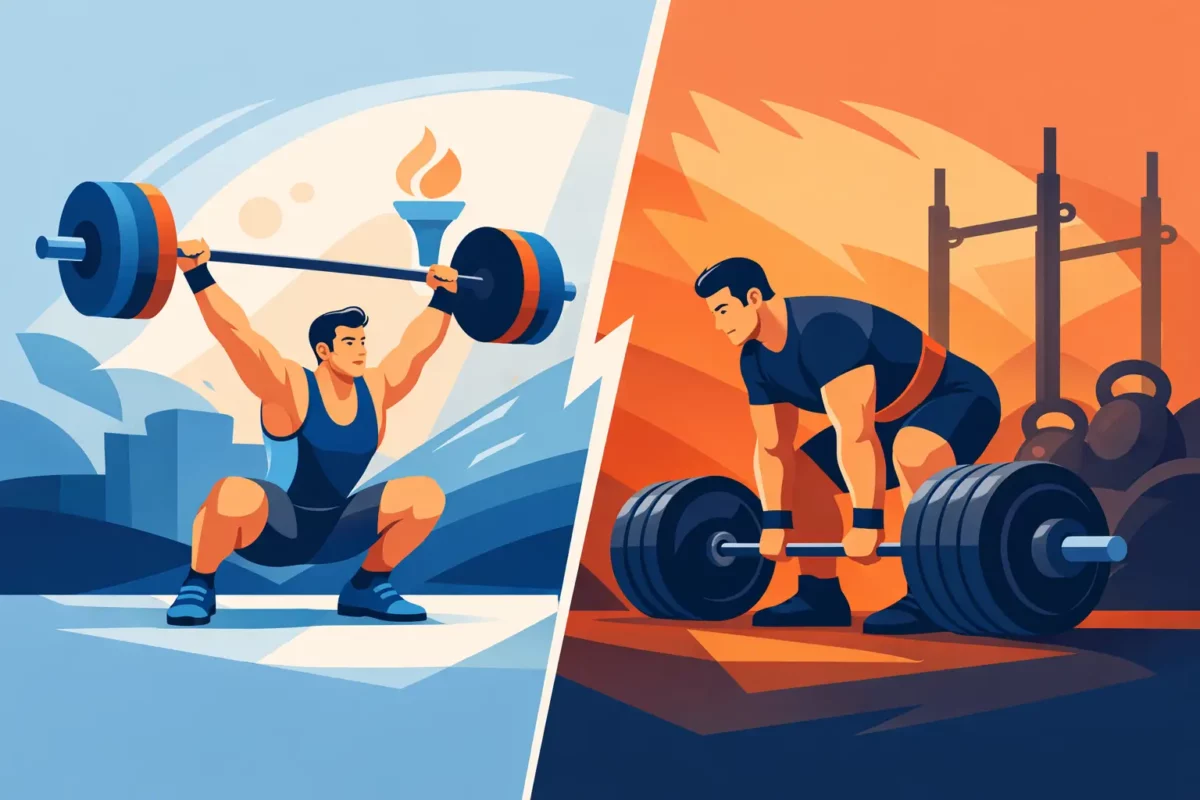
A heavy deadlift can make you brutally strong. A crisp clean can teach you to apply force before the bar has time to leave the floor. That difference sits at the center of olympic lifts vs powerlifting. Both methods build capable athletes, but they challenge the body and nervous system in different ways.
If your training has stalled because every session feels like slow grinding, or because you can move weight but cannot move explosively, choosing the right emphasis matters. The question is not which sport is tougher. The useful question is which lifts best serve the physical outcome you need right now.
Olympic Lifts vs Powerlifting: The Core Difference
Olympic weightlifting is built around the snatch and the clean and jerk. These lifts require an athlete to move a barbell from the floor to overhead with speed, timing, positional discipline, and full-body coordination. The goal is to lift the greatest weight possible in two technically demanding explosive movements.
Powerlifting centers on the squat, bench press, and deadlift. Its goal is maximal strength across three lifts. A successful powerlifting attempt may be fast when the athlete is strong, but speed is not the main requirement. The bar only needs to keep moving long enough to complete the lift within the rules.
That distinction changes training. Olympic lifting asks, “How quickly can you create force and direct it into the bar?” Powerlifting asks, “How much force can you sustain against a maximal load?” Both questions matter for performance, but they are not interchangeable.
What Olympic Lifts Build
The snatch, clean, jerk, and their variations are exceptional tools for developing rate of force production. In plain terms, they train you to produce high force quickly. That quality matters for jumping, sprinting, changing direction, throwing, and many sport actions where there is no time to grind through a heavy rep.
Olympic lifts also demand positions that expose weak links. A clean that crashes forward often points to poor bar path, weak front-rack mechanics, limited mobility, or a failure to finish the pull. A missed jerk can reveal unstable overhead positions, poor dip-and-drive timing, or insufficient leg strength. The lifts give immediate feedback because poor force direction is hard to hide.
There is a trade-off. The technical learning curve is steep. A lifter can become stronger with basic squats, presses, pulls, and progressive loading relatively quickly. Becoming competent in the snatch and clean and jerk takes repeated practice with manageable loads. Mobility, timing, confidence receiving the bar, and coaching all affect the process.
For that reason, athletes do not need to start with full lifts. Power variations such as the hang power clean, clean pull, high pull, push press, and power jerk can build explosive intent while reducing complexity. These movements are often the smarter entry point for adult lifters training in commercial gyms or athletes with limited time.
The power benefit is not automatic
Performing Olympic lifts does not guarantee athletic power. A slow, poorly timed clean with inconsistent positions is not an explosive movement simply because it is called a clean. The bar must be moved with intent, and the load must allow quality execution.
Likewise, the lifts should support the broader program. An athlete with weak legs will not solve the problem by adding more complicated barbell drills. Squats, pulls, presses, jumps, and basic strength work create the foundation that lets Olympic lift variations produce more return.
What Powerlifting Builds
Powerlifting creates high levels of absolute strength. Heavy squats build leg and trunk strength. Bench pressing develops pressing force and upper-body stability. Deadlifts train the ability to produce force from the floor while maintaining a rigid position under demanding load.
For many lifters, this is the most direct route to measurable barbell progress. The lifts are simpler to learn than the snatch and clean and jerk, even though truly strong powerlifting technique is still highly technical. They are also easier to load progressively. Adding five pounds to a squat or deadlift is a clear, useful signal that strength is improving.
Powerlifting training teaches discipline under heavy weight. It develops bracing, patience, confidence, and the ability to keep a position when a bar wants to pull you out of it. Those qualities carry into nearly every serious strength pursuit.
The trade-off is that heavy lifting alone may not fully develop fast force production. A lifter can build an impressive squat and still struggle to jump, sprint, or change direction efficiently if their training contains little explosive work. Strength provides the engine. Power training teaches the engine to deliver force quickly.
Max strength raises the ceiling
This is why powerlifting movements remain valuable for athletes and Olympic lifters. Greater strength gives you more potential force to use. A stronger front squat can support a heavier clean. A stronger deadlift can improve general pulling capacity. A stronger press can contribute to a more stable jerk or push press.
But strength must be converted. If athletic performance is the goal, include movements that demand speed: Olympic lift variations, loaded jumps, medicine ball throws, short sprints, or ballistic lower-body work. The right choice depends on skill level, equipment, sport demands, and injury history.
Which Is Better for Athletes?
Neither method wins automatically. The best option depends on the athlete, the sport, and the current limitation.
A field athlete who lacks general strength may benefit more from an organized squat, press, hinge, and pull program than from chasing a technically complex snatch. An experienced athlete with a solid strength base but limited explosiveness may benefit greatly from power cleans, clean pulls, push jerks, and jumps.
For collision athletes, powerlifting-style strength work can build the force needed to hold positions, tackle, block, and resist contact. For sprinters, jumpers, and athletes who need rapid extension through the hips, Olympic lift variations can be highly useful when coached well and placed intelligently in the training week.
You also need to respect the cost of training. Heavy deadlifts can create substantial fatigue. Full Olympic lifts require focus and technical freshness. Trying to max both styles every week is not a serious program. It is a fast way to accumulate fatigue, lose bar speed, and blur your priorities.
How to Combine Olympic Lifting and Powerlifting
For most performance-minded lifters, combining the two is more productive than picking a permanent side. Build strength with foundational barbell lifts, then use Olympic lift variations to express that strength with speed.
Start explosive work early in the session, when you are fresh. A few quality sets of hang power cleans or push jerks belong before heavy squats or deadlifts, not after your legs and grip are already exhausted. Keep reps low, usually one to three per set, so each rep is sharp.
Then train the strength pattern that supports the power movement. After power cleans, front squats and Romanian deadlifts make sense. After push jerks, pressing and upper-back work can reinforce the positions involved. The goal is not to pile on exercises. It is to make each lift earn its place.
A simple two-day approach might pair power cleans with front squats on one day and push presses with deadlifts on another. Add pulling, single-leg training, trunk work, and conditioning according to your needs. Progress the strength lifts steadily while keeping the explosive lifts technically clean and fast.
The Best Choice for Your Training Right Now
Choose powerlifting emphasis when you need a stronger foundation, clearer progression, and more total force. Choose Olympic lift emphasis when you already have workable strength and need to develop speed, coordination, and explosive barbell skill. Use a hybrid approach when your goal is broad physical capability rather than competition in either sport.
Beginners should not confuse complexity with effectiveness. Learn to squat, hinge, press, brace, and control a barbell first. Then introduce simple explosive movements under control. Intermediate lifters should not confuse strength plateaus with a need for random variety. Assess whether the limiting factor is force production, technique, recovery, or programming.
The most productive program is the one that makes you stronger where you are weak and faster where your sport or goals demand speed. Build the base, train the explosive expression, and let every hard set move you toward more usable power.