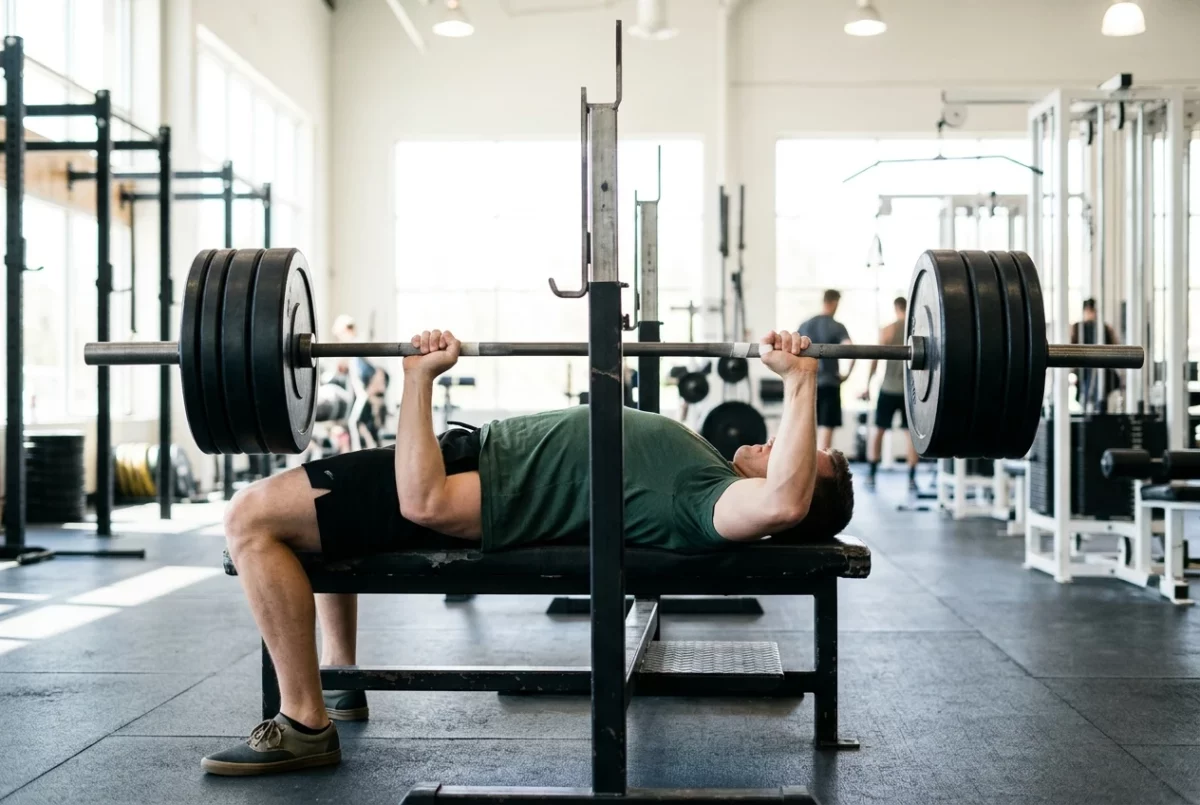
Most lifters who bench regularly chase the same number: more weight on the bar. For a bigger chest, the better question is whether each session gives the pecs more tension than the last one did. A heavier bar can raise that tension. It can also hide a shorter range of motion, a bigger arch, a bounce off the chest, or triceps doing a larger share of the work.
This guide gives you a bench press progression for chest hypertrophy that judges every step by the muscle being trained. It covers when to add reps, load, range, tempo, volume, or an angle change, and how to set up the bench so the chest has a fair chance of reaching failure before your triceps do.
What the bench press actually asks of your chest and triceps
The bench press is a shared job. The pectorals bring the upper arm across the body and forward. The triceps straighten the elbow. The front of the shoulder helps with both. The bar moves whenever the combined effort is enough, and the set ends when the weakest link in that group gives out.
That last point matters for growth. If your triceps fail first, the set ends before the chest has been taken anywhere near its limit. You can log a decent bench number for months while the chest gets a mild stimulus and the triceps get most of the hard work. This is the pattern behind the common complaint of sore elbows and a pump in the arms, but little change in the chest.
Hypertrophy depends on a few practical conditions:
- The target muscle is under real tension through a full, controlled range.
- The set ends close to failure, meaning you could do perhaps one to three more good reps.
- You repeat that stimulus often enough, and slightly harder over time.
The bench press can meet all three, but only when your setup and progression keep the chest in the lead. Everything below follows from that.
Why a heavier bar is not always the best progression for growth
Bar weight is a proxy for muscle tension, and a loose one. Adding 2.5 kg to the bar looks like progress, but several things can produce that increase without more chest work:
- A higher arch shortens the distance the bar travels.
- Touching the bar higher on the chest, or stopping short of it, cuts the stretched portion of the rep.
- A bounce or fast drop carries the bar through the hardest part.
- Flaring or tucking the elbows differently moves work toward the shoulders or triceps.
- Grip creeping inward turns the lift into a triceps exercise.
None of these are cheating in a powerlifting context, where the goal is to move the most weight over a legal range. For muscle growth, they can quietly remove the very thing you want from the exercise.
This does not mean load stops mattering. Over months and years, a lifter who builds a bigger chest will almost always be pressing more weight for the same quality of reps. The difference is the order of operations: keep the rep standard fixed, then let the load rise as a result. A step counts as progress only if the chest is still doing the work at the same depth and the same control.
For a strength-focused view of the same topic, the site’s piece on why lifts stall and how to progress again covers the load-driven side. This article treats those methods as one tool among several.
Set your base: grip width, bench angle, and bar path for chest tension
Before progressing to anything, fix the variables you will hold constant. A progression only means something if last week’s reps and this week’s reps were performed the same way.
Grip width
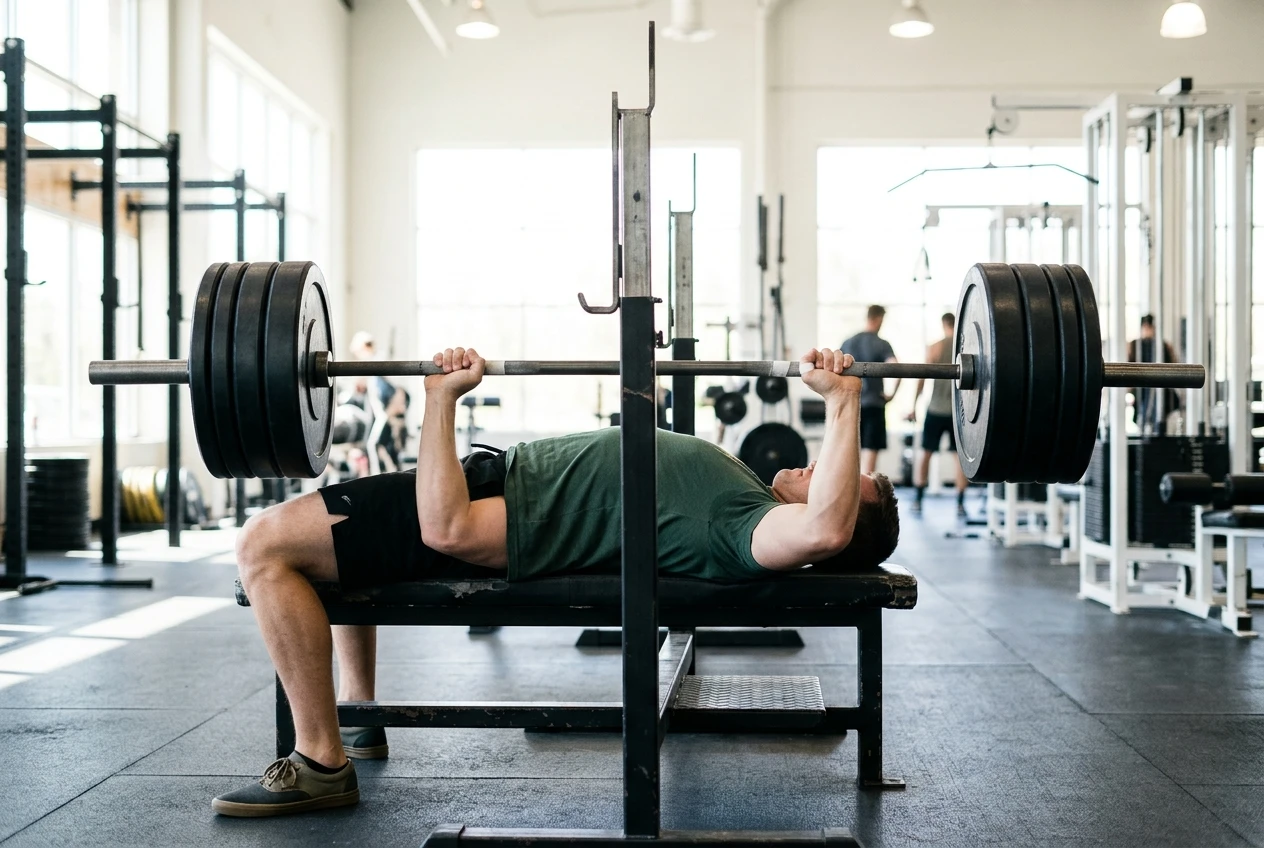
A common starting point for chest emphasis is a grip a little wider than shoulder width, set so your forearms are close to vertical when the bar is at your chest. If your hands are much wider, the range of motion shrinks, and the shoulder joint takes more strain. If your hands are much narrower, the elbows travel further forward, and the triceps take over more of the press.
Test it simply. Lower the bar to your chest and pause. Look at your forearms from the side, or have someone check. If the wrists are well in front of or behind the elbows, shift your grip a thumb’s width and try again. Then mark the bar with a piece of tape or note the ring position so you can repeat it.
Bench angle
A flat bench loads the middle and lower parts of the chest and is easy to compare week to week. A low incline, roughly 15 to 30 degrees as a starting range, shifts more tension toward the upper chest. A steep incline moves a good deal of the work to the front of the shoulder, so a very steep bench is usually a poor choice for chest growth.
Many lifters do well using both: a flat press as the first exercise one day and a low incline press on another day. Whichever you pick, treat each angle as a separate lift in your log. A weight that is easy on flat will often be too heavy on an incline.
Bar path and body position
Pull your shoulder blades back and down against the bench before you unrack, and keep them there. Plant your feet so you can push through them without lifting your hips. Lower the bar to the lower half of the chest, around the nipple line or slightly below, and press it back up and slightly toward your face so it finishes over your shoulders.
For elbow position, a middle ground works for most people: roughly 45 to 60 degrees from the torso, not pinned to the ribs and not flared out at 90. You should feel the chest stretch at the bottom, and your shoulders should feel stable rather than pinched. If a position hurts the front of the shoulder, change it. No bench setup is worth training through sharp pain.
A double progression ladder: reps first, then load
Double progression is the simplest hypertrophy-friendly system for the bench press. You pick a rep range, and you earn the right to add weight by hitting the top of that range.
Here is how it works with a range of 6 to 10 reps for three working sets:
- Choose a weight you can press for 6 reps on the first set, with one or two reps left in reserve.
- Next session, use the same weight and try to add a rep to some sets. Keep going until all three sets reach 10 reps.
- Once all three sets hit 10 clean reps, add the smallest jump available, 1 to 2.5 kg per side, or less if you have fractional plates.
- The heavier weight will drop you back to around 6 or 7 reps. Start climbing again.
As an illustration, the sets might read 8, 7, 6 one week, then 9, 8, 7, then 10, 9, 8, then 10, 10, 9, then 10, 10, 10. That is five sessions of progress with no change in load. The only thing that changed is how many reps your chest produced under tension.
Some rules keep this honest:
- Rep standard. A rep counts only if the bar touches the same spot on your chest, you control the descent, and you press without bouncing or lifting your hips.
- Proximity to failure. Stop sets when the next rep would break the standard or when you have around one to three reps left. Going to failure on every set of every session adds fatigue quickly.
- Rest. Rest long enough, often two to three minutes, so that the triceps and shoulders recover, and your later sets stay close to the first.
- Rep range. Moderate ranges such as 6 to 10 or 8 to 12 suit the bench because the movement is stable and loadable. Lighter, higher-rep work also builds muscle when sets are taken close to failure, so you can use it on incline or accessory work.
If your triceps keep ending the set while your chest still has plenty left, lower the weight a little and slow down, and use the accessory work in a later section to bring the triceps up.
Progress without adding weight: range of motion, tempo, pauses, and volume
Load is one of at least five levers. When your reps have stalled, or when adding weight would push you past good form, one of these may serve the chest better:
- Range of motion. A slightly deeper press increases the stretch on the pecs. Dumbbells allow more depth than a barbell, because the bar stops at your chest, and the dumbbells can pass lower. Increase depth gradually, and only as far as your shoulders tolerate without discomfort.
- Tempo. Lowering the bar over two to three seconds raises time under tension and removes momentum. Keep the press itself controlled but intentional. If a slower descent drops your reps by one or two, that is normal, and the sets are now harder in the way you want.
- Pauses. A one- to two-second pause on the chest takes out the stretch-reflex bounce. It also reveals whether you were using that bounce. Pausing is a good way to check that last month’s heavier bar was really pressed with the chest.
- Volume. Adding a set to a lift you recover well from is a legitimate progression. Add one set at a time and keep it for a few weeks to judge whether your performance and recovery hold. If your reps start falling across sessions, you added more than you can currently recover from.
- Angle change. Replacing a flat bench with a low incline, or alternating them, changes which parts of the chest receive the most tension. It is also a reasonable response to a stall on one angle, because a fresh variation resets the rep range without any loss of stimulus.
A practical order to use when your double progression stalls: first, try to add a rep across a couple of sets, then add a controlled tempo or pause, then add a set, and finally change the angle or exercise. Change one lever at a time so you can tell what worked.
Add accessories that fix whichever muscle is lagging (chest or triceps)
Your logbook and your own notes about where each set ended will tell you which muscle to support. Two patterns are common.

When the triceps or shoulders quit first
If the bar slows near lockout and your chest feels fresh, or if your elbows and front delts are the sore parts the next day, the chest is not being worked to its limit. Two approaches help, and you can use both:
- Use pressing movements where the triceps are less limiting. A machine chest press, a low incline dumbbell press, or a cable fly lets you take the chest close to failure with less triceps involvement. Flyes and cable crossovers remove the elbow extension almost entirely, so the chest can fail first.
- Strengthen the triceps so they stop limiting the bench. Close-grip bench press, overhead triceps extensions, and pushdowns all build the muscle directly. Overhead variations train the long head of the triceps in a stretched position, which complements the bench well.
When the chest lags, and the triceps keep up
If your lockout is strong but you feel little in the pecs, the setup may be the problem before any accessory is. Recheck grip width and elbow position. Then add chest-focused work in a stretched position: dumbbell flyes, a deep-range incline dumbbell press, or a cable fly with a pause at the stretched point. Chest-supported dips with a forward lean also load the pecs, though they stress the shoulder joint more, so treat them with care.
For both cases, keep accessory volume modest. Two or three accessory exercises of two to four sets are usually plenty besides a main bench session. More than that tends to cut into recovery for the next bench day.
Reading your logbook: when to push, hold, or reset a progression
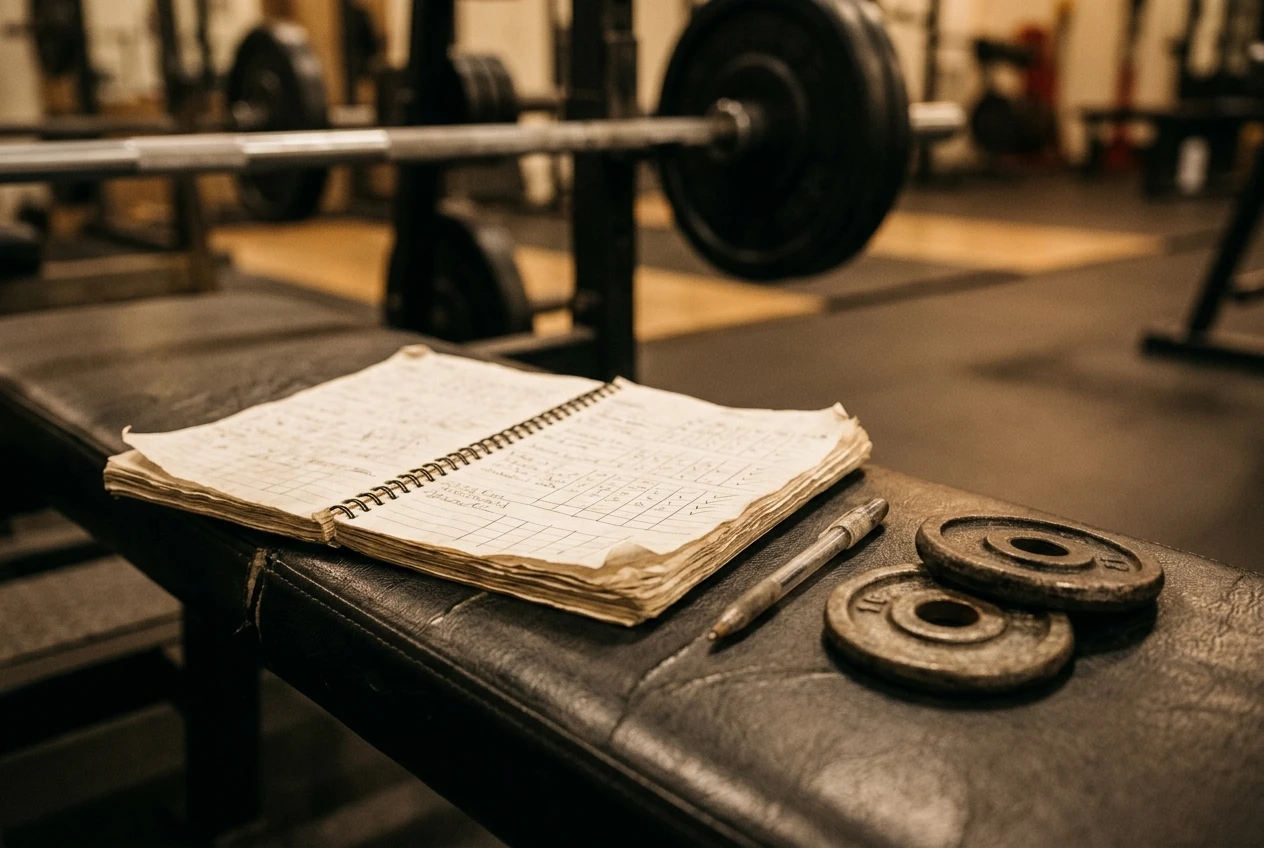
A log turns a vague feeling about progress into a decision. For each bench session, record:
- Exercise, bench angle, and grip position
- Weight, reps per set, and any tempo or pause used
- Reps left in reserve on the last set
- Which muscle ended the set: chest, triceps, or shoulders
- Sleep, soreness, or anything unusual
With that information, three decisions cover most situations.
Push when you reach the top of your rep range on all sets with good form and one or two reps in reserve, or when you added reps on at least one set compared with last time. Add the next small increment of load or reps.
Hold when reps stayed the same or dropped by one rep on a single set, and the cause is plausible and temporary, such as a poor night’s sleep, a stressful week, or a different time of day. Repeat the same weight and standard next session. One flat session is not a stall.
Reset when reps have dropped or stayed flat across several sessions, when joints are bothering you, or when the lift keeps getting harder at the same load. Lower the weight by roughly 10 percent, return to the bottom of your rep range with clean reps, and rebuild. A planned lighter week is another reasonable reset. Alternatively, switch the angle or exercise for a few weeks and return later.
Watch for the notes that show which muscle ended the set. If “triceps” shows up in most of your entries, that is the signal to adjust grip, add accessory work, or both. If “chest” shows up in most of them, your setup is doing what it should.
Training at home or with limited gear: floor press variations and what to buy only if you need it
You can build the chest at home with a modest setup, provided you keep the same principles: a fixed standard for reps, a range of motion you can repeat, and sets that finish close to failure.
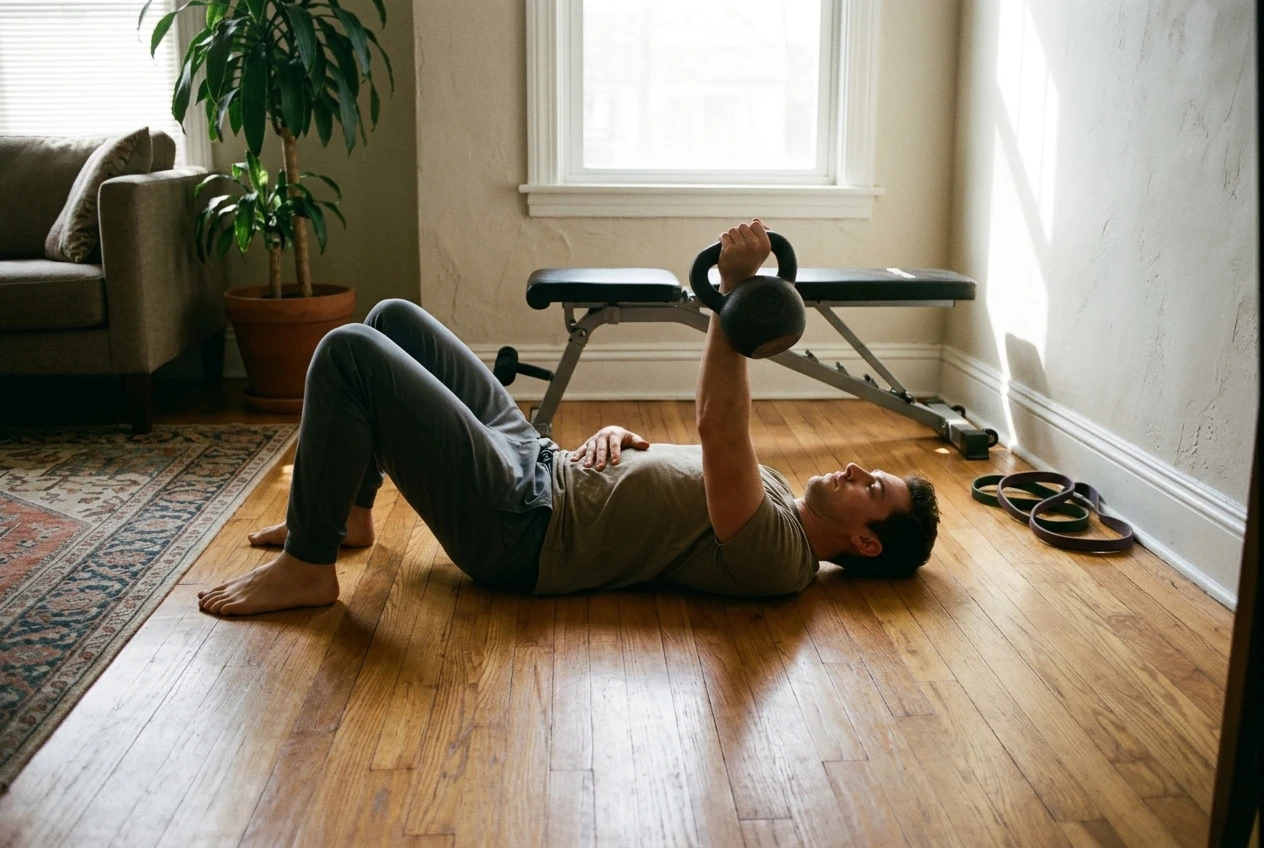
The floor press is the core home option. You lie on the floor and press dumbbells or kettlebells, and your upper arms stop when they touch the floor. That limits the bottom stretch compared with a bench, so it removes some of the chest’s most productive range. It also reduces strain on the shoulder, which some lifters welcome. Use it as a way to load the chest and triceps with fewer joint demands, not as a full replacement for a deep dumbbell press.
You can progress floor presses by the same levers as before:
- Add reps within a range until you hit the top, then use the next heavier weight.
- Slow the lowering phase and pause briefly with your upper arms on the floor.
- Switch from both arms together to one arm at a time, which makes each side work harder and exposes imbalances.
- Add sets once your recovery allows it.
For push-ups, raise your feet on a step or chair to shift the load toward the upper chest, slow the descent, and add a resistance band across your back once bodyweight reps become easy.
If you want to buy something, decide by what limits you. An adjustable bench makes incline and flat pressing possible with the same dumbbells. Adjustable dumbbells or a heavier pair solve the problem of outgrowing your weights. Resistance bands are cheap and useful for flyes and for loading push-ups. If you press a barbell alone, safety arms or a rack matter more than any extra attachment. Skip anything that does not fix a limit you have actually run into.
If you train at home and want a structured program built around pressing work, such as kettlebell floor presses, take a look at the kettlebell. monster (affiliate link: I may earn a commission if you buy through it). If you would rather follow along on screen, there is also the Samsung Tizen TV workout app (affiliate link: I may earn a commission if you buy through it).