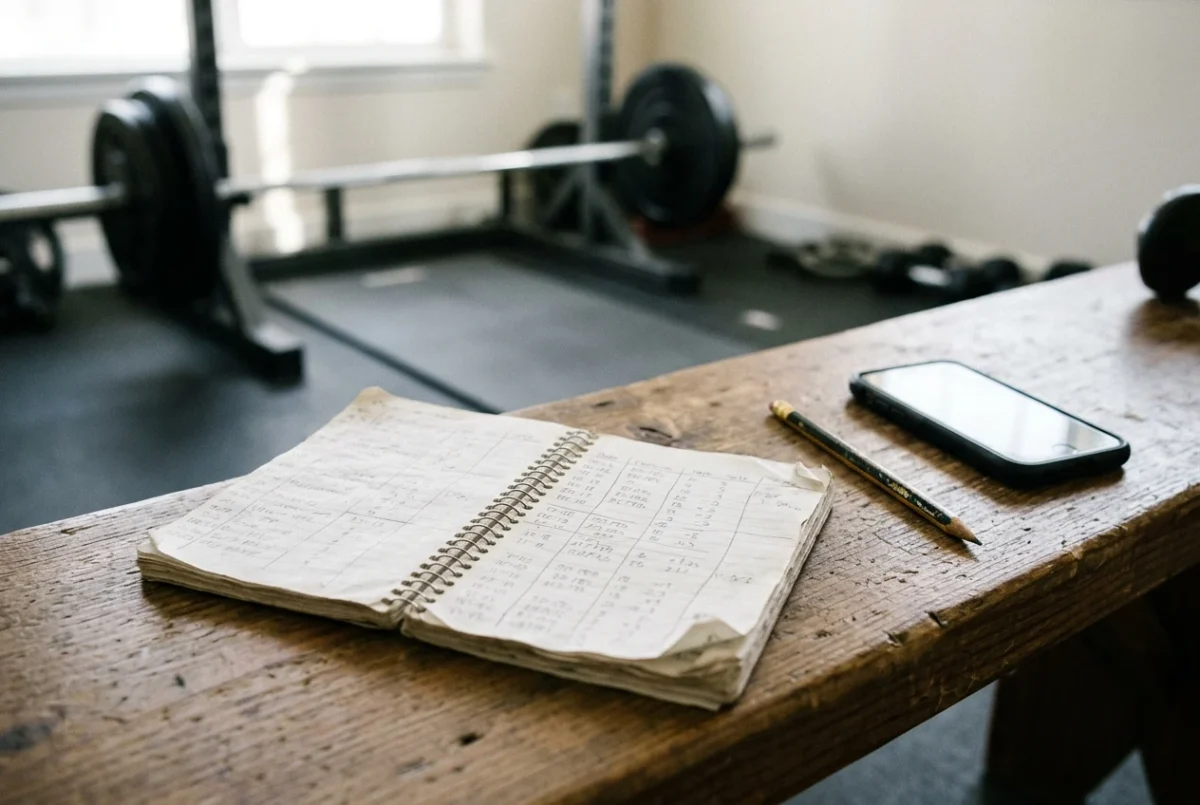
Most advice for a flat overhead press focuses on the day you press: warm-up, bar path, rep scheme. Your overhead press may have stalled because of what happens in the 48 hours between sessions. Your shoulders get loaded, rested, fed and slept on during that time, and none of it shows up in a training log that only records the press itself.
This article gives you a three-day log for those rest days, then matches each thing the log shows to one change.
The press you can’t add weight to may be a recovery problem, not a technique problem
A press that has stopped moving while the bar path looks fine and the warm-ups feel normal often points to recovery. The signs are specific. Your first warm-up set feels heavier than it did last week. One shoulder is stiff or achy when you start. You hit the same number of reps you hit three weeks ago, with the same grind at the end.
If those sound familiar, the shoulder is probably arriving at the rack in a different state than the one your program assumed. The program assumes two or three days of recovery between press sessions. If those days include a hard bench session, a pull-up workout, a long carry and five hours of sleep, the recovery you planned is not the recovery you got.
You can’t fix that by guessing. You need a record of what those days contain, and most lifters have never written one down.
Log three rest days: what your shoulders did, how you slept, what you ate
Pick three days between press sessions. If you press every other day, there is only one rest day per gap, so log the rest day in three consecutive gaps instead. Use a notes app or the back of your training notebook. Every entry takes about two minutes.
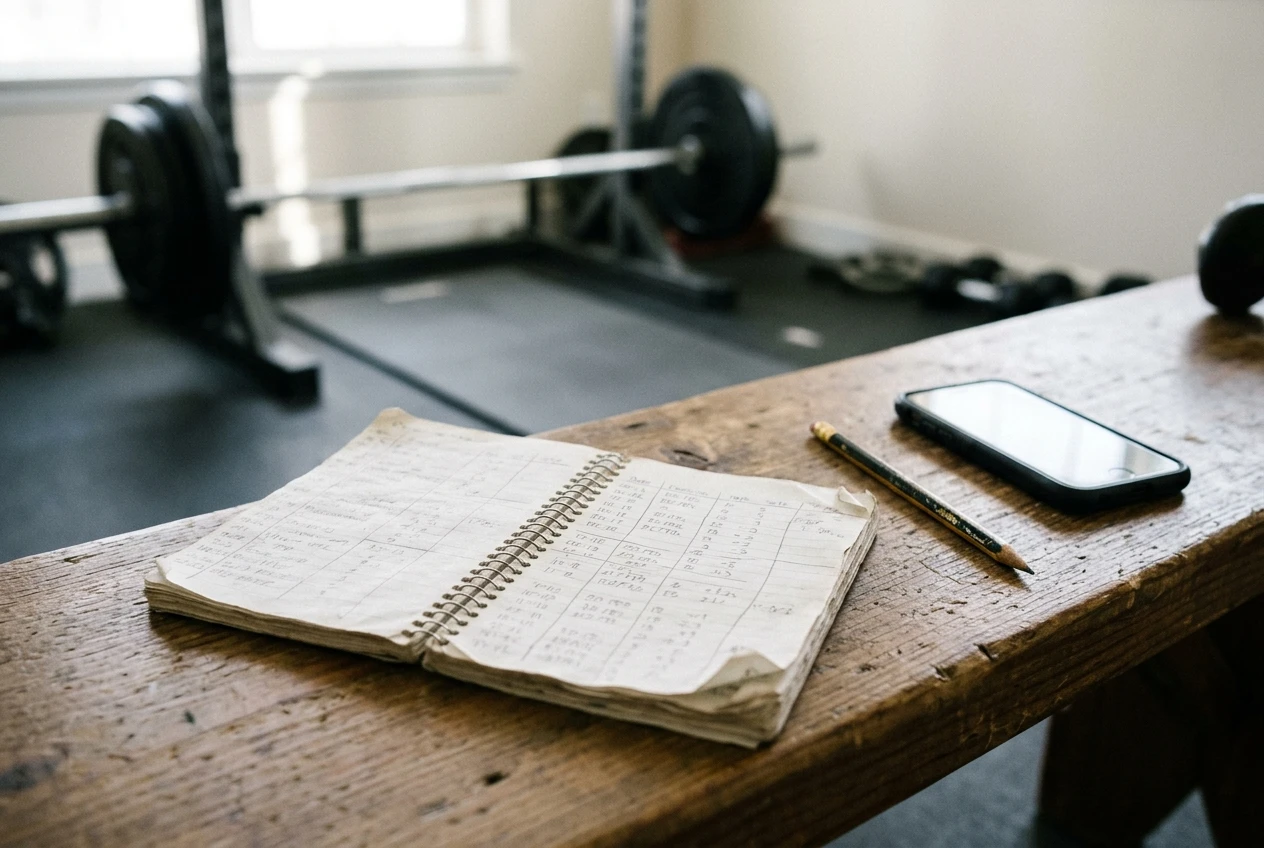
For each day, record these four things:
- Shoulder load. Every set or activity that put weight through your shoulders or made them work: bench, dips, push-ups, rows, pull-ups, hangs, farmer carries, overhead dumbbell work, and anything outside the gym such as moving furniture, painting a ceiling, or working at a desk with your shoulders hunched.
- Shoulder state. A score from 0 to 10 for stiffness or ache when you wake up, and another before bed. Note which shoulder if it differs.
- Sleep. Bedtime, wake time, how many times you woke, and a plain rating of how rested you felt. Record the night before your next press session as well, since that is the night that matters most.
- Food. Roughly what you ate at each meal, whether you ate more or less than you do on a training day, and how much protein-containing food was in each meal. You do not need exact grams. You need to see the pattern.
On the next press day, add two more lines: how the first warm-up set felt, and your top set result. That connects the rest days to the outcome.
Write what happened, not what you meant to happen. A log you tidy up afterwards will not show you anything.
The “rest day” that quietly loads your shoulders
When lifters read back their first log, the shoulder load line usually surprises them. Rest days in a real week are rarely empty.

These are the common sources of hidden shoulder work:
- Bench volume the day before pressing. A heavy bench session loads the front delts and triceps, the same muscles that drive your press. If bench sits on the day before overhead press, the press starts from a tired position.
- Pull-ups and chin-ups. They are pulling work, but they load the shoulder joint hard at the bottom of the rep, and high-rep sets leave the shoulders sore.
- Carries. Heavy farmer carries and suitcase carries keep the shoulder girdle working for the whole walk. Count them.
- Overhead work you forgot to count. Landmine presses, dumbbell lateral raises, push press as a “warm-up”, handstand practice, and kettlebell work in the rack position all count. If your hands finished above your head, it goes in the log.
- Life outside the gym. Hanging shelves, lifting a toddler or luggage overhead, swimming, or a physical job.
None of these is bad. The point is that each one adds fatigue to a shoulder you intend to press heavy within a day or two. If your log shows meaningful shoulder work on all three days, the rest day is a training day under another name.
Too little movement is also a problem: when a full rest day hurts your next press
The opposite pattern also shows up. Some lifters take a rest day literally: no movement, long hours seated, shoulders rolled forward over a keyboard. Then they walk to the rack and the first warm-up set feels stiff and sticky.
You can spot this in the log. The evening shoulder score is fine, the morning score on press day is worse, and your sitting hours are high. The shoulders were not tired, they were idle, and the joint and the muscles around it started the session cold and stiff.
A fully sedentary day is not automatically a recovery day. Recovery from hard training goes better with light circulation and easy range of motion than with hours of stillness. Whether it does for you is exactly what the log can show: compare press days that followed a still rest day with press days that followed a day of easy movement.
How to read your log: matching each pattern to one change
Resist the urge to fix everything at once. If you change sleep, food, bench volume and your program in one week, you will not know which one mattered. Find the strongest pattern in the log and make one change.
What the log shows | The one change |
|---|---|
Shoulder work on all three rest days, especially bench, pull-ups or carries within a day of pressing | Move or cut the heaviest of those sessions so that at least one full day before your press has no hard shoulder work. Trim sets before you remove an exercise. |
Hidden overhead work, such as lateral raises or push press, that you had not counted | Remove it from the days next to your press for four weeks, or move it to the day after your press. |
Evening shoulders fine, but morning press-day stiffness is high and the rest day was mostly sitting | Add a short, low-effort movement session to the rest day (described below). |
Short or broken sleep on the night before the press | Fix that night first: set a fixed bedtime for the night before pressing and keep screens and caffeine out of the last stretch of it. Change nothing else yet. |
You ate noticeably less on rest days than on training days | Bring rest-day food close to your training-day food. Keep protein-containing meals in the day, not just the dinner. |
Everything looks reasonable: moderate load, steady sleep, regular meals, easy movement | Recovery is probably not the limit. Move on to testing range and control. |
If your log lands in that last row, the stall most likely sits in how the shoulder moves under load rather than in how it recovers. Our guide to a stalled overhead press and whether it is a range problem or a control problem gives you the tests to run next, before you spend anything on mobility gear.
A recovery-day session that keeps shoulders moving without adding fatigue
The aim of this session is circulation and range, with no new fatigue. Keep effort at about 4 out of 10 or lower throughout. If you feel a pump or burn building, the weight or the reps are too high for a recovery day.
A light kettlebell fits well here because you can hold the bell close to your body and control the load. Choose a bell much lighter than anything you train with. A weight you could hold for a long time is the right one.

Run this as a circuit, resting only as long as you need:
- Halos: 2 sets of 8 slow circles in each direction, bell held at chest height, ribs stacked over hips.
- Goblet squat: 2 sets of 8, slow, pausing at the bottom to open the hips and let the upper back stay tall.
- Light two-hand swings: 4 sets of 10, to hip height only, crisp and easy. Stop each set while it still feels too light.
- Wall slides or floor angels, bodyweight: 2 sets of 10, moving only through the range you can control without arching your lower back.
- Easy hang or supported stretch: 2 holds of 20 to 30 seconds, hanging from a bar with your feet on the floor or a box so the arms take little load, or a doorway chest stretch if hanging bothers you.
The session should take 15 to 20 minutes. You should finish it feeling looser than you started, with your morning shoulder score unchanged or better the next day. If the score gets worse, cut the swings or the hang first.
For where a session like this belongs in a heavier week, the guide to kettlebell flow as recovery between heavy days covers placement in a powerlifting split.
If you want a structured, low-load session to use on recovery days, take a look at kettlebell.monster. Affiliate disclosure: I earn a commission if you buy through this link.
Run a four-week check: what to track and when to change your plan
One log tells you where to start. Four weeks tells you whether the change worked. Give the change at least four weeks, which covers several press sessions, before you judge it.
Track these four items after every press session:
- Top set weight and reps.
- How the first warm-up set felt, on a simple scale of 1 to 5.
- Your morning shoulder score on press day.
- Sleep on the night before the press.
Keep a one-line note on what your rest days contained each week, so you can see whether you kept to the change you chose.
Then read the result at the end of week four:
- Top set or reps have gone up, or the same weight moves more easily. The change is working. Keep it, and add the smallest weight jump you can. Wait to make a second change until that jump holds.
- Warm-ups and morning shoulder scores improved, but the top set has not moved. Recovery is better and you are likely closer to the limit. Give it another two weeks, then reassess the program itself.
- Nothing changed at all. Repeat the three-day log. If it is still clean, recovery is not what is holding you back, and the range and control tests are your next step.
- Things got worse. Undo the change and pick the second-strongest pattern from your first log.
Your rest days are part of your training, and the log lets you manage them with the same attention you give your sets and reps. Run it for three days, make one change, and let four weeks of press sessions show you what it did.