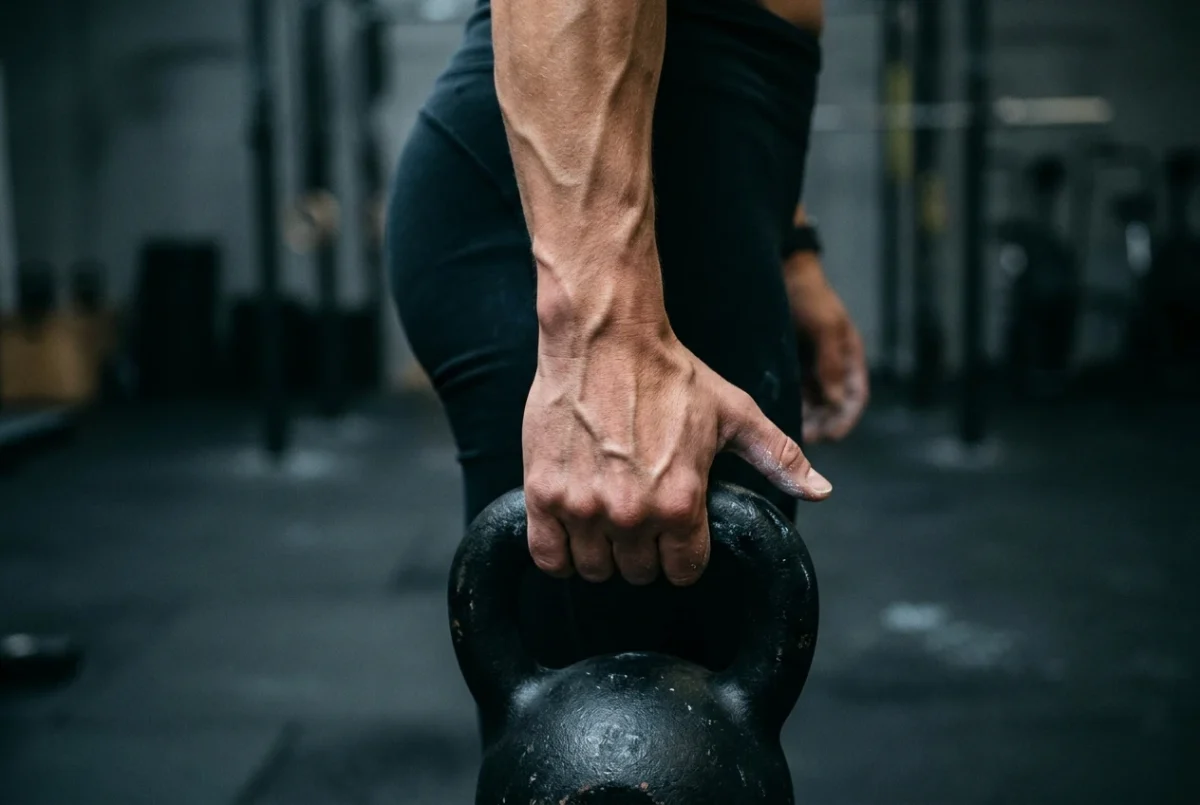
Most lifters who swing for time describe the same moment: the hips and legs could keep going, but the hands start to open. That one complaint covers at least three different problems. Kettlebell swing grip fatigue can come from tired forearm muscles, from skin that has had enough of the handle, or from a hand that cannot hold the handle steady as the bell changes direction. They feel alike in the moment and respond to different training.
If you have already decided to give grip its own block, the how-to is in this guide to giving your kettlebell grip its own block. This piece helps you choose what goes in that block.
What Your Hand Is Actually Doing Through a Long Swing Set
A swing asks the hand to do something different at each point of the arc. The load on the handle is not constant, and the hand is not simply squeezing for the whole set.
In most swings the bell pulls hardest on the hand as it falls and passes back between your legs. The hand has to hold the handle against the bell’s weight plus its momentum. At the top the bell is moving slowest and is close to weightless, so the demand changes from pulling force to control: the hand has to keep the handle from rolling or shifting as the bell turns over and starts to drop.
Three things are working in the hand at once:
- The muscles in the forearm that close the fingers produce the squeeze.
- The skin of the palm and fingers takes friction and pressure from the handle on every rep.
- The hand’s overall hold keeps the handle in place under sudden changes in the direction of pull.
Any of the three can end your set first. A hanging routine only addresses the first, which is why it helps some lifters and does little for others.
Failure Point One: The Forearm Muscles That Close Your Fingers
The muscles that close your fingers sit in the forearm, and a long swing set loads them for minutes at a time. This is endurance work. The muscles are not hitting a maximum, but they are being asked to hold a moderate contraction repeatedly with little rest, and eventually they tire.
The signs are fairly clear. The forearms feel tight or full and the fingers start to uncurl on the backswing. The handle sits lower in the hand because you can no longer keep the grip closed. Your palms feel fine, and the handle has not shifted or slipped. The muscles just stopped producing the squeeze.
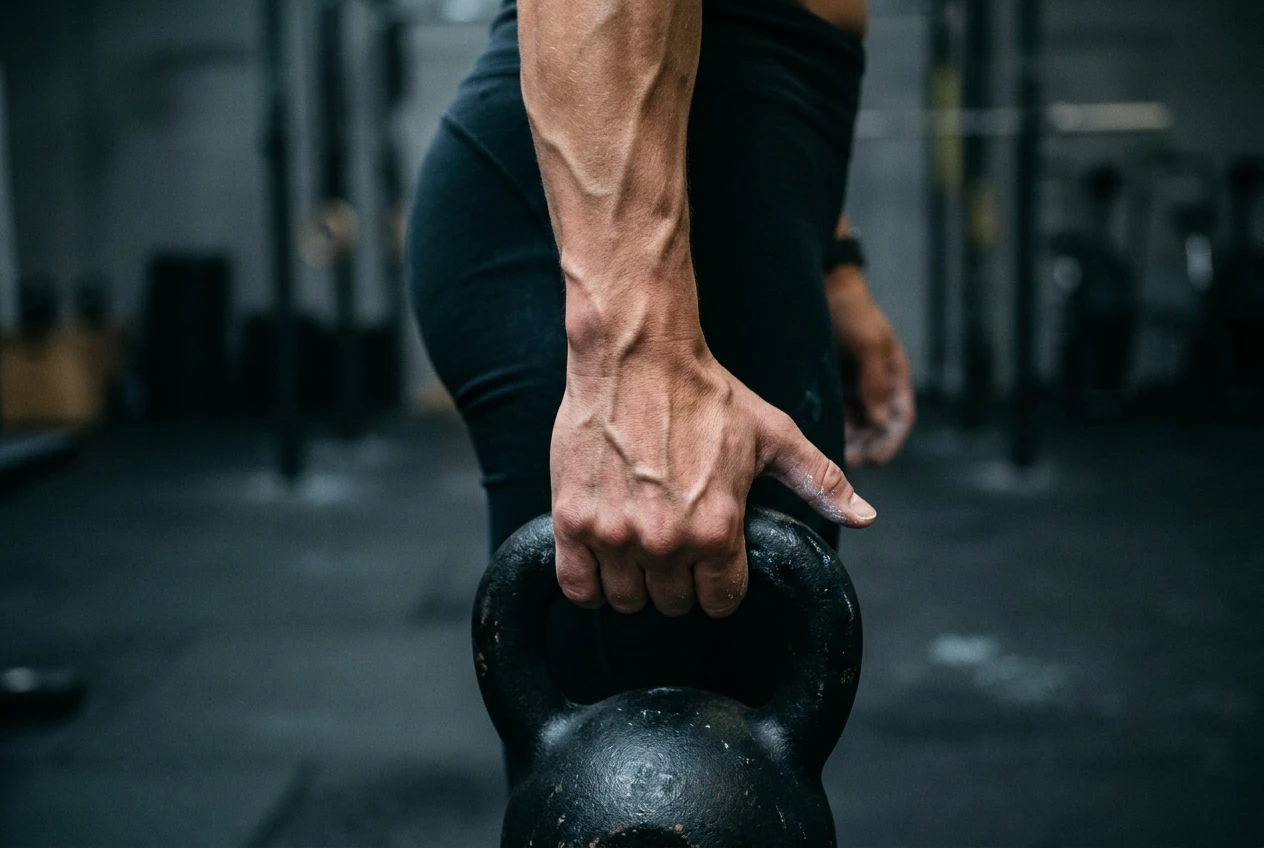
Because the limit is time under tension rather than peak force, the training that fits it is also measured in time. Our piece on grip endurance training for lifters makes the case for working in minutes rather than reps, and that logic applies directly here. A swing set lasts minutes, so the grip work that transfers to it should too.
Work that fits this failure point:
- Timed holds of a kettlebell by the handle at your side, in several rounds with short rests.
- Farmer-style carries with a kettlebell in each hand or one hand at a time.
- Dead hangs from a bar, if you have one, for repeated timed rounds.
The common feature is a closed hand under steady load for long enough to tire the finger flexors. Rest intervals should be short enough that the forearms never fully recover between rounds.
Failure Point Two: The Skin and the Handle, and Why Sore Hands Aren’t Weak Hands
Sometimes the hand quits because it hurts, not because it is out of strength. Swings drag the handle across the skin on every rep. The friction builds heat, and the pressure lands on the same spots each time, usually the pads at the base of the fingers and the creases where the fingers meet the palm.
A hand that ends a set because of a hot spot, a blister, or a torn callus is limited by skin, and forearm work will not fix that. A lifter with strong forearms and tender palms will still put the bell down early. The reverse also happens: tough hands with tired forearms will keep gripping until the muscles give out.
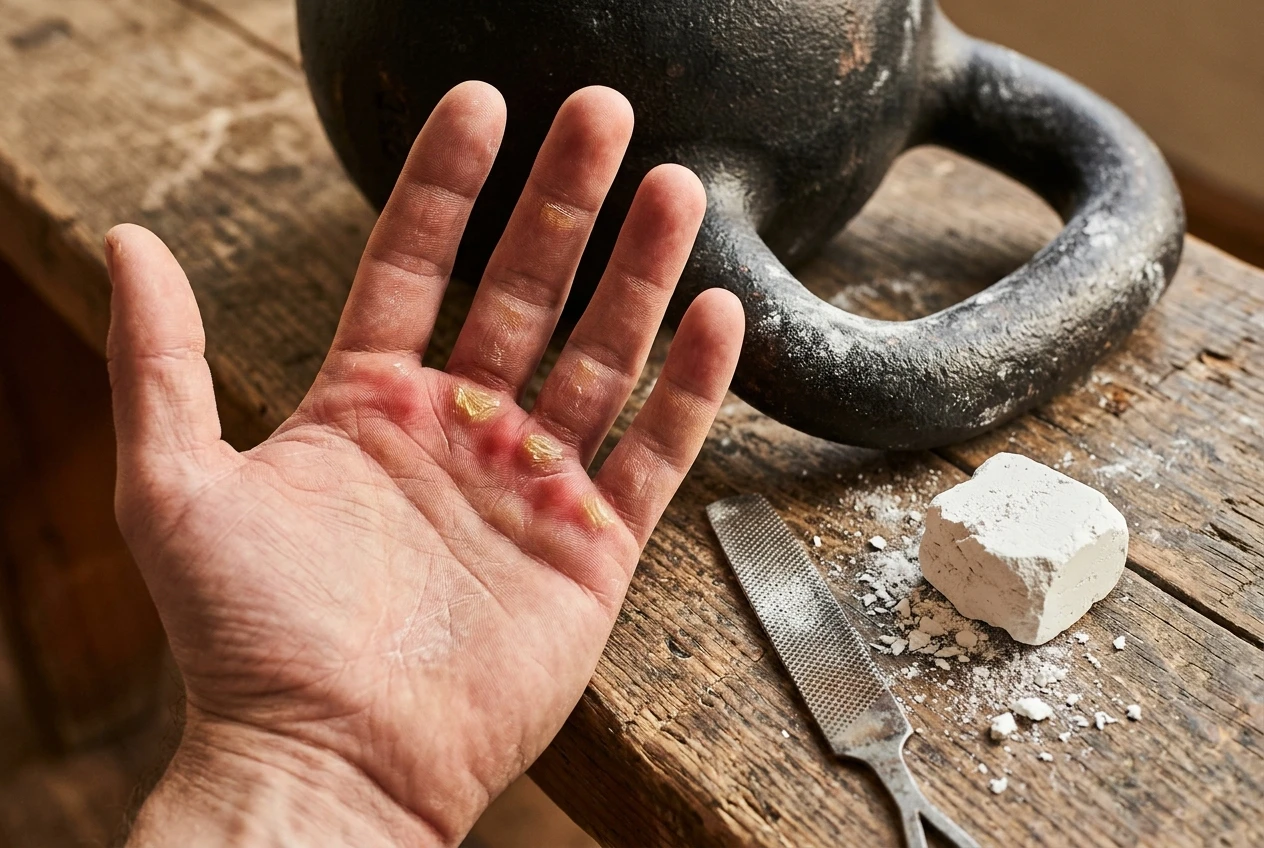
The signs of a skin limit:
- A burning or hot feeling in the palm that builds over the set.
- Pain in specific spots rather than a general forearm burn.
- Your grip still feels strong when you stop, but you do not want the handle in your hand.
- Visible redness, raised callus edges, or torn skin afterward.
Skin responds to different management than muscle does:
- Keep calluses smooth and low. A thick, raised callus catches and tears, so file or trim it rather than leaving it to build up.
- Use chalk if your hands get damp, since moisture changes how the handle moves against the skin. Some lifters prefer a dry hand and others find a bit of chalk helps. Which suits you is your own call.
- Check the handle itself. A rough or poorly finished handle will wear skin faster than a smooth one, and a bell with a thicker handle loads the skin differently.
- Raise your swing volume gradually. Skin adapts over weeks of repeated exposure, and a sudden jump to long sets will outrun it.
The block for this failure point is mostly volume management and hand care. A skin problem is a reason to adjust how quickly you add swing time, not a sign that your grip is weak.
Failure Point Three: Holding On at the Top of the Swing Versus Holding On at the Bottom
The third limit is the hand’s ability to hold the handle in place against the changing pull of the bell. Lifters often mistake it for forearm fatigue, though it can show up while the forearms still have plenty left.
The bottom of the swing is where the bell’s pull on the hand is highest. If the hand is the limit here, you feel the handle trying to drag out of your fingers as the bell drops back between your legs. You may regrip, open the hand slightly to recover, or notice the bell swinging out of line because the grip is giving way under load.
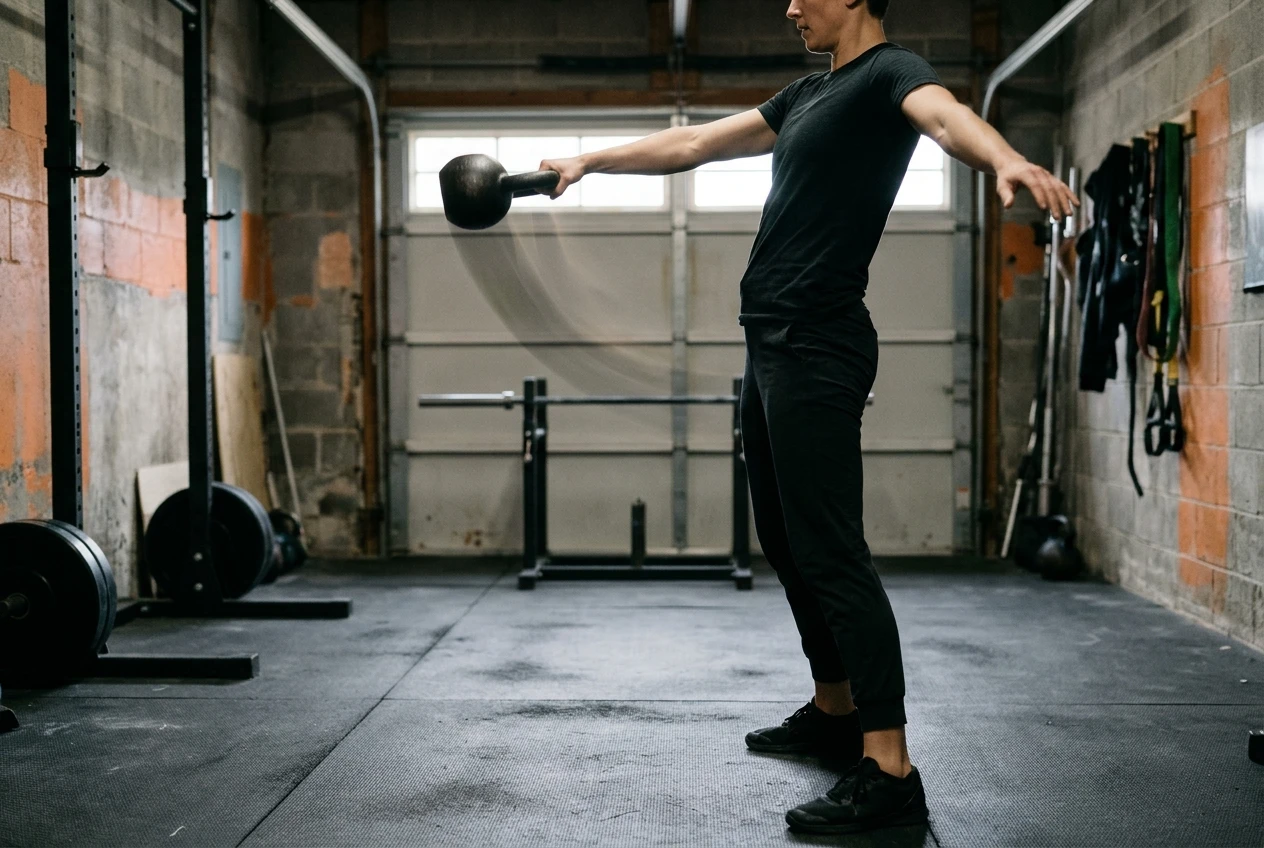
The top is a different kind of demand. The bell is almost weightless, so the hand has to keep control as the bell turns over and begins to fall. If the handle shifts in your hand here, you have to re-catch it on the way down, and that wastes energy and makes the backswing worse. A hand that opens too much at the top then has to clamp down hard at the bottom, which accelerates fatigue.
So the question is where the handle moves. It might slip at the bottom under heavy pull, or it might shift at the top because you let the hand go slack. The first points to a hand that cannot resist peak load. The second points to control, meaning how you hold the handle through the weightless moment.
Work that fits this failure point:
- Heavier holds and carries than your swing bell, in short rounds, to train your hand against a pull greater than the one your swing produces.
- Heavy swings in shorter sets, so the hand meets peak pull while still fresh.
- One-handed swings with a deliberate, even grip through the whole arc, which makes a slack hand obvious.
A Quick Test to Find Which Limit You Hit First
You can sort out your limit across two or three swing sessions with no equipment beyond your usual bell. Swing until your hands force you to stop, and then answer a few questions straight away, while the sensation is fresh.
- Where did it hurt or fail? If the forearms burned and the fingers uncurled, suspect the finger-closing muscles. If one patch of palm burned or stung, suspect skin.
- Did the handle move? If it slid at the bottom of the swing, the problem is resisting peak pull. If it shifted at the top, the problem is control.
- Could you still hold the bell? Pick it up and hold it at your side right after you stop. If you can hold it for a good while longer, finger endurance is probably not the limit, and skin or handle control is the more likely cause. If it drops almost immediately, the forearm muscles are spent.
Repeat the check across a few sessions. One bad day, such as a hot room or damp hands, can mislead you. A pattern across several sessions is more reliable.
If you also deadlift and find your grip fails there, our article on grip fatigue during heavy deadlifts gives a set-by-set way to separate technique from fatigue. The same logic applies here.
Matching the Block to the Limit: What to Train, How Long, and Where It Sits in Your Week
Once you know your limit, the block can be built around it. These are starting points to adjust, not fixed prescriptions.
If your forearms are the limit
Train timed holds or carries for several rounds with short rests, aiming to accumulate total hold time that gradually exceeds the length of your swing sets. Two sessions per week is a reasonable place to begin. Put them after your swing work or on a separate day, so your forearms are not already tired when the swings begin. Increase total time before you increase load.
If your skin is the limit
Skip extra hanging and spend the effort on hand care and volume progression. Keep calluses filed, decide on a consistent chalk habit, and add swing minutes in small steps. Allow a day or two between long swing sessions so the skin can recover. If a tear or blister opens, rest the hand until it has healed. Training through broken skin only extends the problem.
If your hand cannot resist the pull
Use heavier loads for shorter times. Short rounds of holds or carries with a bell heavier than your swing bell train the hand against a stronger pull. Add some sets of heavy swings, performed while you are fresh, so the hand meets peak pull early in the session. If the shifting happens at the top, include one-handed work and focus on keeping the same grip all the way through the arc.
Where it sits in your week
Place grip work where it will not wreck the session it supports. Heavy hand work right before a long swing session leaves you with tired hands for the main event. Putting it after swings, or on a day when swings are light, keeps the quality of your main work intact. Start with one or two short grip sessions a week and keep what you add small enough that you can still swing well the next day.
Reassess every few weeks by repeating the test above. The limit you hit first can change as one weakness improves, and the block should change with it.
If you want a timed swing session to run your grip block alongside, look at kettlebell.monster. Affiliate link: I may earn a commission if you buy, at no extra cost to you.