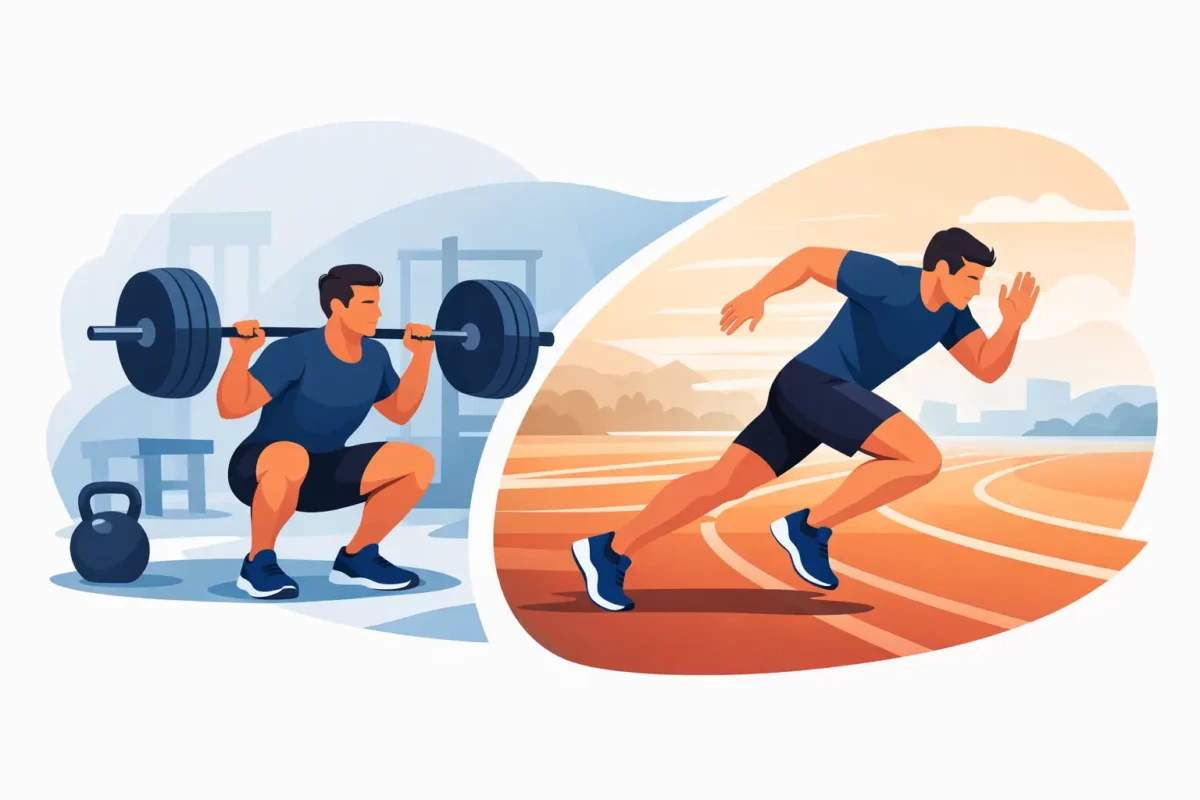
Speed is not just a gift of quick feet. Every hard acceleration begins with force pushed into the ground, and the athlete who can produce more useful force in less time has an advantage. Strength training for speed builds that capacity when it is programmed to support sprint mechanics, explosive intent, and recovery instead of simply adding fatigue.
For athletes and lifters, the goal is not to turn the weight room into a second sport practice. It is to build a stronger engine. The right barbell work raises the ceiling for force production, while power work teaches the body to apply that strength fast enough to matter on the field, track, court, or platform.
Why Strength Makes You Faster
Sprinting requires an athlete to apply high levels of force during extremely short ground-contact times. At acceleration speeds, there is more time to push, which makes raw lower-body strength especially valuable. As speed rises, the available time shrinks, so rate of force development, stiffness, coordination, and elastic qualities become increasingly important.
This is why a bigger squat alone does not guarantee a faster 40-yard dash. Strength is a foundation, not the finished product. A stronger athlete has more force available, but that force must be directed through sound positions and expressed with speed.
A useful way to think about the relationship is simple: maximum strength raises potential, explosive training improves access to that potential, and sprinting teaches the athlete to use it in the movement that counts. Remove any one of those pieces and progress can stall.
Strength Training for Speed Starts With the Right Lifts
The best exercises are not necessarily the ones that create the most soreness. They are the movements that build force in positions relevant to running while allowing consistent progressive overload.
Squats Build Force for Acceleration
Back squats, front squats, safety-bar squats, and trap-bar deadlifts can all serve a speed program. The choice depends on the athlete’s structure, skill, equipment, injury history, and sport demands. There is no prize for forcing one variation when another allows better positions and harder productive training.
Squatting strength is particularly useful for early acceleration, where the body leans forward and the athlete must project themselves down the field. Train through a controlled range of motion, use stable technique, and get stronger over time. For most athletes, sets of three to six reps with challenging but clean loads are highly productive.
Hinge Strength Supports Powerful Hip Extension
The posterior chain matters because sprinting demands forceful hip extension and control of the pelvis under high speed. Romanian deadlifts, conventional deadlifts, good mornings, and hip thrusts can develop the hamstrings and glutes, but they do not all do the same job.
Romanian deadlifts are particularly valuable for loading the hamstrings at longer muscle lengths. Hip thrusts can build hip-extension strength with less spinal loading. Deadlifts build total-body force but can carry a high fatigue cost, especially when trained heavily alongside sprint work. Use the lift that gives you the intended stimulus without draining the quality from the rest of your week.
Single-Leg Work Closes Gaps
Sprint contacts happen one leg at a time. Split squats, reverse lunges, step-ups, and single-leg Romanian deadlifts are not replacements for heavy bilateral lifting, but they are strong supporting tools. They expose side-to-side differences, challenge pelvic control, and build strength through unilateral positions.
Keep these movements demanding but disciplined. A hard set of split squats should improve your ability to produce and control force, not become a balance contest performed to exhaustion.
Power Work Bridges Strength and Sprinting
Heavy strength work teaches you to produce more force. Power training teaches you to produce force quickly. Both matter, but power work must be performed with intent. If a jump, throw, or Olympic lift slows down because fatigue takes over, its value for speed development falls.
Olympic lift variations such as power cleans, hang cleans, clean pulls, and snatches can be effective for trained athletes with competent coaching and enough time to learn them. They are not mandatory. Loaded jumps, trap-bar jumps, medicine-ball throws, kettlebell swings, and plyometrics can also train explosive output with less technical demand.
The key is selecting a method you can execute aggressively and safely. An athlete with strong squat mechanics and crisp trap-bar jumps may get more from that pairing than from poorly learned cleans. Exercise selection should serve power production, not ego or tradition.
Match the Weight Room to Your Speed Work
The biggest programming mistake is treating sprinting and lifting as separate stressors. They train the same athlete. A heavy lower-body session can affect acceleration, max-velocity mechanics, and hamstring readiness for the next 24 to 72 hours depending on training age, volume, and intensity.
When speed is a priority, schedule your highest-quality sprint work when fresh. Many athletes benefit from pairing intense sprinting and lower-body lifting on the same day, then following with a lower-intensity recovery day. This concentrates high neural stress rather than spreading moderate fatigue across the entire week.
For example, an athlete training speed twice weekly might perform acceleration work followed by squats and Romanian deadlifts on one day. Later in the week, they could perform max-velocity sprint work followed by explosive pulls, split squats, and hamstring assistance. The exact layout depends on sport practice, game schedules, and recovery capacity, but the principle remains: protect the quality of fast running.
Use Enough Load, Not Endless Volume
Speed-focused lifters often need less volume than they think. Adding sets because a workout feels too short is a reliable way to turn useful training into fatigue that lingers.
For primary strength movements, two to five hard work sets are often enough. Accessory work should fill genuine needs such as hamstring strength, calf capacity, trunk control, or unilateral development. It should not be random punishment at the end of the session.
A practical weekly lower-body framework might include:
- One to two primary strength lifts performed for three to six reps
- One explosive movement performed for two to five reps per set
- One unilateral exercise and one posterior-chain accessory
- Calf, trunk, and hamstring work dosed according to individual needs
Leave a rep or two in reserve on most strength sets, particularly during competitive seasons or high-speed sprint blocks. Grinding maximal lifts may build toughness, but it can also disrupt the movement quality you are trying to improve.
Do Not Neglect the Lower Leg and Trunk
Fast athletes need more than powerful hips. The calves and feet transfer force to the ground, while the trunk helps maintain the positions that let the hips produce force efficiently. Weak links here can limit speed even when squat numbers look impressive.
Train calves with both straight-knee and bent-knee variations to address the gastrocnemius and soleus. Use controlled heavy raises as well as isometric holds when appropriate. Build trunk strength through loaded carries, anti-rotation work, hanging leg raises, and bracing under squats, pulls, and split squats.
These areas do not need flashy programming. They need consistent work. A stronger lower leg can improve force transfer and help prepare tissues for the repeated high forces of sprinting.
Progress Without Losing the Point
Progressive overload still drives adaptation. Add load, reps, range of motion, density, or technical quality over time. But in strength training for speed, the scoreboard is larger than the barbell. Track sprint times, jump performance, body weight, training loads, and how well you recover between hard sessions.
If your squat rises while your sprint times worsen and your legs feel permanently flat, the program needs adjustment. You may need less lifting volume, better exercise placement, more recovery, or more actual sprint practice. If sprinting improves but strength stagnates for a few weeks, that may be an acceptable trade when speed is the primary goal.
Train hard enough to build force. Move explosively enough to express it. Then give your body the recovery required to make that new strength show up when your foot hits the ground.