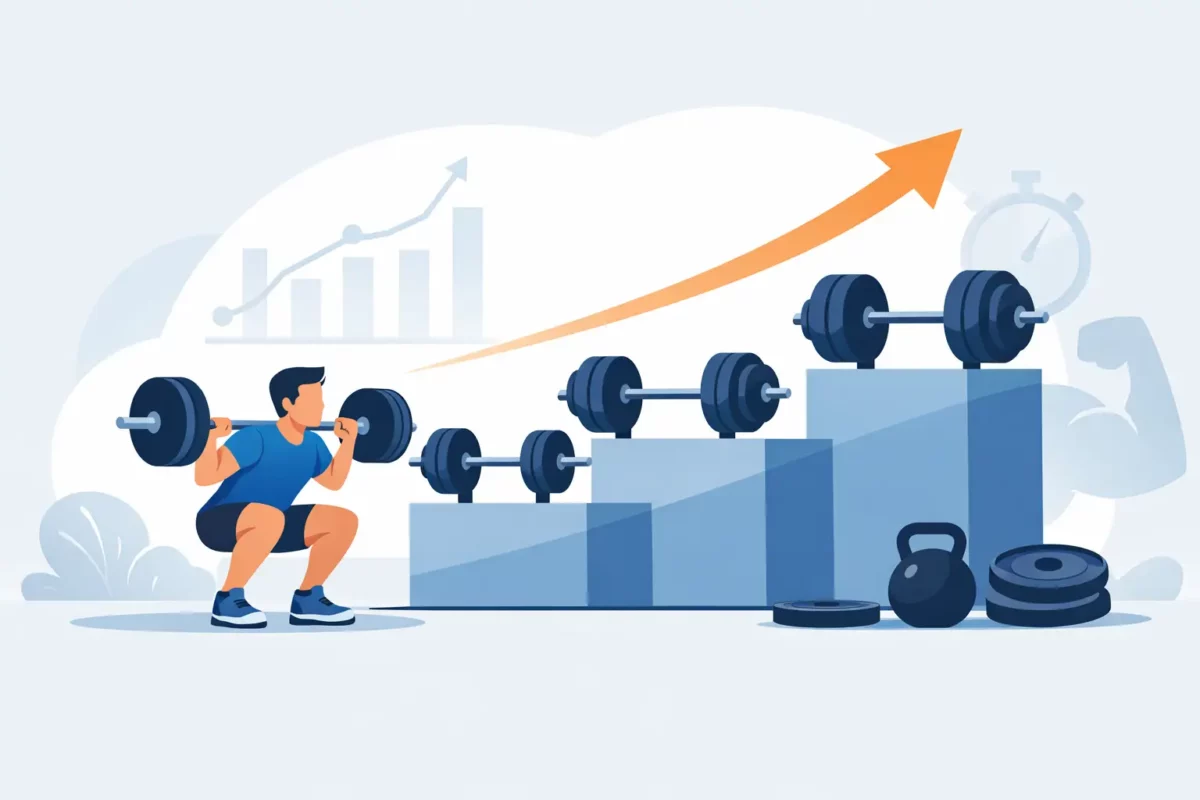
Your barbell does not care how hard last week’s session felt. It responds to the work you can repeat, recover from, and gradually exceed. That is the practical purpose of progressive overload for strength: creating a training demand that forces your body to produce more force over time.
For a lifter chasing bigger squats, presses, pulls, and more athletic power, progression is not a motivational slogan. It is the operating system of training. Randomly changing exercises, maxing out every Friday, or adding weight with broken positions may feel intense, but none of it guarantees a stronger athlete. Productive overload is planned, measurable, and tied to movement quality.
What Progressive Overload for Strength Actually Means
Progressive overload means gradually increasing the stress placed on the body so it has a reason to adapt. In strength training, that adaptation includes better coordination, improved skill under load, increased muscle mass where it is useful, stronger connective tissues, and a greater ability to recruit force quickly.
More weight on the bar is the most obvious form of overload, but it is not the only one. You can also progress by completing more quality reps at the same load, adding a set, improving range of motion, using a more demanding variation, or performing the same work with cleaner technique and less fatigue.
The key word is gradually. A jump that overwhelms your recovery or changes the lift beyond recognition is not useful overload. If your squat turns into a good morning when you add 20 pounds, you did not build squat strength. You practiced compensating under a heavier bar.
Strength is specific. To get stronger at a lift, you need frequent, technically sound practice with meaningful loads. To become more powerful, you also need to protect your ability to move with intent. Heavy training builds force capacity, while explosive work teaches you to express force fast. Your program should make room for both.
The Best Ways to Create Overload
A strong program does not force every variable upward at once. Adding load, sets, reps, and exercise difficulty in the same week is a fast way to turn productive training into accumulated fatigue. Choose one primary progression target for a block, then keep the rest stable enough to see whether it is working.
Add Load When the Reps Earn It
For core barbell lifts, adding small amounts of weight is usually the clearest path. A beginner may add 5 to 10 pounds to a lower-body lift each week and 2.5 to 5 pounds to an upper-body lift. An intermediate lifter will often progress more slowly, perhaps adding weight every two to four weeks after building enough quality volume.
Do not make arbitrary plate jumps your boss. If 185 pounds for three sets of five was a grinder, 190 may be too soon. Repeat the load until bar speed, positions, and rep quality improve. Then move up. Small plates are valuable because long-term strength is built through small, repeatable wins.
Use Rep Progression Before Weight Progression
Rep ranges are especially useful for accessory lifts and for lifters who cannot add weight every session. Say you are performing Romanian deadlifts for three sets in an 6-to-10 rep range. Start with a load you can control for 3 sets of 6. Over several sessions, add reps while keeping your hinge position tight and the bar close. Once you reach 3 sets of 10, add weight and return to 6 or 7 reps.
This method keeps the focus on execution. It also prevents the common mistake of loading an exercise beyond the point where the target muscles and positions can do their job.
Add Volume With a Reason
More hard sets can build strength, particularly when a lifter needs more practice or more muscle. But volume has a cost. Four strong work sets may move you forward; eight hard sets of the same lift may leave you too fatigued to recover or train explosively later in the week.
Add a set when you can recover from your current work, your technique stays solid, and you need more productive exposure. For example, moving from three to four sets of front squats can make sense during a volume-focused phase. It may not make sense during a phase centered on heavy cleans, sprint work, and competition preparation.
Improve the Work Before Expanding It
Overload can be technical. A deadlift pulled from the floor with better bracing, a full pause, and no hitch is a more demanding and more transferable rep than a loose pull at the same weight. A deeper squat that maintains a stable foot and torso is real progress.
This matters for athletes and serious lifters because power depends on position. You cannot consistently apply force through a weak brace, unstable knee, or collapsing shoulder. Better mechanics let you train harder and transfer more of that strength to jumping, sprinting, throwing, and explosive lifting.
Use Effort to Control the Dose
Most strength work should not be taken to failure. Leave enough margin to keep force production high and technique reliable. A useful tool is reps in reserve, or RIR. If you finish a set with two reps in reserve, you believe you could have completed two more clean reps before failure.
For major compound lifts, much of your productive work will sit around 1 to 3 RIR. This is heavy enough to drive adaptation without turning every set into a recovery problem. On accessory work, getting closer to failure can be appropriate, especially when the exercise is stable and lower risk. A hard set of hamstring curls carries less technical risk than a maximal set of back squats.
The right effort depends on the day and the goal. Heavy doubles and triples may require more rest and a larger technical margin. A hypertrophy-focused block may use moderate loads and more total reps. Neither is automatically better. The question is whether the work supports the next phase of stronger, more powerful performance.
Build Progression Into Your Main Lifts
Your primary lifts deserve the clearest plan because they produce the greatest return. That does not mean every session needs a personal record. It means your weekly training should move toward a defined target.
A simple four-week squat progression might use three sets of five. In week one, perform 3 sets of 5 at 75 percent of your current training max. In week two, add 5 pounds. In week three, add another 5 pounds if all reps remain crisp. In week four, either perform the same load for fewer total reps to reduce fatigue or shift to heavier sets of three.
That final week is not lost momentum. It is how you turn accumulated work into usable strength. The next block can begin with a slightly higher training max, a different rep range, or a variation that addresses a weakness, such as pause squats for bottom-position control.
For power development, pair heavy strength work with low-fatigue explosive work. After your warm-up, you might perform jumps, medicine ball throws, or light barbell derivatives before the heavier lift. Keep explosive reps fast. Once speed drops sharply, the power stimulus is fading and fatigue is taking over.
Why Lifters Stall
Most plateaus are not mysterious. The lifter is either repeating the same stress without increasing it, increasing it too aggressively, or failing to recover from the work already performed.
Check the basics before replacing your entire program. Are you recording loads, reps, and sets? Are you sleeping enough to recover? Are you eating enough protein and total calories to support the goal? Are your hard sets actually consistent in depth, range of motion, and technique? A training log often exposes the problem quickly.
If progress has stopped for several weeks, reduce fatigue before assuming you need more effort. A deload can mean cutting volume roughly in half and keeping loads moderate for a week. You can also hold the same load and improve rep quality, change the rep range, or use a closely related variation for a short block.
Do not confuse novelty with progress. New exercises can be useful, but your body needs enough repeated exposure to become efficient and strong. Keep your main movement patterns in place long enough to develop them. Rotate accessories when needed, not because you are bored with the work.
Track What Produces More Force
Write down the load, reps, sets, and a brief note about execution after each session. For power work, record the variation, load, and whether speed stayed sharp. This does not need to become complicated. A simple log gives you the information needed to make the next decision.
Look for trends, not one dramatic workout. If your front squat has moved from 135 pounds for three shaky sets of five to 155 for three controlled sets of five, you are stronger. If your clean pull is faster at the same load and your positions hold under heavier attempts, your force production is improving.
Train with enough patience to let those trends compound. Put quality reps under the bar, add stress only when you can own it, and let every phase build a stronger base for the power you want to display.