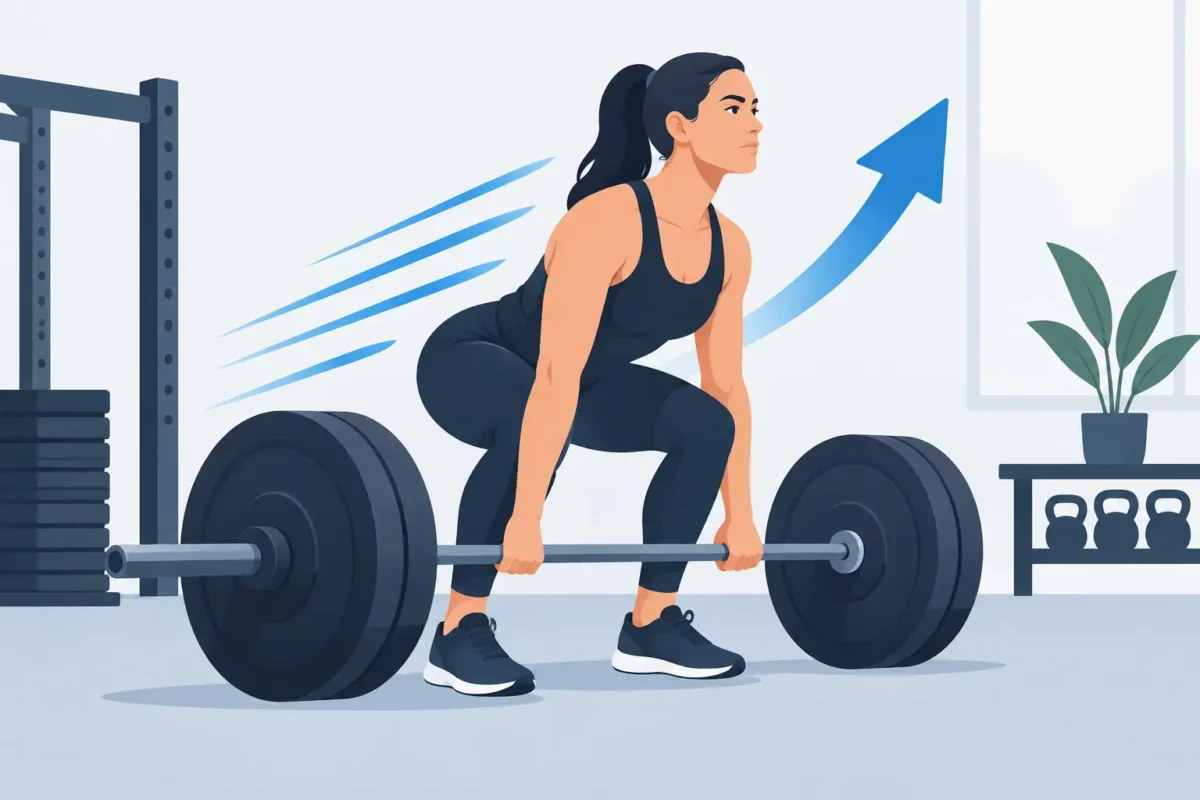
A clean or snatch rarely fails because the lifter did not try hard enough. More often, the bar leaves the floor slowly, drifts away from the body, or reaches the power position without enough upward force to finish the lift. Learning how to improve pull speed means building force from the floor, applying it in the right sequence, and keeping the bar close enough for that force to matter.
Pull speed is not simply moving a light barbell quickly. It is the ability to produce force rapidly while holding strong positions under a meaningful load. For weightlifters, athletes, and serious strength trainees, that quality carries over to more powerful cleans, snatches, jumps, sprinting mechanics, and general athletic output.
What Pull Speed Actually Means
In Olympic-style lifting, the pull has distinct phases. The first pull moves the bar from the floor to around knee height. The transition brings the knees back under the bar as the torso becomes more upright. Then comes the second pull, where the hips, knees, and ankles extend violently to accelerate the bar upward.
A fast second pull is useful, but it cannot rescue a poor first pull or a weak transition. If the bar swings forward off the floor, or if the lifter rushes past the knees and loses balance, force leaks before the explosive finish even begins. Better pull speed is therefore a full-lift quality, not just a hard hip drive at the top.
There is also a trade-off to understand. Heavy pulls develop force, but they do not always look fast. Light explosive work develops intent and timing, but it may not build enough strength on its own. Productive training uses both instead of treating speed and strength as separate goals.
Build Positions Before You Chase Speed
The fastest bar path is usually the most efficient one. Start by making your setup repeatable: pressure balanced through the whole foot, shoulders slightly in front of the bar, lats engaged, and the bar positioned close to the body. From the floor, push the ground away rather than yanking the bar upward with the arms.
Keep the bar close through the first pull. As it passes the knees, sweep it back toward the body by using the lats and bringing the knees under the bar. This transition places you in a strong power position, with the bar near the upper thigh and your balance centered over the midfoot.
Many lifters try to create speed by opening the hips early. That usually sends the bar forward and forces a loop around the knees. Instead, stay patient off the floor, keep the chest rising with the hips, and accelerate progressively. The bar should gain speed because your positions allow force to build, not because you rush the start.
Use Video to Find the Actual Leak
A side-view video is one of the best tools for improving pull mechanics. Look for the bar separating from the body, hips shooting up ahead of the shoulders, early arm bend, or a jump forward during the extension. These errors often feel like a lack of speed, but they are usually a lack of position.
Film working sets from the same angle and compare them over several weeks. One useful technical cue is enough. Trying to correct every detail during a heavy session usually creates hesitation rather than a better pull.
Get Stronger in the Positions That Drive the Bar
Speed without force has a low ceiling. If you cannot maintain posture and leg drive against heavy weight, your pull will slow down as loading rises. The most direct solution is targeted strength work that supports the positions used in the clean and snatch.
Clean pulls and snatch pulls are foundational. They let you load the movement more heavily than the full lift while reinforcing a close bar path and complete extension. Pulls should not become upright shrugs with loose arms. Finish tall, extend through the floor, and keep the bar traveling close to the torso.
Paused pulls are especially useful when the bar loses position around the knee. Pause for one or two seconds just below or just above the knee, maintain tension through the lats and legs, then finish with intent. The pause removes momentum and exposes weak positions quickly.
Deficit pulls can improve strength off the floor for lifters who consistently start slowly, while block pulls can emphasize the second pull and extension. Use them based on the weak point you can actually identify. A lifter who gets pulled forward from the floor does not need more block pulls as the first solution. They need better balance, stronger legs, and more disciplined starts.
Squats remain essential. Front squats build the upright strength needed to recover cleans and stay connected through the pull. Back squats develop broad leg strength and loading tolerance. Romanian deadlifts, clean-grip deadlifts, and controlled posterior-chain work help you hold the bar close and maintain a strong back angle.
Train Explosiveness With the Right Loads
Once the positions are solid and strength work is in place, use exercises that demand rapid force production. High pulls, power cleans, power snatches, jump shrugs, and loaded jumps can all improve intent when programmed well.
For Olympic-lift derivatives, use loads that allow clear acceleration and consistent mechanics. If every rep is slow, grinding, or pulling you out of position, the load is too heavy for speed work that day. That does not make the set useless, but it changes the training effect.
Power variations are often effective because they require you to finish the pull aggressively, then receive the bar without relying on a deep squat to save the rep. They also provide immediate feedback. If the bar crashes or you catch it low despite trying to power it, your pull may lack vertical finish, timing, or enough force.
Jump work deserves a place as well, particularly for athletes. A small dose of vertical jumps, broad jumps, or loaded jumps before the main lifting work can sharpen intent. Keep the volume low and the quality high. Jumps are not conditioning. Stop before fatigue turns explosive contacts into slow, heavy reps.
How to Improve Pull Speed in Your Weekly Program
Most lifters improve faster when pull-speed work is distributed across the week rather than piled into one exhausting session. A simple approach is to give each session a primary purpose: technique and speed, strength, or heavier competition-style lifting.
For example, one training day might begin with power cleans for crisp doubles, followed by paused clean pulls and front squats. Another day could use full cleans at moderate-heavy loads, then clean deadlifts or Romanian deadlifts. A third session might feature lighter high pulls or jump shrugs before squat work.
Keep the rep quality high. For speed-focused pulls, sets of two or three are usually more productive than long sets that turn into fatigue practice. Heavy pulls can be performed for two to four reps, depending on the exercise and training age. Rest long enough to attack each set with intent, often two to four minutes for demanding barbell work.
A practical progression is to spend three or four weeks emphasizing a specific weak phase. If you are slow from the floor, prioritize paused pulls below the knee and clean deadlifts with strict position. If you lose speed at the hip, prioritize power variations, high pulls, and pulls from blocks. Retest with full lifts, then adjust based on what the barbell shows you.
Avoid the Habits That Kill Bar Speed
Early arm bend is one of the most common problems. The arms should stay long during the drive so the legs and hips can accelerate the bar. Bending early disconnects the big force-producing muscles and often pushes the bar away from the body.
Another mistake is treating every pull as a maximum attempt. Heavy training has a place, but repeated grinders teach slow execution and create fatigue that can damage the next technical session. Use hard pulls to build strength, then use lighter, sharper work to express it.
Finally, do not confuse noise with speed. Stomping the feet, slamming the bar into the hips, or overextending the back may feel aggressive, but none of it guarantees upward barbell acceleration. Powerful lifting is controlled force applied in the correct direction.
A faster pull is earned through patient positions, stronger legs and back, and repeated exposure to quality explosive reps. Put that work into your program, respect the bar path, and let speed become the visible result of better force production.