
Understanding the Dumbbell Bench Press: A Path to Symmetrical Strength
The Technique:
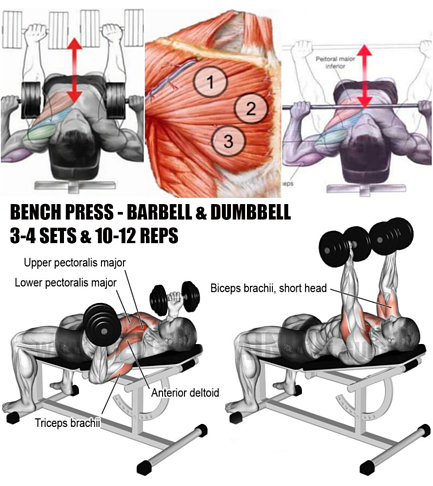
To perform the dumbbell bench press:
- To perform the exercise correctly, hold the dumbbells at shoulder level. Make sure your palms are facing forward.
- To execute the workout, grasp the dumbbells and position them at the level of your shoulders, ensuring your palms are facing forward. “Lower the dumbbells slowly towards your chest while keeping your elbows at a 90-degree angle.
- Take a momentary pause, then slowly lift the dumbbells to shoulder height, keeping your arms close to your body. Extend your arms by pushing the dumbbells back up to the starting position.
- Repeat for the desired number of repetitions.
Increased Muscle Activation:
One of the main advantages of the dumbbell bench press is that it requires more stabilization and coordination compared to the barbell bench press. Since each arm operates independently, your muscles require more effort to maintain balance and control throughout the movement. This increased muscle activation can lead to more significant overall strength gains and improved muscle symmetry.
Improved Range of Motion:
Dumbbells offer a distinct advantage of a more excellent range of motion than a barbell. This extended range of motion stretches your muscles more during each repetition, fostering enhanced muscle development. Plus, the freedom to move each arm independently promotes a more natural movement pattern, which reduces injury risk and boosts overall joint health.
Addressing Muscle Imbalances:
The dumbbell bench press excels in addressing muscle imbalances. The independent work of each arm ensures that weaker muscles can’t rely on stronger ones to compensate for their lack of strength. It compels weaker muscles to work harder and gradually match their more substantial counterparts, leading to improved muscle balance and a lower risk of injury.
Targeting Specific Muscle Groups
The dumbbell press is an effective exercise that primarily targets the chest muscles, specifically the pectoralis major and minor. Unlike the barbell bench press, which relies on both arms working together, dumbbell presses allow each arm to work independently. This exercise helps identify and correct any strength imbalances in the body. By performing dumbbell presses regularly, you can ensure that both sides of your chest are equally engaged, promoting balanced muscle development.
In addition to the chest muscles, dumbbell presses also engage the shoulders and triceps. These secondary muscle groups play a crucial role in stabilizing the movement and assisting in pushing the weights overhead. You can further enhance upper body strength and stability by strengthening these muscles through dumbbell presses.
Improving Stability
Muscle imbalances often result from overuse or underuse of specific muscles. Dumbbell presses require significant stabilization as you lift and lower the weights. The exercise requires you to move each arm independently, forcing your core muscles to work harder to maintain balance. Over time, this increased demand on your stabilizer muscles can help correct imbalances and improve overall stability.
Choosing the Right Weight:
Picking the appropriate weight is fundamental for preserving proper form throughout your fitness routine and preventing injuries. Choosing a weight that challenges you without compromising your form is vital. If you encounter difficulties maintaining correct technique, use lighter dumbbells until you feel comfortable with the exercise.
Proper Grip:
Maintaining a secure grip on the dumbbells is essential for safety and effectiveness. Hold the dumbbells firmly, but avoid excessive grip as it can strain your wrists and forearms. Ensure your hands are on the dumbbell handles and your fingers are wrapped around them securely. This grip will provide stability and control throughout the exercise.
Proper posture during workouts is essential to prevent injuries and ensure effective results. Correct posture involves standing tall with shoulders back, chest lifted, and core muscles engaged. Avoid arching the back or rounding the shoulders to prevent strain or injury. Keeping a neutral spine will help distribute the load evenly across your body and protect your back from harm.
Controlled Movements:
Performing exercises with controlled movements is essential for both safety and effectiveness. Avoid using momentum or swinging the dumbbells, which can strain your muscles and joints. Instead, focus on slow and controlled movements, ensuring you feel the muscles throughout the entire range of motion.
Proper Breathing:
Breathing correctly during dumbbell exercises is often overlooked but is crucial in maintaining form and safety. Inhale before starting the movement and exhale as you exert force. This breathing technique can help you stabilize your core muscles and support your body.
Commence the exercise by reclining on a horizontal bench with a dumbbell gripped in each hand, placed at the level of your shoulders. Slowly push the dumbbells up until your arms are straight, then lower them back down to the starting position. Aim to perform 2-3 sets of 10-12 reps, ensuring proper form and control.
Intermediate Level:
After mastering the fundamentals of dumbbell presses, you can diversify your workout by implementing various techniques that target distinct muscle groups and elevate the level of intensity. One effective variation is the incline dumbbell press. This exercise is on an inclined bench, set at an angle of around 30-45 degrees. The incline targets the upper chest and shoulders, stimulating your muscles differently.
Mastering the Barbell Bench Press: Powering Your Way to Peak Performance
Proper Technique
To perform the barbell bench press correctly:
Lay on a flat bench with your feet firmly planted on the ground.
Hold the barbell with your hands positioned slightly wider than your shoulders.
To perform the exercise correctly, slowly lower the barbell towards your chest while maintaining your elbows at a 45-degree angle.
Push the barbell back up until your arms return to the starting position to complete the exercise.
It is crucial to maintain control throughout the movement and avoid bouncing the barbell off your chest.
Variations
When performing chest exercises, it’s essential to understand the different muscle groups. Specifically, the incline bench press is ideal for developing the upper chest, while the decline bench press is better suited for targeting the lower chest. Furthermore, adjusting your grip can also impact the muscle groups. A closed grip will engage the triceps more intensely, whereas a wide grip will emphasize the chest muscles more.
Benefits
The barbell bench press offers numerous benefits for strength training enthusiasts. Engaging multiple muscle groups is an excellent exercise for increasing upper body strength. Athletes who engage in sports that demand explosive upper-body movements can benefit from the improved muscular endurance and power this training method provides.
The barbell bench press is a productive workout that aids in developing the chest, shoulder, and tricep muscles. By consistently challenging these muscles with progressively heavier weights, individuals can stimulate muscle growth and achieve a more defined and sculpted upper body.
1. Compound Movements and Muscle Development
Barbells are a highly advantageous practice for developing muscles due to their ability to enable compound movements. Compound exercises involve several joints and muscle groups, making them more effective and efficient for workouts. A barbell allows you to perform compound exercises that activate multiple muscle groups simultaneously, such as squats, deadlifts, bench presses, and overhead presses.
2. Enhanced Stability and Core Strength
Using a barbell requires stability and balance, which engages your core muscles. Stabilizing the weight during squats and overhead presses helps strengthen your core muscles, including your abdominals, obliques, and lower back. A strong core improves your overall posture, enhances your performance in other activities, and reduces the risk of injury.
The barbell’s centralized weight distribution also forces your body to work harder to maintain proper form throughout each exercise. This increased demand for stabilizer muscles improves coordination and overall body control.
3. Increased Strength and Power
Powerlifting enthusiasts can greatly benefit from incorporating barbell exercises into their training regimen. The barbell allows for heavy lifting, which is essential for developing maximum strength and power. Exercises like the deadlift and squat can significantly improve your overall strength and progressively increase weight when performed with proper technique.
https://www.wealthyaffiliate.com?a_aid=352a86b2
Best Exercise Training Programs
