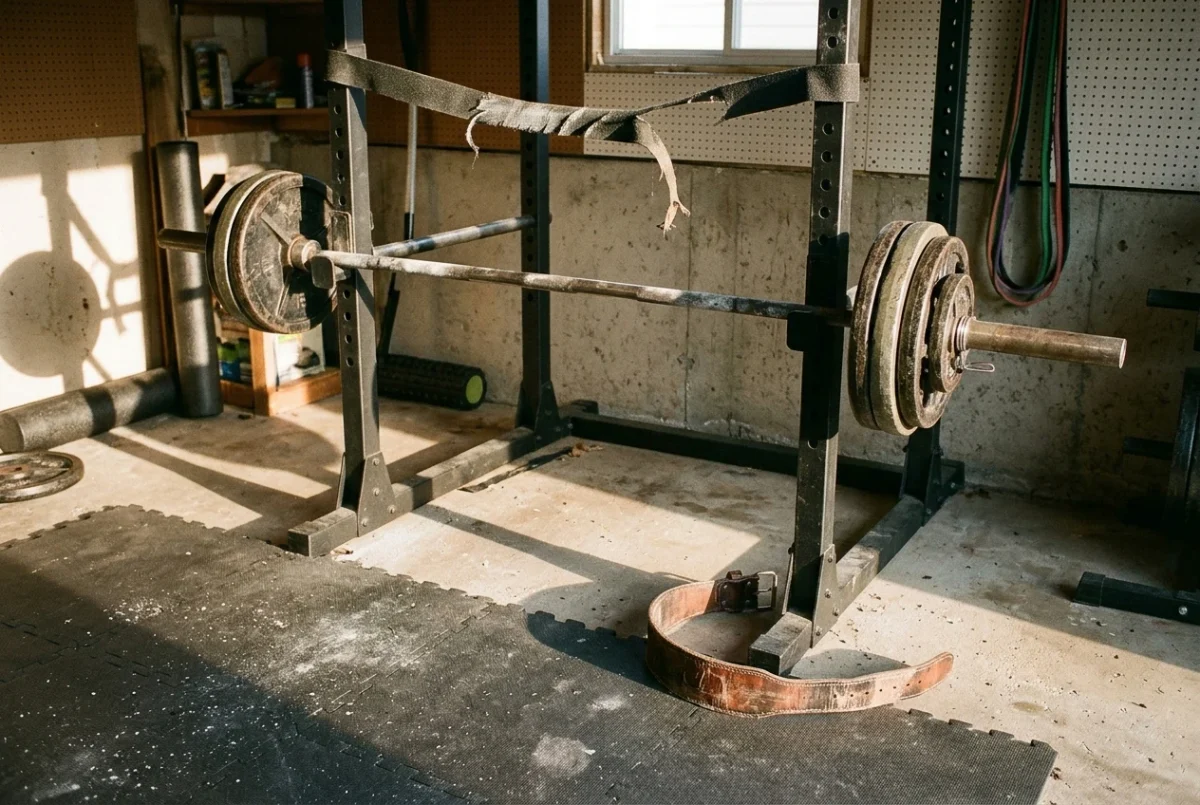
Is quality home gym equipment worth it? The price tag cannot answer that by itself, because worn or cheap gear charges you in minutes: re-taping a grip, re-cinching a belt, shoving a rack back into position, redoing a set that stopped for a reason that had nothing to do with your legs. Most lifters never add those minutes up, so the patching never gets weighed against the cost of replacing anything.
This article gives you a two-week log that does the adding. You turn it into minutes per year and a cost per lost minute, then rank your replacements by how many minutes each one gives back.
A failed set costs more than the rep you missed
If you want the price of one failed top set, the cheap lifting straps piece works through it. A single piece of gear is only part of the picture, though. The same worn grip tape, stretched belt or wobbling rack interrupts your training in small ways on most days, and none of those interruptions feels large enough to count.
Each interruption costs more than the seconds it takes to fix. You stop, fix the problem, and then your rest period runs long, your focus drops, and the next set starts colder than planned. When the interruption ends a set early, you also lose the training stimulus that set was supposed to give you. That second cost does not fit into minutes, so keep it in mind as a tie-breaker later.
Because the interruptions are small and scattered across different pieces of gear, they are hard to judge from memory. Writing them down for two weeks gives you real numbers to work with.
Log every gear interruption for two weeks, and what to write down each time
Two weeks covers enough sessions to catch the problems that only show up on certain lifts or certain days. Keep a note on your phone or a sheet of paper in the gym and write an entry every time the gear interrupts you, however minor.
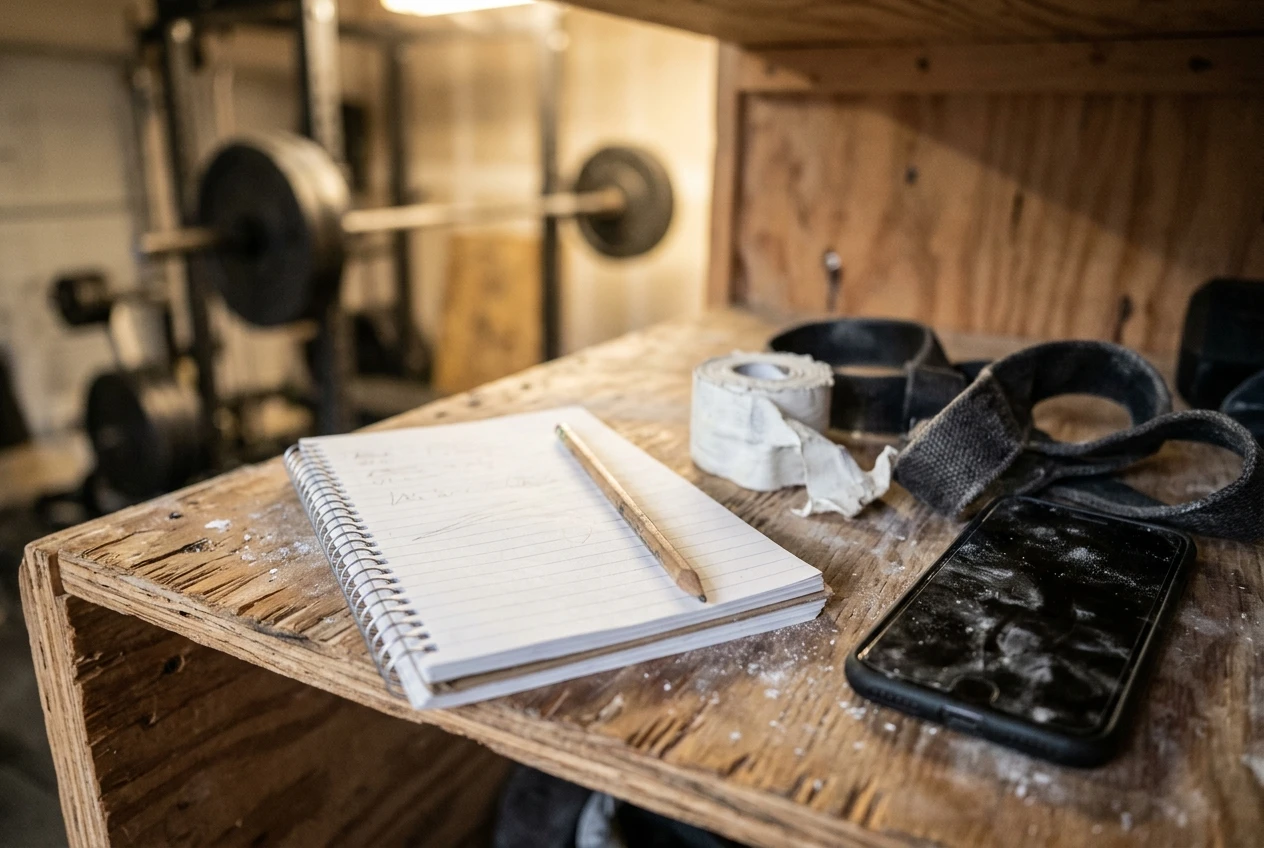
Record these six things for each entry:
- The item. Name the specific piece: the chalk-stained grip tape on the pull-up bar, the belt, the left upright of the rack, the bench, the straps, the shoes.
- What happened. Use plain words: grip tape peeled, belt loosened mid-set, rack walked across the floor, bar collar slipped.
- The lift and load. A wobble at 60 percent of your working weight tells you something different from the same wobble at a top set.
- Minutes lost. Count the repair time plus any rest you added because of it. A tape job done during a normal rest period costs nothing in time. A tape job that stretches a two-minute rest to four costs two minutes.
- What happened to the set. Finished as planned, finished with lower load or fewer reps, or aborted.
- The patch. Write what you did to get going again, such as retaped, tightened, shimmed, switched equipment, or nothing.
Do not edit the log as you go. If a missed rep looks like your fault rather than the gear’s, write it down anyway and sort it later. Deciding in the moment which entries count will bias the numbers toward whatever you already believe about your equipment.
Turn the log into minutes per year and a cost per lost minute
At the end of the two weeks, total the minutes lost for each item. Then multiply each total by 26 to get minutes per year, since a year holds 26 two-week blocks.
Here is an example with made-up numbers. Replace them with yours.
- Grip re-taping: 6 times at 2 minutes each, 12 minutes per fortnight, 312 minutes per year
- Belt re-cinching: 9 times at 1 minute each, 9 minutes, 234 per year
- Rack re-positioning: 3 times at 4 minutes each, 12 minutes, 312 per year
- Aborted sets: 2 sets at 10 minutes each (extra warm-up and rest to redo them), 20 minutes, 520 per year
That adds up to 53 minutes per fortnight and 1,378 minutes per year, a little under 23 hours.
Next, put a value on a minute. Pick whichever of these fits your situation:
- Your hourly earnings divided by 60, if your training time competes with paid work.
- Your monthly gym membership, or what the same training would cost you elsewhere, divided by the minutes you train in a month.
- A figure you choose yourself, if neither of those fits. Use the same one every time you run this, so the comparison stays honest.
At a value of $20 an hour, a minute is worth about 33 cents, and the example’s 1,378 lost minutes come to roughly $459 a year. That figure is the yearly cost of keeping the current gear, and it is the number to hold against any replacement price.
The aborted sets need one more step. A set that ended early has a cause, and the cause is usually one of your other items: the grip tape, the belt, the rack. Reassign those minutes in your log to the item that ended the set. If the cause is unclear, hold them in their own line for the next section.
Sort the failures: gear problem or technique and programming problem
Not every entry in the log belongs to the equipment. Some of them are you, and buying better gear for a technique problem takes your money and leaves the interruption in place. Run each entry through three questions.
Does it repeat on light loads? A grip that fails at a top set but holds through every warm-up is probably fatigue. A grip that slips on the empty bar is a worn surface or loose tape. If you are unsure which one you have on deadlifts, this set-by-set test for grip failure separates the two.
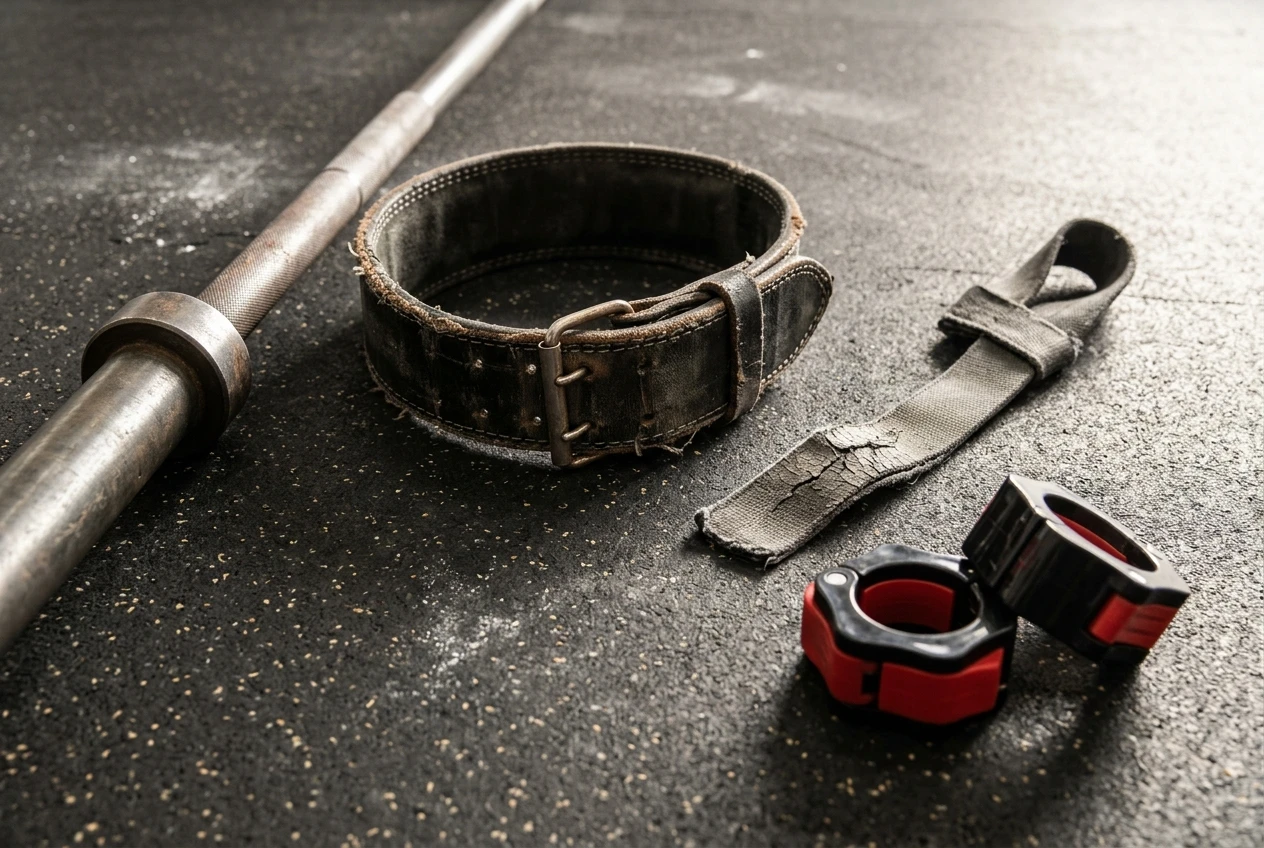
Does it follow the item or the lift? If one belt loosens on squats, deadlifts and presses, the belt is the likely cause. If it only loosens on one lift, look at your bracing and positioning on that lift first.
Is the wear visible? Frayed stitching, a flattened strap, a cracked handle, a rack upright that rocks when you push it: those are gear failures you can see and point at. If the item looks intact and the problem only shows up under certain conditions, treat it as unproven.
Sort every entry into one of three groups: gear, technique or programming, and unclear. Total each group’s minutes. Only the gear group goes into the replacement ranking. The technique group needs coaching, a deload, or a change to how you structure your sessions. The unclear group gets another log week after you change one variable, such as new tape on the bar while everything else stays the same.
A caution on the unclear group: it will be tempting to file everything there so you can avoid the sorting. If most of your minutes land in it, that is a sign to run the log again with more careful entries rather than to buy anything.
Replace in order of minutes recovered, not by price tag
With the gear group totaled, rank items by minutes per year, highest first. That order is your replacement list. The most expensive item and the most annoying item often turn out to be different from the one losing you the most time.
For each item, look up the price of a replacement that fixes the specific failure you logged. Then divide the price by the minutes you expect to get back in a year. In the example, a belt costing $40 that ends all 234 belt minutes comes to about 17 cents per recovered minute in the first year. A $300 rack upgrade that recovers 312 minutes comes to about 96 cents per minute in the first year, though it should last well past one year, so divide again by the years you expect to use it if that is what you want to compare.
Use the figures like this:
- Rank first by minutes recovered per year.
- If two items are close, buy the one with the lower price per recovered minute.
- Compare each price per minute against your own value per minute from the previous section. If the replacement costs less per recovered minute than a minute is worth to you, it pays for itself in time. If it costs more, the log is telling you to wait.
- For ties that remain, take the item that causes aborted sets. An aborted set loses training stimulus as well as time, and the minutes figure does not capture that.
Buy one thing, then run the log for another two weeks. The numbers will shift, because a wobbling rack can hide a belt problem and a fixed grip can expose a bracing problem. If you plan a longer sequence of purchases, a five-year home gym plan where every upgrade has to be earned fits well with this approach, since the log supplies the evidence each upgrade needs.
When the cheap option is still the right call
The log does not always point toward spending. Several results mean keeping what you have.
The item costs you almost nothing. If your cheap collars slipped once in two weeks and fixing it took ten seconds, a replacement would have to cost very little to be worth it. The yearly minutes will tell you.
The failure is cosmetic. A scuffed bench pad, faded paint, or a peeling logo does not interrupt a set. Leave them alone.
A better item would not fix the cause. If the problem is technique, programming or fatigue, a premium version of the same gear will fail the same way. This is why the sorting step comes before the ranking.
A cheap fix works. Fresh tape on a bar, a shim under a rack foot, or a new set of inexpensive collars might remove most of an item’s lost minutes. If the repair is cheaper than a replacement and the log shows the problem staying fixed over the next two weeks, it was the right call.
The numbers are too small to rank. If your total for the fortnight is only a few minutes, your gear is not the thing limiting your training, and you can spend the budget on something else.
So, is quality home gym equipment worth it? For the specific items where your log shows large, repeated, gear-caused losses and a replacement costs less per recovered minute than a minute is worth to you, yes. For the rest, the log gives you a reason to keep what you have.
Run the log before your next purchase
Before you buy anything for your home gym, keep the log for two weeks, total it, sort it, and rank it. The ranking will often be different from the list you had in mind, and in some cases it will show that you do not need to buy anything yet.
If the log shows that the gap is a kettlebell or a guided session, for example you have no good option for finishers or conditioning work and your sessions keep stalling for that reason, take a look at kettlebell.monster. The offer includes kettlebell training programs and a workout app for Samsung Tizen TVs. Affiliate disclosure: if you buy through this link, I may earn a commission.