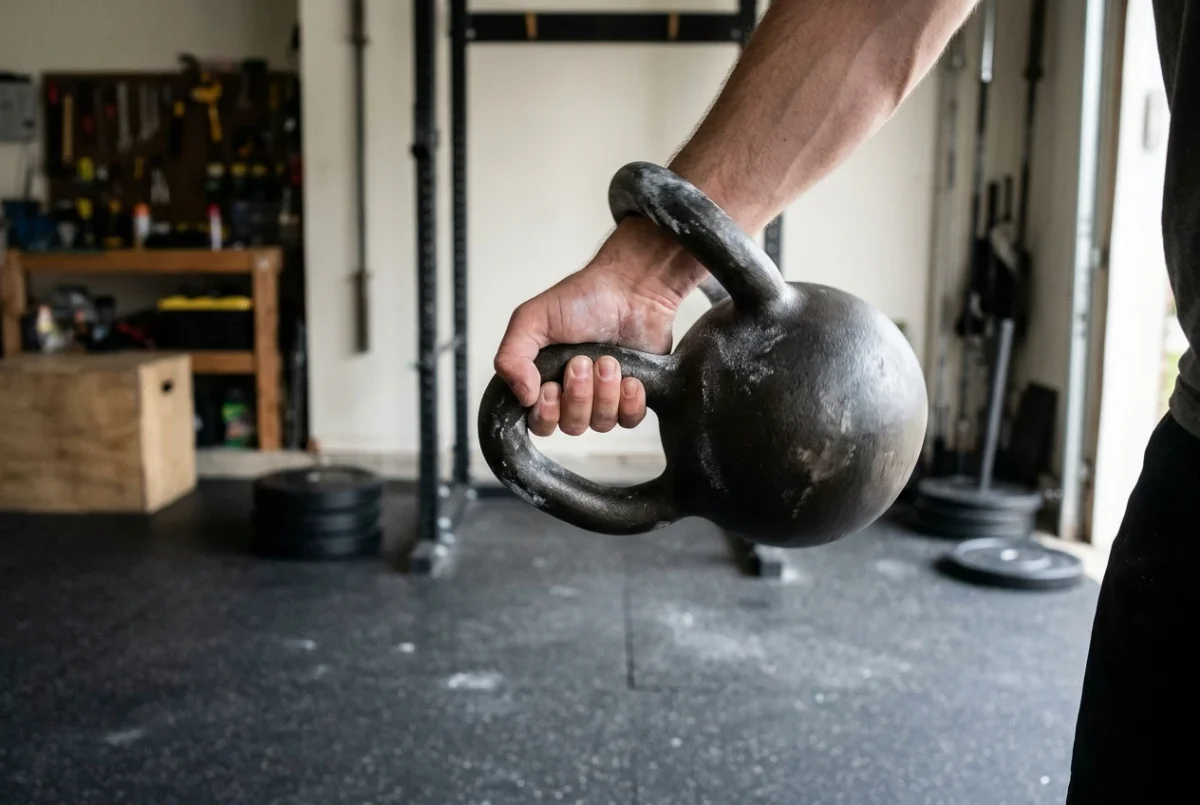
If your grip gives out before your legs or shoulders do, the complex is ending early for a reason that has nothing to do with your strength. Lifting straps for kettlebell training are one possible answer, but they fit some movements in a complex way and get in the way of others. This guide goes through a typical complex one movement at a time and says where a strap helps, where it blocks you, and where chalk, a different hand habit, or a shorter set does the job better.
The complex used as the example is swing, clean, press, squat, done on one side without setting the bell down. Your own order may differ, but the same logic applies to any version.
Why does a complex punish your grip differently than a single set of swings?
A set of swings has a rhythm that includes a rest. The bell travels, your hand loads and unloads, and between sets, you put it down and shake out your fingers. A complex removes that. Your hand holds the same handle for every rep of every movement, so the grip works for the full duration of the set.
The demand also changes from move to move. Your fingers resist the bell pulling away from you on a swing, rotate around the handle on a clean, and hold a steady load in the rack. Fatigue from the first movement carries into the next one, so a grip that is fine on swing number ten may fail on the clean that follows it.
That is why the weak link often shows up late in the set, in a movement that is not hard for grip in isolation. The press and the squat rarely tax your hands much alone. They feel hard in a complex because the hand was already tired when they began.
Where grip actually fails in a complex: swing, clean, rack, press, squat
Knowing which movement drains your grip tells you which fix to use. Here is where it tends to happen, reasoned from what each movement asks of your hand.
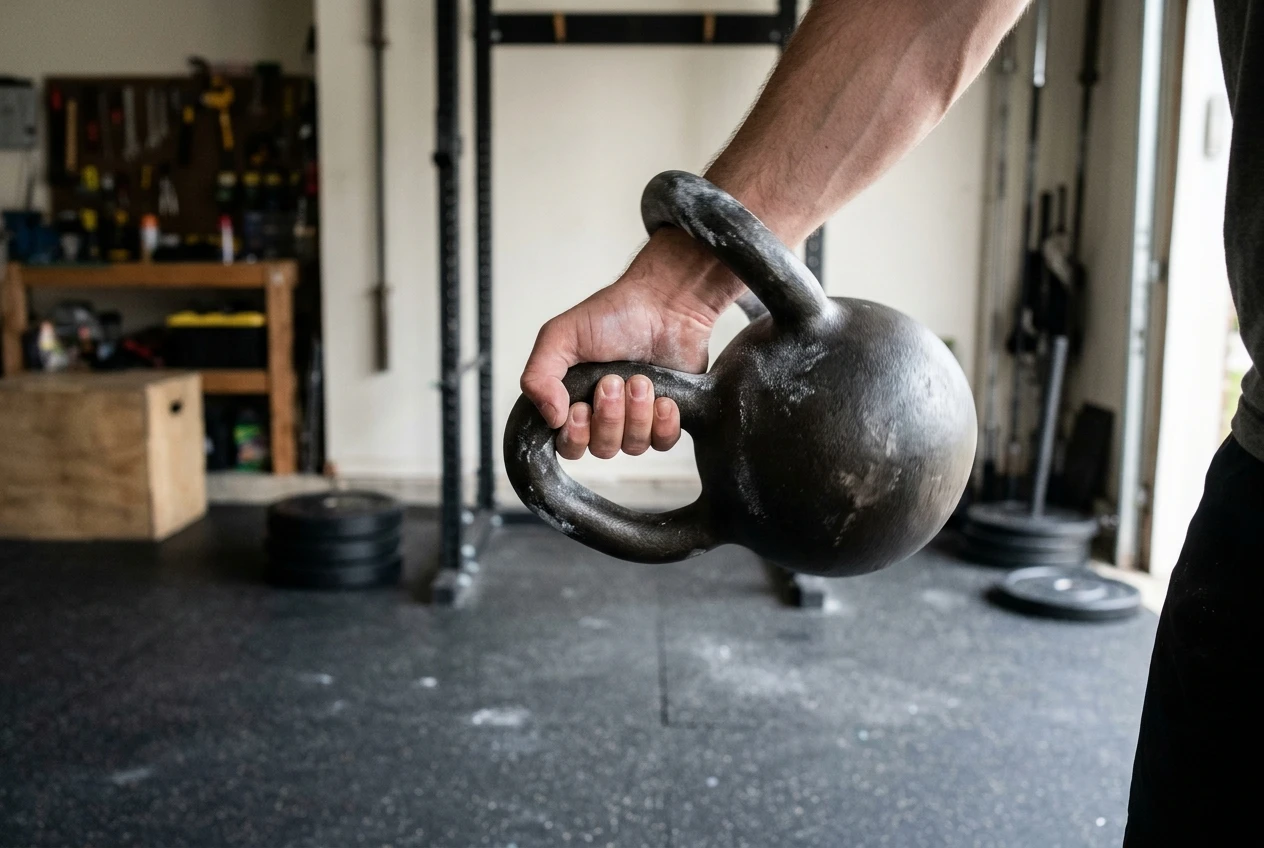
- Swing: The bell pulls hard on the handle at the bottom of the arc and at the top, where it floats. Most of the grip work in the whole complex happens here, especially in high-rep sets. Sweaty palms make it worse, because the handle slides toward your fingertips.
- Clean: The handle has to turn in your hand as the bell rotates around your wrist to the rack. A hand that is tired and gripping too hard cannot make this turn smoothly, and the bell often bangs down onto the forearm.
- Rack: The bell sits on your forearm and chest, so grip demand is low. The hand still has to stay closed on the handle, and a cramped or clenched hand here uses up energy you need later.
- Press: Your hand needs to keep the handle steady while the bell travels overhead. A tired grip shows up as a bell that tilts or a wrist that bends back.
- Squat: In a racked or goblet squat, the grip load is light. If your hands fail here, they were already spent before you reached this movement.
Pay attention to the first place the handle starts to shift or your fingers start to open. That movement, not the last one, is where a fix should go.
The moves where a strap helps, and the ones where it gets in the way
A strap fixes one problem: the hand cannot hold the handle, so the strap holds it for you. That is useful only when holding the handle is the whole job.
Where a strap can help
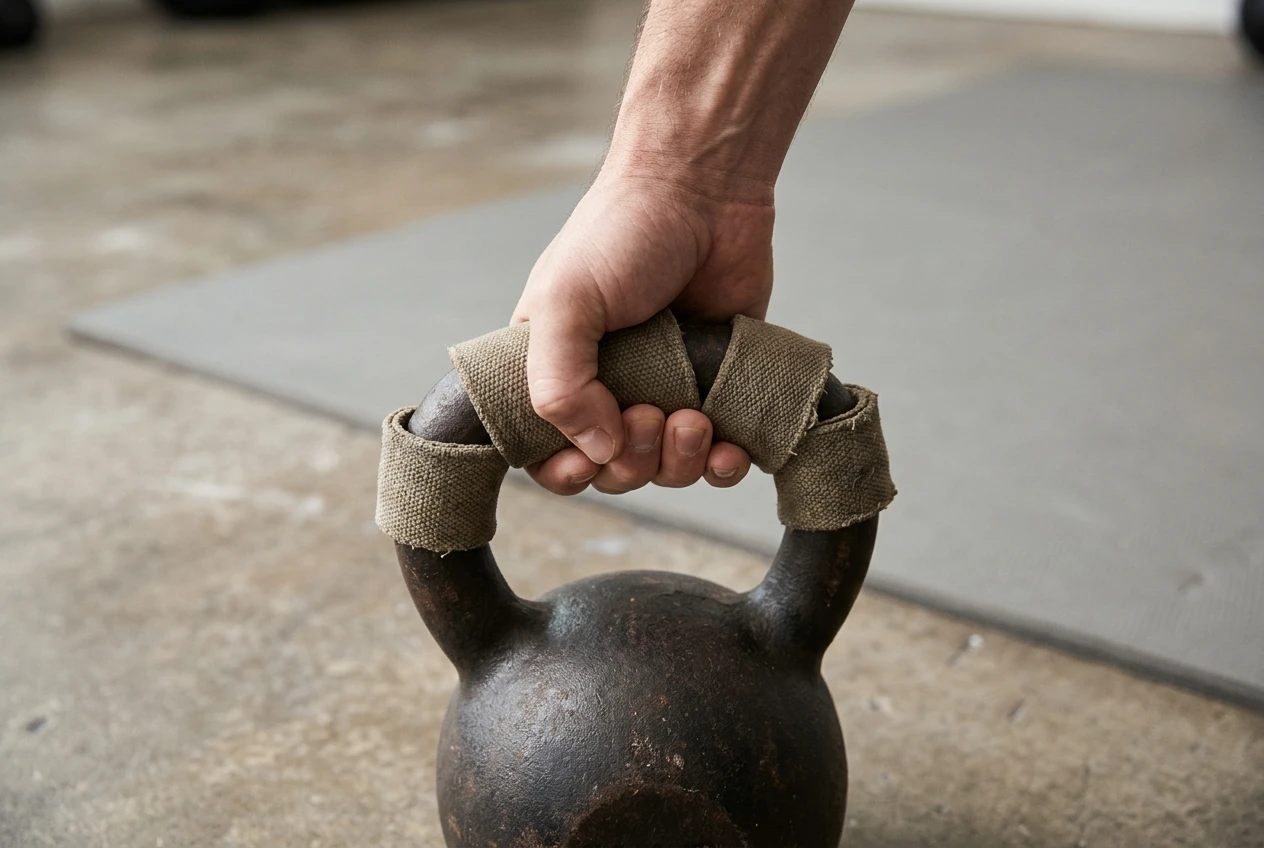
The swing. Heavy or high-rep swings are the clearest case. The hand just has to keep a hold on the handle as the bell pulls away, and a strap that anchors the handle to your wrist or hand takes that load off the fingers. This is also where the downside is largest: if you lose control of the bell, you cannot let go. Use a strap-on swing only with plenty of clear space around you, and think about what happens if the swing goes wrong before you commit to it.
Hang-style pulls. If your complex includes a deadlift or a high pull where the bell simply hangs and you lift it, a strap holds the handle without any hand rotation involved. These moves behave much like a barbell deadlift, where straps are normal.
Where a strap gets in the way
The clean. The handle has to turn in your hand, and a strap wraps around the handle, and your hand works against that turn. A strap that binds the handle can pull the bell against your forearm or make the bell stop mid-rotation. Most lifters find that a strap and a smooth clean do not go together.
The rack. A strap adds a lump of material between the bell, the forearm, and the chest. It can change where the bell sits, and a rack that no longer feels settled makes the press harder.
The press and the squat. Grip demand here is low, and a strap can limit how freely your wrist can adjust under the bell. If these are the moves where your hand gives out, the strap is treating the wrong problem.
So if your grip fails on the swing, a strap is a reasonable option. If it fails on the clean or later, look elsewhere first.
What to do when you can’t strap: chalk, handle habits, and rest placement
In most complexes, a strap cannot stay on the whole time. You need something that works across the swing, the clean, and the rack together, and these fixes do.
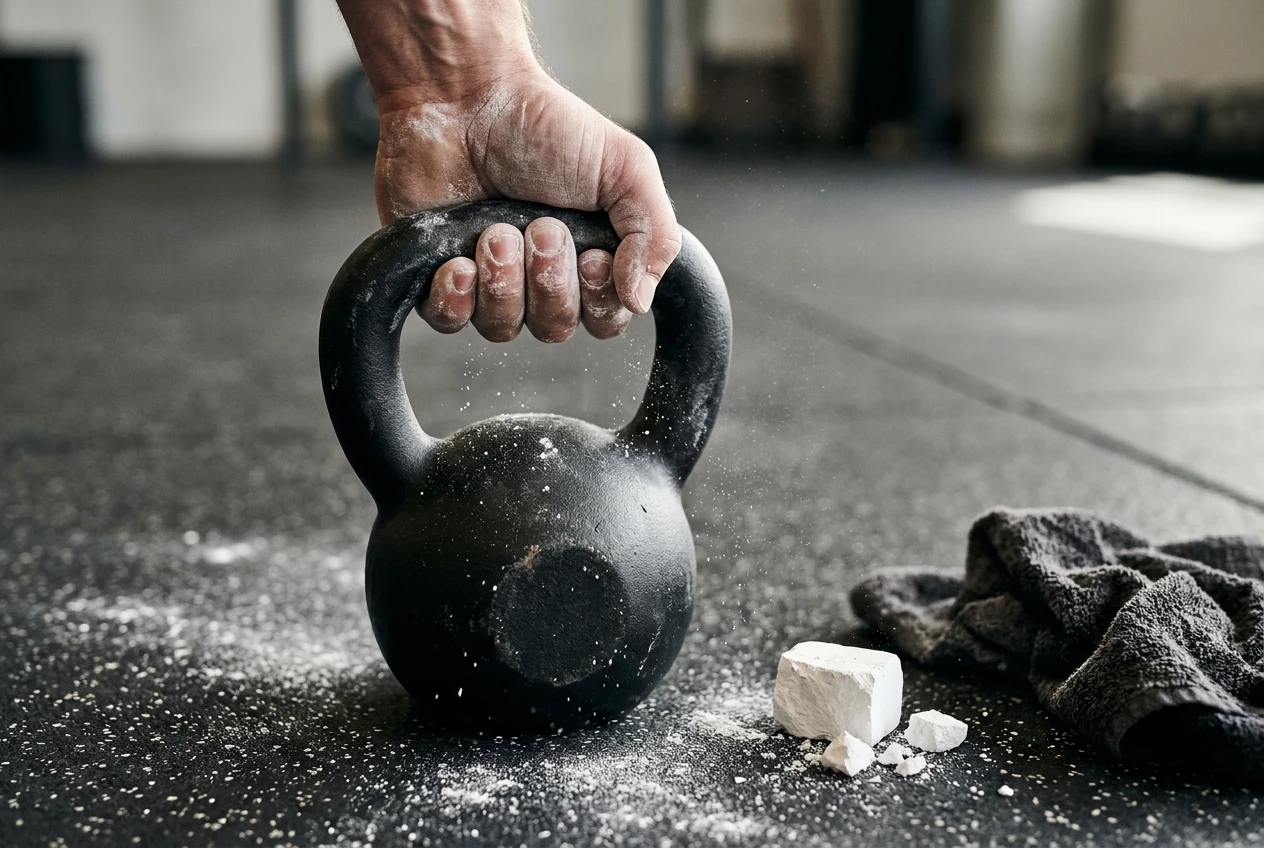
Chalk. If your hand slips because of sweat, chalk addresses the cause directly. It dries the palm and the handle, and it leaves the hand free to turn on the cleaning. Use it before the set and reapply when the handle starts to feel slick. If your hands do not sweat much, chalk gives you little.
Handle habits. Many lifters squeeze the handle as hard as they can for the whole set. That tires the forearm faster than it needs to. A few habits cost nothing:
- Hold the handle in the base of your fingers and let the bell hang from the hook of the hand rather than crushing it in the palm.
- Loosen your grip at the top of the swing, where the bell is weightless, and tighten only as it drops.
- Open the hand slightly in the rack so the forearm can recover.
You can also train grip separately on a lighter day, using heavier bells for short carries or holds. This builds the hand over weeks, so it will not change tonight’s set.
Rest placement. If the same movement always breaks your grip, put the rest right before it, not at the end of the round. For example, set the bell down after the clean and before the press, so you start the press with a rested hand. Rests of a few seconds, repeated through the set, help more than one long rest at the end.
How to pick a strap for kettlebell work without losing feel in your hands
If the swing is where your grip fails and you decide a strap fits, a few practical points matter. Kettlebell handles are thicker and rounder than a barbell, so a strap needs to wrap cleanly without bunching under the palm.
- Length. It should wrap the handle once or twice without a long tail flapping around. A long, loose tail can catch on the bell or your forearm.
- Width and thickness. A thin strap lets you keep more feel through the handle. A thick or padded one reduces feel, which matters if you also need to change hand position mid-set.
- Closed loop or open strap. A closed loop is quick to put on between sets. An open strap wraps more securely but takes longer to set up, which matters when you want to switch hands without a long pause.
- Material. Leather and synthetic materials wear and grip differently, and the right one depends on the lift. The leather or synthetic lifting straps guide covers that comparison, so it is not repeated here.
Test any strap with an empty hand first. Close your hand around the handle with the strap on, and check that you can still feel where the handle sits in your fingers. If you cannot tell, the strap is costing you the feedback you need on the swing.
A durability check you can run at home on any strap, week by week
You do not need lab equipment to judge a strap. You need a baseline and a habit of looking at the same things each week. These checks use only what you own, and they will not tell you how long a strap will last, only whether it is wearing faster than it should.
Week 0, baseline.
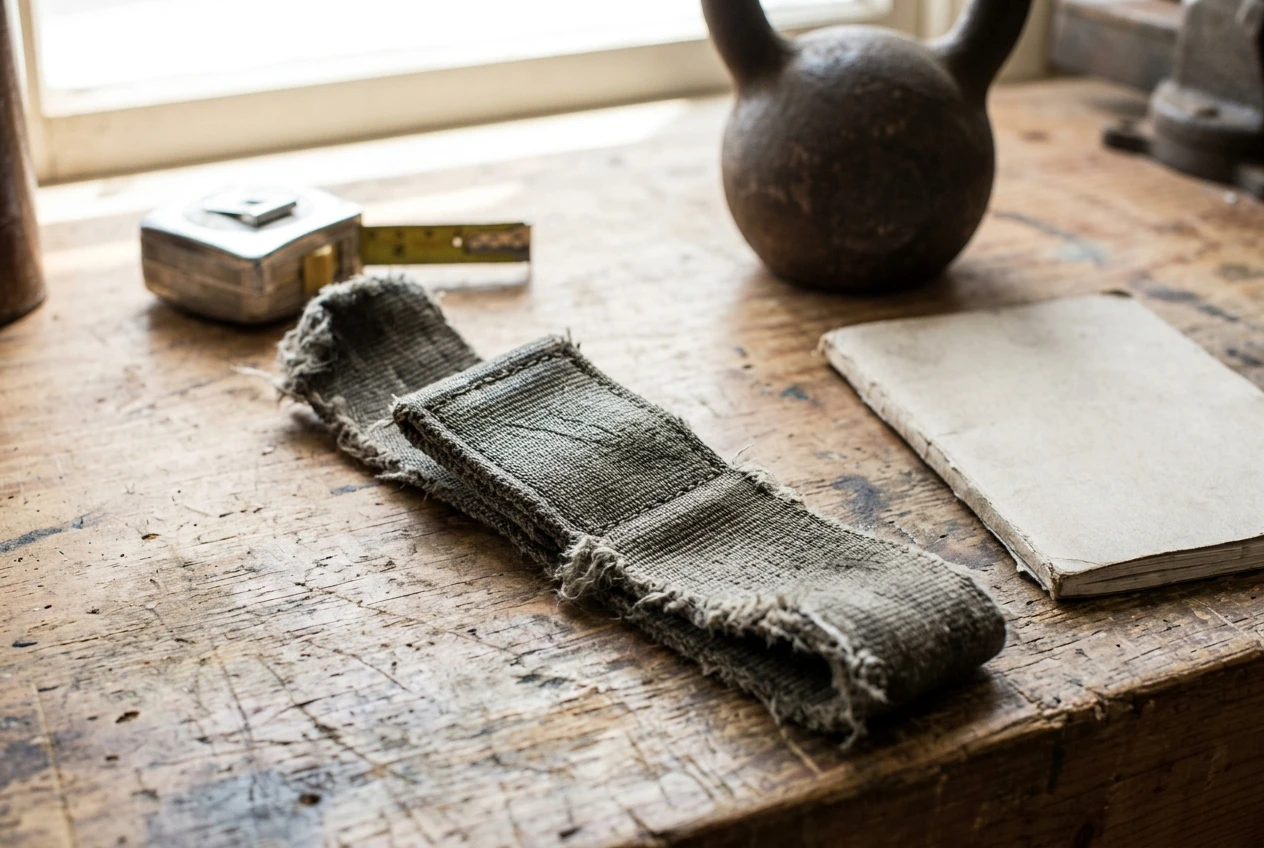
- Photograph the stitching and the edges at the points where the strap bends or takes load.
- Measure the loop or the total length with a tape measure and write the number down.
- Hang the bell by the strap a few inches off the floor, over a mat, for a few seconds. Check that nothing shifts or tears.
Each week, after use.
- Stitching: Look for loose, pulled, or missing stitches, especially where the strap folds over.
- Edges: Look for fraying or curling. A little at the start may be normal, but it should not grow.
- Length: Measure again. A strap that has lengthened noticeably is stretching under load.
- Surface: Check whether the grip surface has gone glossy or slick. A smooth strap slips more.
- Hardware or seams: If the strap has a ring, buckle, or sewn loop, check that it is not bending or pulling free.
After sweaty sessions. Let the strap dry fully before you store it, and wipe off chalk and sweat. Damp storage speeds up wear in most materials.
Retire it when stitching is coming apart, the strap has stretched past what you noted at baseline, or the hang check no longer holds. A strap on a swing is a safety item as well as a convenience, so replace it early.
Keep the weekly notes in the same place as your training log. After a month, you will have your own record of how that strap wears under your own sets.
When grip fatigue means the complex itself needs changing, not your gear
Sometimes the grip is doing its job, and the complex is asking too much of it. A few signs point to this:
- Your grip fails on the same movement every session, even with chalk and relaxed-hand habits.
- You need a strap on every movement to finish the set, which means the bell is too heavy for the volume.
- Your form on the clean or press gets worse as the set goes on, so the late reps are not the ones you meant to train.
In these cases, change the complex before you change the gear:
- Drop the reps per movement. Fewer swings before the clean leave your hand fresher for the rest of the sequence.
- Use a lighter bell. A complex with good form at a lighter weight beats a heavier one that ends in dropped bells.
- Split the complex. Run, swing, and clean together, then rest, then run, press, and squat.
- Reorder the movements. Put the grip-heavy swing later, or separate it from the clean with a rest.
A well-built program handles this for you by setting reps, rest, and bell weight so your grip is not the limit. If you are deciding between writing your own sessions and following one, follow a kettlebell program, or write your own guide that walks through how to choose.
Pair your grip fixes with a program built around complexes: see the kettlebell. monster programs (affiliate link, I earn a commission if you buy, at no extra cost to you).