A heavy deadlift that barely leaves the floor does not produce much athletic value by itself. Neither does a fast jump performed with poor landing control. Force production training exercises close that gap by teaching you to apply force through the ground, a barbell, or your own body with enough strength, speed, and position to make the effort transfer.
Power is not a feeling you chase with random explosive workouts. It is a physical quality built from force, velocity, timing, and repeated exposure to sound movement under progressive load. The right exercise depends on what you can currently control, how strong you are, and whether your goal is a bigger total, a faster first step, or more pop in your sport.
What Force Production Actually Means
Force is the push or pull you create against an external resistance. In training, that resistance may be a barbell, the floor, a sled, a medicine ball, or your bodyweight. Producing more force gives you a larger engine. Producing it quickly gives that engine athletic usefulness.
This is why maximal strength and explosive training belong in the same plan. Heavy squats and pulls improve your ability to generate high force. Olympic lift variations, jumps, throws, and short accelerations teach you to express force rapidly. One does not replace the other.
A beginner who cannot squat, hinge, brace, or land consistently usually needs more foundational strength work before adding high volumes of plyometrics. An experienced lifter with a strong squat but limited speed may benefit from more dynamic work. The answer is not a universal exercise list. It is matching the training demand to the lifter in front of it.
Force Production Training Exercises Worth Building Around
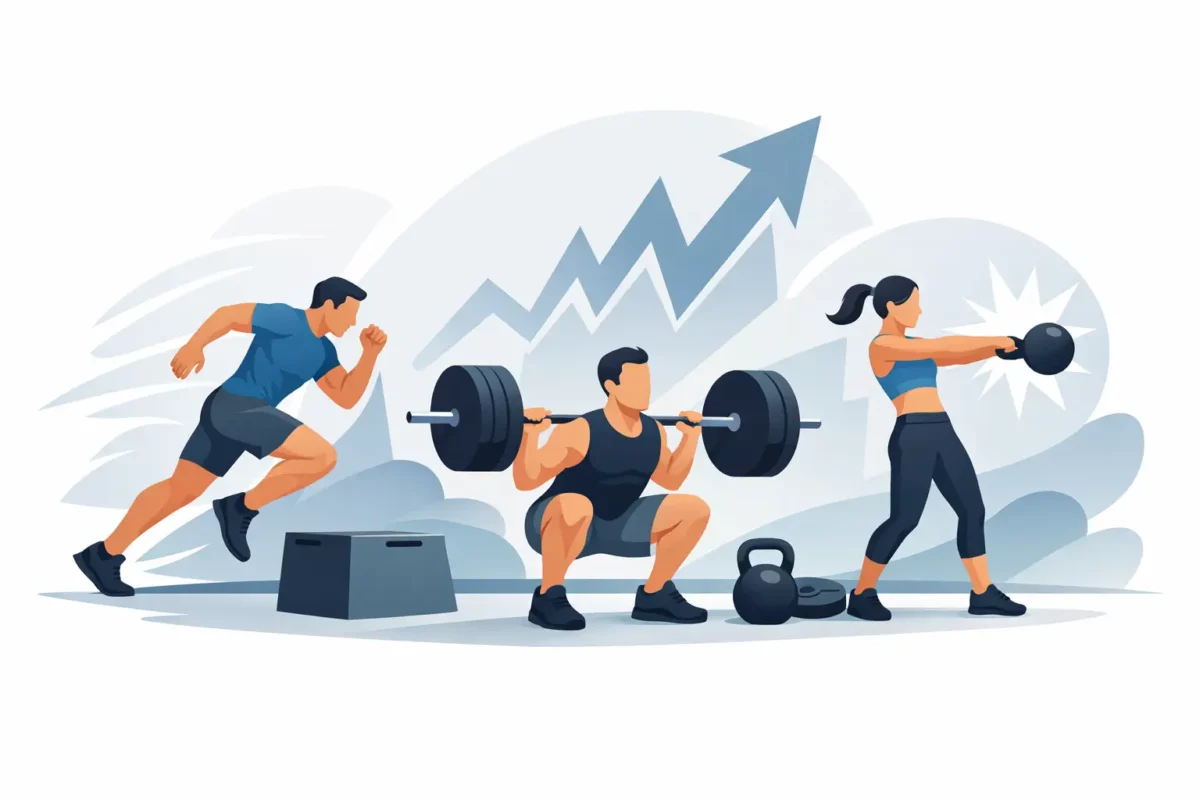
The most productive exercises usually fall into four categories: heavy bilateral strength lifts, explosive barbell lifts, ballistic bodyweight or medicine-ball movements, and sport-relevant resisted work. Each category develops a different part of the power equation.
Squats Build the Base
The back squat and front squat are foundational because they let you progressively load the legs, hips, and trunk through a large range of motion. Stronger squatting generally improves your capacity to push forcefully into the ground, especially when your technique allows you to maintain balance and position under challenging weights.
Use the back squat when overall lower-body strength is the priority and you can tolerate the loading well. Use the front squat when you want a more upright position, greater demand on the upper back and trunk, or more direct carryover to the receiving position of the clean.
For force production, most squat work should not turn into slow, exhausted grinding. Hard sets have a place, but repeated maximal strain can bury the speed and recovery needed for the rest of your training. Quality sets of three to six reps, progressed over time, are often more productive than testing your limit every week.
Deadlifts and Pulls Train Powerful Hip Extension
A deadlift develops force through the posterior chain and teaches you to create tension from the floor. It is a valuable strength builder, but conventional deadlifts can create substantial fatigue when loaded heavily. For some lifters, trap-bar deadlifts offer a more athletic position and easier recovery. For others, clean pulls and snatch pulls provide a better bridge between strength and speed.
Pulls are especially useful because they allow you to load the explosive extension used in weightlifting without requiring a full catch. Start each rep from a stable setup, drive through the floor, and finish tall through the hips rather than throwing the bar away with the arms. If the bar path drifts forward or your back position fails, the load is too heavy for the purpose of the drill.
Cleans and Snatches Demand Speed With Precision
The clean, power clean, snatch, and power snatch are high-value force production training exercises when coaching, mobility, and technical readiness are present. They require rapid force application, coordinated extension, and the ability to receive a moving barbell in a strong position.
They are not mandatory for everyone. A lifter who lacks coaching access or cannot consistently hold a front-rack or overhead position may make faster progress with pulls, jumps, and throws while improving mobility and foundational strength. But when taught well, weightlifting movements provide a direct, measurable way to train explosive power.
Keep Olympic lift variations crisp. Sets of one to three reps with sufficient rest preserve speed and allow you to practice the movement instead of rehearsing fatigue. Adding weight only makes sense when positions remain sharp and the bar continues to move aggressively.
Jumps Teach You to Use the Strength You Built
Vertical jumps, broad jumps, and low-volume hurdle jumps train rapid force expression with minimal equipment. They also reveal whether an athlete can organize their body quickly. A jump that looks powerful but ends in a loud, unstable landing is not a quality rep.
Box jumps can be useful, but they are often misused. The height of the box can reward hip mobility and knee tuck more than actual jump height. Choose a box you can land on quietly with control. If you want to measure vertical output, use a true vertical jump rather than chasing a higher box.
Start with low total volume. Three to five sets of two to five quality jumps is enough for many lifters, particularly when heavy lower-body lifting is also in the session. More contacts are not automatically better. The goal is powerful output, not conditioning.
Medicine-Ball Throws Build Intent Without Heavy Fatigue
Medicine-ball chest passes, overhead throws, rotational throws, and scoop tosses let you train violent intent with lower joint stress than repeated heavy lifting. They are useful for athletes and general lifters because they teach full-body force transfer without needing to decelerate a heavy object in the same way you would with a barbell.
Match the throw to the pattern you want to train. A scoop toss supports hip extension. A rotational throw challenges force transfer through the trunk and hips. An overhead throw emphasizes a coordinated extension pattern. Use a ball light enough to move fast. If it turns into a slow heave, it has stopped being a power exercise.
How to Program for More Force and Power
Exercise selection matters, but the order and dosage matter just as much. Put high-speed work early in the session, when your nervous system is fresh and your mechanics are reliable. Jumps, throws, and Olympic lift variations usually come before heavy strength work. Assistance exercises and higher-rep muscle-building work belong later.
A simple lower-body power session might begin with broad jumps, move to power cleans or clean pulls, then progress to front squats and a posterior-chain accessory such as Romanian deadlifts. Another day could emphasize heavy back squats followed by light jump variations. The two sessions complement each other: one prioritizes speed, the other raises the force ceiling.
Rest long enough to preserve output. For heavy barbell sets and explosive movements, two to three minutes is often appropriate, with more rest for demanding loads or technical lifts. If your jump distance drops sharply, your bar speed slows, or your positions break down, end the exercise or reduce the load. Power training depends on high-quality repetitions.
Progression should be visible. Add a small amount of load to squats and pulls when you complete the work with solid mechanics. Improve jump quality before adding contacts. Increase the complexity of weightlifting variations only after the simpler version is dependable. A stronger, cleaner power clean at 135 pounds is more useful than a sloppy attempt at 185.
Common Mistakes That Limit Power Development
The first mistake is treating every rep as a conditioning challenge. Exhaustion has a role in training, but it is not the primary target during explosive work. You cannot train maximum speed well when every set is performed gasping for air.
The second is confusing heavy loading with power. A near-maximal squat builds strength, but its bar speed is low. A bodyweight jump is fast, but its force demand may be limited for a strong athlete. Productive programming uses both ends of the spectrum rather than arguing that one quality is enough.
The third mistake is skipping the landing, catch, and bracing requirements. Athletic power is force applied in a usable position. Learn to absorb force with stacked joints, controlled knees, and a braced trunk. That discipline reduces wasted movement and gives you a stronger platform for the next rep.
Finally, do not change exercises every week because a new variation looks exciting. Force production improves when you practice key patterns long enough to get stronger, faster, and more technically efficient. Keep the main lifts in place, track your outputs, and rotate smaller variations only when they serve a clear purpose.
Treat every explosive rep as a test of intent. Set up with discipline, apply force with purpose, and stop before fatigue turns power work into ordinary work.